Colònia Güell and the Gaudí crypt: a day trip from Barcelona
Barcelona: guided visit to Gaudí's crypt and Colonia Güell
Duration: 2 hours
- Free cancellation
Why visit Colònia Güell and how do you get there?
The unfinished crypt at Colònia Güell was the structural laboratory where Gaudí invented the catenary arch system he later used for Sagrada Família. It is 20 km southwest of Barcelona and reached by FGC train from Plaça Espanya in about 25 minutes. The crypt ticket is around €9–22 depending on whether you take a guided or audio tour.
Twenty kilometres southwest of Barcelona, on a low hill above the flat industrial plain of the Llobregat delta, stands one of the most important unfinished buildings in the history of architecture. Gaudí’s crypt at Colònia Güell was never completed — only the basement level of what should have been a church was built — but those few vaulted rooms are where the structural language of the Sagrada Família was invented and proved.
| Where | 20km southwest of Barcelona, FGC train from Plaça Espanya (~25 min) |
| Cost | Around €9 audio guide, ~€22 guided tour with transport |
| Time needed | 1–1.5 hours (crypt + village walk) |
| Best time | Spring or autumn; site open year-round |
| Pairs well with | Sagrada Família the same afternoon |
Why Eusebi Güell built a village
Eusebi Güell was the wealthiest industrialist in Catalonia and Gaudí’s most important patron — the man who commissioned Park Güell, the Palau Güell on La Rambla and, eventually, the crypt at Colònia Güell.
In 1890, Güell decided to move his textile factory from central Barcelona to a rural site where he could build a complete planned community for his workers. This was not unusual in the era of industrial paternalism: Bournville in England and Saltaire in Yorkshire had been built on the same principle. Güell’s ambition was larger. He commissioned various architects to design workers’ housing, a cooperative building, a theatre, a school and an oratory. The village has a remarkably coherent architectural character, mixing neomedieval and Arts and Crafts influences.
The factory itself ran from 1892 to 1945. After its closure, Colònia Güell continued as a working community and many of the original buildings are still occupied today as private residences. It remains a living village, not a museum.
Gaudí’s structural experiment
Gaudí received the commission for the church in 1900. Between 1908 — when construction finally began — and 1914, he used the project as the testing ground for his most radical structural ideas.
The method was the catenary chain model: Gaudí built an inverted model of the planned vaulting using small weighted bags hung from a network of string. Under gravity, each chain and bag naturally hangs in the most structurally efficient curve. Gaudí photographed these inverted models, then flipped the photographs to derive the shapes of his arches under compression. An arch in the shape of an inverted catenary transmits loads purely through compression — no tensile forces, which stone cannot withstand.
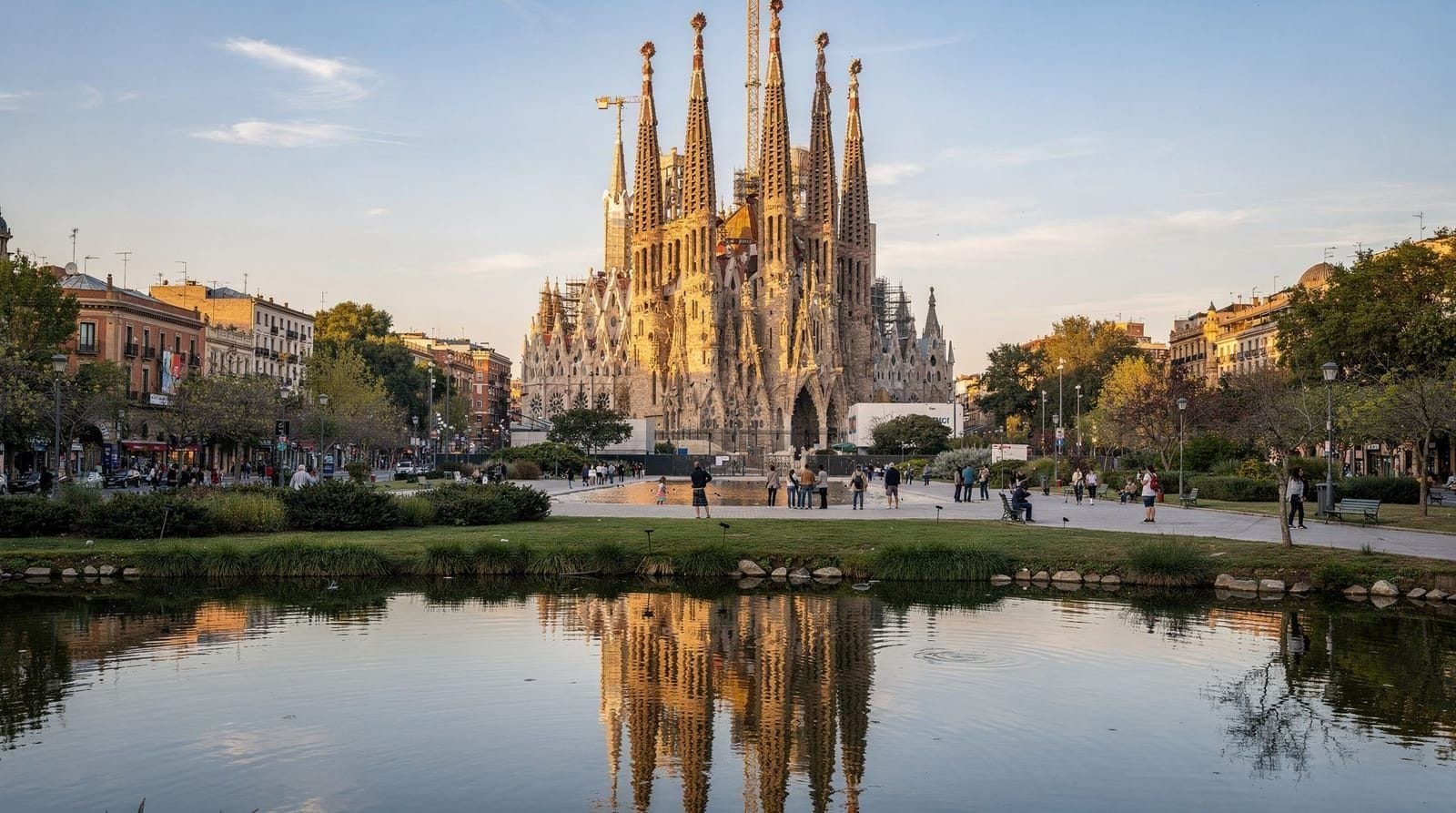
This method was direct, empirical and Gaudí’s own. The structural engineers of the era used calculations; Gaudí used physics. When the crypt’s basement was built, the arches worked. The same principle was transferred to the Sagrada Família, where the same branching column structure and tilted arches appear on a vastly larger scale. Understanding Colònia Güell makes the Sagrada Família comprehensible in a way no guidebook explanation can fully achieve — read the Sagrada Família booking guide before you go so the pairing works smoothly on the day.
For a guide who can explain the catenary model on site and connect it directly to Gaudí’s later work, a guided architecture visit is worth the extra cost:
What you see at the crypt
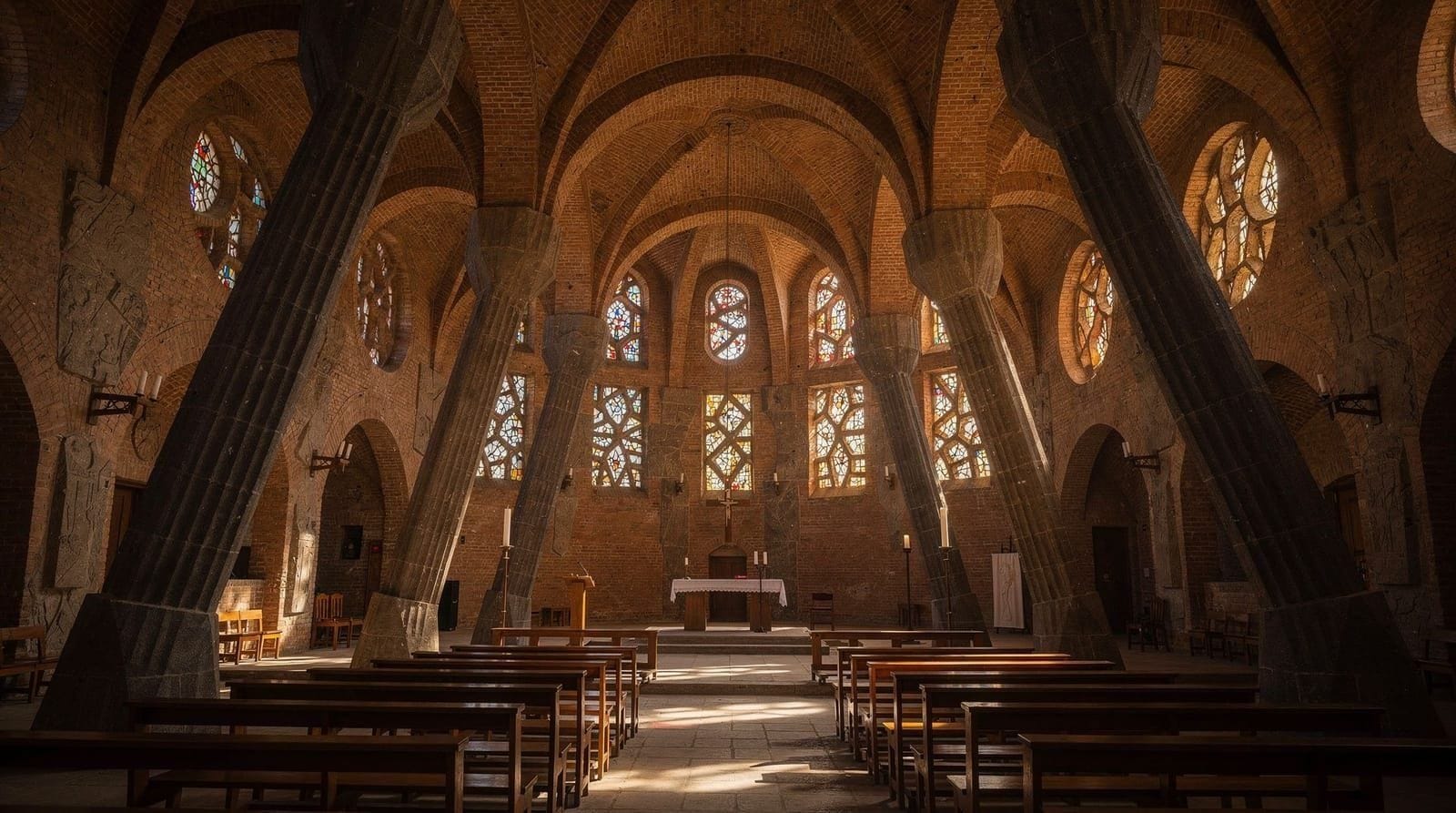
The crypt — the only completed section of the church — is an intimate vaulted space about 15 metres wide and 10 metres high at the apex. It sits half-buried in the hillside.
The exterior: Approaching from the village path, the crypt appears as a low structure with a porch of inclined basalt columns. The columns are dark volcanic stone, irregular in cross-section, set at calculated tilts that transfer load laterally rather than vertically. They look unstable; they are not. Scattered fragments of coloured tile on the arches above the porch give the only colour note on an otherwise sombre exterior.
The interior: Four brick piers support a low vaulted ceiling. The light enters through stained glass windows set in the walls and through an oculus above the altar. The palette is dark — basalt, brick, natural stone — and the atmosphere is more cavelike than ecclesiastical. This was intentional; Gaudí spoke of the earth as the fundamental material of his architecture.
The pews and altar fittings visible today are not original Gaudí elements but later additions. The structural fabric — columns, vaults, walls — is entirely original.
The village walk
Allow 45–60 minutes to walk through Colònia Güell after visiting the crypt.
The workers’ housing streets are arranged in a legible grid with variations in terrace house design that reflect different periods of construction. The cooperative building (the social centre of the community) has survived in reasonable condition. The theatre, school and pharmacy are still recognisable as the buildings that Güell commissioned.
The village gives context for understanding Gaudí’s patron: Güell was not simply buying prestige architecture but genuinely attempting to create a model of industrial community life. His other commissions — Park Güell, designed as a garden city that was never fully built — reflect the same utopian ambition, slightly more detached from social reality.
How it compares to Gaudí’s other sites
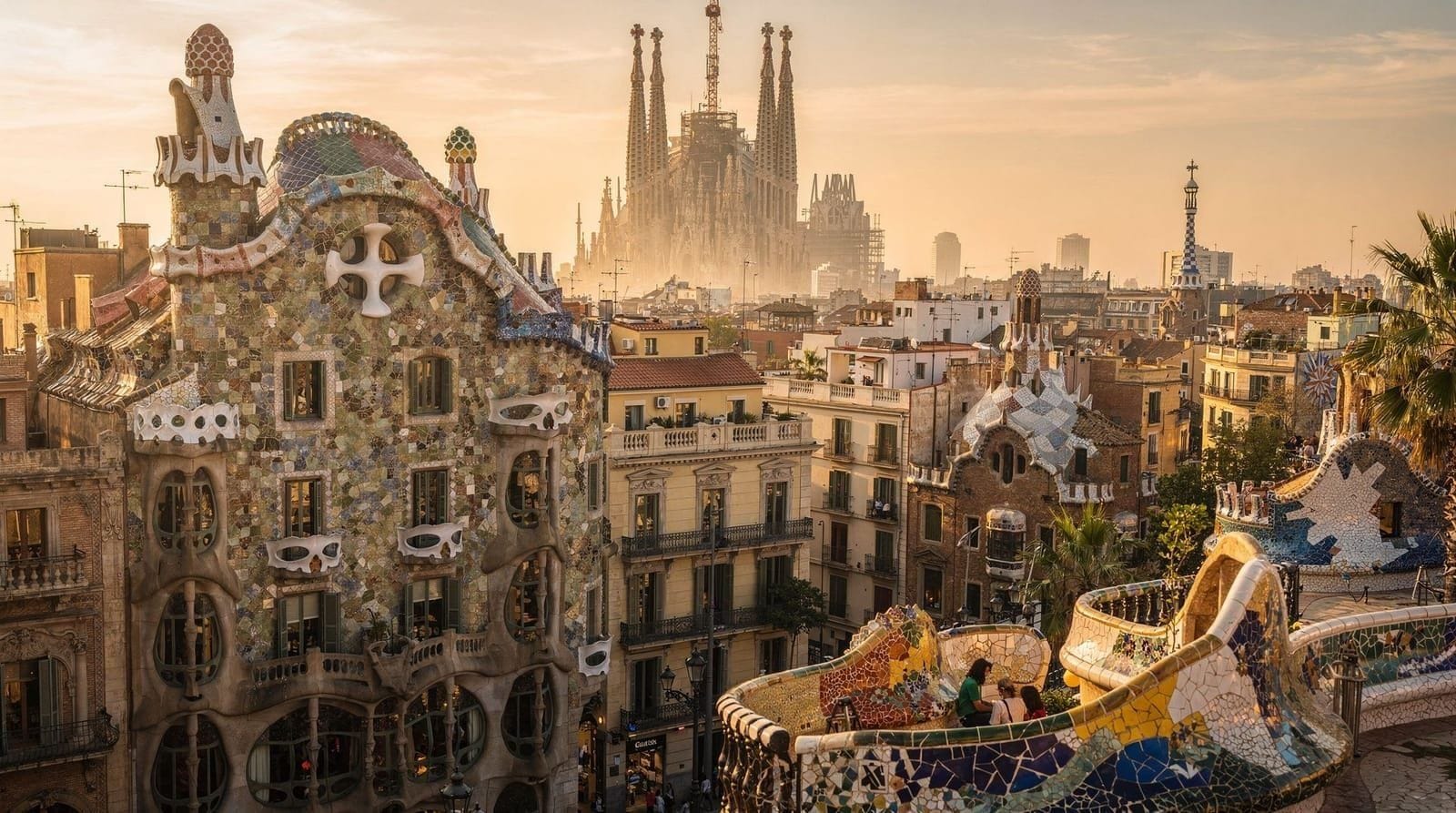
Visitors who have already done Park Güell sometimes wonder whether Colònia Güell is worth the extra trip out of the city. The two sites answer different questions. Park Güell shows Gaudí working at civic, decorative scale — mosaic, colour, a garden city imagined for the public. Colònia Güell shows the engineering underneath all of it: the structural discovery that made the Sagrada Família’s soaring, column-free interior possible. If your interest is decorative and photogenic, Park Güell alone may be enough. If you want to understand how Gaudí actually thought as a builder, Colònia Güell is the more important stop, and the Gaudí trail guide sets out how to sequence both sites along with his other Barcelona buildings, while the Modernisme route places the crypt in the wider context of Catalan Art Nouveau architecture.
Getting there and practical notes
By FGC train: Lines S4 and S8 from Plaça Espanya station to Colònia Güell station. Journey approximately 25 minutes. Trains run every 15–30 minutes. T-Casual Zone 2 (€25.50) or a single ticket (~€3.50 each way) covers the fare.
By car: About 25 minutes from central Barcelona via the C-31. Parking is available near the village.
Ticket: Purchase at coloniaGuell.cat or at the crypt entrance. The audio guide tour (€9) covers the crypt and village. A fully guided tour (approximately €22) includes return transport from Barcelona and a guide for the full site.
When to visit: Spring and autumn are ideal; the landscape is more attractive than in the flat heat of summer. The site is open year-round but check current hours at the official site.
With Sagrada Família on the same day: This is the most coherent pairing. Visit Colònia Güell in the morning, return to Barcelona by midday, and see the Sagrada Família in the afternoon. The structural relationship between the two buildings gives the Sagrada Família visit considerably more meaning.
With children: The FGC train journey and the outdoor village walk are straightforward with children. The crypt interior requires some tolerance for dim, confined spaces.
Colònia Güell is the Gaudí site that architecture enthusiasts rate most highly relative to its visitor numbers. The crypt is small, the travel is easy and the structural importance — for understanding everything Gaudí built after 1908, including the Sagrada Família — is out of proportion to the building’s modest appearance. If you have already visited the main Barcelona Gaudí buildings and want to go deeper, this is the obvious next step.
Frequently asked questions about Colònia Güell and the Gaudí crypt
What is Colònia Güell?
Colònia Güell is a planned workers' village built from 1890 by Eusebi Güell (Gaudí's main patron) for the workers of his textile factory. It is a near-complete garden city from the Arts and Crafts era, with housing, a theatre, a school and a cooperative designed by various architects. Gaudí was commissioned in 1900 to design the church.Why is the crypt important for understanding Gaudí?
Between 1908 and 1914, Gaudí used the Colònia Güell project as a full-scale structural experiment. He hung bags of lead from a net model and photographed the inverted curves — the ideal arch shape under gravity — then inverted the photographs to derive the optimal vaulted forms. This catenary method was then transferred directly to the Sagrada Família. The crypt is the proof of concept.How much does it cost?
The audio guide ticket is approximately €9 for independent visitors. A guided tour including transport from Barcelona is around €22. On-site entrance alone (crypt exterior only, no audio) may be available at reduced cost — check the current policy at coloniaGuell.cat.How long does the visit take?
The crypt itself takes about 30–45 minutes. The broader village of Colònia Güell — walking through the streets, seeing the workers' housing and the cooperative building — adds another 45 minutes to 1 hour. Half a day is comfortable.Is Colònia Güell accessible by public transport?
Yes. FGC line S4 or S8 from Plaça Espanya to Colònia Güell station takes approximately 25 minutes. Trains run every 30 minutes. From the station it is a short walk to the village. Total journey from central Barcelona is about 40 minutes.Is it suitable for children?
The village and the surrounding landscape are enjoyable for all ages. The crypt interior is compact and the lighting is dim, which some younger children find uncomfortable, but the outdoor village tour is accessible and the train journey is part of the experience.Is Colònia Güell worth it compared to Park Güell?
They serve different purposes and aren't really substitutes for each other. Park Güell shows Gaudí's decorative, civic-scale work; Colònia Güell shows the structural engineering — the catenary arch experiments — that made the Sagrada Família's interior possible. Architecture enthusiasts and repeat visitors tend to rate Colònia Güell especially highly relative to how few tourists make the trip.Can I visit Colònia Güell without a guide?
Yes. The audio guide ticket (around €9) is self-paced and covers the crypt and enough of the village to understand the site. A live guide adds context on the catenary model and Gaudí's working method that the audio guide compresses, which is worthwhile if you're combining the visit with the Sagrada Família the same day.
Top experiences
Bookable activities with verified prices and instant confirmation on GetYourGuide.