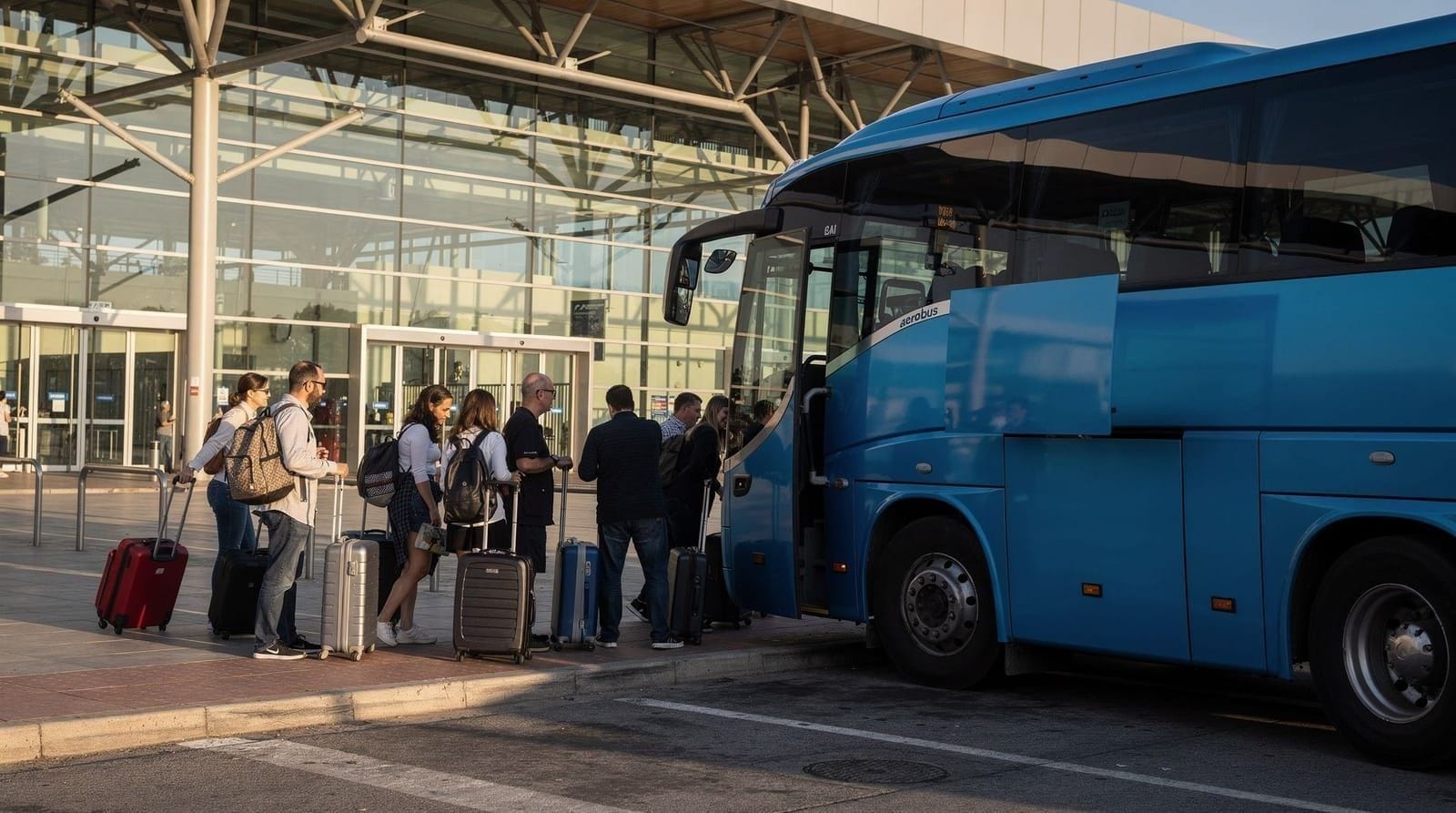
Getting around Barcelona: metro, buses, trams and bikes explained
Barcelona: Hola Barcelona public transport travel card
Duration: 48-120 hours
- Instant confirmation
What is the best transport option for first-time visitors to Barcelona?
For most first-time visitors spending 3–5 days, the T-Casual (€13 for 10 trips) covers all city metro and bus travel and is enough for a 3-day trip with central accommodation. If you are arriving or departing via the airport on the metro, upgrade to the Hola Barcelona 3-day (€27.30) which includes the airport L9 fare that T-Casual does not cover.
Barcelona has one of the better urban transport networks in southern Europe, and understanding it saves both money and friction during your visit. The city is genuinely walkable within its historic districts, well-served by metro for longer distances, and unusually easy to figure out compared to cities like London or Paris. This guide walks through each mode of transport with honest assessments of when it is actually useful versus when you are better off walking.
| Default card | T-Casual, around €13 for 10 trips (Zone 1) |
| Airport metro | L9 Sud, around €5.70 supplement not covered by T-Casual |
| Metro hours | 05:00–00:00 most days; 24-hour service on Saturdays |
| Taxi | Meter from around €2.30; airport flat rate around €39 to Eixample |
| Best for walking | Gothic Quarter, El Born, Barceloneta, Gràcia |
The walkability reality
Before discussing any public transport, it is worth being clear about walking. The Gothic Quarter, El Born, La Barceloneta, and Poble-sec are all navigable entirely on foot from a centrally placed hotel. Gràcia is walkable from Eixample. The Passeig de Gràcia strip — covering Casa Batlló, La Pedrera, and nearby restaurants — is walkable from most Eixample accommodation.
Where walking becomes impractical: getting from Eixample to Sagrada Família (comfortable walking distance at 1.5–2 km, but metro is faster), from anywhere to Montjuïc hill (cable car or Bus 150 recommended), from the city to the waterfront (manageable but further than it looks on maps), and from Barceloneta to Park Güell (metro is the right call).
A common mistake is underestimating Eixample block sizes. The grid looks compact but each block is 113 metres wide. A “short walk” on the map can easily be 20–25 minutes. Keep this in mind when deciding whether to metro or walk.
Metro (TMB)
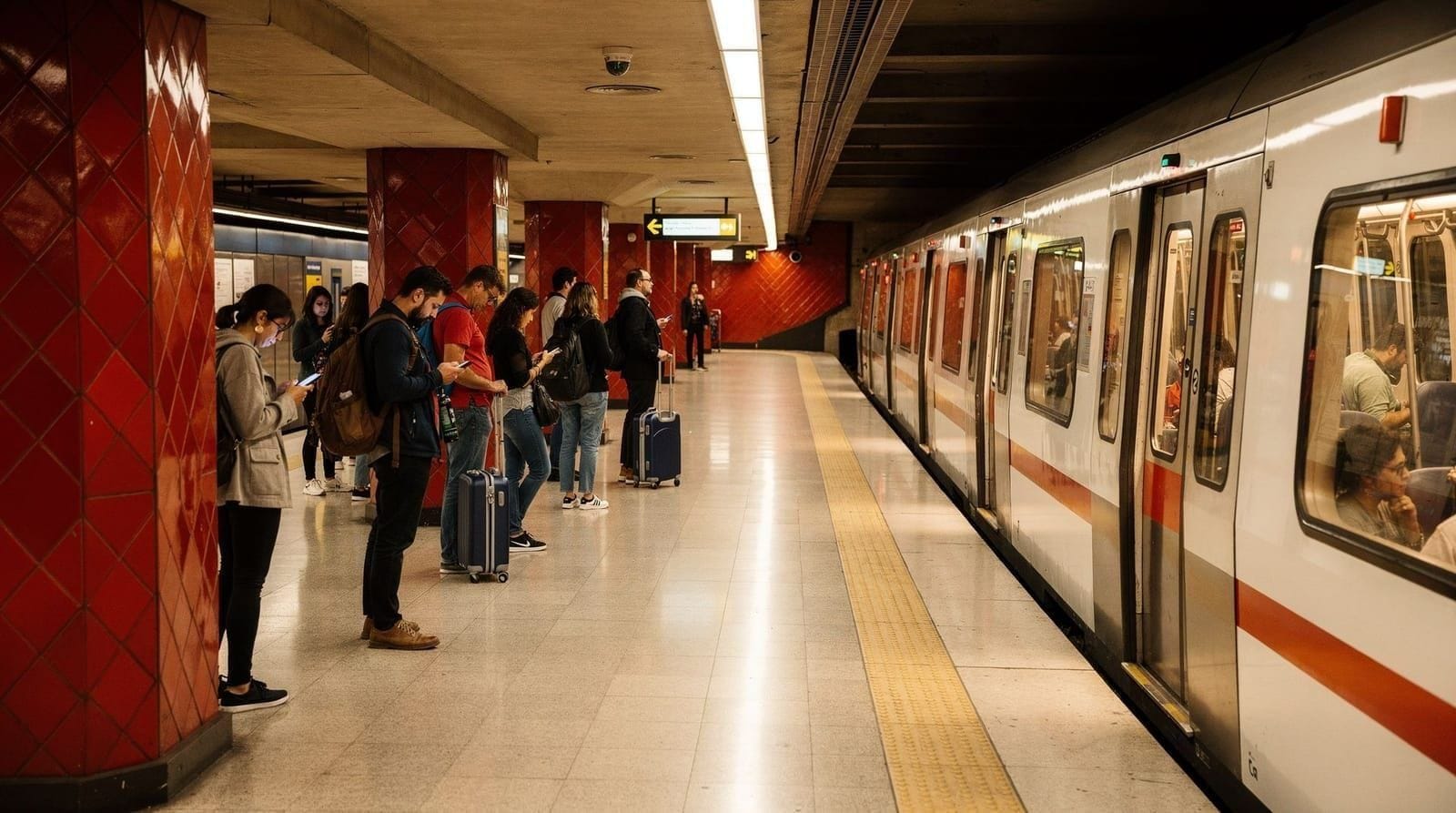
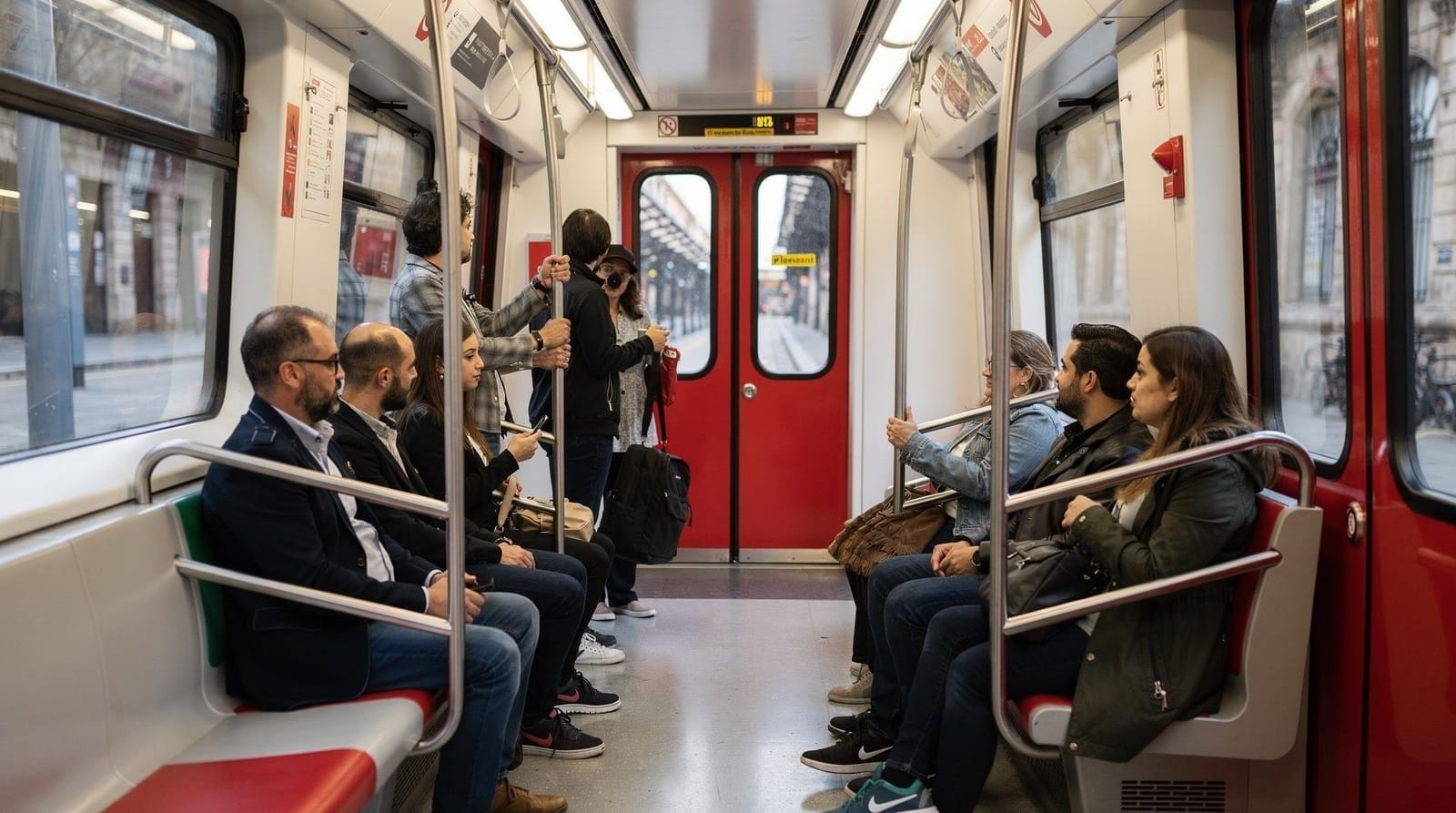
Barcelona’s metro has 12 lines (L1 through L12, with some gaps in the numbering) colour-coded and well-signed in both Catalan and Spanish. The network covers the central city thoroughly; the outer lines (L9, L10) extend to the airport and suburban areas.
The key lines for visitors:
- L1 (red): Hospital de Bellvitge to Fondo, passing through Eixample and Clot. Good for central connections.
- L2 (purple): Paral·lel to Badalona. Connects to L3 and reaches La Sagrera.
- L3 (green): Zona Universitària to Trinitat Nova, running through Eixample and passing Diagonal and Fontana (for Gràcia). Connects to the Funicular de Montjuïc at Paral·lel.
- L4 (yellow): La Pau to La Trinitat Nova, running along the waterfront direction. Barceloneta and Jaume I (Gothic Quarter/El Born) are on this line.
- L5 (blue): Cornellà to Vall d’Hebron. Passes through Hospital de la Vall d’Hebron and connects at Diagonal.
- L9 Sud (orange): Airport T1 and T2 to Zona Universitària — the airport metro with the special €5.70 fare not covered by T-Casual.
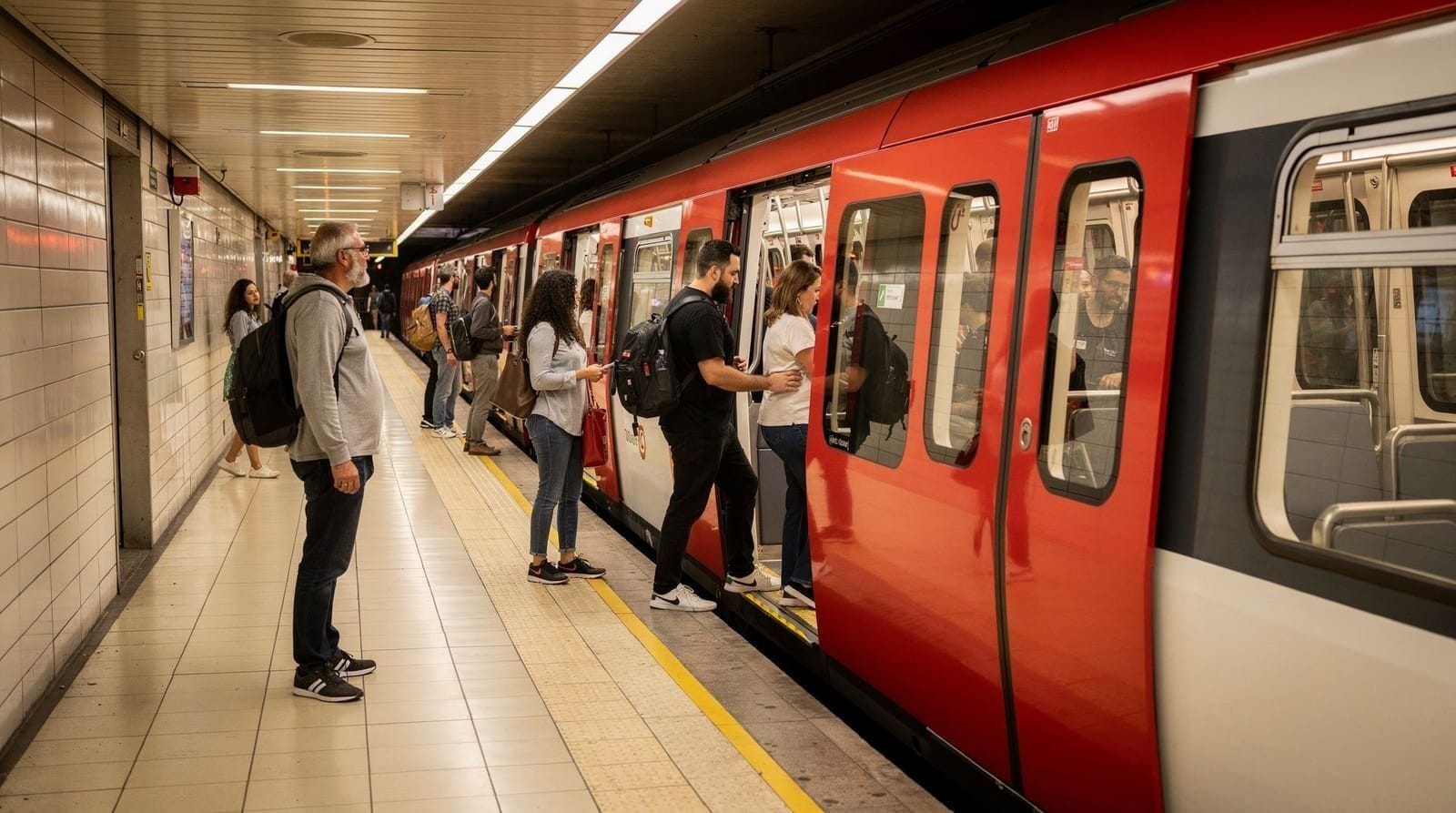
How to validate: Insert your card into the turnstile reader at the start of each metro journey. For multi-trip cards (T-Casual, T-dia), the reader deducts one trip. For unlimited cards (Hola Barcelona), it simply validates without deducting. Keep your card until you exit — some systems require it.
Frequency: Every 2–4 minutes during peak hours on the main lines. Every 5–8 minutes off-peak. Weekend late-night services (Fri–Sat after midnight) run every 10–20 minutes on reduced lines.
Hours: Monday to Thursday 05:00–00:00. Friday until 02:00. Saturday: continuous 24-hour service. Sunday until 00:00. The Saturday 24-hour service is useful if you are out late.
Accessibility: Most central stations have lifts. Older outer stations may not. The TMB website and app show accessibility status per station if this is important to your visit.
TMB buses
Barcelona’s bus network is extensive but slower than the metro for most cross-city journeys because buses share road space with cars and do not have fully dedicated lanes throughout. For most visitor itineraries, metro is the default for longer distances and buses cover the gaps.
The Horaris page on tmb.cat or the TMB app shows real-time positioning for all buses. There is no meaningful disadvantage to the T-Casual or Hola Barcelona on buses — the same card works.
Bus routes that matter for visitors:
- Bus 150 (from Paral·lel to Montjuïc): Gets you up to the castle and gardens without the cable car price. €2.90 if paying separately or counted as one T-Casual trip.
- Bus D20: Diagonal to Barceloneta, useful from some Eixample accommodation addresses to the beach when the L4 metro is not the most convenient connection.
- Bus 92 (Montjuïc circular): Loops around Montjuïc from Plaça d’Espanya, passing MNAC, Joan Miró Foundation, and the Olympic Stadium. A quick way to cover the hill without walking up.
- Night buses (N-series): Run through the night on major routes when the metro is closed on weekdays. The N18 covers the airport.
Honest bus assessment: For sightseeing, bus travel is slower and less predictable than the metro. Use buses for specific routes (Montjuïc, beach) rather than as the default for getting across town.
Tram (T1–T6)
Barcelona’s tram network covers corridors in the northern and southern parts of the city: the Trambaix (T1, T2, T3) serves the western suburbs towards L’Hospitalet and Sant Joan Despí; the Trambesòs (T4, T5, T6) serves the eastern waterfront districts towards Sant Adrià and Badalona.
For most visitors, the tram is only relevant for reaching specific destinations in the Diagonal corridor or eastern waterfront areas that are not well-served by metro. The Diagonal stop connects to the FGC and metro network.
The same T-Casual and Hola Barcelona cards work on all tram lines. Journey time varies by route; tram is typically faster than bus on its dedicated lanes.
FGC (Ferrocarrils de la Generalitat de Catalunya)
FGC is a regional railway network that supplements the metro. From Plaça de Catalunya station, it serves several destinations relevant to visitors:
- Gràcia, Sarrià, and the upper city: FGC lines S1 and S5 climb from Plaça de Catalunya through the hillside neighbourhoods above Eixample.
- Tibidabo: Take FGC to Avinguda Tibidabo, then the historic Tramvia Blau (blue tram, seasonal) or taxi to the funicular station, then the funicular to the summit.
- Montserrat: FGC lines from Plaça de Catalunya connect to the rack railway (cremallera) at Monistrol de Montserrat. Journey time approximately 70 minutes to the transfer station, then 15 minutes on the cremallera. See the Montserrat day trip guide for the full itinerary.
Within Zone 1, the T-Casual and Hola Barcelona cards cover FGC. The Montserrat journey requires a separate combined ticket that includes the cremallera.
Rodalies RENFE (suburban rail)
Rodalies are RENFE’s suburban commuter trains operating in and around Barcelona. For visitors, the key lines are:
- R2 Nord: City centre → Airport T2 (~26 min to Passeig de Gràcia). See the airport transfer guide for full details.
- R2 / R2 Sud: City centre → Sitges (40 min) and Vilanova i la Geltrú. Within Zone 2, so the T-Casual Zone 1 does not cover this — you need a T-Casual Zone 2 (€25.50 for 10 trips) or a separate ticket.
- R11: Barcelona Sants → Tarragona (~55 min). Long-distance, requires separate ticket.
- Regional trains to Girona and Figueres: Depart from Barcelona Sants or Passeig de Gràcia with advance booking via Renfe.cat.
For the Sitges day trip specifically, a T-Casual Zone 2 at €25.50 is the most economical option if you plan to use metro within the city for the rest of your stay. See our getting around Barcelona guide for the broader context.
Taxis
White official taxis are Barcelona’s regulated taxi service. They are metered, plentiful, and honest — there is no strong incentive to bargain or pre-negotiate a price for in-city journeys.
Fares: The meter starts at approximately €2.30 (day rate, tariff 1). A typical journey such as Eixample to the Gothic Quarter runs €7–10. Barceloneta to Park Güell runs approximately €10–14 depending on traffic.
Rate periods:
- Tariff 1 (cheapest): Weekdays 08:00–21:00
- Tariff 2: Weekdays 21:00–08:00, weekends and public holidays all day
- Additional supplements: Airport, large luggage, cruise port, phone booking
Getting a taxi: Hail on the street (green roof light = available), use taxi stands near hotels and major attractions, or use the official Free Now app (formerly MyTaxi). Cabify (ride-hailing) is also available and sometimes slightly cheaper for comparable journeys.
The airport flat rate: Approximately €39 to Eixample, fixed. See the airport transfer comparator for details.
Bike
Cycling is a realistic option for flat urban touring in Barcelona. Key points:
Tourist rental: Several operators near Las Ramblas, El Born, and the waterfront offer daily rental for €15–20. Electric bikes are available at €25–35/day. Helmets are often provided but check ahead.
Bicing: Barcelona’s municipal bike-share scheme requires a monthly (€17.50) or annual (€50) subscription and is designed for residents. Visitors cannot buy single-trip Bicing credits — it is not the equivalent of London’s Santander Cycles or Paris’s Vélib. Stick to rental operators.
Where cycling works well:
- The waterfront path from Port Olímpic to Barceloneta and continuing to the Fòrum area
- Poblenou and the 22@ district
- The Eixample grid (flat, with dedicated cycle lanes on some streets)
- Gràcia neighbourhood (flat, limited car traffic on some streets)
Where cycling is not practical:
- Gothic Quarter and El Born (narrow medieval streets, pedestrian-heavy)
- Montjuïc (steep climb, cable car is better)
- Tibidabo hill
- Passeig de Gràcia during peak tourist hours (congested pavements)
Bus Turístic (hop-on hop-off)
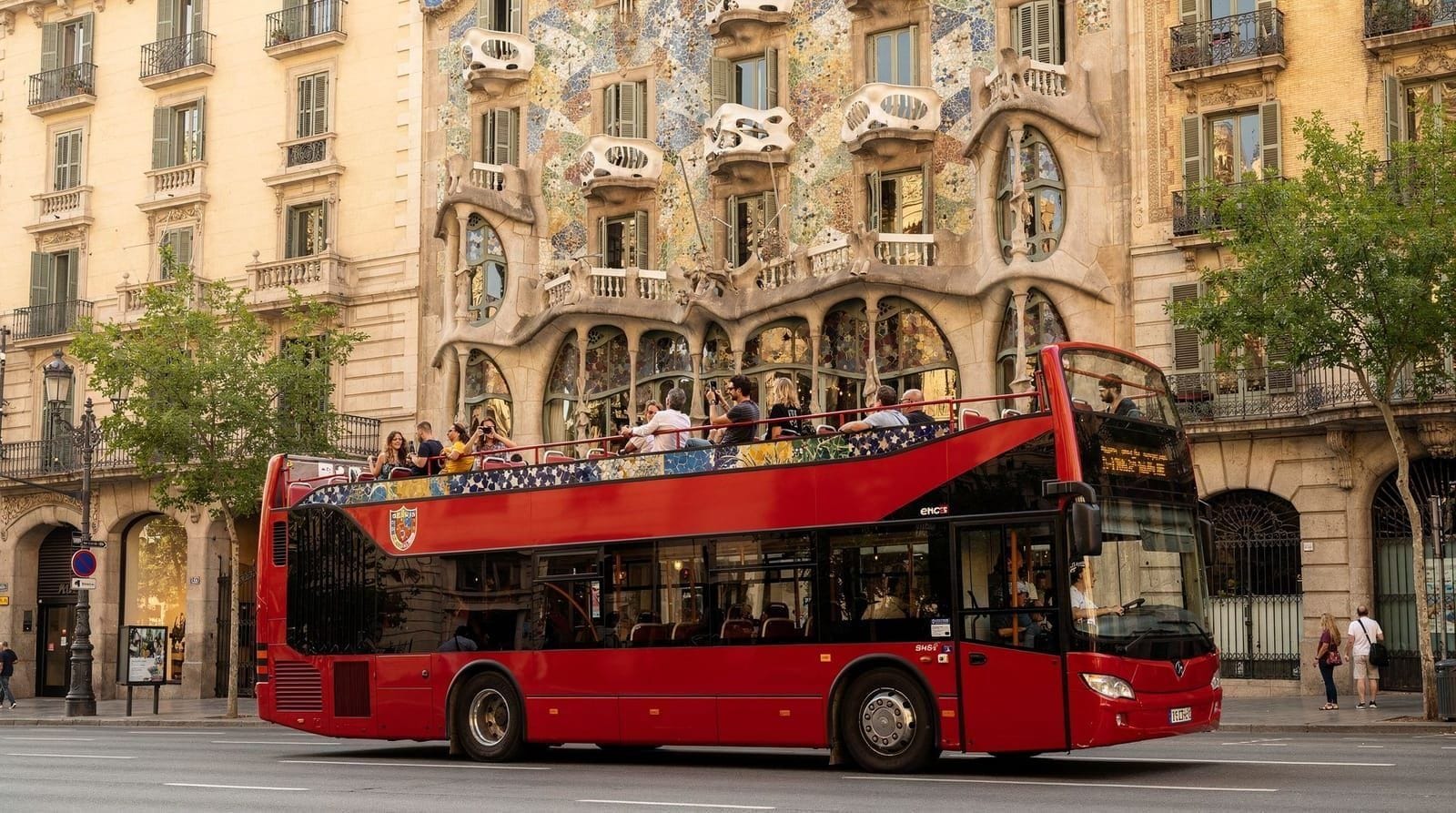
The city’s dedicated tourist bus operates three colour-coded routes (Red, Blue, Green) with audio commentary and Wi-Fi. One-day tickets cost €33, two-day tickets €44. The ticket includes a discount booklet.
Honest assessment of when it is useful:
Day 1 orientation is the strongest use case. If you have never been to Barcelona, spending your first morning on the Red or Blue route gives you a visual overview of where everything is, which helps navigation for the rest of the trip.
When it becomes redundant: If you already know the city layout, use the metro — it is faster and the T-Casual is €13 for 10 trips versus €33 for a day on the tourist bus. The hop-on hop-off stops are also less convenient than metro stations for many attractions.
See our dedicated hop-on hop-off bus guide for a stop-by-stop breakdown.
Accessibility across the network
Barcelona’s transport accessibility has improved substantially in recent years but remains uneven. Metro lines L2, L9 and L10 were built or fully renovated with step-free access throughout; L1, L3, L4 and L5 are a mix, with many central stations retrofitted with lifts but some older stations still lacking them. The TMB website and app show a wheelchair icon per station indicating current accessibility status, which is worth checking for your specific route rather than assuming coverage. Buses are uniformly accessible — all TMB buses have low floors and a ramp for wheelchair users. The tram network is fully accessible by design, being newer infrastructure. FGC is more mixed than the metro, particularly on the older sections serving Tibidabo and the upper city. For visitors with mobility needs, planning routes around the more reliably accessible lines (L2, L9, L10, trams, buses) rather than defaulting to whichever line looks shortest on the map avoids most frustration.
Which transport card is right for your trip?
This is the question most visitors get wrong, usually by buying a card that costs more than they spend, or buying the wrong card and paying extra at the airport.
Quick decision guide:
| Trip profile | Best option | Cost |
|---|---|---|
| 1–2 days, central hotel, no airport metro | T-Casual (will use ~5–6 trips) | €13 |
| 2–3 days, flying in/out via metro | Hola Barcelona 48h or 72h | €18.70–€27.30 |
| 4–5 days, staying central, mainly walking | T-Casual (likely 8–10 trips) | €13 |
| 5+ days, heavy metro user | T-Casual × 2 or T-dia per day | €13–€12/day |
| Museum focus, 4–5 days | Barcelona Card (evaluate carefully) | €50–€75 |
For a full analysis of every pass with break-even calculations, see the transport pass comparison or use the pass calculator.
The Hola Barcelona card suits short intensive trips where you want airport transport included — if you arrive and depart by metro from El Prat, those two journeys alone cost €11.40, substantially narrowing the gap with the Aerobus and making the unlimited card financially sensible even for short trips.
For most 3–5 day visitors who are staying centrally and plan to walk substantial distances, the T-Casual at €13 is the right default. See the Hola Barcelona card guide for a detailed cost analysis comparing it to single tickets for specific trip lengths.
Barcelona’s transport network rewards a small amount of pre-planning — specifically, knowing which card to buy and whether your hotel and the airport metro line affect the calculation. The metro is excellent, buses fill the gaps, and the city is genuinely walkable for short distances between attractions. The most common mistake is buying the Barcelona Card expecting comprehensive value, then discovering it does not cover Sagrada Família or Park Güell. Get the T-Casual for standard city travel, add the Hola Barcelona only if you need airport metro coverage, and budget separately for Gaudí attractions which require individual booking regardless of which card you carry.
Frequently asked questions about Getting around Barcelona
Which metro card should I buy in Barcelona?
The T-Casual (€13, 10 trips) works for most 3–5 day visits with central accommodation. It covers metro, bus, tram and Rodalies within Zone 1. It does NOT cover the airport metro L9. For airport travel included, use the Hola Barcelona card (from €18.70 for 48 hours). See the transport pass comparison for the full breakdown.What are the metro opening hours in Barcelona?
Monday to Thursday: 05:00–00:00. Friday: 05:00–02:00. Saturday: continuous 24-hour service. Sunday: 05:00–00:00. On public holidays the metro typically runs Friday-pattern hours. The 24-hour Saturday service is a genuine advantage if you are out late on weekends.How often does the Barcelona metro run?
Every 2–4 minutes during peak hours (07:00–21:00 on weekdays). Every 5–8 minutes off-peak. Every 10–15 minutes late night. Lines L1, L2, L3, L4 and L5 are the most frequent. L9 and L10 run less frequently as they are newer outer-district lines.Is Barcelona easy to navigate by walking?
Very much so within each district. The Gothic Quarter, El Born, Barceloneta, Gràcia and Poble-sec are all excellent on foot. The Eixample grid is easy to navigate but distances are larger than they look — a single Eixample block is 113 metres on each side. The main challenge is the hill to Montjuïc and the distance between Barceloneta beach and the Sagrada Família area.Can I use the same metro card for buses and trams?
Yes. The T-Casual and Hola Barcelona cards are valid on metro, TMB buses, tram (T1–T6 lines), Rodalies (Zone 1), FGC (Zone 1) and the Funicular de Montjuïc. Validate once per journey per mode of transport; a transfer within 1h15 counts as one trip on some combinations.Is cycling a realistic option for tourists in Barcelona?
Yes, for flat areas. The waterfront path, Barceloneta, Poblenou, and the Eixample have good cycling infrastructure. Rental is €15–20 per day. Bicing (the public bike-share) requires a monthly or annual subscription and is designed for residents, not visitors. Avoid cycling on La Rambla (pedestrian-heavy) and up to Montjuïc or Tibidabo (steep).Are taxis easy to get in Barcelona?
Yes. White official taxis are abundant in the city. You can hail them on the street (green light on the roof means available), find them at taxi stands near major hotels and attractions, or book via the MyTaxi/Cabify apps. Meters start at approximately €2.30 with a minimum fare around €5.40. Night and weekend tariffs apply from 21:00.What is the best way to get to Montserrat from Barcelona?
Take the Rodalies R5 or FGC from Plaça de Catalunya to Monistrol de Montserrat, then the rack railway (cremallera) or cable car to the monastery. A combined ticket covering train plus cremallera is approximately €35 return. Journey time is about 90 minutes each way from central Barcelona.
Top experiences
Bookable activities with verified prices and instant confirmation on GetYourGuide.