Hospital de Sant Pau: Barcelona's hidden modernisme gem
Barcelona: Sant Pau Recinte Modernista entry ticket
Duration: 1.5 hours
- Free cancellation
What is the Hospital de Sant Pau and is it worth visiting?
The Recinte Modernista de Sant Pau is a former hospital campus built between 1902 and 1930 by Lluís Domènech i Montaner. It is a UNESCO World Heritage Site, largely unknown to first-time visitors, and arguably the most beautiful example of applied modernisme in the city. Tickets are €16 and the visit takes about 1.5 hours.
Walk north along Avinguda de Gaudí from the Sagrada Família and after ten minutes you reach a pair of brick towers framing a garden entrance. Behind them are twelve Art Nouveau pavilions in a park of palm trees and manicured paths. This is the Recinte Modernista de Sant Pau — formerly the Hospital de la Santa Creu i Sant Pau — and it is one of the most concentrated examples of decorative architectural ambition in the city.
| Where | Carrer de Sant Antoni Maria Claret 167, Metro L5 Sant Pau | Dos de Maig |
| Cost | Around €16 adults, €11 students/seniors, under-12s free |
| Time needed | 1.5–2 hours |
| Getting there | 10-min walk from Sagrada Família, or Metro L5 |
| Best time | Weekday mornings, spring or early autumn |
Why it was built this way
In 1901, the Catalan banker Pau Gil left a substantial bequest to fund a new hospital for Barcelona. The city’s existing medieval hospital, founded in 1401, was desperately overcrowded. The Catalan modernisme movement was at its peak; the commission went to Lluís Domènech i Montaner, who had already designed the Palau de la Música Catalana.
Domènech i Montaner’s premise was architectural and philosophical: a hospital should not be an institutional building. Patients recover better in light, beautiful surroundings with access to gardens. He designed 12 self-contained pavilions — each specialising in different medical functions — arranged in a grid with underground corridors connecting them. The pavilions face south across internal gardens. Every surface was decorated.
Construction ran from 1902 to 1930. Domènech i Montaner died in 1923 before completion; his son Pere Domènech i Roura finished the complex. In 1997, the buildings were listed as a UNESCO World Heritage Site — one of the relatively rare cases where an entire hospital campus received the designation.
What you see on the visit
The visitor route covers the central gardens, the main administration pavilion (the largest and most elaborately decorated building) and several of the medical pavilions. The total complex is large enough that an unhurried visit of 1.5–2 hours covers the highlights without exhaustion.
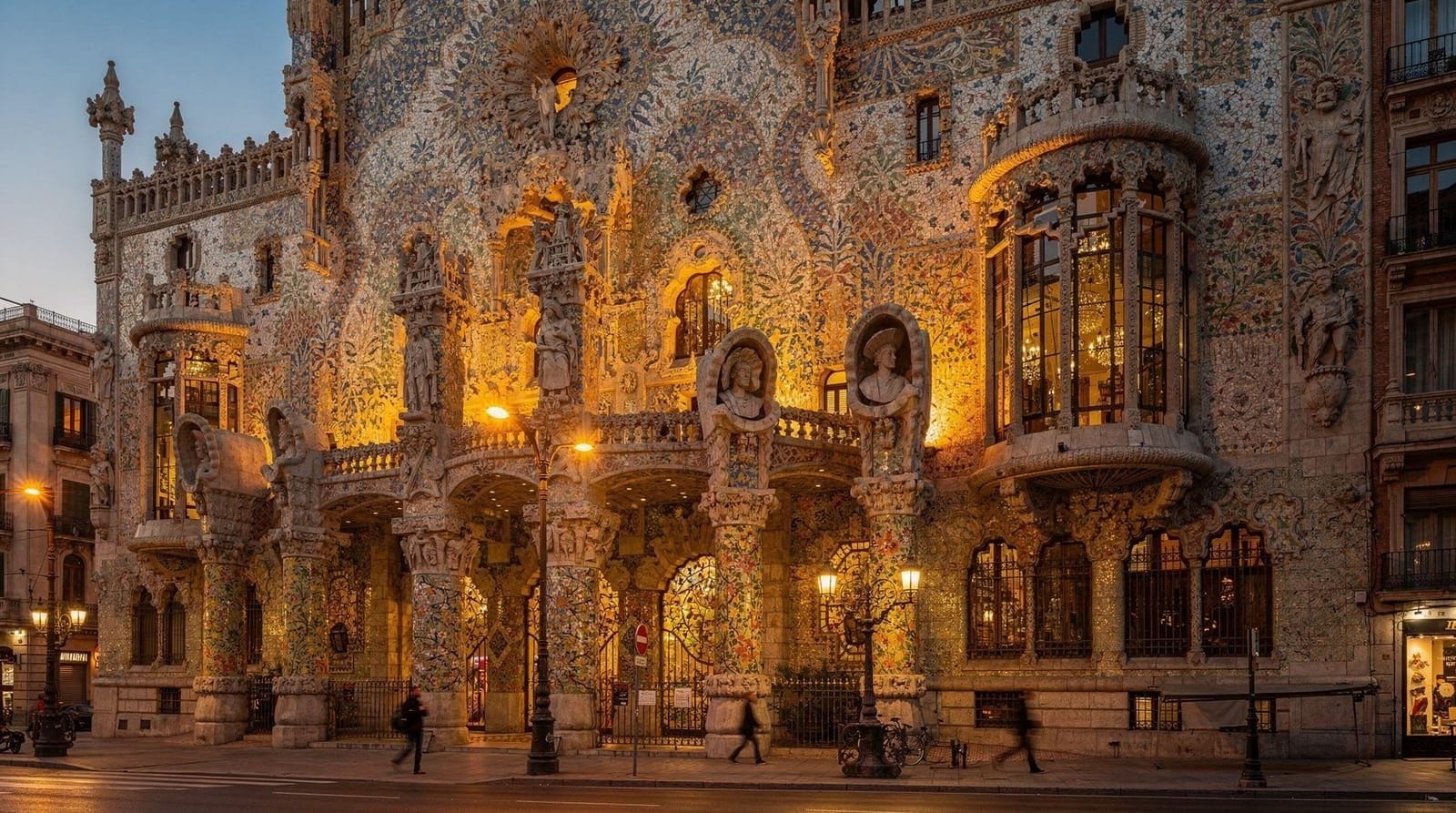
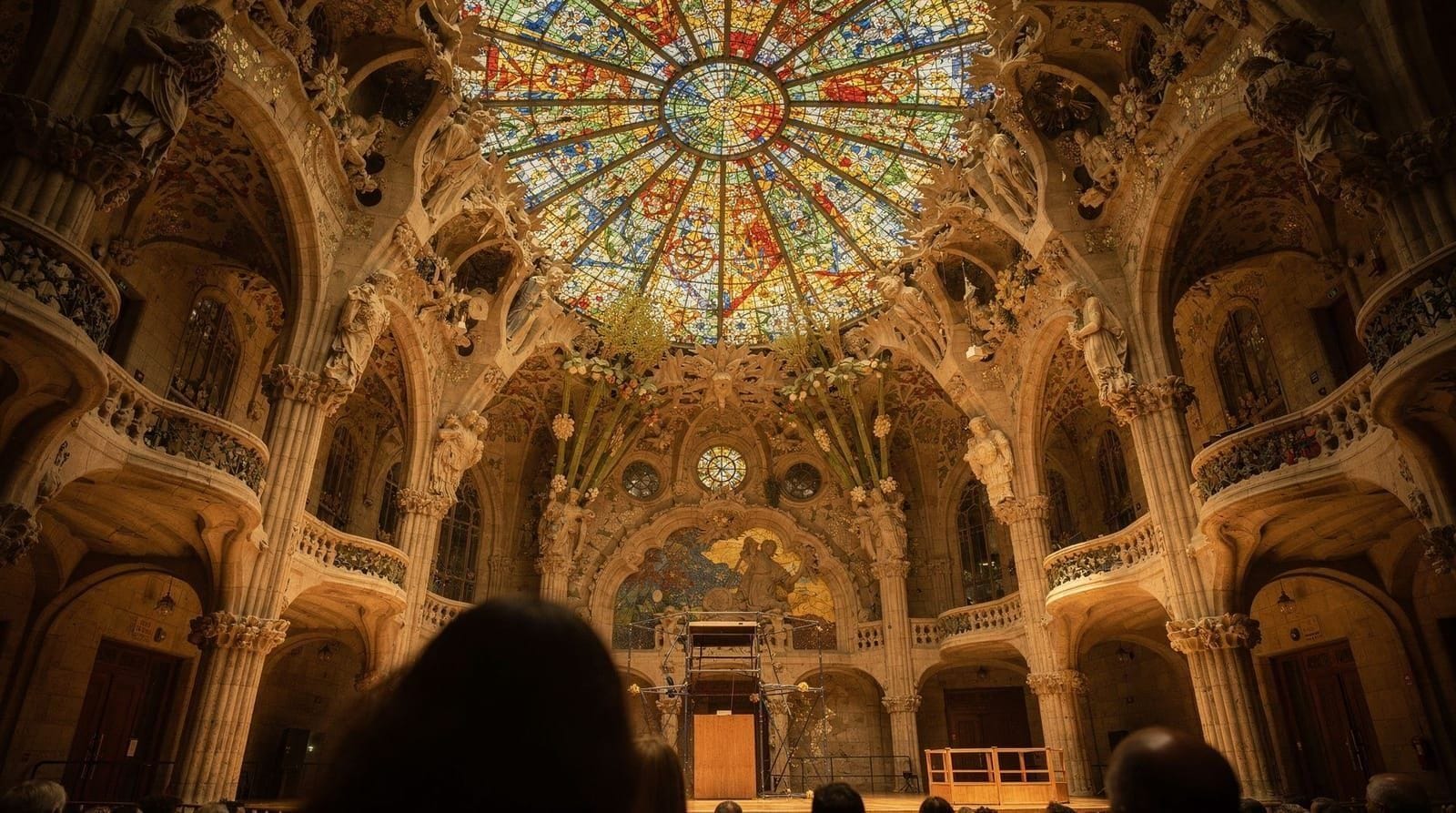
The central administration pavilion: The building that faces the main entrance is the most ornate. The tower over the entrance contains a clock and sculptural group; the main hall inside has polychrome tilework on the vaulted ceiling in a palette of warm terracotta, blue and white. The scale is comparable to a cathedral nave. Temporary exhibitions are often mounted here.
The garden pavilions: Each of the twelve specialised buildings has its own character within a shared vocabulary of red brick, Art Nouveau ironwork and ceramic tile. The differences between them — one pavilion has a domed Moorish-influenced roof; another has a mosaic frieze at cornice level — reward close attention.
The underground corridors: The service tunnels that once allowed food, laundry and patients to move between buildings without using the gardens are partially open for visitors. They are plain brick arches, functional and austere — a useful contrast with the elaborately decorated spaces above ground.
The gardens: Eleven hectares of palms, orange trees and formal paths. The layout is based on an 1890s design that has been repeatedly restored. In spring, the combination of flowering trees and the warm ochre brick of the pavilions is genuinely beautiful.
Combining with Palau de la Música
The most natural combination visit pairs Sant Pau with the Palau de la Música Catalana — both by the same architect, both UNESCO-listed, both representing Domènech i Montaner’s belief that public buildings should function as expressions of Catalan cultural identity. A combined ticket costs approximately €40 and allows both visits on the same day.
The two buildings are about 2 km apart, separated by the dense historic centre. The logical sequence is Sant Pau in the morning (Metro to Sant Pau | Dos de Maig), then a short taxi or metro ride to the Palau in time for a midday or early afternoon guided tour.
The Modernisme route maps this and other non-Gaudí modernisme buildings across the city.
Domènech i Montaner versus Gaudí
It is worth being explicit about why this comparison matters, since most first-time visitors arrive in Barcelona knowing only Gaudí’s name. Domènech i Montaner was a contemporary of Gaudí, a fellow leading figure of Catalan modernisme, and — by the account of many architectural historians — his equal in ambition if not fame. Where Gaudí’s work (Sagrada Família, Park Güell, Casa Batlló) leans toward organic, sculptural forms, Domènech i Montaner’s buildings favour structured ornament: repeating brick patterns, ceramic tile friezes and disciplined geometric layouts dressed in exuberant surface decoration. Visiting Sant Pau after any of the major Gaudí sites gives a genuinely useful contrast in how differently two leading architects of the same movement, working in the same city in the same two decades, interpreted it.
Suggested half-day route
Pair Sant Pau with its immediate neighbour for an efficient half day that avoids backtracking across the city:
- Sagrada Família (early morning, pre-booked timed entry) — allow 1.5–2 hours.
- Walk Avinguda de Gaudí (10 minutes) — the pedestrian boulevard connecting the two UNESCO sites.
- Recinte Modernista de Sant Pau (late morning) — 1.5–2 hours with the audio guide.
- Lunch nearby — the streets around Avinguda Gaudí have straightforward local restaurants, less touristy than the Sagrada Família’s immediate surroundings.
This sequence works well for visitors staying in the Eixample district, since both sites sit at its northeastern edge, an easy taxi or metro ride from most Eixample hotels.
Getting there
Sant Pau has two practical access points.
Metro L5 to Sant Pau | Dos de Maig is the closest stop, about 5 minutes from the main entrance.
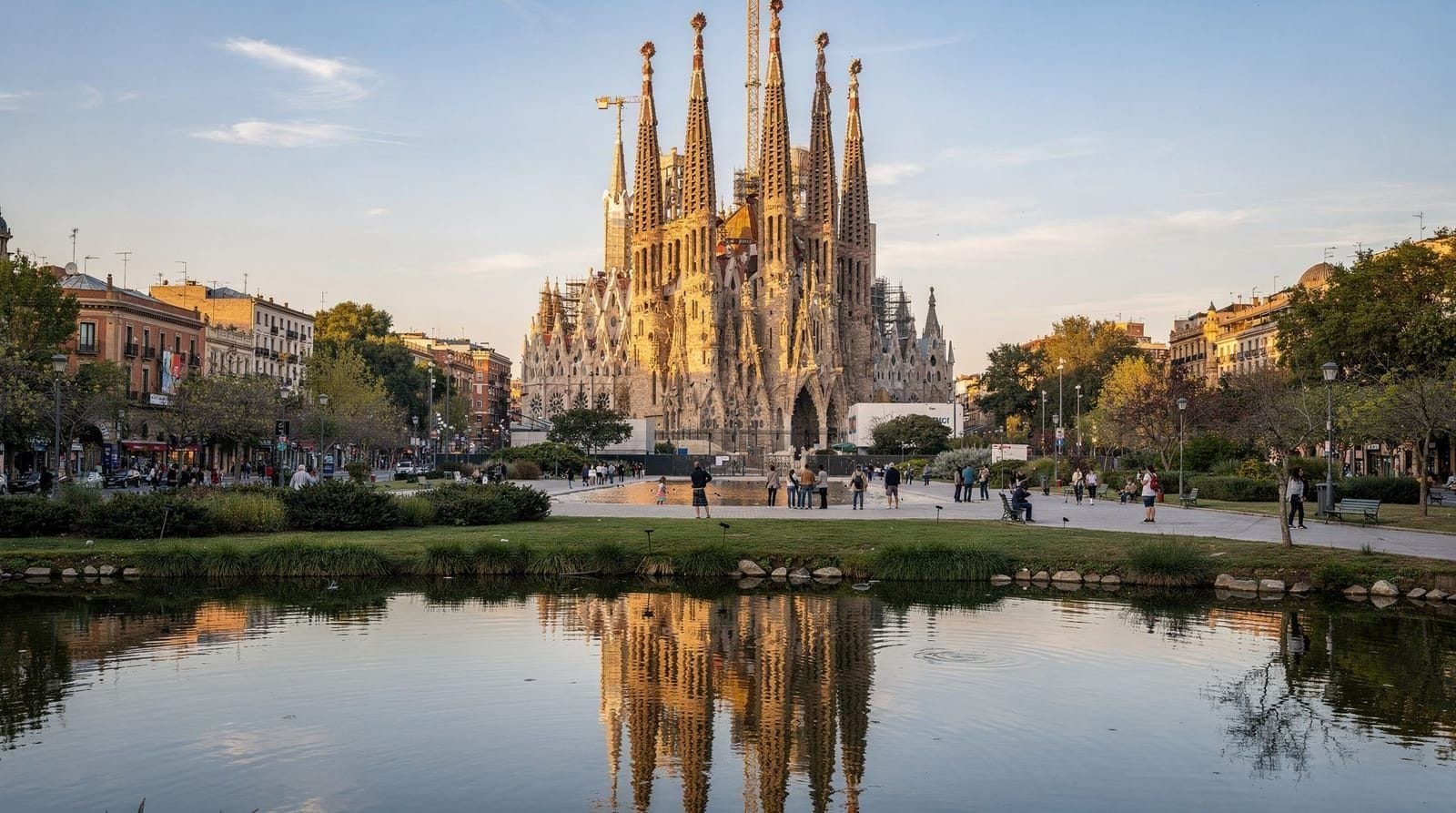
Walking from Sagrada Família: The 10-minute walk along Avinguda de Gaudí — a pedestrian boulevard aligned so that the Sagrada Família’s towers are visible from the Sant Pau entrance — is itself worth doing. The visual relationship between the two buildings, both UNESCO Heritage Sites, is intentional: the avenue was designed in the same period that both buildings were under construction.
The main entrance is at Carrer de Sant Antoni Maria Claret 167, on the north side of the complex.
Practical notes
Tickets and booking: The €16 adult ticket can be bought at santpaurecinte.org. Walk-up entry is usually available but online booking saves time at peak periods. The site is less pressured than the Gaudí buildings; same-day booking is typically fine.
Audio guide: Included in the ticket. Available in 12 languages. The narration is thorough — more so than at some of the commercially busier Gaudí sites — and the pace allows proper time at each pavilion.
Photography: Permitted throughout. The best interior photography is in the central hall of the main pavilion, where the ceiling tilework benefits from wide-angle framing.
Crowds: Far smaller than the Sagrada Família or Casa Batlló. Even on busy summer days, the gardens absorb visitors comfortably. This is one of Barcelona’s few major heritage sites where you can spend time without feeling pressed by other visitors.
Accessibility: The outdoor paths are level and accessible. The main pavilion has lift access. Some pavilion stairs are steep — check the current accessibility map at santpaurecinte.org.
The Recinte Modernista de Sant Pau is the most consistent recommendation from visitors who have seen everything else and want one more thing. It is calmer than the Gaudí sites, less well known, architecturally extraordinary and genuinely pleasant to walk through. The combined ticket with the Palau de la Música makes it a logical half-day addition to any Modernisme route itinerary.
Frequently asked questions about Hospital de Sant Pau
Is it still a hospital?
No. The original hospital buildings were decommissioned in 2009 when a new facility opened. The historic complex — 12 Art Nouveau pavilions across a 9-hectare garden — was restored and reopened as a cultural and heritage site from 2014. Several pavilions now host biomedical research institutes; the main restored area is open to visitors.How much does it cost to visit?
Adult entry is €16. Students and seniors pay €11. Under-12s are free. A combined ticket with the Palau de la Música Catalana costs approximately €40. Booking online is recommended but walk-up entry is usually possible except on busy weekend mornings.How do I get there?
Metro L5 to Sant Pau | Dos de Maig. The main entrance is at Carrer de Sant Antoni Maria Claret 167. The hospital is at the end of Avinguda de Gaudí, a pedestrian axis that runs directly north from the Sagrada Família — a 10-minute walk of considerable symbolic weight, as both buildings are UNESCO listed and the avenue was deliberately aligned so each faces the other.How long does a visit take?
Allow 1.5–2 hours to walk the gardens and enter the main pavilions with the audio guide. The space is large enough that it never feels rushed, but most of the significant decorative detail is concentrated in three or four of the twelve pavilions.Why is this building not better known?
Almost entirely because of Gaudí. In any other city, a UNESCO-listed Art Nouveau hospital campus by one of Europe's leading architects would be the main attraction. In Barcelona, Domènech i Montaner's two masterpieces (this and the Palau de la Música) are consistently overshadowed by Gaudí's higher-profile work. This is the honest assessment: the building deserves far more visitors than it gets.What is the best time to visit?
Weekday mornings are quietest. The outdoor gardens look best in spring (April–May) and early autumn (September–October) when the light is warm and the vegetation is at its most lush. Summer visits are possible but the gardens offer minimal shade.Can I visit Sant Pau and Sagrada Família in the same morning?
Yes, and it's the most efficient sequence — start at the Sagrada Família with a pre-booked timed entry, then walk 10 minutes north along Avinguda de Gaudí to Sant Pau. Together they take around 3–4 hours including the walk, making a natural half-day itinerary.
Top experiences
Bookable activities with verified prices and instant confirmation on GetYourGuide.