Palau de la Música Catalana: tickets and how to visit
Barcelona: Palau de la Música guided tour
Duration: 1 hour
- Free cancellation
How do you visit the Palau de la Música Catalana?
You can visit on a guided tour (daily from 09:30, approximately €30 for a 55-minute tour) or book concert tickets to experience the hall during a live performance. The guided tour is the practical choice for most visitors — it is available without advance notice and covers the full auditorium and foyer.
One of the most persistent mistakes visitors make in Barcelona is assuming the Palau de la Música Catalana is less important than the Gaudí buildings simply because it is less famous internationally. It is not. Built between 1905 and 1908 by Lluís Domènech i Montaner — the other great master of Catalan Modernisme — the Palau is a building of such sustained decorative ambition that even those who have seen every major Gaudí building in the city are often stopped short inside.
| Where | Sant Pere, near Via Laietana — between El Born and the Gothic Quarter |
| Cost | Guided tour around €30; audio tour around €23; concerts from around €15 |
| Time needed | 55 minutes for the guided tour; add 30 minutes either side for a concert |
| Getting there | Metro Urquinaona (L1/L4), about 5 minutes’ walk |
| Best time | Book ahead for weekend concerts in the September–June season |
A concert hall built as a manifesto
The Palau was commissioned by the Orfeó Català, the choral society that was a central institution of the Catalan cultural renaissance of the late nineteenth and early twentieth centuries. Domènech i Montaner designed it as a statement: Catalan music, Catalan craftsmanship and Catalan identity, concentrated into a single building on a narrow street in the city’s historic textile district.
The brief from the Orfeó was for a concert hall that would serve the choral tradition. What they got was one of the most intensely decorated interiors in European architecture of any era.
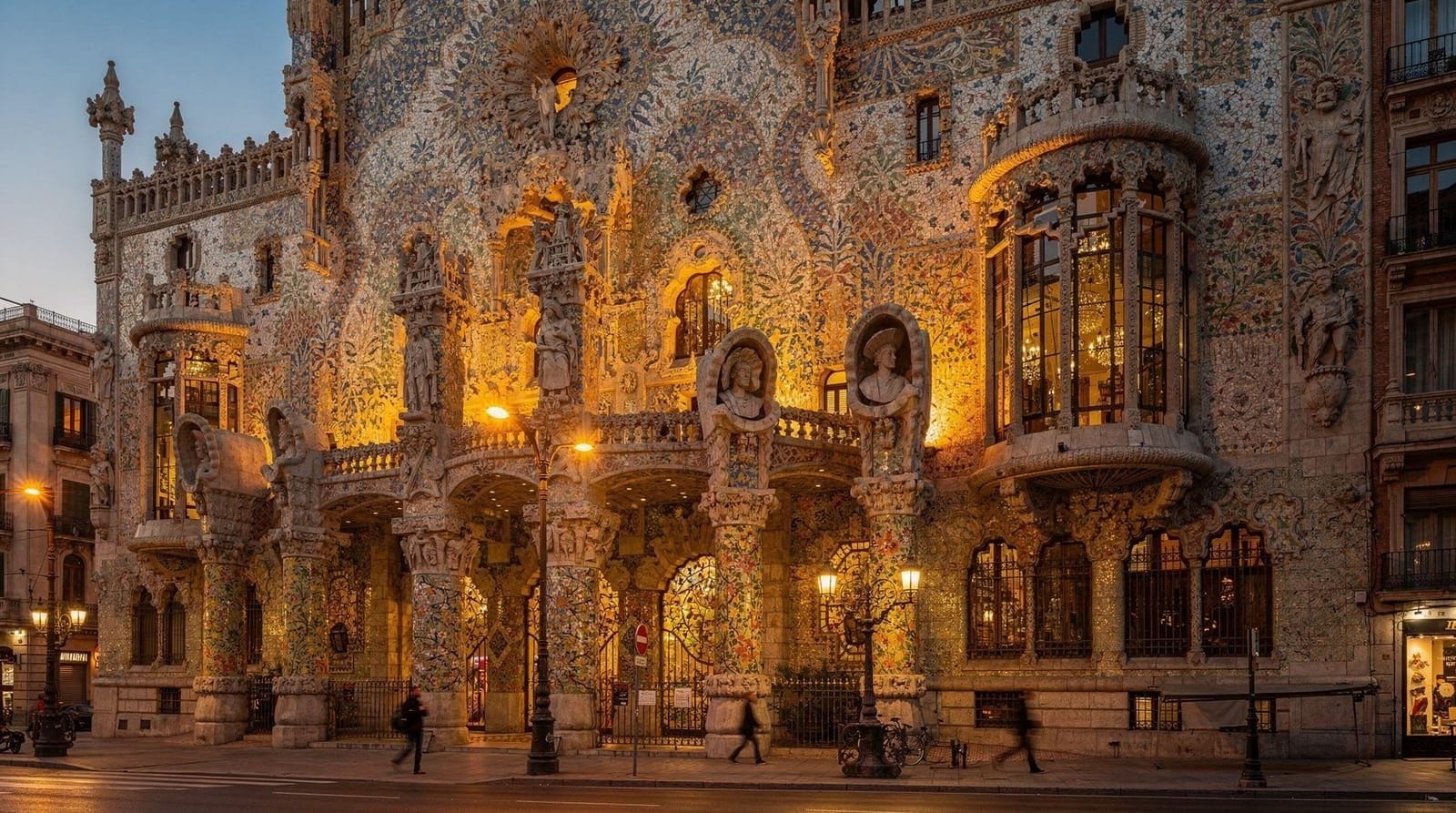
The facades are covered in sculpted stonework, mosaics and ceramic panels. The corner turret is crowned by a mosaic dome. The main entrance foyer is a cascade of stained glass, mosaic columns and carved stone that continues the exterior’s energy without a pause. The auditorium inside is the culmination.
What you see on the tour
The guided tour departs from the main entrance on Carrer de Palau de la Música. A guide leads the group through three main areas.
The foyer: Arched ceilings with ceramic mosaic, columns of polished tile, a staircase with wide stone treads and elaborate ironwork banisters. The foyer was designed to accommodate the social life of concert evenings — the promenade before and during interval. Even empty, it functions as a set piece of spatial drama.
The rehearsal room (Petit Palau): A smaller hall below the main auditorium, used for chamber performances and rehearsals. It has a glass roof and decorated walls; the proportions are intimate and the acoustic is reportedly excellent for chamber music.
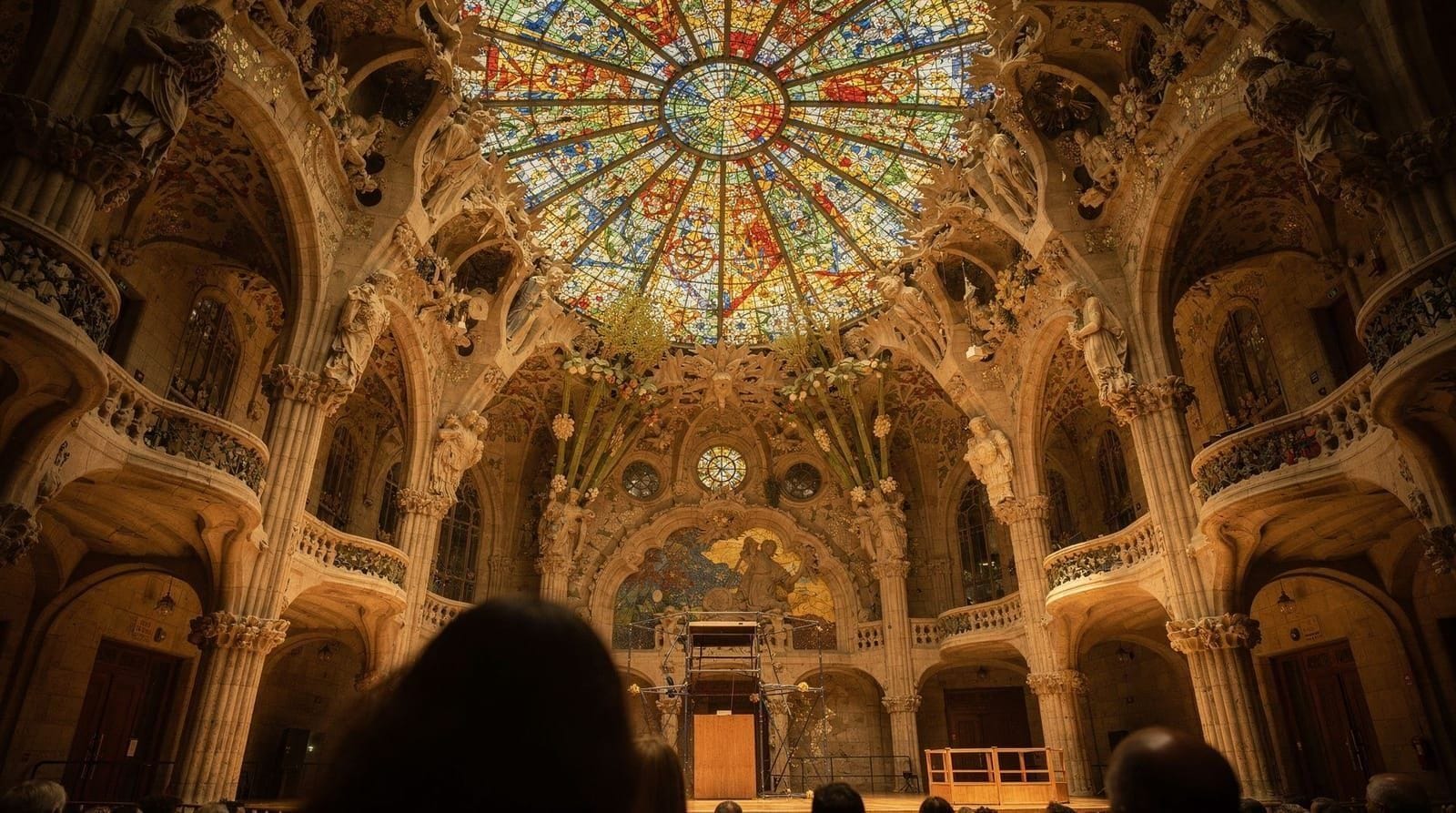
The auditorium: This is the destination. The main concert hall seats 2,200 and the decoration covers every surface. The back wall is a ceramic relief by Domènech’s collaborators: an equestrian statue of Wagner flanks a willow tree on the left (representing the German Romantic tradition the Orfeó admired); a bust of Josep Anselm Clavé, founder of the Catalan choral movement, emerges from a column of roses on the right. The two traditions — German and Catalan — face each other across the hall.
The ceiling is the centrepiece: an inverted dome of stained glass, approximately 5 metres across, through which natural light diffuses in patterns of gold, blue and amber throughout the day. In summer concerts, the light changes during the performance. The effect is unlike any other concert hall in the world.
Attending a concert
The Palau hosts approximately 300 concerts per year across a range of genres: classical, choral, flamenco, jazz and world music. The winter season (September–June) is the primary programme; the summer season includes shorter runs of popular concerts.
Tickets range from approximately €15 for standing or restricted-view seats to €80–120 for the best orchestral stalls seats at headline performances. The Orfeó Català choir performs several times per year and the acoustics are designed around choral music.
Booking in advance is recommended for weekend concerts in the main season. The Palau’s box office at palaumusica.cat is the authorised source. Resellers operate on third-party platforms with markup.
Tour or concert: which to choose
Most first-time visitors default to the guided tour, and it is the right call for anyone whose schedule does not line up with a performance — it is bookable at short notice and covers the whole building in under an hour. But if your dates overlap with a concert, especially anything choral (the Orfeó Català’s own performances are the most fitting given the building’s origins), prioritise the concert over the tour. Seeing the stained glass ceiling shift colour above a live performance, with the ceramic Wagner and Clavé reliefs flanking the stage, is the fuller experience the building was designed for. If time allows, some visitors do both on separate days — the daytime tour to study the details up close, then an evening concert to experience the room as intended.
Getting there
The Palau is at Carrer de Palau de la Música 4–6, in the Sant Pere neighbourhood. The address is deceptive — you reach it most easily by walking from the Via Laietana rather than from El Born’s main pedestrian streets.
Metro: Urquinaona (L1 red line and L4 yellow line) is the closest station, approximately 5 minutes’ walk. Arc de Triomf (L1) and Jaume I (L4) are each about 10 minutes.
The Palau sits about 500 metres from the Barcelona Cathedral and 300 metres from the northern edge of the Gothic Quarter. It is walkable from El Born and Barceloneta in under 15 minutes.
Combining with Hospital de Sant Pau
The most natural combination visit is the Hospital de Sant Pau (the Recinte Modernista de Sant Pau), which is Domènech i Montaner’s other great UNESCO-listed building in Barcelona. The two buildings are by the same architect, from the same period, and together demonstrate the full range of his modernisme approach. A combined ticket is available (see GYG tours listed on this page) and typically allows both buildings to be visited in a full morning.
The Modernisme route guide maps all the major non-Gaudí modernisme buildings in Barcelona, including both the Palau and Sant Pau. For visitors weighing up Domènech i Montaner against Gaudí himself, the Gaudí trail guide lays out the comparable circuit of Gaudí buildings across the city.
Practical notes
Photography: No photographs permitted inside the auditorium during tours. Photography is allowed in the foyer and exterior.
Accessibility: The Palau is accessible via lift; contact the box office for specific assistance requirements.
Duration: The guided tour is 55 minutes. If attending a concert, build in 30 minutes before and after for the foyer.
Language: Guided tours run in Catalan, Spanish and English. Check the current schedule at palaumusica.cat for English departure times.
Quiet season: Tours run throughout the year but the building is busiest October–March when the concert season is active. In July and August, the main season is suspended and the building is quieter. Tours continue daily year-round.
The Palau de la Música Catalana rewards visitors who approach it as architecture of equal standing to the Gaudí buildings, not as an add-on to them. The auditorium’s stained glass ceiling, seen under natural light during a concert, is among the most memorable single interiors in the city. The guided tour gives access when no concert is scheduled.
Frequently asked questions about Palau de la Música Catalana
Who designed the Palau de la Música Catalana?
Lluís Domènech i Montaner designed the Palau between 1905 and 1908. It is his masterpiece and arguably the single most elaborate example of Catalan Modernisme in existence — more ornate than anything Gaudí built, though less well known outside Spain. It is a UNESCO World Heritage Site.How much does it cost to visit the Palau?
Entry for a guided tour costs approximately €30 (guided, 55 minutes). A self-guided audio tour costs around €23. Attending a concert instead of a tour gives you access to the full auditorium experience — ticket prices range from €15 to €120+ depending on the event and seating.What is the famous stained glass ceiling?
The central inverted dome of stained glass in the concert hall ceiling is the most celebrated element of the building. Natural light filters through it from above during daytime concerts, creating a luminous effect that no photograph fully captures. It was designed by Antoni Rigalt and contains 40 maidens playing instruments in ceramic and glass.How long does the guided tour take?
The standard guided tour takes 55 minutes and covers the foyer, the rehearsal room, the main auditorium and the exterior facades. Tours depart every 30 minutes from the main entrance.Should I go to a concert or do a tour?
If you can align your visit with a concert — especially a choral or orchestral performance — the combination of the architecture and live music in the hall is extraordinary and not matched by the daytime tour alone. The tour is the fallback for those whose schedules do not allow a concert booking.Where is the Palau de la Música Catalana?
It is in the Sant Pere neighbourhood, one block from the Via Laietana, between El Born and the Gothic Quarter. The nearest metro is Urquinaona (L1/L4), about 5 minutes' walk.Can I visit the Palau de la Música Catalana without a tour or concert?
No — the interior is only accessible via a paid guided tour, a self-guided audio tour, or a concert ticket. There is no free entry to see the auditorium, though the exterior facades on Carrer de Palau de la Música can be viewed from the street at any time.
Top experiences
Bookable activities with verified prices and instant confirmation on GetYourGuide.