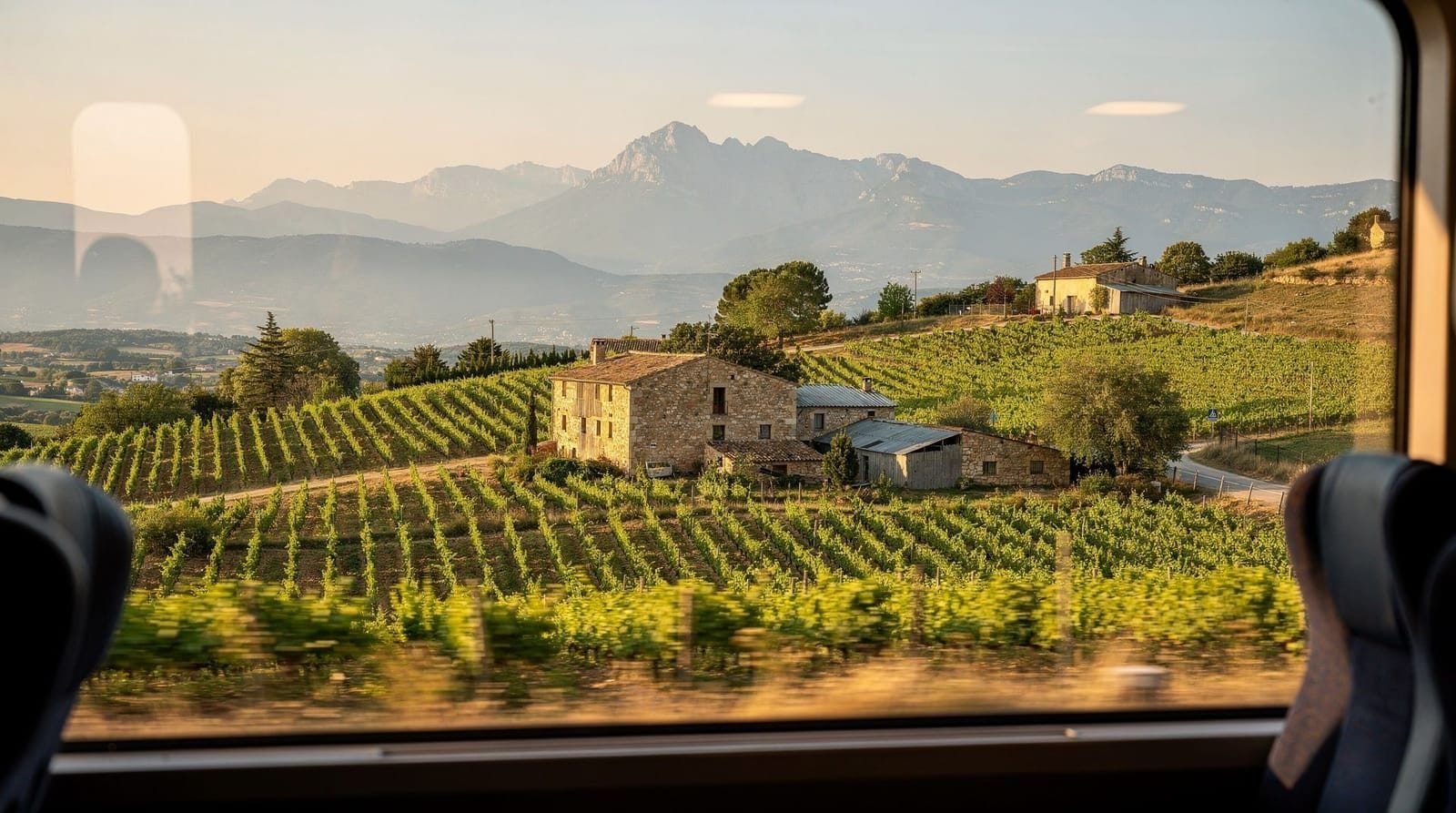
Montserrat day trip from Barcelona: the complete guide
Barcelona: Montserrat monastery and natural park day trip
Duration: Full day
- Free cancellation
- Hotel pickup
How do I get to Montserrat from Barcelona by train?
Take FGC line R5 from Plaça Espanya to Monistrol de Montserrat (about 1 hour), then the cremallera rack railway up the mountain (15 minutes). A combined FGC + cremallera return ticket costs approximately €30 and is sold at Plaça Espanya station.
| Where | 50 km northwest of Barcelona |
| Cost | Around €30 return (train + cremallera) |
| Time needed | Half-day minimum, full day recommended |
| Getting there | FGC R5 from Plaça Espanya, then the cremallera |
| Best time | Weekday mornings, avoid summer weekend crowds |
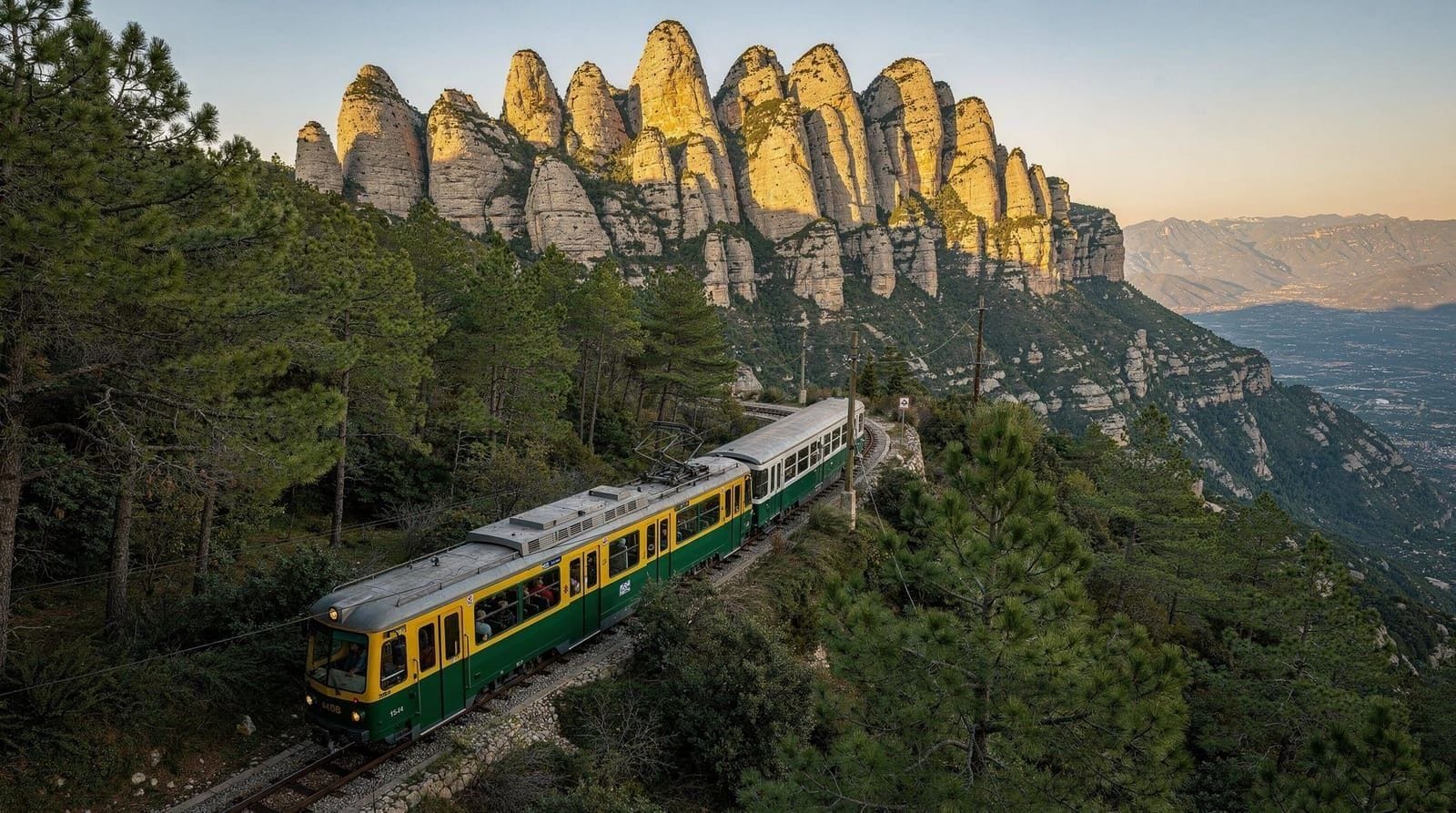
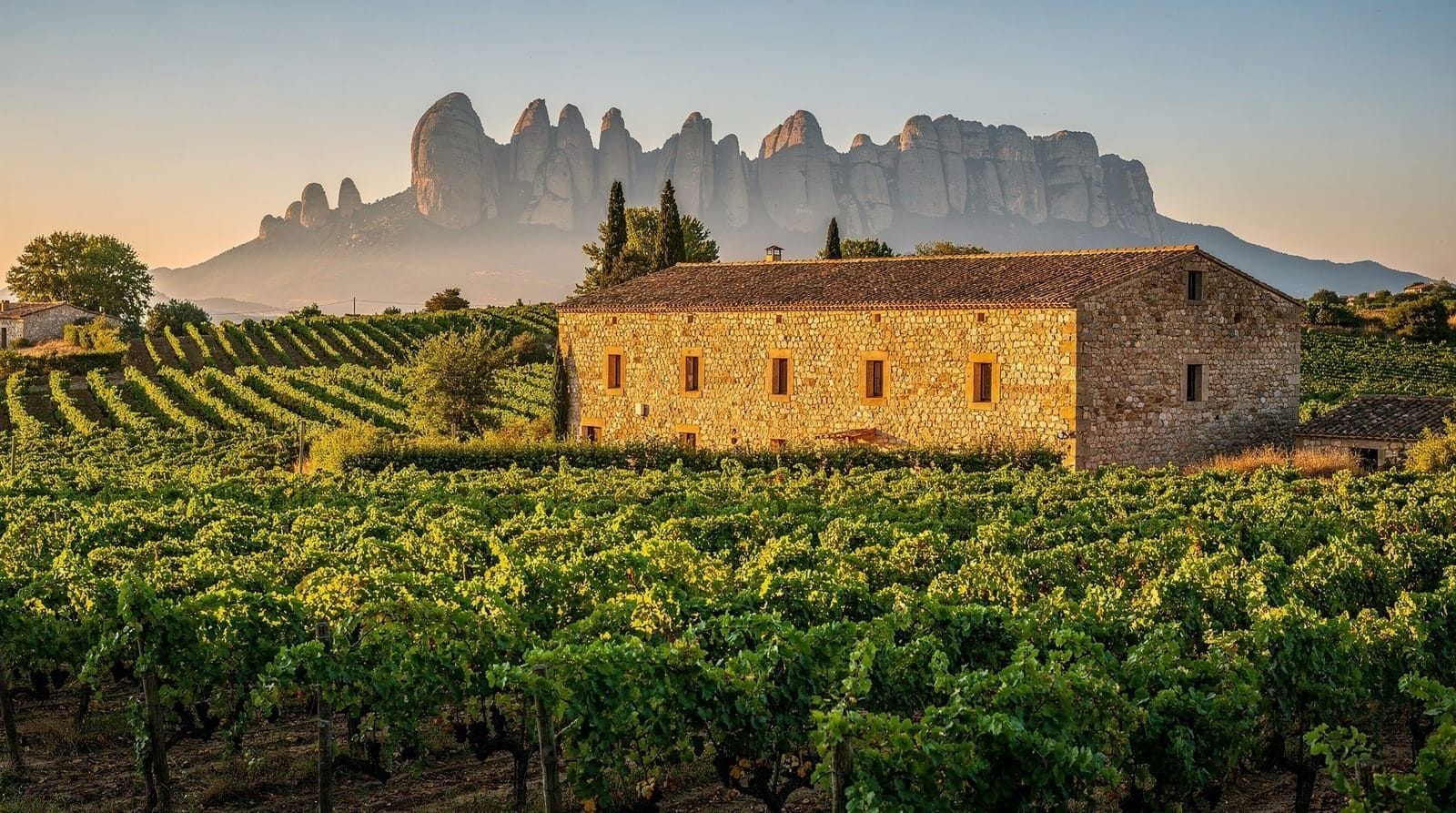
Fifty kilometres northwest of Barcelona, a ridge of serrated limestone peaks rises dramatically from the Catalonian plain. The locals call it Montserrat — “serrated mountain” — and the name does it justice. On a clear morning the jagged silhouette is visible from the Eixample rooftops. Up close, the mountain is extraordinary: conglomerate rock worn over millions of years into vertical needles, natural arches and pinnacles between 800 and 1,236 metres, with a Benedictine monastery clinging to one of the lower flanks.
This is Catalonia’s most iconic day trip from Barcelona. It is also one of the most logistically straightforward — the combined FGC train and rack railway from Plaça Espanya requires no tour booking, no car, and costs around €30 return.
Getting there from Barcelona
Option 1: FGC train + cremallera rack railway (recommended)
The most popular and scenic route:
- Take FGC line R5 from Plaça Espanya station, direction Manresa — trains depart roughly every hour. Journey to Monistrol de Montserrat: 1 hour approximately. A combined return ticket (FGC + cremallera) costs around €30 for adults and is sold at Plaça Espanya.
- At Monistrol de Montserrat, board the cremallera (rack railway). The 15-minute ascent climbs 550 metres with the valley falling away dramatically beneath the carriages. Rack railways use a central cog that locks into a toothed rail — you will feel the difference from a normal train.
- Alight at the main Montserrat station, adjacent to the monastery complex.
Trains run from approximately 07:30 to 20:30 with roughly hourly frequency. On summer weekends they can be crowded; go early.
Option 2: FGC train + Aeri cable car
An alternative from Monistrol de Montserrat is a brief walk to the Aeri de Montserrat cable car station. The aerial gondola is faster than the rack railway (five minutes vs fifteen) but carries fewer passengers and has more waiting time in peak season. Some visitors go up by cable car and return by rack railway for variety.
Option 3: By car
The AP-2 motorway to Martorell, then C-55 towards Manresa. Parking at the monastery complex costs approximately €10–12 per day. Driving gives flexibility for the more remote hiking trails but offers no advantage for the monastery and is slower than the train on busy summer weekends.
Option 4: Guided tour from Barcelona
Tours (from €45) handle all transport and typically include a guide for the monastery and surrounding area. The main advantage is hotel pickup and no timetable management. The main disadvantage is a fixed schedule — you leave when the group leaves. See the tour options above.
What to do at Montserrat
The monastery and basilica
The Benedictine monastery of Santa Maria de Montserrat was founded in 1025 and has been a continuous monastic community ever since. The current neoclassical basilica dates from the 19th century; the cloister and the atrium arcade are earlier.
The main draw inside the basilica is La Moreneta — the Black Madonna, a polychrome wooden sculpture from the 12th century (some art historians argue earlier). She is Catalonia’s patron saint and the destination of thousands of pilgrims weekly. To touch the orb in her hand, join the side queue to the left of the main altar; expect 20–45 minutes wait at peak times. Go before 09:30 or after 17:00 for shorter queues.
The Escolania de Montserrat, one of Europe’s oldest boys’ choirs (founded in the 13th century), sings the Salve daily at 13:00 and Virolai at 18:45 (not Saturdays). Worth timing your visit around.
Museum of Montserrat
The monastery’s art museum holds works ranging from archaeological finds to pieces by El Greco, Caravaggio, Monet and Picasso. The collection is genuinely strong for a site of this remoteness. Entry approximately €8 adults. If you have a cultural interest, allow 45 minutes here.
Hiking trails
Montserrat is a natural park with a network of signed trails. Two stand out for day-trippers:
Sant Joan trail: From the funicular de Sant Joan (upper funicular, departs near the main station), a 20-minute ride up, then 45-minute walk to the Sant Joan chapel and panoramic viewpoints. The views north to the Pyrenees on a clear day are remarkable. Total round trip including funicular: 2–3 hours.
Santa Cova trail: A 2-kilometre round trip along a path decorated with Modernisme sculptures by Puig i Cadafalch and Gaudí. This path descends from the main station to the cave where La Moreneta was reputedly discovered. Easy, 45–60 minutes round trip.
More demanding routes (Sant Jeroni, the highest peak at 1,236 metres) require a full day and appropriate footwear.
Eating at Montserrat
The monastery complex has a cafeteria and a restaurant (reservations recommended for lunch). Quality is adequate; prices reflect the captive audience. A better option: pack a picnic, which you can eat on any of the trail viewpoints with views of the valley. There is a small shop selling monastery-produced products including liqueurs, cheese and honey.
Montserrat with Penedès cava
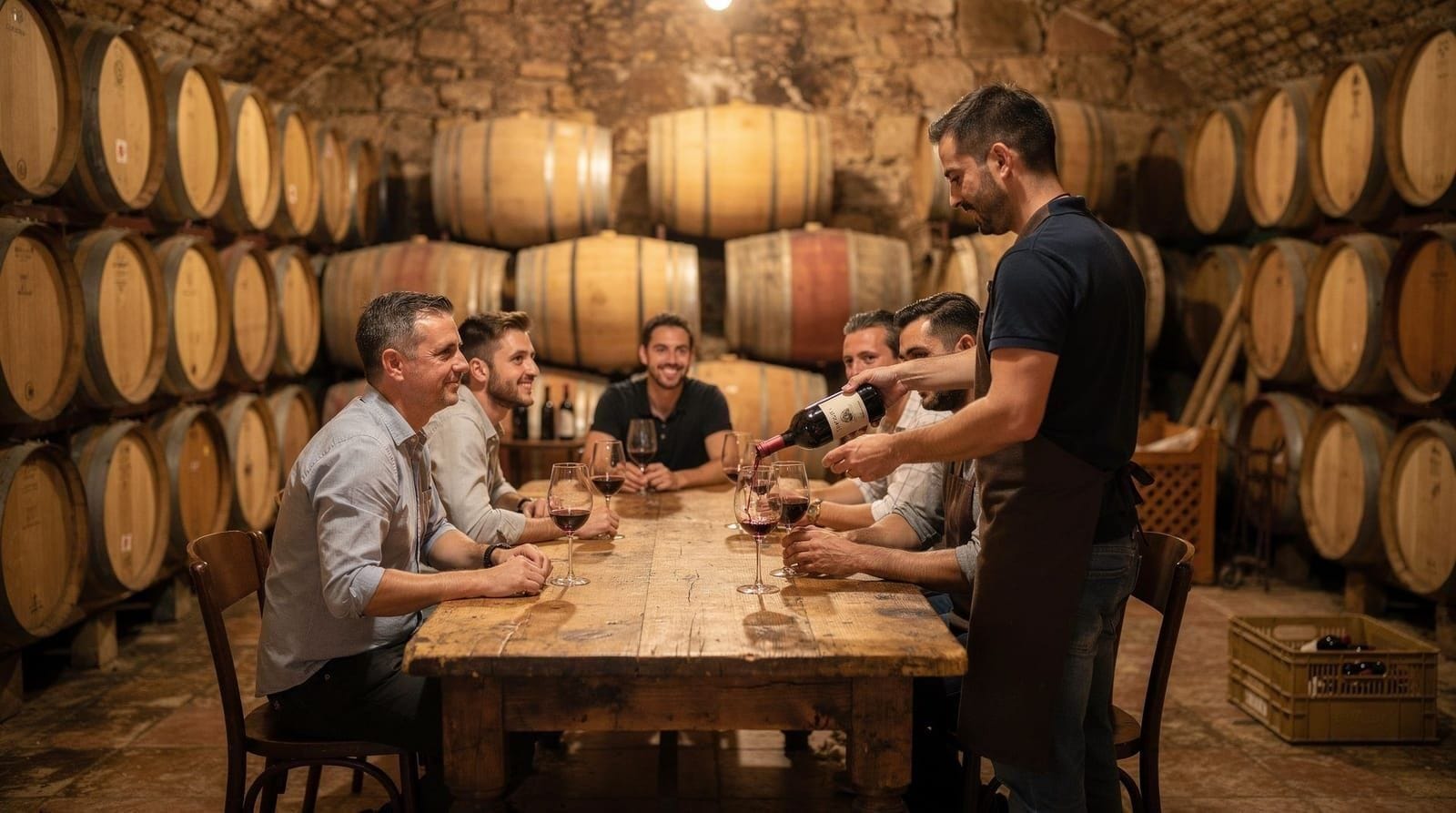
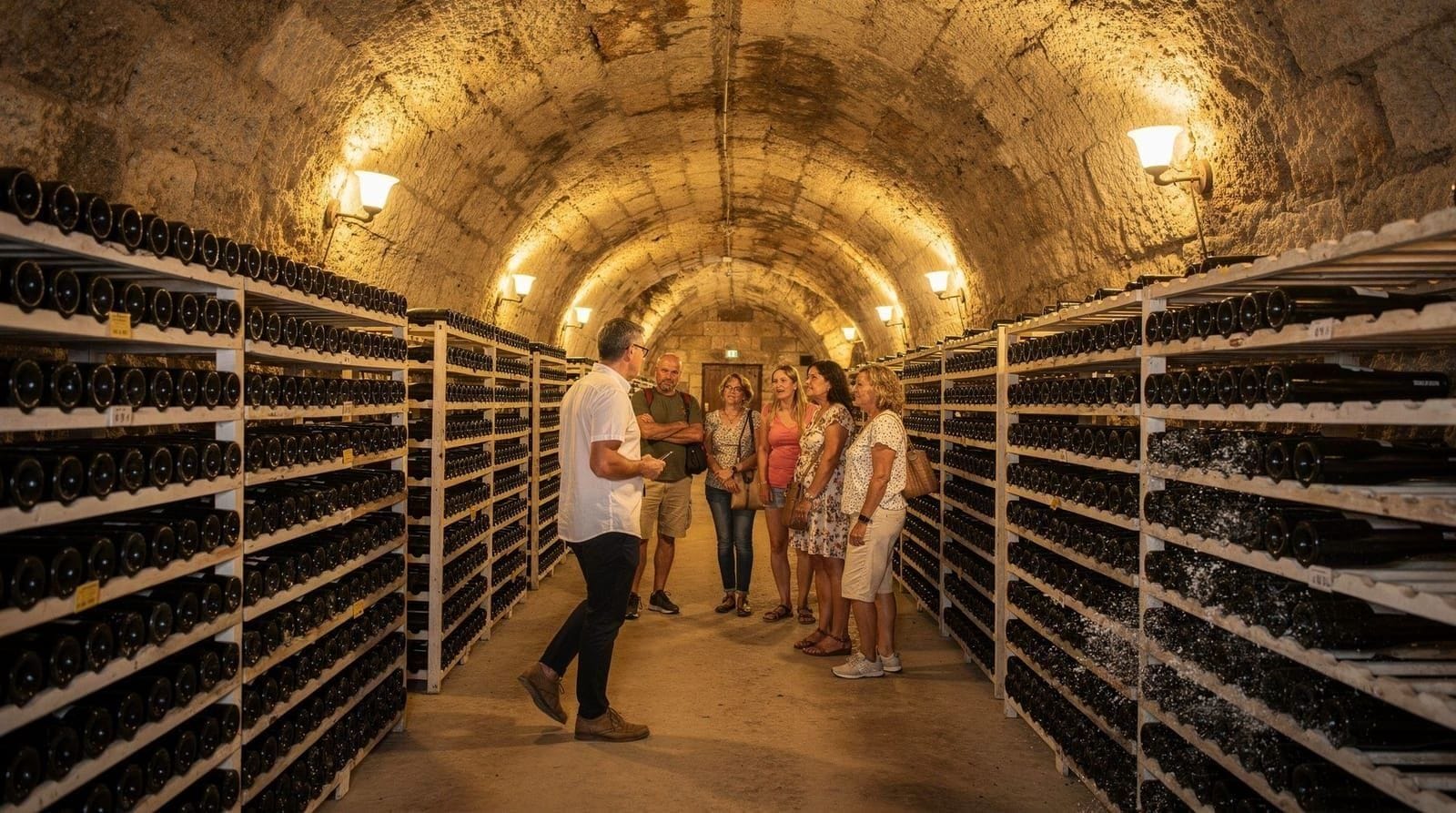
A popular combination tour runs from Barcelona to Montserrat in the morning and a Penedès winery in the afternoon — logical geographically since the Penedès DO lies between Barcelona and the mountain. These combined tours (approximately €85–90) typically include the rack railway, guided monastery visit, and a cava or wine tasting with cellar tour. If you are interested in both wine and the mountain, this is an efficient use of a full day. Our Penedès wine guide covers the wine country in detail.
What to bring
- Layers: the mountain is significantly cooler than Barcelona (often 5–8°C difference at the monastery level; more at higher altitude). A light jacket is essential year-round.
- Walking shoes: the Santa Cova trail is paved, but Sant Joan and higher routes are rocky.
- Water: drinking fountains are available at the main station; bring a bottle for trails.
- Cash or card: most facilities accept cards, but the small trail-side bar at Sant Joan is cash only.
DIY vs guided tour: cost and time compared
| DIY (train + cremallera) | Guided tour | |
|---|---|---|
| Cost | Around €30 return | €45–90 depending on inclusions |
| Time to the mountain | About 1h15 each way | Similar, but includes hotel pickup |
| Flexibility | Full control over timing | Fixed group schedule |
| Guide/context | None included | Monastery history explained |
| Best for | Independent travellers, budget-conscious | First-time visitors who want context, no logistics |
For most visitors comfortable navigating a train and a rack railway, the DIY route is the better value and gives you control over how long to spend on each trail. A guided option earns its price mainly through the history and legend context around La Moreneta and the monastery, which the self-guided visitor has to piece together from signage and guides like this one.
Families travelling with young children or visitors with limited mobility often find the guided option worth the extra cost specifically because it removes the need to manage train timetables and queue logistics on a day that already involves a fair amount of walking around the monastery complex. Independent travellers who enjoy figuring out transport as part of the adventure tend to prefer the DIY route and rarely report any real difficulty with it — the FGC and cremallera system is well signposted in English as well as Catalan and Spanish.
Best time of year to visit Montserrat
| Season | Conditions | Crowd level |
|---|---|---|
| Spring (Mar–May) | Mild, wildflowers on the trails | Moderate |
| Summer (Jun–Aug) | Hot, exposed trails, best long-distance visibility after rain | High, especially weekends |
| Autumn (Sep–Nov) | Mild, clear air, good hiking conditions | Moderate |
| Winter (Dec–Feb) | Cold at altitude, occasional snow on peaks, quietest | Low |
Autumn and late spring offer the best balance of comfortable hiking temperatures and manageable crowds. Summer weekends bring the heaviest crowds to both the train and the monastery queue for La Moreneta — going on a weekday, any season, meaningfully improves the experience. Winter visits reward clear-day visitors with the sharpest long-distance views, though the funicular and some trail sections can close briefly in poor weather. Whatever season you choose, checking the forecast the night before is worthwhile — Montserrat’s exposed ridge trails and the Sant Joan funicular terrace are considerably more affected by wind and cloud than central Barcelona, and a hazy day at street level can mean genuinely poor visibility at 900 metres.
Booking advice
No advance booking is required for the FGC + cremallera DIY option — you buy the combined ticket at Plaça Espanya (ticket machines or ticket office). For guided tours, book at least 48 hours ahead in high season (July–September), as the better small-group operators sell out. If cava and wine are part of your plan, a combined Montserrat and Penedès day covers both without you having to arrange separate transport.
The monastery’s history and its role in Catalan identity
Origins and the legend of the Black Madonna
The mountain was inhabited by hermits from at least the 9th century, drawn by the isolation and the dramatic landscape. The legend of La Moreneta holds that the statue was discovered in a cave on the mountain by shepherds following a mysterious light, and that repeated attempts to move her to a lower location were frustrated by miraculous resistance — the statue refusing to be lifted. A chapel was built on the site of the discovery; by 1025, Abbot Oliba of Ripoll had established a full Benedictine monastery.
The dark colour of the Romanesque wooden statue — carved between the 12th and early 13th centuries — has generated centuries of interpretation. The most honest explanation is that the original light-coloured wood darkened over centuries from candle smoke and varnish oxidation. The resulting appearance gave rise to the affectionate name La Moreneta (the Little Dark One), which she has carried ever since.
The statue depicts the Virgin Mary enthroned with the Christ child — a Sedes Sapientiae (Seat of Wisdom) type common in Romanesque Marian iconography across Europe. What is unusual is its context: a major pilgrimage statue on an isolated mountain that became progressively more significant as Catalan political identity developed and was periodically threatened.
Escolania de Montserrat — one of Europe’s oldest choirs
The Escolania (school of singers) was established no later than the 13th century, making it one of the oldest continuously operating boys’ choirs in the world — comparable in age to the Vienna Boys’ Choir. The choir trains approximately 50 boys aged 9–14, who combine a full academic education at the monastery school with intensive musical training.
The Escolania sings a daily schedule during the school year: the Salve Regina at 13:00 and the Virolai (the Catalan hymn to the Virgin of Montserrat) at 18:45, with additional performances on Sunday mornings. During school holidays (July–August), a reduced schedule applies and the full choir is not present — if hearing the Escolania is important to you, visit during term time (September–June, outside Easter week).
The Virolai, composed in 1880 with words by Jacint Verdaguer (the great poet of the Catalan Renaixença literary revival), is recognisable across Catalonia as a quasi-national hymn. Hearing it sung by the Escolania in the basilica is one of the most atmospheric and specifically Catalan experiences available to any visitor.
Montserrat under Franco — resistance through faith and culture
The Franco dictatorship (1939–1975) suppressed the Catalan language in public life, banned Catalan-language publications, and attempted to erase the cultural markers of Catalan identity. Montserrat became a crucial exception. The monastery, as a religious institution with international Vatican connections, retained a degree of autonomy that secular Catalan institutions did not have.
The Benedictines continued to celebrate Mass in Catalan when it was illegal elsewhere. They hosted cultural events, published Catalan-language texts, and sheltered political meetings that could not happen publicly in Barcelona. In 1970, 300 Catalan intellectuals, artists and clergy staged a five-day sit-in at the monastery to protest the Franco regime’s Burgos trial of Basque activists — a significant act of civil resistance that made international news.
The monks’ continuation of Catalan liturgy, publication and cultural activity during four decades of suppression made Montserrat something beyond a pilgrimage destination: a refuge for the idea of Catalonia itself. This history is part of what visitors are walking into when they arrive, and it explains why the mountain occupies a place in Catalan consciousness out of proportion to its size.
Hiking trails: practical descriptions
Santa Cova trail (easy — 45–60 minutes return)
Distance: 2 km return. Elevation change: Modest descent and return ascent. Surface: Paved path with some steps.
This is the most accessible trail and the one with the most direct connection to the monastery’s religious history. The path descends from the main station area along a route lined with Modernisme sculptures commissioned in the early 20th century — pieces by Gaudí, Puig i Cadafalch, and other artists of the period, each depicting a mystery of the rosary.
The destination is the Santa Cova chapel, built on the site of the cave where the legend places the discovery of La Moreneta. The cave itself is a small Baroque chapel set into the cliff face, dramatically positioned above the valley. The path back up is the same route; the slight ascent on return is the only physical challenge.
Best for: All fitness levels, families with children, visitors who want a meaningful trail experience without committing to serious hiking.
Sant Joan trail via funicular (moderate — 2–3 hours with funicular)
Distance: Approximately 4 km from funicular upper station to Sant Joan chapel and back. Elevation change: 200 metres from funicular exit to the highest points. Surface: Rocky mountain trail, marked.
Take the funicular de Sant Joan from near the main monastery complex (approximately €15 return, runs every 20 minutes in peak season). The upper station sits at around 900 metres — already well above the monastery level with immediate panoramic views.
From the funicular exit, the signed trail to Sant Joan chapel takes approximately 30–40 minutes each way. The chapel is an austere 14th-century hermitage in a commanding position. On clear days the view stretches north to the Pyrenees and south across the Penedès plain to the sea. The ridge trail beyond the chapel leads to higher viewpoints — follow signs to the Pla dels Ocells for the widest panorama on the mountain.
Best for: Visitors with reasonable fitness who want genuine mountain scenery beyond the monastery complex.
Sant Jeroni summit trail (demanding — 5–6 hours full circuit)
Distance: 8–10 km depending on route. Elevation change: 400+ metres from funicular exit. Surface: Rocky trails, exposed ridge sections. Proper walking shoes mandatory.
Sant Jeroni (1,236 m) is the highest point of the Montserrat massif. The trail from the Sant Joan funicular exit is well-marked and follows the ridge north before ascending to the summit. The views from the top are among the finest in eastern Catalonia.
This is a serious hike for the day. Bring at least 1.5 litres of water per person, sun protection, and cold-weather layers (the summit can be 10°C cooler than the monastery level, with wind). The route is not technically difficult but is exposed and long — not suitable for children under about 10 unless they are experienced walkers.
Best for: Visitors who want a full mountain day rather than a cultural visit.
Best viewpoints on Montserrat
Sant Joan terrace (funicular upper station): The easiest dramatic viewpoint, reached without walking. The terrace at the funicular exit looks south across the entire Penedès valley and the Barcelona coastal plain. On exceptionally clear days (typically after rain, or in winter), the city of Barcelona and the sea are visible 50 km away.
The monastery terrace: The open terrace outside the basilica and the Escolania building — the first thing you see after arriving by rack railway — already provides striking views of the needle-shaped rock formations above and the valley below. Many visitors spend time here without going further.
Pla dels Ocells (Birds’ Plain): A flat rock platform about 45 minutes beyond the Sant Joan funicular exit on the ridge trail. Panoramic in all directions, with the distinctive rock needles of Montserrat’s highest section rising immediately to the north.
Santa Cova overlook: Midpoint on the Santa Cova trail, where the path turns and descends toward the chapel. The valley view here — looking down hundreds of metres to the Llobregat river and the Penedès plain — is one of the most vertiginous on the mountain and entirely missed by visitors who only go to the monastery.
Montserrat is the most dramatic natural setting within a day trip of Barcelona and the mountain the Benedictines chose for their monastery eleven centuries ago. Whether you take the rack railway for the first time or walk to Sant Jeroni for the hundredth, the scale of the place is hard to prepare for until you are standing on the terrace and looking out over the Catalonian plain spread below you.
Frequently asked questions about Montserrat day trip from Barcelona
How much does a Montserrat day trip cost?
DIY: ~€30 combined FGC train + cremallera rack railway return. The cable car (Aeri) is a slightly cheaper alternative to the rack railway. Guided tours from Barcelona cost €45–90 depending on group size and whether wine/cava tastings are included.How long should I spend at Montserrat?
A half-day (4 hours on the mountain) is enough to see the monastery, queue for La Moreneta, and walk a short viewpoint trail. A full day adds hiking on Sant Joan or Santa Cova routes.Is Montserrat worth it?
Yes, for almost every visitor. The mountain landscape is unique in Europe — a ridge of conglomerate limestone eroded into vertical needles. The Benedictine monastery has occupied the site since the 11th century and the rack railway ride itself is memorable.What is La Moreneta?
La Moreneta (the Little Dark One) is a polychrome wooden statue of the Virgin Mary, dated to the 12th century, housed in the basilica at Montserrat. It is Catalonia's patron saint and a major pilgrimage object. The queue to touch the orb she holds can be 45 minutes — go early or late in the day.Can I combine Montserrat with cava wineries?
Yes. Combined Montserrat + Penedès cava winery tours run from Barcelona for approximately €85–90 and make logical geographic sense — the Penedès valleys lie between Barcelona and the mountain.
Top experiences
Bookable activities with verified prices and instant confirmation on GetYourGuide.
From Barcelona: Montserrat full-day trip with guided hike
- Free cancellation
- Small group
Barcelona: Montserrat cogwheel train, Black Madonna and winery tour
- Free cancellation
From Barcelona: Montserrat & cava winery day trip
- Free cancellation
- Small group
Barcelona: Montserrat & cava wineries day trip with pickup
- Free cancellation
- Hotel pickup
Montserrat: morning or afternoon half-day trip with pickup
- Free cancellation
- Hotel pickup