Park Güell free vs paid: what you need to know before you visit
Barcelona: Park Güell skip-the-line admission ticket
Duration: 2 hours
- Free cancellation
Do you have to pay to enter Park Güell?
Most of the park is free. Only the central Monumental Zone — the Hypostyle Room and the famous mosaic terrace — costs €13 (advance booking mandatory). Everything else, including the terraces with panoramic views, the forest paths, the viaducts, and the gingerbread gatehouses, is free and open at all times.
Park Güell is the most confusing major attraction in Barcelona, and the source of the most consistent planning mistake: visitors paying reseller prices for a ticket they needed but overpaid for, or buying a ticket covering only a fraction of the park without realising the rest was free.
This guide draws a clear line between what requires payment and what does not.
| Where | Carmel/Gràcia hillside, north of the city centre |
| Cost | Free zone: €0. Monumental Zone: around €13 (advance booking mandatory) |
| Time needed | 2–3 hours for both zones |
| Getting there | Bus 116 from Sagrada Família area, or metro L3 to Lesseps/Vallcarca + uphill walk |
| Best time | Early morning slot (09:00–09:30) for the Monumental Zone, any time for the free zone |
The two-zone structure
Gaudí designed Park Güell as a private garden city for 60 residential plots — a project that never found buyers and was eventually gifted to the city. The city council divided it into two access tiers when visitor numbers became unmanageable:
The free zone: The vast majority of the park’s 17 hectares. This includes all the forested hillside paths, the upper terraces, the viaducts, the gingerbread gatehouses at the main entrance (Pavilions Güell), the portico columns on the north slope, the Austria gardens, and the Turó de les Tres Creus viewpoint at the summit. No ticket, no booking, no time slot. Open at all times.
The Monumental Zone: The central Gaudí-designed public area: the Hypostyle Room and El Pla de la Natura (the main esplanade with the mosaic bench). This is the part that requires the €13 timed ticket and advance booking. Capacity is capped at 1,400 visitors per hour, entry is timed to a 30-minute grace-period slot, and walk-up tickets are not available.
The reason this matters practically: many of the photographs that make Park Güell famous worldwide — the views from the upper terraces, the forested viaducts, the gingerbread entrance pavilions — are taken from the free zone.
| Area | Zone | Ticket needed |
|---|---|---|
| Gingerbread gatehouses (Pavilions Güell) | Free | No |
| Upper terraces and city viewpoints | Free | No |
| Turó de les Tres Creus summit | Free | No |
| Viaducts and forested paths | Free | No |
| Austria gardens | Free | No |
| Hypostyle Room (86 columns) | Monumental Zone | Yes, around €13 |
| El Pla de la Natura (mosaic bench) | Monumental Zone | Yes, around €13 |
| South portico colonnade | Monumental Zone | Yes, around €13 |
| Gaudí House Museum | Separate building | Yes, separate ticket around €6–7 |
The history and original purpose of Park Güell
Park Güell was not conceived as a public park. The project began in 1900 when Eusebi Güell — the wealthy industrialist and Gaudí’s principal patron — purchased a 15-hectare hillside in the Carmel neighbourhood with a view to creating an English-style garden city: 60 residential plots for Barcelona’s upper bourgeoisie, with Gaudí designing the communal areas, roads, viaducts, and public spaces.
The concept was modelled on the English garden city movement (hence the English spelling of “Park” rather than Catalan “Parc”), then fashionable in progressive planning circles. Güell envisioned a community of villas connected by elevated roads supported on viaduct arches, with a central market hall at the top and a covered terrace providing views over the city and sea.
The project failed commercially. In 15 years of marketing, only two residential plots were sold (one to Güell himself, one purchased by Gaudí as his own residence). The reasons were multiple: the steep hillside was inconvenient to access in an era before cars, the neighbourhood was considered unfashionable, and the project’s ambitious communal infrastructure may have made the plot prices too high.
By 1914 the project was effectively abandoned. Güell died in 1918 and left the property to the city of Barcelona, which opened it as a public park in 1926 — the year Gaudí himself died. The UNESCO listing came in 1984, when it was incorporated into the designation of the Works of Antoni Gaudí, a World Heritage Site.
The failed garden city origin explains the infrastructure you see: the grand entrance pavilions were gatehouse lodges for the estate, not public entrances. The viaducts were residential access roads, not walking paths. The central market hall (the Hypostyle Room) was designed to be a covered farmers’ market serving the 60 households. The esplanade above it (El Pla de la Natura) was the communal terrace where residents could gather and enjoy the views. Almost nothing was built for public use — every element was residential infrastructure repurposed into one of the most visited parks in Europe.
Gaudí’s design principles in the park
Park Güell is one of the most complete expressions of Gaudí’s mature design philosophy, applied across 17 hectares rather than concentrated in a single building. Several principles are visible throughout.
Integration with natural forms: Gaudí’s primary design principle was working with the existing landscape rather than against it. The viaducts follow the natural contours of the hillside; the columns tilt at angles that express the geological thrust of the slope; the retaining walls at the esplanade level are designed to look as if they grew from the hillside rather than being imposed on it. The palette of stone matches the local rock type. From a distance, the structures of the park are almost invisible against the hill.
The trencadís technique: The mosaic method used throughout the park — particularly on the famous serpentine bench and in the Hypostyle Room medallions — is called trencadís. It involves fragments of broken ceramic tile, glass, and china applied to curved surfaces to create polychromatic patterns. Gaudí and his collaborator Josep Maria Jujol used this technique to solve a geometric problem: covering doubly-curved surfaces (which cannot be covered with flat tiles) requires either cutting tiles to fit or breaking them into small enough pieces that the curvature is absorbed in the grout lines. Trencadís turns this structural necessity into an aesthetic system.
The materials for the trencadís came from multiple sources, including ceramic waste from local tile factories and Gaudí’s own purchases of specific glazed pieces. Jujol’s contributions to the main bench are especially inventive — he embedded ceramic fragments in patterns that contain text, astronomical symbols, and abstract forms that are not part of any systematic iconographic programme but express a kind of improvisational genius.
The forest of columns: The Hypostyle Room’s 86 Doric columns are not vertical — they tilt slightly inward, following the line of natural geological stratification on that part of the hillside. The geometry distributes the weight of the esplanade above without buttresses. Gaudí studied the structural properties of Gothic columns and developed his own refinements, using a tilted column in conjunction with hyperboloid vaulting to achieve load distribution with less material than conventional construction.
Organic capital forms: At the top of each column, Gaudí designed a different capital based on plant and natural forms rather than the standard Doric disc and abacus. These were intended to be partly functional — each capital collects rainwater and channels it through hollow columns into a cistern below the Hypostyle Room, used for irrigation — and partly expressive of the organic integration between structure and nature that defines Gaudí’s mature work.
Getting to Park Güell: transport options in detail
There is no metro station adjacent to Park Güell. This is the most consistently underestimated logistics issue in visiting the park.
Bus 116: The most practical option for most visitors. From the stop on Avinguda de Gaudí (near the Sagrada Família), bus 116 runs directly to the main Park Güell entrance on Carrer d’Olot. Journey time approximately 15–18 minutes depending on traffic. Covered by the T-Casual card. The bus stop is approximately 200 metres from the entrance pavilions on a flat approach. Frequency every 12–15 minutes in peak hours.
Taxi or ride-hailing: Direct to the main entrance, 10–12 minutes from the Eixample, €10–13. The easiest option if you are arriving directly from the Sagrada Família in the morning. Taxis can pull up directly at the main entrance.
Metro L3 + walk: Lesseps or Vallcarca stations are the nearest on Line 3. From Lesseps it is approximately 15–20 minutes uphill on foot to the main entrance. From Vallcarca (closer to the Carmel entrance on the north side), 12–15 minutes. Both routes involve significant uphill walking, which can be demanding in summer heat. The return (downhill) is more comfortable.
Bus Turístic (hop-on hop-off): The blue line of the tourist bus includes a Park Güell stop at the main entrance. Useful if you are using the bus for multiple stops on the same day.
Carmel entrance (north side): If arriving from the Carmel side (by bus 92, which runs to Carrer del Carmel), the north entrance provides direct access to the upper free zone without passing through the main entrance area. This route is used by local walkers and cyclists and avoids the main entrance concentration. It is the recommended approach for visitors specifically interested in the free upper zone and the Turó de les Tres Creus.
What to expect by season
Spring (April–May): The optimal season for Park Güell. The vegetation is at its greenest, temperatures are comfortable for the uphill walk, and the Monumental Zone is bookable 3–10 days ahead rather than weeks. The park in April morning light is exceptional — the terracotta and mosaic colours against the green hillside and blue sky are at their most photogenic.
Summer (June–August): The busiest period. The Monumental Zone reaches its maximum density; book 2–4 weeks ahead minimum. The exposed esplanade in July and August can be very hot between 11:00 and 16:00; early morning visits (09:00 slot) are significantly more comfortable than afternoon. The upper forested areas provide shade and remain pleasant through the day.
Autumn (September–October): September is the optimal late-season month — still warm enough for comfortable outdoor visiting, crowds beginning to thin from mid-month. October is excellent: lower visitor numbers, cooler temperatures good for the uphill walk, and the autumn light on the city views from the upper terraces is notable.
Winter (November–March): Low crowds and immediate ticket availability. The park is fully open and the views on clear winter days (which are common) are exceptional. The Turó de les Tres Creus has 360-degree visibility on clear winter days that summer haze sometimes limits. Dress in layers — the hilltop is more exposed to wind than the city centre.
The Gaudí House Museum
The Casa Museu Gaudí is the pink Neo-Gothic house visible from the park’s central path, designed by Gaudí’s associate Francesc Berenguer. Gaudí bought it from the original purchaser and lived in it from 1906 until he moved into the Sagrada Família crypt shortly before his death in 1926.
The museum requires a separate entry ticket (approximately €6–7) from the Monumental Zone ticket. It contains:
- Furniture designed by Gaudí for his own use and for earlier patron commissions
- Personal objects including his religious devotion items
- Documents and photographs from his life
- The parlour and bedroom as they appeared during his residence
It is a modest building — two floors of domestic scale — but the furniture collection is genuinely interesting for its combination of structural experimentation and religious asceticism. The prie-dieu chair he designed for his own use, with its unusual ergonomic angles, is a good example of Gaudí applying his structural thinking to everyday objects. The museum is typically low-crowd and can be combined with the Monumental Zone ticket visit on the same morning.
Photography tips: free and paid zones
The most photographed element of Park Güell — the famous mosaic bench and the Hypostyle Room — are in the Monumental Zone and require the paid ticket. The best photographs of the park as a whole, however, are available from the free zones.
Free zone photography:
The gingerbread entrance pavilions (Pavilions Güell at the Carrer d’Olot entrance) are in the free zone and can be photographed from any angle without a ticket. The best light is morning from 09:00–11:00 when the east-facing surfaces are in direct sun.
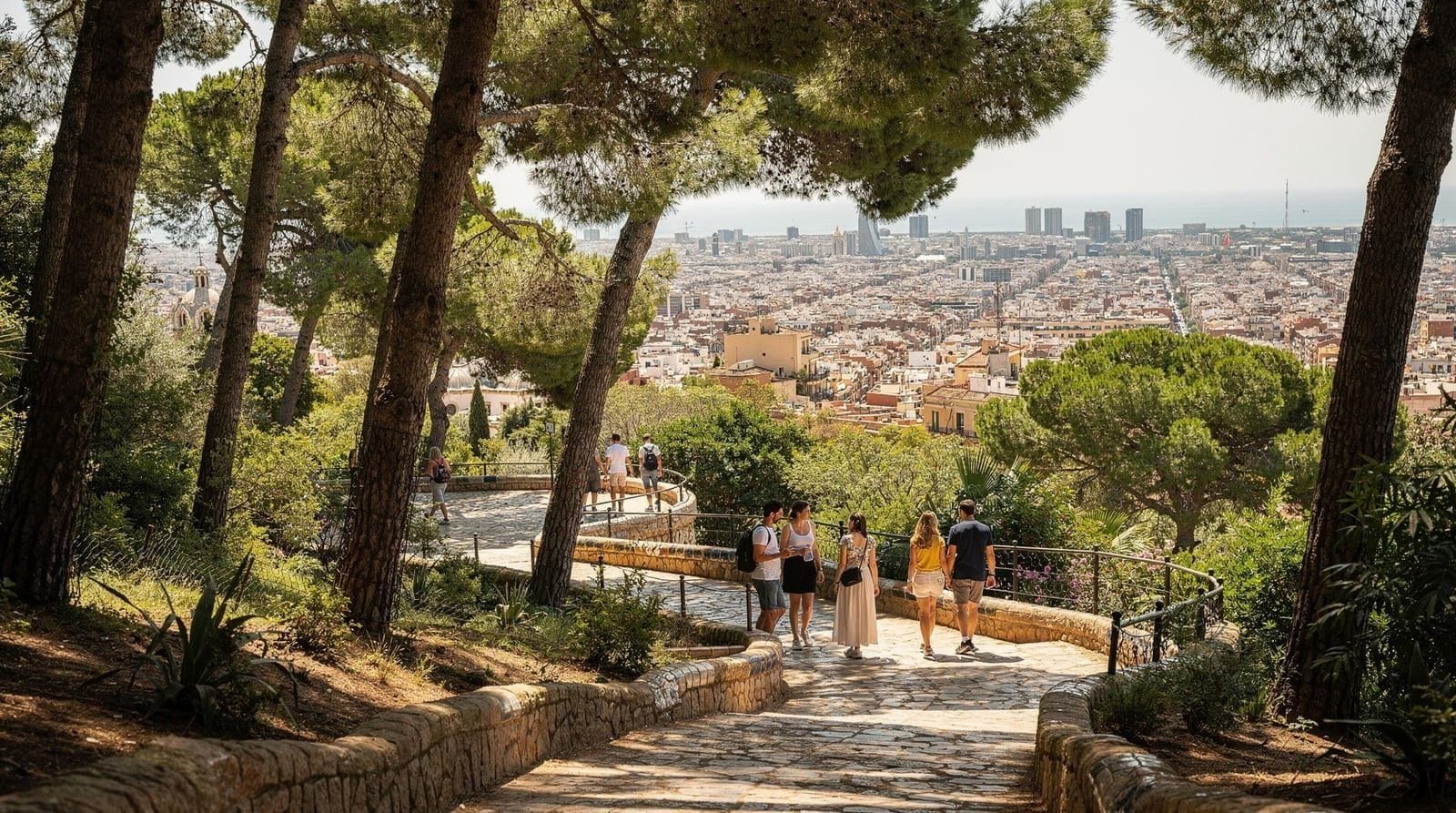
The upper terraces above the Monumental Zone have the best wide-angle views of the park’s landscape — the terrace with its mosaic elements visible below, the city grid extending to the sea, and the Sagrada Família towers visible on the horizon (best in the morning before haze builds). No ticket required.
The viaduct arches from below — the walkways on the hillside where the stone columns and curved arches form a colonnade — photograph well in morning and afternoon light. The roughness of the stone against the curved geometry is characteristic of Gaudí’s approach to the park infrastructure.
Monumental Zone photography:
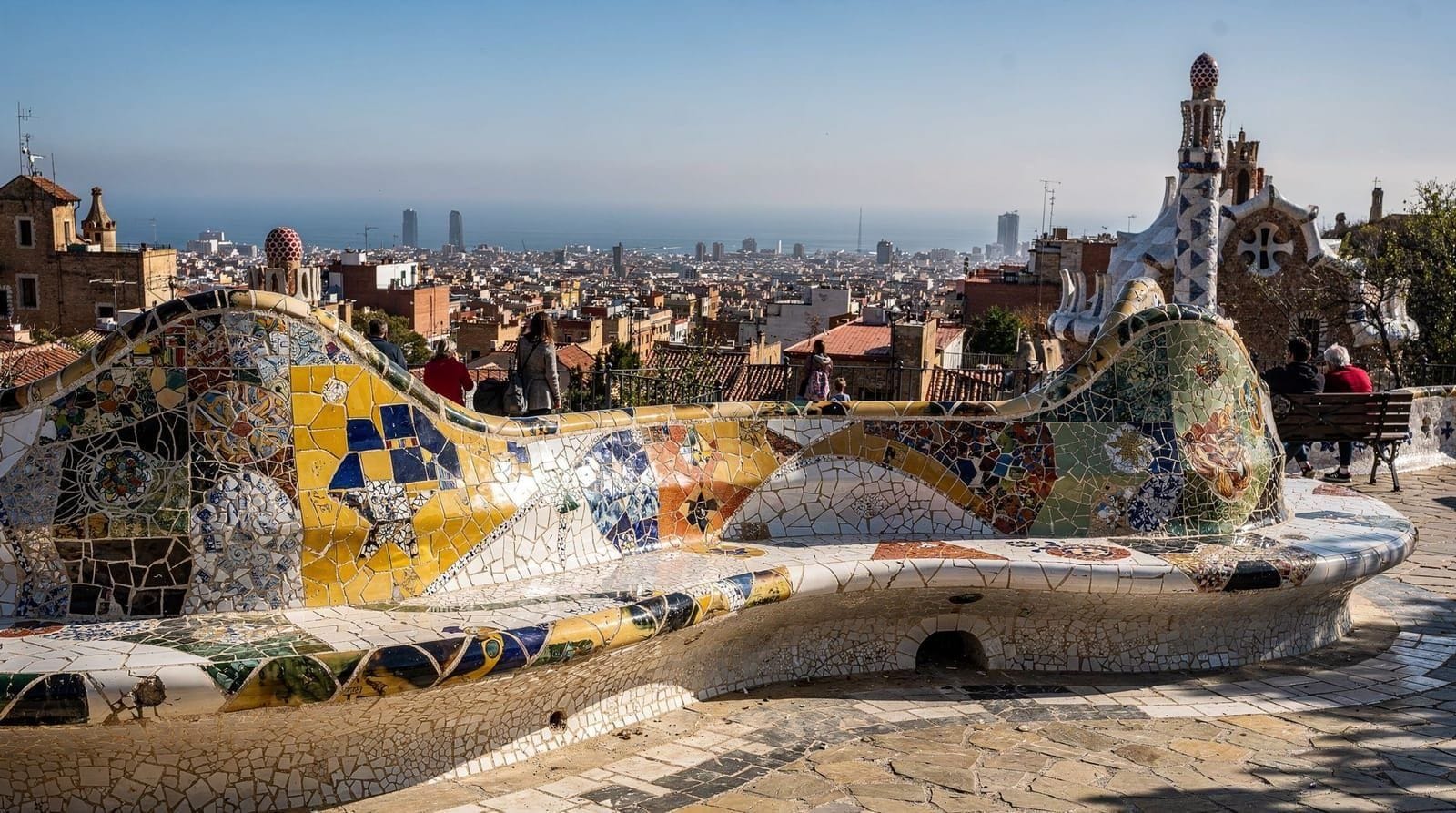
The mosaic bench (El Pla de la Natura) is at its best in the first 30 minutes of your timed slot — before the next group arrives and fills the esplanade. Aim for the early morning slot (09:00 or 09:30). The curved east end of the bench with the city as background is the classic composition; the bench surface detail from close range is also worth attention.
The Hypostyle Room columns photograph better with a wide angle — the 86 columns filling the frame with the mosaic ceiling above. The room has no artificial lighting; natural light from the openings in the ceiling and the entrance end is what illuminates it.
What is free, specifically
The gingerbread gatehouses — the two candy-house pavilions at the main Carrer d’Olot entrance are in the free zone. You can walk past and photograph them without a ticket. They are among the most distinctive structures in the park.
The main entrance staircase — the approach from the entrance gates upward has the Dragon Staircase (the famous mosaic salamander). As of 2026, the salamander is within or at the boundary of the Monumental Zone; the lower staircase approach and views of the salamander from below are accessible without a ticket.
Forested paths and viaducts — the most extensive part of the park. The sloping stone viaducts with their arched underpasses are entirely in the free zone. Walking the hillside paths through carob and pine trees for 30–45 minutes without encountering any ticket checkpoint is the normal experience.
Upper terraces and Austria gardens — the terraced gardens above the Monumental Zone are free and offer some of the best views in the park toward the Sagrada Família and the Eixample grid.
Turó de les Tres Creus — the summit of the hill, reached via paths within the free zone. A 20-minute walk from the Carmel entrance; offers 360-degree views including the sea. There are no ticket checks on the path.
Carmel entrance — the park has a second entrance at Carrer del Carmel on the north side. This is the route used by many local walkers and cyclists and provides direct access to the upper free zone. Arriving via the Carmel entrance is often less crowded than the main Carrer d’Olot entrance.
What requires the €13 ticket
Hypostyle Room — the 86-column hall designed to support the esplanade above. The columns lean slightly inward in a structural feat of Gaudí’s engineering, and the ceiling is covered in mosaic medallions. This is one of the most remarkable interior spaces in any of Gaudí’s public works. The room is inside the Monumental Zone and requires the timed ticket.
El Pla de la Natura (the main esplanade/terrace) — the open terrace with the long curving bench that winds around its perimeter. The bench, covered in the trencadís mosaic technique (shards of ceramic tile in polychromatic patterns), was designed by Gaudí’s collaborator Josep Maria Jujol. This is the most photographed element of the park. It is worth the ticket price.
The colonnaded portico on the south edge — the covered walkway running along the south side of the main esplanade, with its tilted supporting columns and mosaic ceiling.
The reseller problem at Park Güell
The official ticket is €13 from parkguell.barcelona. Multiple reseller websites — some with very high search engine visibility — charge €15–20 for the same ticket. They add a “booking fee” or “service charge” that takes the official €13 and marks it up to €16–20.
For a couple visiting, the reseller charges €6–14 more. For a family of four, €12–28 more. For nothing — the same timed entry slot is purchased either way.
The specific URL to use is parkguell.barcelona. Any other website selling “Park Güell tickets” with a price above €13 for the adult Monumental Zone is adding a markup. See the tourist traps guide for the full context on Barcelona ticket resellers.
How to sequence your Park Güell visit
A logical 2–3 hour visit to the park works as follows:
Arrival via main entrance (Carrer d’Olot): 10 minutes to walk up from the bus stop. See the gingerbread gatehouses on the way in.
Monumental Zone slot (30 minutes): Enter your timed slot. See the Hypostyle Room — allow 10 minutes to walk through and absorb the engineering. Emerge onto El Pla de la Natura: the mosaic bench, the curved terrace, the view over the city. Allow 20 minutes here for photographs and the panorama.
Free zone exploration (60–90 minutes): After your Monumental Zone visit, exit and continue into the free upper zones. Walk the forested paths northeast toward the Turó de les Tres Creus if you have the energy (20–30 minute walk uphill from the esplanade). Walk the viaducts on the return. Descend via the Austria gardens for a less crowded route back to the entrance.
Alternatively, arrive via the Carmel entrance, explore the free zone first, then walk down to the Monumental Zone for your timed slot. This reversal avoids the crowd buildup at the main entrance in the morning.
Accessibility and comfort notes
The park sits on a steep hillside, and this affects both zones differently. The Monumental Zone is largely level once you reach it — the esplanade and Hypostyle Room are accessible by lift from the main entrance for visitors with mobility needs, and this should be requested at the ticket gate rather than assumed. The free zone is a different matter: the paths connecting the upper terraces, the Turó de les Tres Creus and the viaducts involve sustained uphill walking on stone and gravel surfaces, some of it steep. Visitors with limited mobility are generally better served concentrating on the Monumental Zone and the immediate area around the main entrance rather than attempting the full free-zone circuit.
Shade is uneven. The Monumental Zone esplanade is largely exposed, which matters in the June–August heat — the early morning slots are noticeably more comfortable than midday ones for this reason. The forested paths in the free zone, by contrast, offer far more natural shade and are a reasonable summer option even at midday if you are not tied to a Monumental Zone time slot.
Toilets and water fountains exist near the main entrance and at a few points along the free-zone paths, but they are not frequent once you are deep into the upper terraces, so it is worth carrying water on longer free-zone walks, particularly in summer.
Strollers and pushchairs can manage the Monumental Zone and the main paths near the entrance without much difficulty, but the steeper free-zone routes toward the Turó de les Tres Creus are genuinely hard going with a pushchair; families with young children in a stroller are usually better off sticking to the lower paths and the esplanade rather than attempting the summit circuit.
Pairing with Sagrada Família
The most natural Gaudí day pairs Sagrada Família in the morning with Park Güell in the afternoon. From the basilica, bus 116 reaches the main Park Güell entrance in approximately 15 minutes. Book your Park Güell Monumental Zone slot for 13:00 or 13:30 to allow a comfortable transition from a 09:00 Sagrada Família entry.
This sequence works well because the Sagrada Família interior is at its most spectacular in morning light (the Nativity façade stained glass); Park Güell’s views and terraces are pleasant throughout the day but less busy in the early afternoon after the morning rush clears.
The combined GYG option covers both sites with pre-coordinated timing and is worth considering for visitors who prefer not to manage two separate booking sites and time slots independently.
For the full planning detail on the basilica side of that pairing, see the Sagrada Família booking guide. If you want a broader overview of the park beyond the free-vs-paid question — history, layout, what a first visit actually feels like — the companion Park Güell guide covers that ground, and the Gaudí trail guide places the park in context alongside Casa Vicens and the rest of the architect’s Barcelona work.
Park Güell is a genuinely impressive Gaudí creation — the Monumental Zone is worth the €13 ticket and the planning required to book it. At the same time, a full morning in the free zone of the park is independently worthwhile, and many visitors leave surprised that the forest walks and upper terraces were included at no cost. Plan for both zones and you get the complete picture.
Frequently asked questions about Park Güell free vs paid
How much does Park Güell cost in 2026?
The Monumental Zone ticket is €13 for adults, approximately €7 for children aged 7–12, and free for children under 7. This is the official price at parkguell.barcelona. Third-party resellers charge €15–20 for the same ticket. There is no charge to enter the rest of the park.Do I need to book in advance for Park Güell?
Yes, for the Monumental Zone. Walk-up tickets are not available — the capacity is capped at 1,400 visitors per hour with timed entry. In peak season (June–September) book 2–4 weeks ahead. Shoulder season (March–May, October) requires 3–5 days minimum. Book at parkguell.barcelona only.What is in the free zone of Park Güell?
The free zone contains the majority of the park's area: the upper wooded terraces with panoramic views, the viaduct system with archways along the hillside, the Austria gardens and gardens above the Monumental Zone, the portico columns on the north slope, the park's main gatehouses (the famous gingerbread pavilions), the paths and steps connecting all the areas, and the Gaudí House Museum building (visible but requiring a separate entry ticket of €6–7).The Dragon Staircase — is it in the free or paid zone?
The Dragon Staircase (with the famous mosaic salamander/dragon) is on the main entrance staircase leading up toward the Monumental Zone. It is technically in the entrance transition area. As of 2026, the mosaic salamander itself and the staircase above it are within the Monumental Zone boundary. Confirm on-site signage on arrival, as the boundary has been adjusted in previous years. The best views of the salamander from below are accessible without a ticket.What does the €13 ticket actually give access to?
The Hypostyle Room (the famous forest of 86 leaning Doric columns designed to evoke a forest of stone trees) and El Pla de la Natura — the main esplanade with Gaudí's famous serpentine mosaic bench that winds around the perimeter. The bench is the most photographed element in the park. The Monumental Zone also includes the colonnaded paths along the south edge of the terrace. Your slot is timed with a 30-minute grace period.What are the best free views from the park?
The free upper terraces above the Monumental Zone have excellent views over the city and Eixample grid to the sea. The Turó de les Tres Creus (Three Crosses Hill), accessible via a winding path from within the free zone, is the highest point in the park and offers a 360-degree panorama. It is a 20-minute walk from the Carmel entrance and requires no ticket.Is there a free way to get to Park Güell?
Bus 116 from the Sagrada Família area stops directly at the main entrance and is the most efficient route from the tourist centre. The T-Casual card covers it. A taxi from central Barcelona costs around €10–12. There is no metro station near the park; the nearest is Lesseps or Vallcarca on L3, both requiring a 15–20 minute uphill walk. Some visitors use the blue Bus Turístic hop-on-hop-off (which has a Park Güell stop) on the same day.Can I visit the Gaudí House Museum with the Monumental Zone ticket?
No. The Gaudí House Museum (Casa Museu Gaudí) is inside the park and is where Gaudí lived from 1906 to 1926, but it requires a separate entry ticket (approximately €6–7). It contains furniture and personal objects designed by Gaudí. It is a modest addition worth considering if you are spending the morning in the park.Is it worth combining Park Güell with Sagrada Família on the same day?
Yes, it is a natural pairing — bus 116 connects the Sagrada Família area to Park Güell's main entrance in around 15 minutes. A common sequence is a 09:00 Sagrada Família entry followed by a 13:00 or 13:30 Park Güell Monumental Zone slot, giving a comfortable transition between the two without rushing either visit.
Top experiences
Bookable activities with verified prices and instant confirmation on GetYourGuide.
Barcelona: Park Güell skip-the-line admission ticket
- Free cancellation
Barcelona: Park Güell guided tour with fast-track ticket
- Free cancellation
- Small group
Barcelona: Park Güell guided tour with skip-the-line entry
- Free cancellation
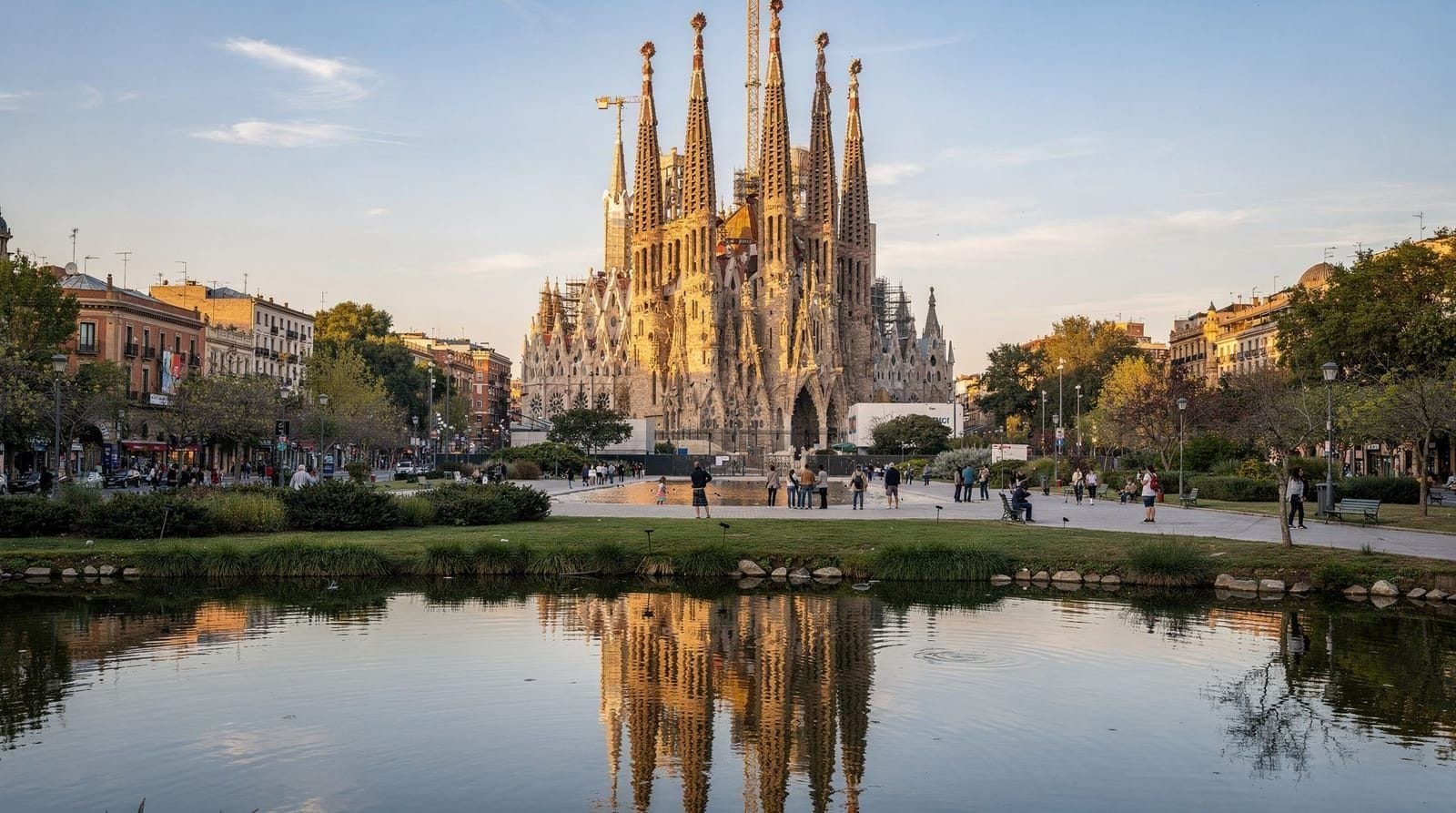
Barcelona: Sagrada Família and Park Güell tickets combo
- Free cancellation