Sagrada Família booking guide: how to get the right ticket
Barcelona: Sagrada Família skip-the-line ticket with audio guide
Duration: 2 hours
- Free cancellation
- Instant confirmation
How far ahead should I book Sagrada Família tickets?
Book the moment your travel dates are confirmed. Basic entry sells out 1–2 weeks ahead on weekdays in shoulder season; 3–4 weeks on weekends. Tower tickets go 4–6 weeks ahead in spring/autumn and 8–12 weeks in summer. The 2026 centenary is extending all these windows.
The Sagrada Família is the most-visited building in Spain and the single attraction most likely to wreck a Barcelona trip when left unbooked. This is the guide that tells you exactly what to do, in order, without the marketing padding. For the fuller picture of the basilica beyond ticketing logistics — history, architecture, what a visit actually feels like — see the companion Sagrada Família guide.
| Where | Eixample, Carrer de Mallorca 401 |
| Cost | Basic entry around €26–28; with one tower around €36–38; both towers around €46 |
| Time needed | 1.5–2 hours basic; add 45–60 minutes per tower |
| Getting there | Metro Sagrada Família (L2/L5) |
| Best time | 09:00 slot for the best light and thinnest crowds |
Why the booking window matters more than you think
The basilica admits visitors in fixed-capacity timed slots. Tickets are released on a rolling three-month window. In practice, the demand curve looks like this:
- Basic entry, weekday, January–February: bookable same-morning or a few days ahead
- Basic entry, weekday, March–May and October: 1–2 weeks ahead
- Basic entry, weekend, any season: 2–4 weeks ahead
- Single tower, spring/autumn: 3–5 weeks ahead
- Single tower, June–August: 6–8 weeks ahead
- Both towers, June–August: 8–12 weeks ahead
The 2026 Gaudí centenary is compressing these windows. Basic entry that would normally be bookable 10 days ahead in May is going two to three weeks ahead this year. If your dates are set, book immediately — even if your trip is three months away.
The system has no same-day waitlist and no cancellation release to walk-up buyers. If you arrive without a ticket in peak season, you will very likely not get in that day.
The ticket types, explained plainly
Basic entry (from €26): Timed-entry ticket with audio guide. Gives access to the full interior of the basilica, including both the Nativity and Passion façade interiors, the Apse, the central nave, and the Gaudí Crypt Museum below. The audio guide (available in 12 languages) is included and covers the building’s symbolism, history, and engineering in substantial depth. This is the minimum you need for a meaningful visit.
Entry with one tower (from €36–38): Adds either the Nativity tower (east side, faces the old city and residential Eixample) or the Passion tower (southwest, faces the sea and modern Barcelona). The tower access is a separate timed slot from your main entry — it typically runs 30 minutes before or after your main entry window. You take a lift up to the bridge between towers, spend about 15 minutes at the viewing level, then descend via a tight spiral staircase.
Entry with both towers (€46): Includes both the Nativity and Passion towers on separate timed access slots. Note that this is not a single combined tower visit — you will need to be at both towers at different specified times.
Guided tours (from €40): Include entry, audio guide, and a licensed guide who covers Gaudí’s symbolism, the structural innovation of the arboreal columns, the sacred geometry of the floor plan, and the iconographic programme on both façades in considerably more depth than the audio guide. Worth it for architecture enthusiasts and those on a first visit who want to understand what they are looking at. Small group tours (max 8–12 people) are available at premium.
Sagrada Família + Park Güell combo: Several GYG operators offer combined-day tickets covering both sites. These can be more convenient than booking separately if you plan to visit both on the same day — the timing is pre-coordinated, which removes the logistical puzzle of pairing two timed slots.
| Ticket type | Price from | Includes | Book ahead |
|---|---|---|---|
| Basic entry | Around €26–28 | Interior, both façades, Crypt Museum, audio guide | 1–4 weeks |
| Entry + one tower | Around €36–38 | Basic entry plus Nativity or Passion tower | 3–8 weeks |
| Entry + both towers | Around €46 | Basic entry plus both towers on separate slots | 8–12 weeks in summer |
| Guided tour | From around €40 | Entry, audio guide, licensed guide | 1–4 weeks |
The tower question: is it worth adding?
Yes, with one practical caveat. The spiral staircase descent (several hundred steps in narrow, occasionally claustrophobic stone passages) is the real filter. If heights are a problem, skip the towers. If tight enclosed staircases are a problem, skip the towers.
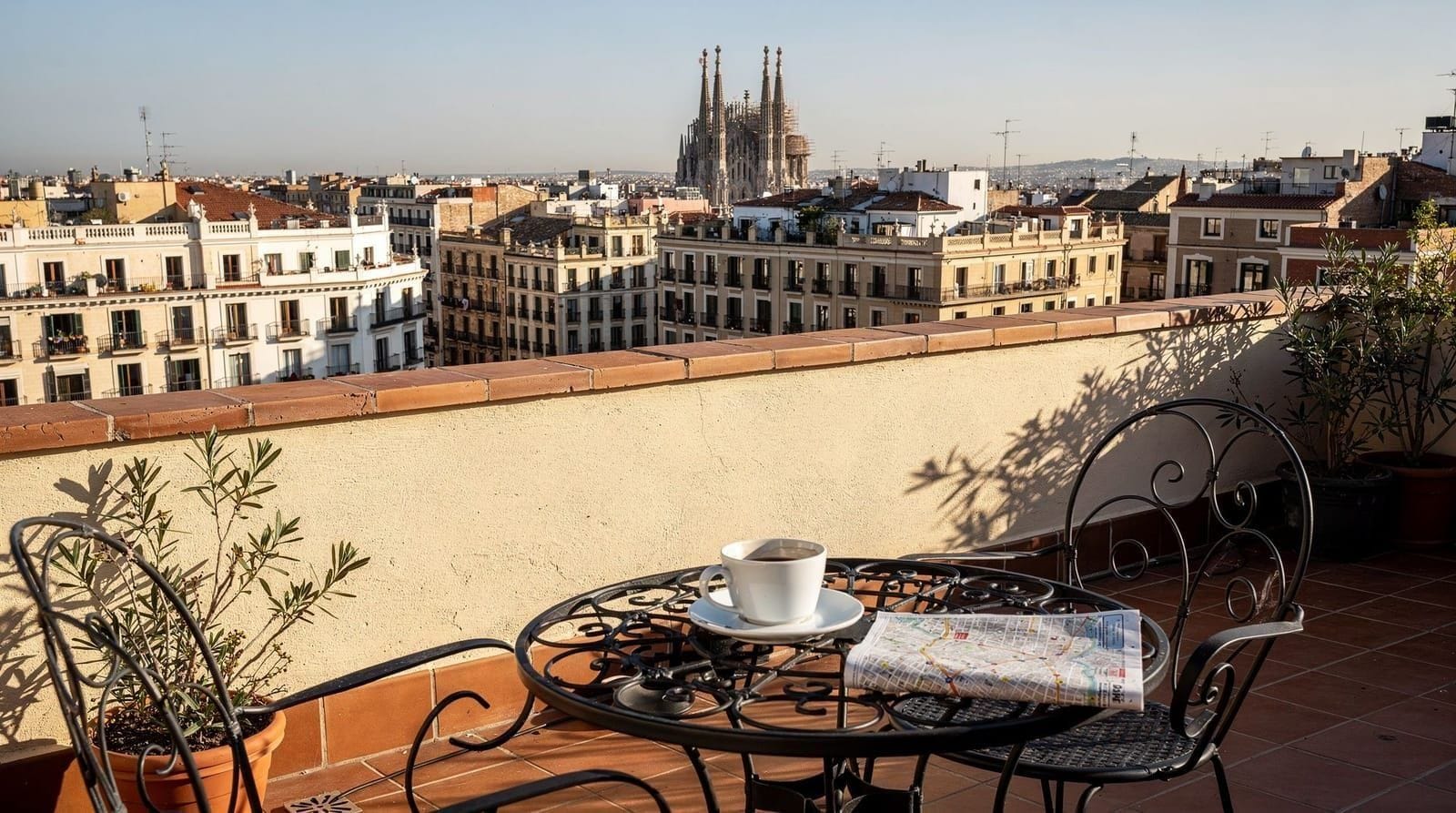
If neither of those applies, the tower is a memorable add. From the Nativity tower you look down over the old Eixample grid (Cerdà’s extraordinary 19th-century planned city unfolds like a map) and out toward the coast. The view from the Passion tower faces the other way: the modern Barcelona skyline, the Olympic port, and the sea. At €10–20 above the base ticket price, the value is high.
The Nativity tower is more popular partly because the morning slot coincides with the best light on that façade. If you can only choose one, the Nativity tower in a morning slot is the recommendation.
Accessibility options
The Sagrada Família has made significant accessibility improvements in recent years, though the building’s nature imposes some constraints.
The main entrance on the Passion façade side (Carrer de Sardenya) has step-free access via ramps and lifts. The interior nave and aisles are fully wheelchair accessible. The Glory façade entrance (under construction but used for some visitor access) also has lift access.
The towers, however, are not accessible for wheelchair users or those with significant mobility limitations. The lift ascent is available but the descent is exclusively via the narrow stone spiral staircase. There is no alternative descent route. Visitors with knee problems or significant mobility difficulties should consider skipping the tower add-on, as the descent is demanding regardless of fitness level.
The audio guide is available in formats for visitors with hearing impairments. The basilica has dedicated accessibility parking on Carrer de Gaudí. Contact the official ticketing site in advance if you have specific requirements — the accessibility office can confirm current arrangements and reserve appropriate entry points.
The construction timeline: what 2026 means
Antoni Gaudí began work on the Sagrada Família in 1883 and devoted the last 43 years of his life to it, being struck and killed by a tram on the Gran Via in 1926. At the time of his death, only the crypt, the apse, and the Nativity façade lower sections were complete.
Construction has continued through the decades since, using Gaudí’s original models, drawings, and the expertise of successive generations of architects. The building was consecrated by Pope Benedict XVI in 2010, even though it remained unfinished. The original projected completion date of 2026 — the centenary of Gaudí’s death — was disrupted by the COVID pandemic and subsequent materials shortages, and the current realistic completion window has shifted to 2028–2030 for the final towers.
As of 2026, the building is substantially further along than most visitors expect. The central tower of Jesus Christ, the tallest of all at 172.5 metres, is under advanced construction. The four towers of the Evangelists around it are nearing completion. The Glory façade on the south side — which Gaudí considered the most important of the three façades — is in active construction and partially visible from street level. Visitors can see the construction scaffolding and cranes as part of the exterior walk-around, which is itself an interesting document of a live cathedral-building project.
The construction site is visible from the south side of the building without entering. This adds a genuinely unusual dimension to the visit: the building is simultaneously a working religious site, the most-visited tourist attraction in Spain, and an active major construction project.
What you see inside: a guide to the interior
The interior of the Sagrada Família is not what most first-time visitors expect. Many anticipate a dark, solemn Gothic cathedral interior; what they encounter is the most light-filled ecclesiastical space in Europe.
The central nave and forest of columns: Gaudí’s structural concept was the tree. The columns of the nave branch near the ceiling into a geometric canopy of interlocking hyperboloids — mathematical forms that distribute weight while allowing maximum light penetration. The columns are of different coloured stone depending on their structural load: basalt at the exterior, porphyry closer in, granite at the main nave piers. Looking up into the vaulted ceiling is disorienting in the best possible way: the geometry is not Gothic rib vaulting but something entirely new, closer to mathematics made physical.
The stained glass: The nave has three distinct light experiences. The Nativity apse on the east end is filled with green and warm blue glass, allowing morning sun to project cool, forest-like light across the columns. The Passion apse on the west end is filled with reds and oranges and ambers, which glow in late afternoon. The nave’s side windows combine multiple colours that shift as the sun moves — blues and greens on the Nativity side transitioning to warmer colours toward the Passion side. Gaudí explicitly described this as recreating the experience of being in a forest at different times of day.
The Nativity façade interior: The east wall behind the Nativity façade entrance has intricate sculptural detail at multiple levels — flora, fauna, nativity scene figures, and abstract organic forms. The programme here celebrates birth and creation; every element is abundant and life-affirming.
The Passion façade interior: The west end, by Josep Maria Subirachs (who took over this façade after Gaudí’s death), is intentionally stark and angular — the suffering of Christ is represented in geometric abstraction rather than naturalistic warmth. The contrast with the Nativity end is deliberate and significant.
The Gaudí Crypt Museum: Below the main nave, down a staircase from the central floor, is a museum of models, photographs, drawings, and construction documents tracing the building’s 140-year history. Gaudí’s tomb is in the lower chapel where he was buried after his death, visible through a glass screen. The museum is included with all entry tickets and is typically uncrowded even when the nave above is busy.
The architecture and its symbolism
Gaudí was a devout Catholic, and the Sagrada Família is an explicitly theological building — every structural and decorative element has symbolic meaning. Understanding some of this before you enter makes the experience substantially richer.
The forest metaphor: Gaudí rejected the buttresses and dark interior spaces of Gothic architecture by solving the structural problem with branching columns. A Gothic cathedral uses external flying buttresses to resist the lateral thrust of the vaulted ceiling; Gaudí’s branches distribute this thrust internally, eliminating the need for buttresses and allowing windows on all exterior walls. The forest is not merely a visual conceit — it is a structural solution to an engineering problem, expressed in a form with symbolic resonance.
The three façades: The Nativity façade (east, toward the rising sun) celebrates the Incarnation — the birth of Christ. The Passion façade (west, toward the setting sun) represents the Crucifixion and death. The Glory façade (south, not yet complete) will celebrate the Resurrection and ascension to glory — the largest of the three, facing the main street approach. The three together form a theological programme walking from birth to death to resurrection.
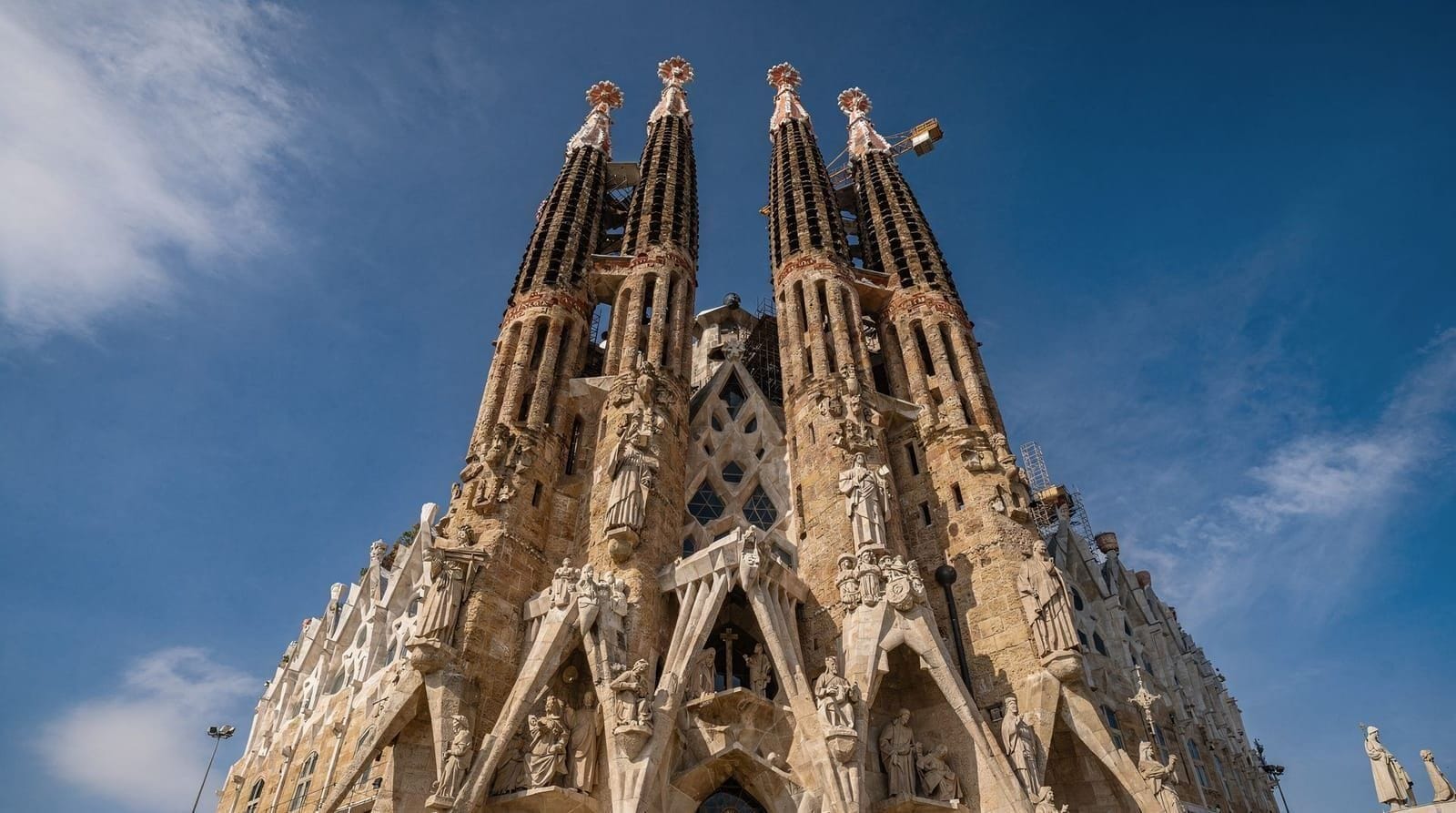
The towers: Gaudí’s design calls for 18 towers in total. The four currently complete towers on the Nativity façade represent four of the twelve Apostles (Barnabas, Simon, Jude, Matthew). The Passion façade towers similarly represent Apostles. The four towers of the Evangelists surround the central tower of Jesus Christ. Two towers of the Virgin Mary and Jesus Christ stand at the crossing. The central tower, when complete, will be 172.5 metres — deliberately one metre shorter than the Montjuïc hill, on the theological principle that human creation should not surpass God’s creation.
Trencadís on the tower tops: The colourful mosaic tile decoration on the tops of the completed towers is done in the trencadís technique — broken ceramic tiles applied to curved surfaces. The colours (Venetian glass imported from Murano for some elements) were chosen by Gaudí for visibility from a distance and for their symbolic associations: gold for glory, green for the episcopal colour of the Evangelists, and so on.
A brief history of Gaudí and the building
Antoni Gaudí i Cornet was born in 1852 in Riudoms, Catalonia, and studied architecture in Barcelona. His early work shows the influence of Moorish and Gothic revival styles, but he progressively developed his own language of organic forms derived from natural models — parabolic arches, helicoids, hyperboloids — that have no precise equivalent in the architectural tradition of his time.
He took over the Sagrada Família project in 1883 from Francisco de Paula del Villar and immediately redesigned the crypt he had inherited into something closer to his own emerging vision. By 1914 he had abandoned all other commissions to devote himself entirely to the basilica. He moved his workshop and eventually his living quarters into the crypt, living in the building he was constructing.
On the afternoon of 7 June 1926, Gaudí was struck by a tram on the Gran Via de les Corts Catalanes as he walked to his daily prayers at Sant Felip Neri. He was not initially recognised — his clothes were worn and his pockets contained only a rosary and some almonds — and was taken to a pauper’s hospital. He died on 10 June. Over 10,000 people lined the streets for his funeral procession. He was buried in the crypt chapel he had designed decades before.
At the time of his death, Gaudí knew the building would not be completed in his lifetime. He left extensive models, drawings, and written specifications. The 1936–1939 Civil War destroyed many of these, and much of the subsequent construction has relied on geometric reconstruction of surviving fragments combined with the ongoing research of architects and mathematicians who have worked to decode Gaudí’s geometric systems.
Reseller scams: the most expensive mistake in Barcelona
Multiple third-party websites present as legitimate ticket sellers for the Sagrada Família. Some are authorised resellers; many are not. The consistent pattern: the same timed-entry slot costs €5–15 more per ticket than the official site. For a family of four, that is €20–60 extra for absolutely nothing.
Worse, there are confirmed reports of counterfeit QR codes purchased outside the basilica from touts (who operate on the surrounding streets and sometimes approach you even on public transport nearby). A counterfeit ticket will scan as invalid at the gate; there is no recourse.
The correct purchasing points:
- Official site: sagradafamilia.org — this is the only source guaranteed to be face value
- Verified GYG tours: include real timed entry and add guide service on top
- Nothing else
Ignore any shop, kiosk, street seller, or website that offers “reduced” or “discounted” Sagrada Família tickets. They do not exist. See the full tourist-trap guide for the wider Barcelona scam context.
Dress code and photography
The Sagrada Família is an active place of worship as well as a monument, and the dress code reflects that, though it is applied loosely for a building this heavily visited. Shoulders and midriffs are the main things to keep covered — a light layer thrown over a tank top is usually enough if you are visiting straight from the beach or a hot walk across the Eixample. Shorts are generally fine at normal length; extremely short shorts occasionally draw comment from staff, though enforcement is inconsistent.
Photography is permitted throughout the interior and towers, including tripods for those with a serious interest, though flash is discouraged as a courtesy to other visitors and, during services, prohibited outright. The best interior light for photography without flash is around the 09:00–10:00 slot, when direct morning sun activates the Nativity-side stained glass most vividly; by early afternoon the light shifts toward the Passion side and the colour palette in your photos will shift with it.
Practical visit tips
Arrive 10–15 minutes before your slot with the QR code downloaded to your phone gallery (not just in an app that requires a data connection). Several visitors per day at peak times miss their slot because venue Wi-Fi is overloaded and their ticket app fails to load.
The Nativity façade is the place to spend time on the exterior. The Passion façade, facing the carpark on the modern side of the building, was completed in the 20th century and is intended to evoke suffering — it is deliberately stark and angular. The Nativity façade (east side) is the original Gaudí construction, laden with naturalistic detail and symbolic flora and fauna. Spend 15–20 minutes studying it before entering.
The Gaudí Crypt Museum is in the basement below the central nave and is included with all entry tickets. It contains models, photos, and documents from the ongoing construction, as well as Gaudí’s tomb in the chapel where he was buried after being struck by a tram in 1926. It is typically uncrowded even when the main nave is busy, and worth 20–30 minutes.
Leave time to walk the exterior fully. The west entrance (Passion façade, street level) is where most people enter; many do not walk around to see the Glory façade on the south side, which is still under active construction and interesting to see in progress, or back around to the Nativity façade for a final look at the detail.
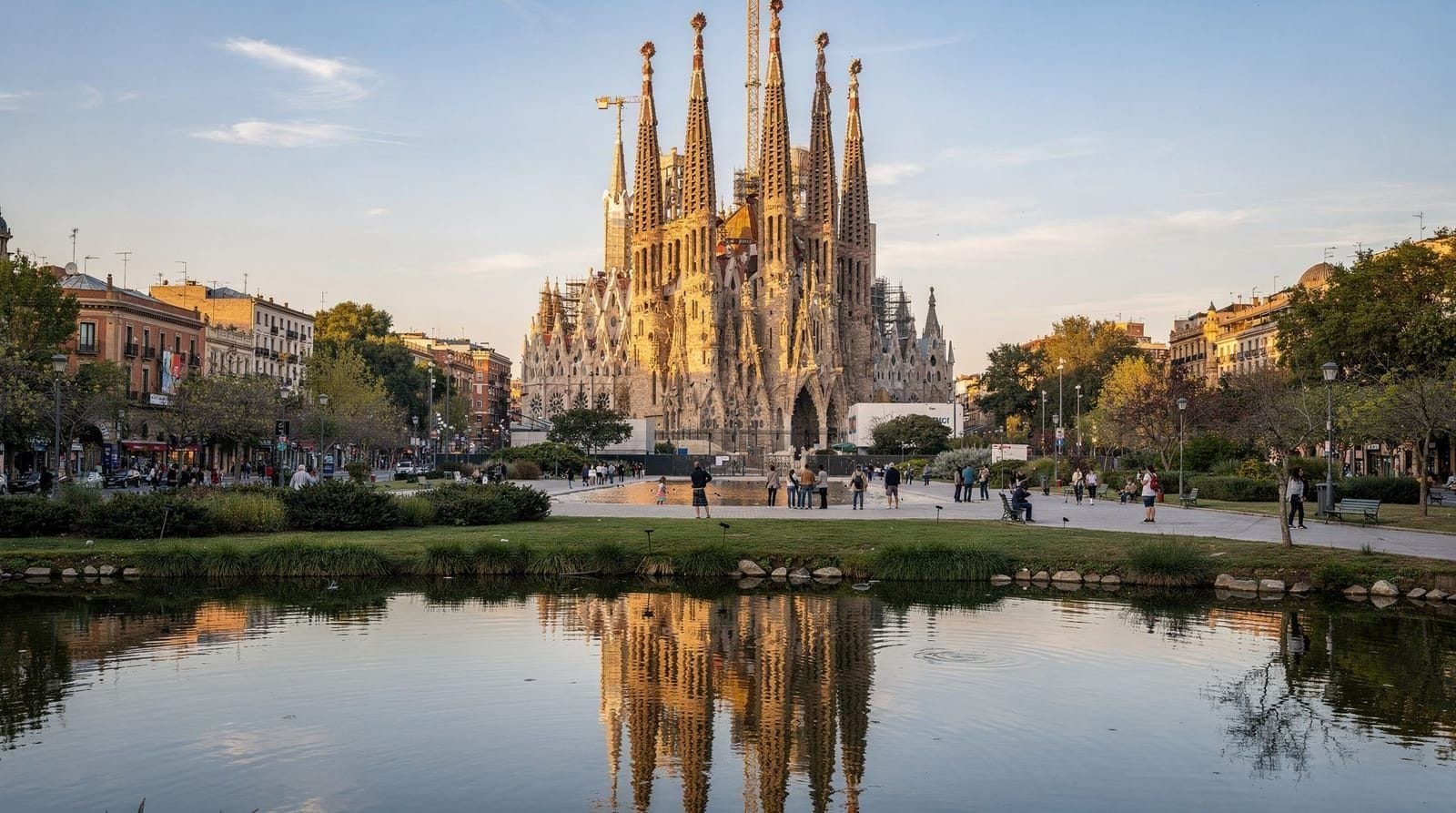
Consider the surrounding park. Plaça de Gaudí, the small park directly across from the Passion façade, has a reflecting pool that gives one of the best photo angles of the towers, and is a good spot to regroup before or after your slot without fighting the crowds directly at the entrance queue.
Combining with Park Güell
The two most-booked Gaudí sites in Barcelona pair naturally into a single day. The Sagrada Família slots between 09:00 and 12:00; Park Güell in the afternoon. From the basilica, bus 116 runs directly to Park Güell in about 15 minutes. Book your Park Güell Monumental Zone slot for 13:00 or 13:30 to allow comfortable transition time.
See the Park Güell free vs paid guide to understand what you are booking before you arrive — many visitors are surprised to find that the majority of the park requires no ticket at all. For the fuller Park Güell guide beyond the free-vs-paid question, or a complete Gaudí circuit across several days, the Gaudí trail guide sequences all the major sites with realistic timing, and the Barcelona itinerary tips guide covers how to fit a booked-ticket day like this one into a wider trip without over-scheduling.
The short version: book immediately when your dates are set, use the official site, choose a 09:00 or 09:30 slot, and add at least one tower if you are comfortable with tight staircases. The experience inside justifies the advance planning — it is a genuinely extraordinary building, and arriving with a pre-booked slot instead of queuing outside is the correct way to see it.
Frequently asked questions about Sagrada Família booking guide
What does a Sagrada Família ticket cost in 2026?
Basic adult entry starts at €26–28 (dynamic pricing — earlier booking is cheaper). Adding the Nativity tower or Passion tower brings the ticket to approximately €36–38. Both towers together reach €46. Guided tours with entry start around €40. The 2026 Gaudí centenary surcharge adds €2–5 to most ticket types.What is the difference between the Nativity tower and the Passion tower?
The Nativity tower faces east over the old city and residential Eixample. The light through the stained glass on this side is best in the morning. The Passion tower faces southwest toward the sea and the modern city skyline. Both require a lift up and a narrow spiral staircase down — several hundred steps on cramped stone stairs. Neither is suitable for anyone with serious claustrophobia or knee problems.Should I book a guided tour or go independently?
Independent entry with the included audio guide is excellent and sufficient for most visitors. The audio guide covers Gaudí's symbolism in detail. A guided tour adds value if you are an architecture enthusiast who wants expert interpretation of the structure's engineering and religious iconography — the symbolism is deep and a knowledgeable guide draws out layers that the audio guide doesn't reach.Can I buy tickets at the door on the day?
Rarely. The basilica sells a small number of same-day tickets, but in any month from March through October these are typically gone within minutes of opening. For summer visits, treat walk-up purchase as unavailable. For January or February, a same-morning walk to the ticket window is possible on quiet weekdays — but online booking is still safer and faster.Where should I buy Sagrada Família tickets?
The official site is sagradafamilia.org. GYG verified tours include the timed entry slot and audio guide. Never buy from third-party reseller sites that add €5–15 per ticket, and never accept tickets from touts near the basilica — counterfeit QR codes are in circulation.How long should I allow for a Sagrada Família visit?
Allow 1.5–2 hours for basic entry with the audio guide, including the Gaudí Crypt Museum below the basilica. Add 45–60 minutes for a single tower. With a guided tour, allow 2–2.5 hours. The exterior alone takes 20–30 minutes to walk around fully.Is there a centenary surcharge in 2026?
Yes. The 2026 centenary of Gaudí's death has prompted a surcharge of €2–5 applied to most ticket types. Additionally, 2026 has seen unusual booking pressure given Barcelona's status as UNESCO–UIA World Capital of Architecture — treat this year as a peak-demand year regardless of the month.What time slot should I choose?
The 09:00 slot is almost always the best choice. Morning light through the Nativity façade's stained glass is dramatically better than afternoon diffusion. Crowds at 09:00 are thinner than at 11:00 or later. By 10:30–11:00 the interior becomes significantly more congested. If 09:00 is unavailable, 09:30 is a solid second choice.Can I combine Sagrada Família with Park Güell on the same day?
Yes, and it is the most natural Gaudí day pairing in Barcelona. Book Sagrada Família for a 09:00–12:00 slot and Park Güell's Monumental Zone for around 13:00–13:30 — bus 116 connects the two in about 15 minutes. Combined GYG tickets with pre-coordinated timing are also available if you prefer not to manage two separate bookings.
Top experiences
Bookable activities with verified prices and instant confirmation on GetYourGuide.
Barcelona: Sagrada Família skip-the-line ticket with audio guide
- Free cancellation
- Instant confirmation
Barcelona: Sagrada Família fast-track guided tour with tower access
- Free cancellation
- Tower access
Barcelona: Sagrada Família guided tour and entry tickets
- Free cancellation
- Small group
Barcelona: Sagrada Família and Park Güell tickets combo
- Free cancellation
Barcelona: official Sagrada Família guided tour with tower access
- Official partner
- Tower access