Tibidabo: the amusement park, views and how to get there
Barcelona: Tibidabo amusement park admission ticket
Duration: Full day
- Free cancellation
Is Tibidabo worth visiting and how do you get there?
Tibidabo is worth the trip primarily for the panoramic views from 512 metres — the highest point accessible to tourists in the Barcelona metropolitan area. The amusement park (from €35) has retro rides and a Ferris wheel for children. Getting there requires 3 transport connections from central Barcelona: Metro to Avinguda Tibidabo, then the Tramvia Blau (blue tram) and the Funicular del Tibidabo. Allow half a day.
Barcelona is a city bounded by hills on three sides and sea on one. Tibidabo — the highest peak of the Serra de Collserola ridge at 512 metres — is the most dramatically positioned of those hills, and the combination of retro amusement park, neo-Gothic church and 360-degree panoramic view makes it one of the more distinctive half-day excursions available without leaving the city’s transport network.
Tibidabo at a glance
| Where | Serra de Collserola, 512m, north of the city centre |
| Cost | Free view from outside; church terrace ~€4; amusement park €35 |
| Time needed | Half a day, including transport |
| Getting there | FGC + Tramvia Blau + funicular, ~40–50 min from Plaça de Catalunya |
| Best time | Clear mornings; check tibidabo.cat before going — variable opening days |
The name and the view
“Tibidabo” is Latin for “I shall give thee” — the first words of Satan’s temptation of Christ on a high mountain, offering him all the kingdoms of the world visible below. The name was supposedly applied when the Jesuits bought the land in 1886, though the exact origin is disputed. The visual conceit is accurate regardless: standing on the Sagrat Cor terrace on a clear day, you see a panorama that includes the entire city grid, the sea, the Llobregat and Besòs river deltas, the mountains of Montserrat to the northwest and — in winter — the Pyrenean peaks to the north.
On very clear days, the coast from the Ebro delta to the north Catalan coast is visible, and the faint outline of the Balearic Islands appears about 250 km to the southeast.
The amusement park
The Parc d’Atraccions Tibidabo opened in 1901 and is one of the oldest continuously operating amusement parks in the world. This is its main character: what distinguishes Tibidabo from other theme parks is the sense of unbroken history in the design. The wooden Atalaia tower (1921) still operates as a slow-spinning observation turret. The carousel (1920) is the original mechanical model. The aircraft attraction — small planes suspended on wire, swinging outward with speed — dates from 1928.
These attractions are not thrilling in the modern sense. They are charming in the way that historic fairgrounds are charming, and they operate alongside newer attractions including a modern roller coaster (Muntanya Russa), a 4D cinema and a water ride. The Ferris wheel at the park’s highest point gives views that duplicate the church terrace at a lower height.
Tickets: The Gran Parc ticket (€35 adults, €15 children under 120 cm) covers all rides. The Cielo option (€15) covers only the upper area with the Ferris wheel, carousel and aircraft. Check tibidabo.cat for 2026 seasonal pricing and family bundles.
Hours: Tibidabo operates primarily on weekends outside school holidays. During summer (late June to early September), it opens daily. The park is often closed on winter weekdays. Always check the calendar on tibidabo.cat before planning.
The Sagrat Cor church
The Temple Expiatori del Sagrat Cor — the church whose tower is the summit landmark visible from across Barcelona — was built between 1902 and 1961 and sits on a rocky promontory just below the park. The exterior neo-Gothic style is 20th-century Catalan religious architecture without the Modernisme influence; the interior is more conventional than the Gaudí churches.
The two relevant elements for visitors are:
The church interior is free and open daily. The crypt chapel (lower level) is a calm space; the main nave above is grander.
The rooftop terrace and tower are accessible via lift from inside the church for approximately €4. The terrace gives a 360-degree view that rivals the park’s Ferris wheel and is not dependent on buying a park ticket. On very clear days, this is one of the best viewpoints in the province of Barcelona.
Getting there
The journey to Tibidabo from central Barcelona involves three separate transport connections.
Step 1: FGC train from Plaça de Catalunya to Avinguda del Tibidabo station (lines S1, S5 or S55). Journey time approximately 10 minutes. T-Casual (Zone 1) covers this.
Step 2: Tramvia Blau (Tram Blau) from Avinguda del Tibidabo to the funicular station at Plaça del Doctor Andreu. This is a historic blue tram that has operated since 1901 — the journey through the upper bourgeois residential streets of the city is part of the experience. Cost: €6.10 single, €10.40 return. The Tramvia Blau does not accept the T-Casual.
Step 3: Funicular del Tibidabo from Plaça del Doctor Andreu to the summit. Cost: €8.60 single, €13.10 return. Funicular return is included in the Gran Parc amusement park ticket. Bus 111 runs as an alternative to both the Tramvia Blau and the funicular in summer.
Total journey time: 40–50 minutes from Plaça de Catalunya.
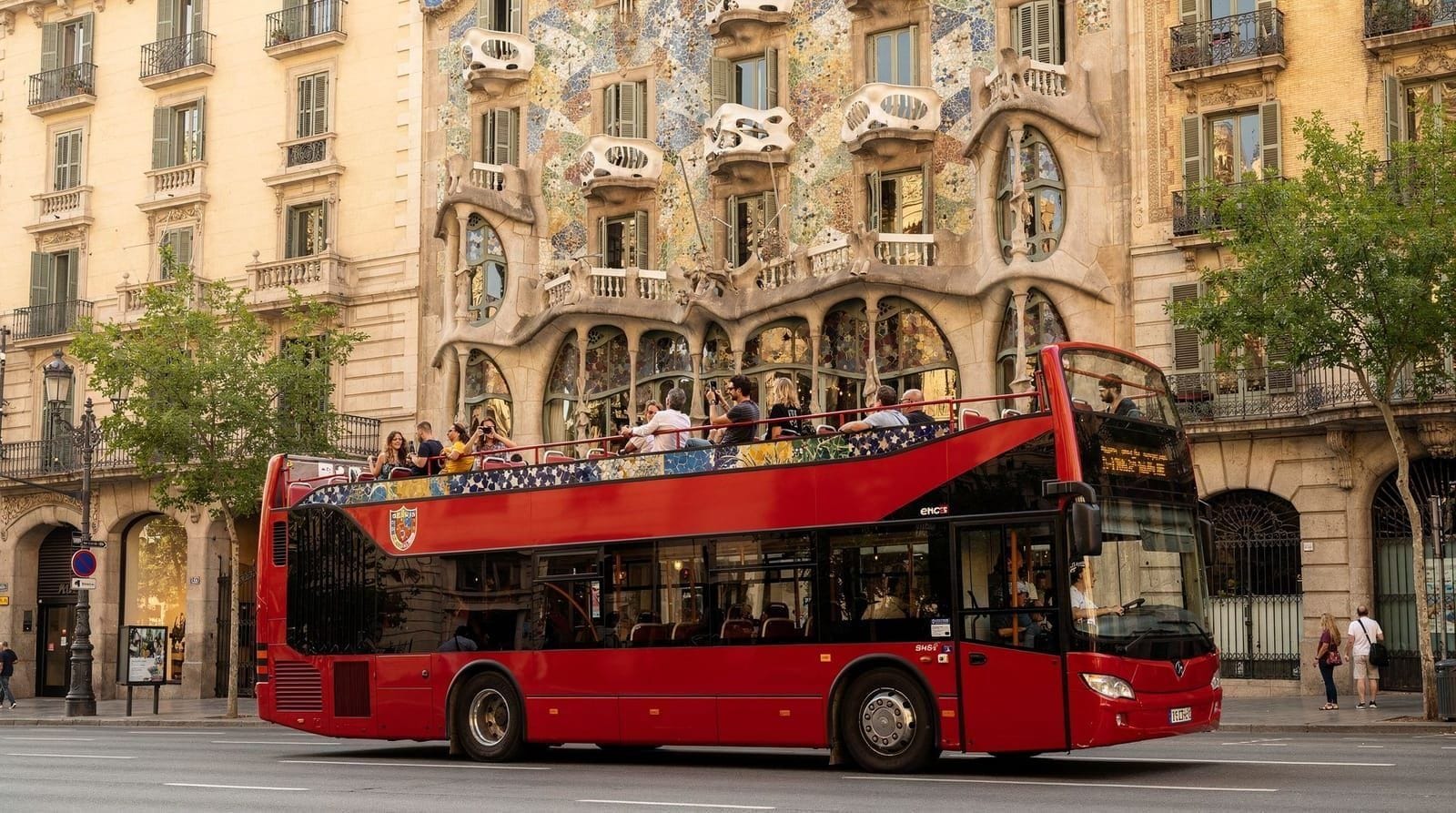
Bus Turístic: The summer hop-on hop-off route T2 reaches Tibidabo; useful if you already have a Bus Turístic ticket for another purpose.
Tibidabo vs the city’s other viewpoints
| Viewpoint | Height | Cost | Best for |
|---|---|---|---|
| Tibidabo (Sagrat Cor terrace) | 512m | Free view; ~€4 terrace | The single highest, widest panorama |
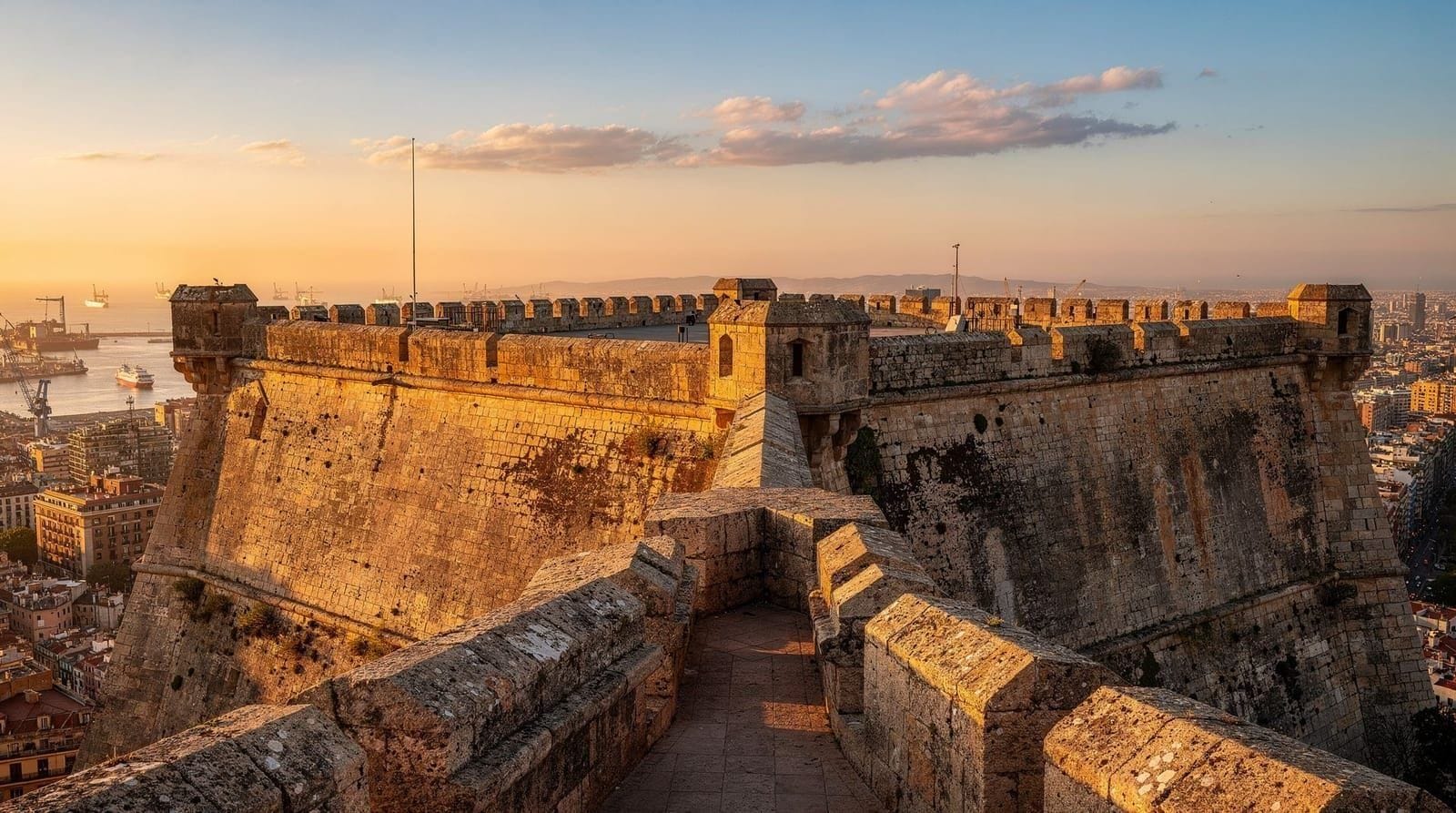
| Montjuïc Castle | 173m | Free grounds; small castle fee | Port and sea views, easy access |
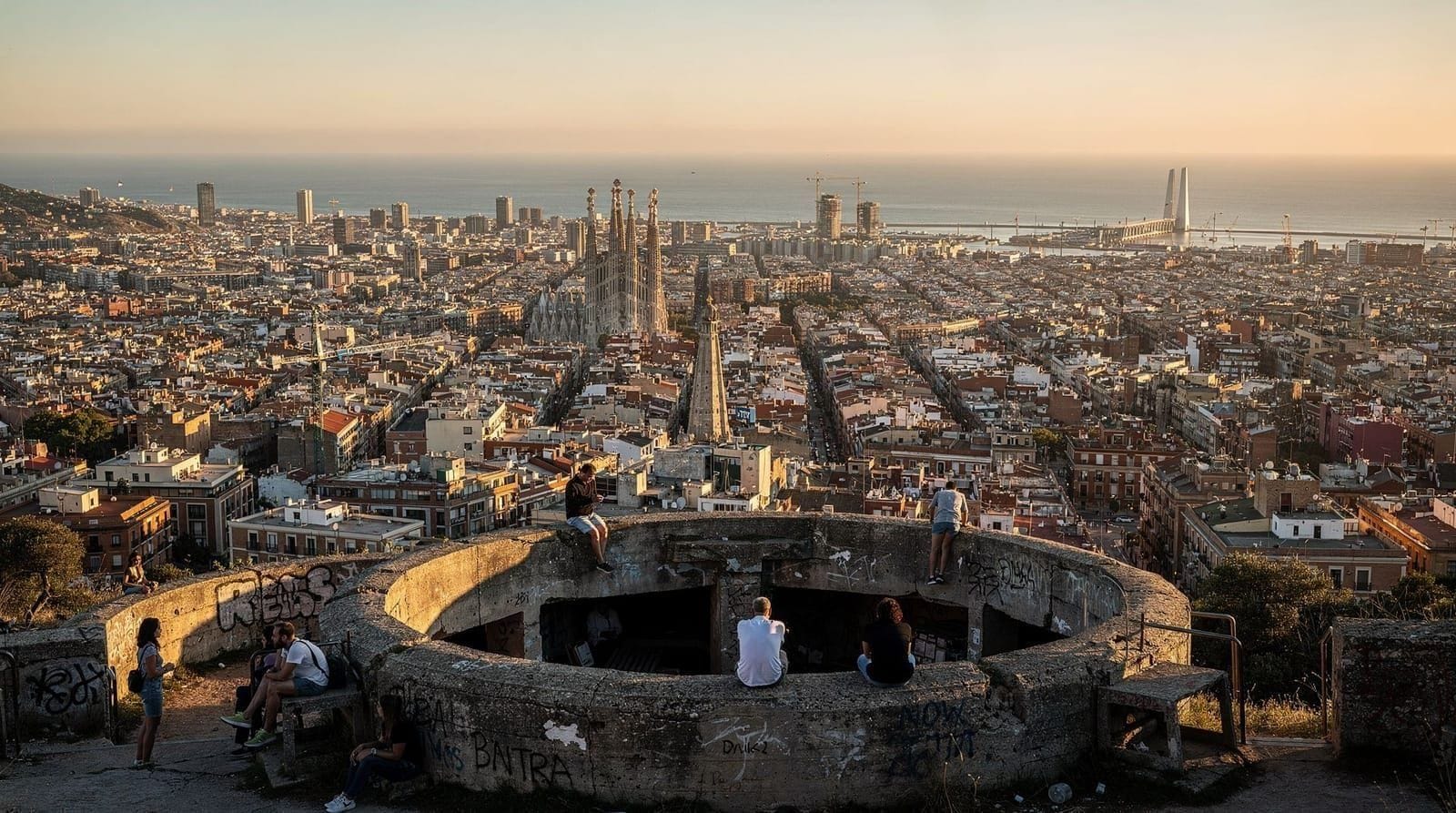
| Bunkers del Carmel | 262m | Free | Sunset views, no ticket needed at all |
Tibidabo wins on sheer altitude and 360-degree scope, but it also asks the most in time and transport connections. If you only have an hour to spare, the free Bunkers del Carmel viewpoint or Montjuïc Castle deliver a comparable sense of the city’s shape for a fraction of the effort.
What’s at the base (Plaça del Doctor Andreu)
The square at the bottom of the funicular has several good terrace café-bars with views over the city — notably La Venta, a long-established restaurant with excellent traditional Catalan cooking. This is a practical lunch stop before or after the summit, and the terrace views at this altitude (about 350 metres) are already excellent.
Honest notes for planning
Weather dependency: Tibidabo is spectacular on a clear day and a waste of a trip in fog. Barcelona’s coastal weather means fog on the Collserola can persist when the city below is bright. Check the weather before committing; the summit can be 5–8°C cooler than the city centre.
Opening day uncertainty: Tibidabo’s complex seasonal calendar is the biggest practical risk. It is almost never open on weekday mornings outside school holidays. The website calendar (tibidabo.cat) is definitive; check it the night before.
Combining with Bunkers del Carmel: The Bunkers del Carmel viewpoint is a reasonable afternoon counterpart — much lower at 262 metres but offering a different view angle over the city and requiring no ticket at all.
Combining with Collserola Park: The natural park of Serra de Collserola around Tibidabo has hiking trails accessible from the funicular lower station. A short trail (1–1.5 hours) through pine forest leads to the Torre de Collserola (Norman Foster’s telecommunications tower), visible from the summit.
Tibidabo with kids: what to expect
The retro rides are the main draw for families with younger children — the 1920s carousel, the Atalaia observation tower and the swinging aircraft ride are gentle enough for children who would find a modern coaster overwhelming. The Automata museum inside the park, a collection of historical fairground mechanical figures, is a good rainy-morning-adjacent activity if the weather turns while you’re up there (though genuine fog usually means postponing the trip entirely rather than sheltering indoors). Buggies are manageable on the paved park paths but less so on the cobbled square at the funicular base; carrying young children up the last stretch is common. The Gran Parc ticket’s child pricing (under 120cm) makes a family day here noticeably cheaper than an equivalent day at PortAventura, though the ride roster is far smaller.
Getting to know the getting there better
If the three-stage journey feels daunting on paper, in practice it is straightforward and, for many visitors, part of the appeal — the Tramvia Blau in particular is a small experience in its own right, trundling past turn-of-the-century mansions on Avinguda del Tibidabo. The getting around Barcelona guide covers how the FGC and tram network fit into the wider city transport picture if you are combining Tibidabo with other sights on the same T-Casual card. Note that the tram and funicular fares are separate from the metro fare, so budget for them individually rather than assuming a Barcelona travel card covers the full route.
Tibidabo works best as a half-day combined with a specific purpose: taking children to the amusement park, seeing the church terrace on a clear day, or riding the Tramvia Blau and funicular as an experience in themselves. The view from the summit on a clear morning is genuinely among the best in Spain. The logistics require planning — check the opening calendar, check the weather and allow 40 minutes each way from the city centre.
Frequently asked questions about Tibidabo
How do you get to Tibidabo?
From Plaça de Catalunya: FGC train S1 or S5 to Avinguda del Tibidabo station (10 minutes), then the Tramvia Blau historical tram (€6.10 single or €10.40 return) to the funicular station, then the Funicular del Tibidabo (€8.60 single, €13.10 return, or free with amusement park ticket) to the summit. Total journey approximately 40–50 minutes. Alternatively, the Bus Turístic runs to Tibidabo in summer (check route T2).How much does Tibidabo amusement park cost?
The standard park ticket (Gran Parc) is €35 for adults (height 120cm+) and €15 for children under 120 cm. The Cielo tour-only option (Ferris wheel, carousel, some rides) costs €15. Check tibidabo.cat for current 2026 pricing and seasonal discounts.What are the opening hours at Tibidabo?
Tibidabo is open primarily on weekends and public holidays, with daily opening during school summer holidays (late June to early September). Typical hours are 12:00–20:00 on weekends; summer daily opening from 11:00–22:00. Tibidabo is closed many winter weekdays — always check tibidabo.cat before planning.What is the Sagrat Cor church on Tibidabo?
The Temple Expiatori del Sagrat Cor is the neo-Gothic church at the summit, topped by a bronze statue of Christ with arms outstretched — the most visible structure from the city below. The church interior is open (free). For panoramic views, the outer terrace of the church base (accessible via lift inside for a small charge) gives 360-degree views of Barcelona and, on clear days, the entire coast from the Pyrenees to the Ebro delta.Is Tibidabo suitable for children?
Very much so. The retro rides (a wooden Atalaia tower from 1921, a carousel from 1920, aircraft on wires from 1928) are more charming than thrilling, making them ideal for younger children. The Automata museum inside the park displays historical fairground mechanical figures. The overall atmosphere is nostalgic and family-friendly.Is there a good view of Tibidabo from the city?
Yes. Tibidabo's silhouette — the church tower and the Ferris wheel above the forested hillside — is visible from almost everywhere in Barcelona on a clear day. Looking north from Passeig de Gràcia or the Barceloneta beach, the hill with its distinctive skyline closes the horizon.
Top experiences
Bookable activities with verified prices and instant confirmation on GetYourGuide.