Montserrat hiking trails: beyond the monastery
Every weekend, thousands of visitors travel to Montserrat from Barcelona. Most follow the same route: arrive by rack railway, queue to see La Moreneta (the Black Madonna) in the basilica, take the cable car up to the Sant Joan viewpoint for photos, eat something in the restaurant, and head back down. This is a perfectly reasonable way to spend a few hours at one of Catalonia’s most dramatic landscapes.
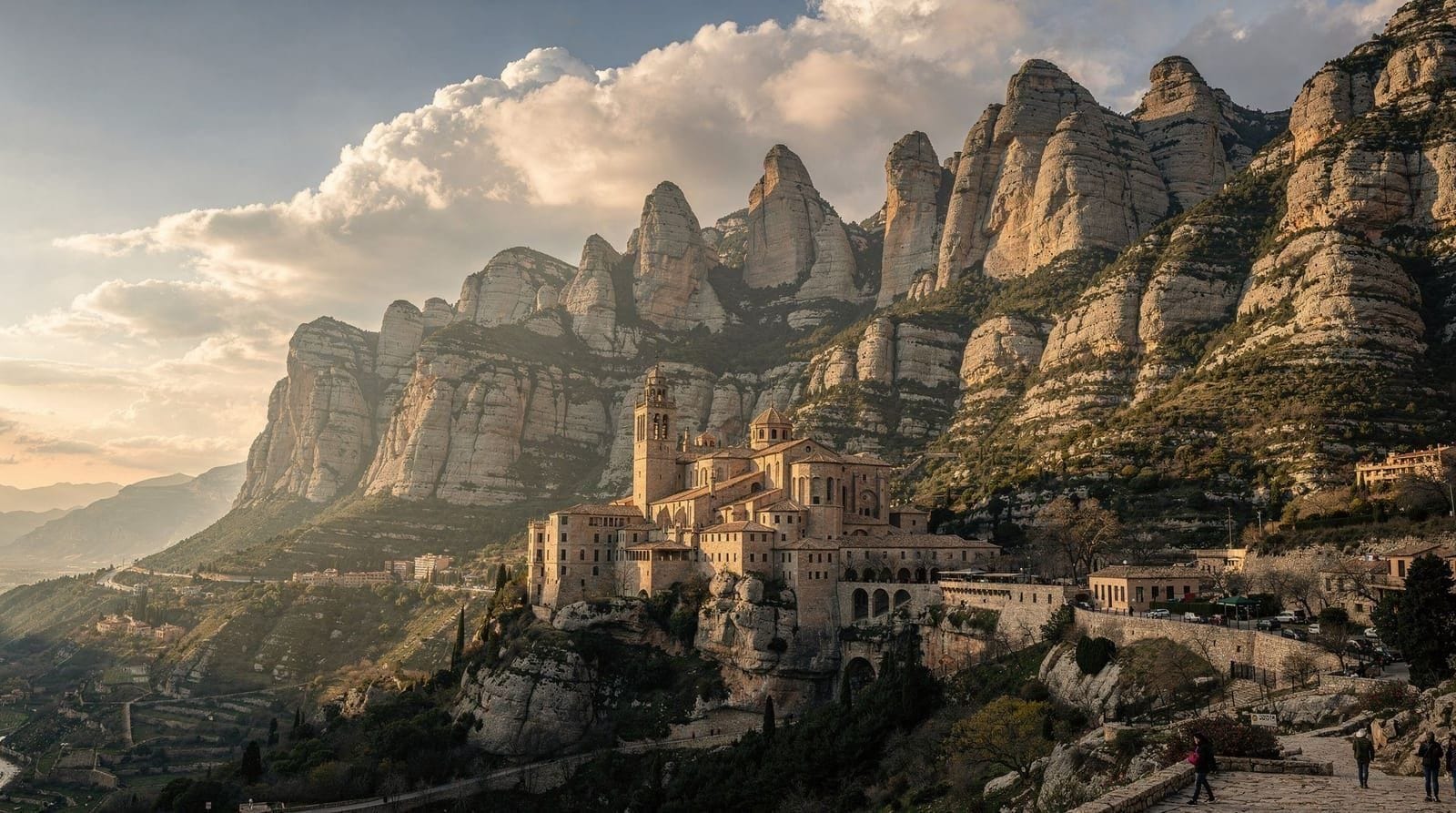
But if all you do is the monastery circuit, you’ve missed what makes Montserrat genuinely extraordinary. The mountain has around 20 kilometres of marked hiking trails, a handful of isolated hermitages crumbling beautifully into the rock, and a summit view — on a clear day — that takes in the Pyrenees to the north, the Balearic Islands to the east, and the plains of central Catalonia in every other direction. The monastery is interesting; the mountain is unforgettable.
| Where | Montserrat mountain, ~1hr from Barcelona (FGC + rack railway) |
| Cost | ~€30 combined train + rack railway return |
| Easiest hike | Sant Joan trail, 1.5–2hrs |
| Full hike | Sant Jeroni peak, 4–5hr circuit |
| Best season | Spring (Apr–May) or October |
Getting there: what the combined ticket covers
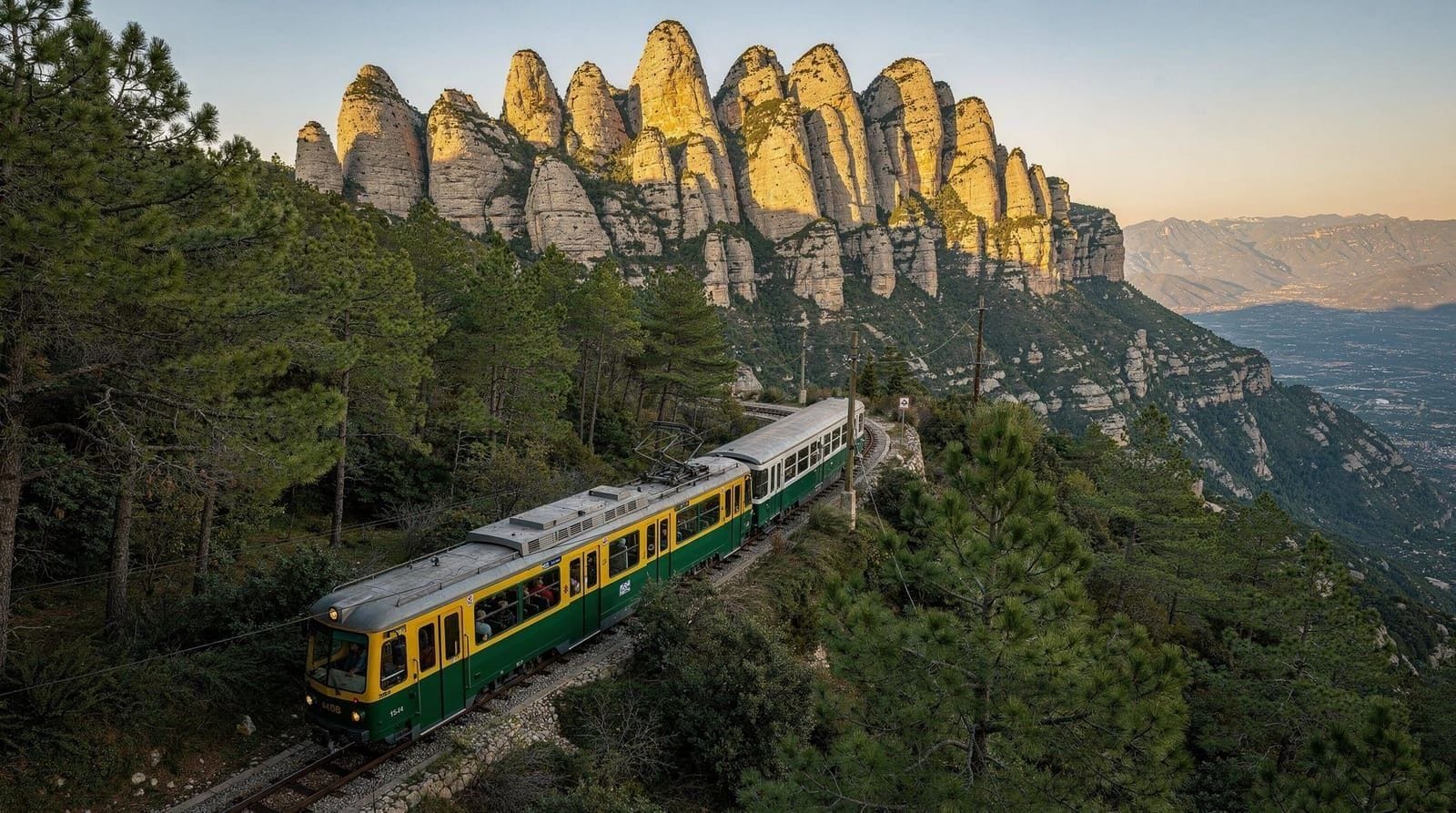
From Barcelona, take the FGC train from Plaça Espanya to Monistrol de Montserrat (the line goes to Manresa; get off at the correct stop, about 1 hour). From Monistrol, the rack railway — Cremallera de Montserrat — climbs to the monastery complex at around 720 metres. A combined ticket covering the FGC train return plus rack railway return costs approximately €30 per adult. The Aeri cable car from Montserrat Aeri station offers an alternative ascent with vertiginous views, at a similar price.
Once at the monastery level, two funiculars depart every 20 minutes: the Sant Joan funicular goes up (useful for the Sant Joan trail) and the Santa Cova funicular goes down to a cave-chapel with another image of La Moreneta. Both are included in various ticket combinations; check the current options at the ticket office. The complete Montserrat day trip guide has all the transport logistics in one place.
If you’d rather not manage trains and funiculars yourself, a guided day trip from Barcelona handles the whole route, often with more time on the trails than the self-guided version allows once queuing is factored in.
Sant Joan trail: the essential hike
The Sant Joan trail is the first hike to attempt, especially if you’re not an experienced mountain walker. Take the Sant Joan funicular from the monastery level — it deposits you at around 1,000 metres in a matter of minutes, saving a 45-minute uphill slog that’s genuinely unpleasant in summer heat.
From the upper funicular station, the trail to the Sant Joan chapel takes about 20 minutes on a clear path through pine trees and the jagged rock formations that give Montserrat its name (the word means “serrated mountain” in Catalan). The chapel is a tiny hermitage, probably 11th century in origin, sitting on a narrow ledge with views out across the lower plains. It’s open, simple, and very quiet — a sharp contrast to the crowds below.
From the chapel, a further 30 minutes on a marked path brings you to a series of viewpoints looking down over the monastery and across the whole Llobregat valley. The height difference between where you’re standing and the buildings below is vertiginous. Spring visits are particularly rewarding: the scrubby vegetation that covers the mountain is in flower, and the air hasn’t yet reached summer temperatures.
Allow 1.5 to 2 hours for the full Sant Joan circuit, not including funicular time. The path is well-marked and suitable for ordinary walking shoes, though proper hiking footwear is better.
Sant Jeroni peak: the full mountain experience
For those who want to earn Montserrat properly, the trail to Sant Jeroni — the highest point on the mountain at 1,236 metres — is a 2 to 3 hour hike from the top of the Sant Joan funicular. The full circuit, returning via a different trail to the monastery level, takes 4 to 5 hours and should not be attempted in summer heat without plenty of water.
The path rises through increasingly spectacular scenery: the weird vertical rock spires, natural arches and balanced boulders that make this mountain look almost designed. The geology is conglomerate — compressed pebble-beds from an ancient river delta, eroded over millions of years into shapes that medieval pilgrims thought could only be divine.
The final approach to Sant Jeroni crosses some exposed ridge walking that requires confidence on uneven ground. The summit itself has a small stone cross and a circular panorama that, on the clearest days of late autumn or early spring, genuinely does extend to the Pyrenees and Mallorca. More often, you’ll see the Catalan hinterland in every direction, the sea glinting to the south, and Barcelona somewhere in the industrial haze beyond. It’s enough.
Bring water — at least 1.5 litres per person for the full hike — and a light jacket even in summer, as the summit is exposed and temperatures drop fast if cloud moves in. Start before 11am to avoid the midday heat and to have the summit to yourself.
The hermitages: Montserrat’s hidden history
Before the current monastery complex was established, a collection of hermitages were scattered across the mountain — thirteen in total at the peak of the hermit tradition in the 17th century. Most are now roofless ruins, but several are marked on trail maps and reachable on foot.
Sant Benet, San Jeroni (near the summit), Sant Joan, Santa Cecília and Sant Dimes are among those worth seeking out. The Santa Cecília hermitage at the lower western end of the mountain is particularly evocative — a complete Romanesque church from the 10th century that still holds occasional services, sitting alone in a wide clearing accessible by car or on foot from the Monistrol road.
What makes the hermitages moving is less the architecture than the choice of location. Each one occupies a place of extreme natural drama: a ledge, a cave, a summit, a hidden valley. The hermits who built them were making a statement about encountering the wild edge of things, not just about prayer. Walking to them, you understand the choice.
Via Ferrata: for experienced climbers only
Montserrat has a marked via ferrata route — a fixed-iron-rung climbing path on the rock face — that attracts experienced sport climbers from across Catalonia. It is not suitable for casual walkers and requires proper climbing equipment: harness, helmet, via ferrata set with lanyard and shock absorber. Do not attempt it in hiking boots without equipment.
If climbing interests you, several outdoor activity companies in Barcelona run guided via ferrata sessions at Montserrat for beginners with all equipment provided. Check the best day trips from Barcelona guide for tour operators.
Timing your visit: spring and autumn are best
The honest advice on timing: avoid Montserrat in July and August unless you’re arriving early (before 9am) or late (after 4pm). The rack railway queues can reach 45 minutes in peak season, the monastery is packed, and the trails are uncomfortably hot by mid-morning.
Spring — particularly April and May — is the ideal hiking season. The mountain is covered in flowering herbs and scrub; temperatures on the trails are 15-20°C; the crowds are significant at monastery level but thin rapidly once you start walking. The Montserrat spring wildflowers are genuinely beautiful.
October is an excellent second option. The light is extraordinary (useful for photography from the viewpoints), the tourist season is winding down, and the temperature on the exposed upper trails is comfortable all day. The autumn in Barcelona guide covers the seasonal context for the whole region.
Winter visits are possible and sometimes magical — the mountain occasionally gets snow, and a dusting on the weird rock spires is spectacular — but check train and rack railway schedules, as some services run reduced hours in the coldest months.
What to bring
For the Sant Joan trail (2 hours): 1 litre of water per person, sunscreen, comfortable walking shoes. No special equipment needed.
For the Sant Jeroni hike (5 hours): 2 litres of water minimum, hiking footwear with ankle support, sun hat, light rain jacket (Montserrat generates its own weather rapidly), snacks. The monastery restaurant and café are available at the start and end, but there is nothing on the trails.
For any visit: download the Montserrat trail map from the official website before you arrive. Phone signal is patchy above 900 metres, and the trails are better navigated with a downloaded offline map than by relying on connectivity.
Combining hiking with the monastery visit
The standard approach is to do the monastery visit first — queue for La Moreneta, see the basilica, look around the museum (the Montserrat Museum has a small but good collection including works by El Greco, Caravaggio and Dalí) — and then head out on the trails in the afternoon. This works well for half-day hikers doing the Sant Joan circuit.
For those tackling Sant Jeroni, reverse it: start hiking early while temperatures are cool, reach the summit by midday, descend to the monastery level in the early afternoon when queues for the Black Madonna are at their worst, then join the shorter queues in the late afternoon.
Either way, the Montserrat day trip guide has the transport and timing logistics laid out. Plan at least 5-6 hours if you want to combine the monastery with any serious hiking — and consider buying the combined FGC and rack railway ticket in advance online during peak season.
Fitness level and who each trail suits
The Sant Joan trail suits nearly anyone with reasonable mobility and ordinary fitness — the funicular removes the steep initial climb, and the walk itself is on a clear, well-graded path. Families with older children manage it comfortably, as do most casual walkers with no hiking background. The Sant Jeroni circuit is a different proposition: it’s a genuine mountain hike with real elevation gain, some exposed ridge sections, and a multi-hour time commitment, so it suits people with at least some hiking experience and a realistic sense of their own pace. If you’re unsure which fits your group, the honest answer is: do the Sant Joan trail first, then decide whether the group has the appetite and the daylight left for more before pushing on toward Sant Jeroni.
Combining Montserrat with the Costa Brava or Girona
For visitors with more than a day to spend outside Barcelona, Montserrat pairs less naturally with the Costa Brava or Girona than you might expect — they’re in different directions from the city, and combining them into a single day means a lot of transit and very little actual time in either place. It’s better treated as its own dedicated day. If you want to see both, plan them as separate day trips, or as one Montserrat day followed by a Girona/Costa Brava day later in the trip. The best day trips from Barcelona guide lays out how these fit around each other across a longer stay.