Casa Vicens: Gaudí's first house and how to visit
Barcelona: Casa Vicens Gaudí skip-the-line entrance ticket
Duration: 1.5 hours
- Free cancellation
Is Casa Vicens worth visiting?
Yes, especially if you have already seen the main Gaudí sites. It is less crowded than Casa Batlló or La Pedrera, the ticket is cheaper (from €16), and it shows the beginning of everything Gaudí later developed. Built in 1885, it is the earliest surviving Gaudí building and a UNESCO World Heritage Site.
Most visitors to Barcelona’s Gaudí trail end at Park Güell or La Pedrera. Casa Vicens, in the neighbourhood of Gràcia, is where the trail should really begin — because this is where Antoni Gaudí’s distinctive visual language first appeared, in a building completed in 1885 when he was barely 33 years old.
Casa Vicens at a glance
| Tickets from | €16 (early access ~€40) |
| Hours | Daily 10:00–20:00 |
| Time needed | 45 minutes – 1 hour |
| Location | Carrer de les Carolines 20, Gràcia |
| Nearest metro | Fontana or Gràcia (L3) |
| Booking lead time | A few days ahead is usually enough |
Where Gaudí’s style began
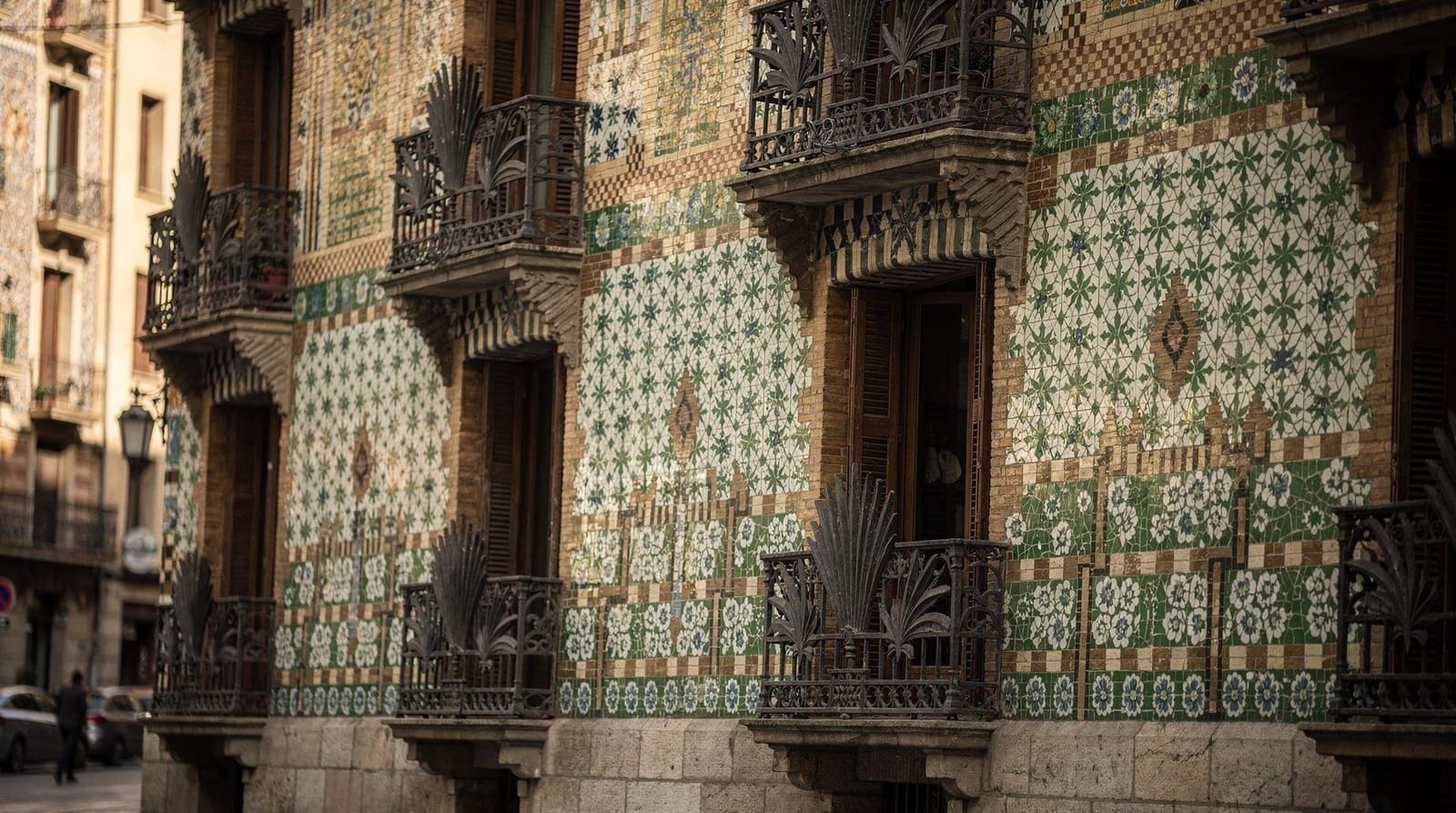
The stockbroker Manuel Vicens commissioned a summer house in what was then still a village separate from Barcelona. Gaudí — only two years out of the architecture school — designed a building unlike anything that existed in Catalonia. The facade is covered in geometric tilework combining green foliage patterns on white backgrounds with orange and white horizontal bands. The metalwork features palm fronds cast in iron. The roof lines are bracketed in elaborate Moorish-influenced timber. There is nothing in the European architecture of 1885 that looks like this.
The building was completed around 1885 and later extended in 1925 by Joan Baptista Serra de Martínez, who added a section respecting Gaudí’s original style. It was a private residence for its entire history until the current owners opened it to the public in 2017 after a major restoration. It was added to the UNESCO World Heritage list in the same year, completing the Barcelona set of Gaudí buildings already recognised.
What to see inside
The visit covers four floors of the original house plus the garden area. The interior restoration is recent and immaculate.
Ground floor: The dining room is the most celebrated interior space — a winter garden of sorts, its walls and ceiling painted with trompe-l’oeil vegetation, birds and Japanese-influenced hanging objects. Gaudí stacked nature imagery so densely that the room feels like an indoor aviary. The fireplace is a Moorish-influenced structure with the muqarnas (honeycomb vaulting) that reappears in his later work.
Upper floors: The bedrooms and reception rooms use more restrained decoration; the tile work shifts from the exterior’s geometric boldness to painted wall panels with peacock feathers, ivy and reed motifs. Some rooms have ceiling decoration in plasterwork that anticipates Gaudí’s later organic experiments.
Roof terrace: Smaller than La Pedrera’s but with views over the Gràcia rooftops. The ceramic detailing on the chimneys is simpler than the later Gaudí buildings but shows the same obsession with making functional elements sculptural.
Garden and exterior: From the street, the building is striking and very photogenic. The iron gate with its cast palm fronds is one of the most consistently overlooked Gaudí details in Barcelona.
How it fits into the Gaudí trail
Casa Vicens is most logically visited on the same day or half-day as Park Güell, since both are in the northern part of the city. Gràcia is the neighbourhood between them, and the walk from Casa Vicens to Park Güell takes about 20 minutes through quiet residential streets.
The Gaudí trail guide covers the optimal sequence for visiting all six major Gaudí sites across two to three days. Casa Vicens is listed as a half-morning excursion for those who have already covered the main trio (Sagrada Família, Park Güell, Casa Batlló).
Casa Vicens versus Casa Batlló and La Pedrera
For visitors deciding whether Casa Vicens is worth adding to an itinerary that already includes Gaudí’s better-known houses, the honest comparison is useful.
| Casa Vicens | Casa Batlló | La Pedrera | |
|---|---|---|---|
| Built | 1885 | 1904–1906 | 1906–1912 |
| Style | Early, Moorish-influenced | Mature biomorphic | Mature biomorphic, stone |
| Ticket from | around €16 | around €29 | comparable to Casa Batlló |
| Crowds | Low | High, especially weekends | High, especially weekends |
| Time needed | 45 min – 1 hour | 1–1.5 hours | 1–1.5 hours |
The price and crowd difference is the real story: Casa Vicens costs roughly half of Casa Batlló’s standard entry and rarely requires booking more than a few days ahead, even in August. For visitors on a tighter Gaudí budget, or those who prefer a quieter, more contemplative visit over a headline attraction, it’s a genuinely strong alternative rather than just a supplement.
For visitors who want the history explained in person rather than self-guided, a specialist covering Gaudí’s full body of work — from this early house through to the Sagrada Família — adds context that’s easy to miss reading panels alone.
The restoration and why it matters
The 2014–2017 restoration that preceded Casa Vicens’ public opening was extensive: conservators stripped later alterations back to Gaudí’s original decorative schemes wherever documentary evidence allowed, restored the painted ceilings in the dining room using historical photographs and paint analysis, and repaired the exterior tilework panel by panel. The project is one of the reasons the interior feels so vivid today — much of what visitors see is closer to Gaudí’s original 1885 intent than the house looked for most of the twentieth century, when later owners had altered several rooms. Understanding this adds useful context to what can otherwise read as simply “very well preserved.”
Practical notes
Getting there: Metro L3 to Fontana or Gràcia stations (both about 8–10 minutes’ walk). Bus 22 also passes nearby.
Tickets: Buy at casavicens.org. The building is significantly less booked than the major Gaudí sites — you can usually book a few days ahead, even in summer.
When to visit: The building is modest in size and can feel crowded in peak hours (11:00–14:00). Early morning or late afternoon is more comfortable.
Combined with Gràcia: Use the visit as a reason to spend half a day in Gràcia — the neighbourhood’s independent restaurants, squares and market (Mercat de l’Abaceria) are among the most authentically local in the city and easily accessible from Casa Vicens. See our Modernisme route guide for broader context on Gaudí’s place in Barcelona’s architectural history.
Casa Vicens is the Gaudí site for visitors who want to understand where everything began, and who find the crowds at Casa Batlló and La Pedrera too heavy. The building is intimate, the ticket is affordable and the context — the earliest surviving major work of one of the twentieth century’s most influential architects — makes it more than a footnote to the main trail.
Frequently asked questions about Casa Vicens
How much does Casa Vicens cost?
The standard skip-the-line ticket is €16 for adults. Early-access visits are approximately €40. Children under 12 enter free. Booking online is recommended; the building is relatively uncrowded compared to Gaudí's later houses.Where is Casa Vicens?
Casa Vicens is at Carrer de les Carolines 20, in the Gràcia neighbourhood — about 1 km north of Park Güell's main entrance and 15 minutes' walk from the Fontana or Gràcia metro stops on L3.How long does a visit take?
About 45 minutes to 1 hour for the standard visit. Allow 1.5 hours if you want to study the design details carefully or if you include the short film about the building's history.When is Casa Vicens open?
Open daily 10:00–20:00. Check casavicens.org for any closures or seasonal variation in 2026.What makes Casa Vicens different from Gaudí's later work?
Casa Vicens shows Gaudí before he fully developed his organic biomorphic style. The building uses Moorish and Oriental influences alongside geometric tile patterns — very different from the flowing curves of La Pedrera or the dragon imagery of Park Güell. You can see the roots of his later ideas in their earliest form.Is Casa Vicens suitable for a rainy day?
Yes — the visit is entirely indoors apart from the small garden and roof terrace, and the four interior floors of tilework and painted decoration are just as absorbing regardless of weather. It's a reasonable rainy-day alternative to outdoor sites like Park Güell.Can I visit Casa Vicens and Park Guell in one morning?
Yes, comfortably. The two sites are about a 20-minute walk apart through Gracia, and a typical sequence is Casa Vicens first (45 minutes to an hour, less crowded early), followed by the walk to Park Guell for the middle of the morning before its own crowds peak.
Top experiences
Bookable activities with verified prices and instant confirmation on GetYourGuide.