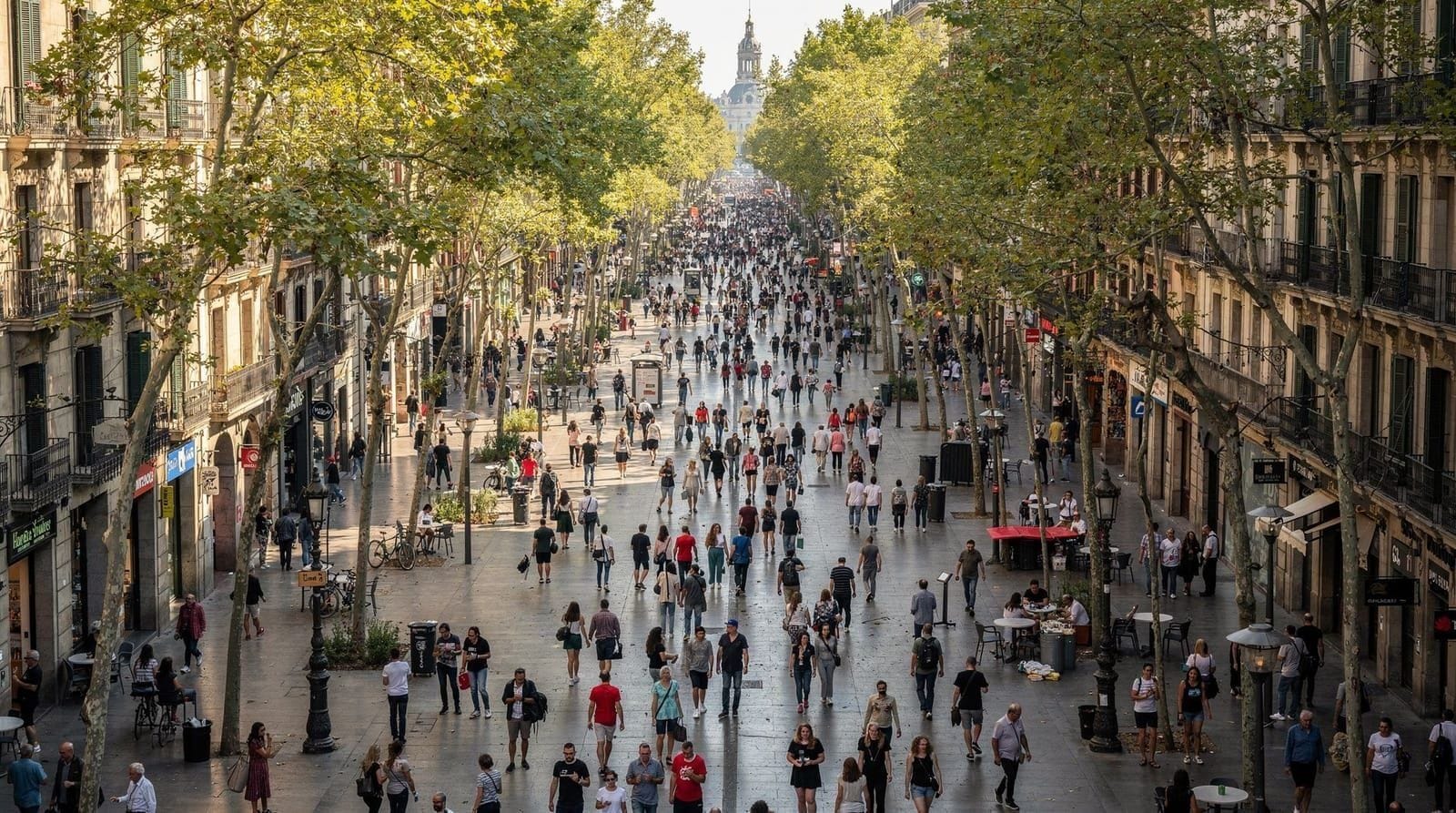
Las Ramblas: what to see, what to skip and how to stay safe
Barcelona: Ramblas, old town & Gaudí houses walking tour
Duration: 2.5 hours
- Free cancellation
Is La Rambla worth visiting and is it safe?
La Rambla is worth a single walk from Plaça de Catalunya to the Columbus Column — it takes 20–30 minutes and covers the most recognisable street in Barcelona. It is also the most pickpocketed street in Europe and the surrounding restaurants are almost universally overpriced. Walk it once, stay alert and eat one block away in any direction.
La Rambla occupies a peculiar position in Barcelona’s visitor experience: it is the street that everyone goes to, often the first thing first-time visitors walk, and simultaneously the street that locals avoid for anything beyond passing through. Understanding why both things are true makes for a better visit.
| Where | Plaça de Catalunya to the Columbus Column, old town |
| Time needed | 20–30 minutes for the walk, longer with stops |
| Cost | Free; Columbus Column lift around €7 |
| Getting there | Metro Catalunya, Liceu or Drassanes (L1/L3) |
| Best time | Early morning or evening, avoid 11:00–14:00 |
What La Rambla actually is
The 1.2-kilometre boulevard runs from Plaça de Catalunya — the central square connecting the old city to the Eixample — down to the Columbus Column at the port. It has been the main public promenade of Barcelona since the 18th century, when the dry riverbed (ramla) that ran here was built over and the boulevard laid out in its current form.
Until the 1990s, it functioned as a genuine mixed-use space: flower sellers, bird sellers (the birds are gone now), kiosk vendors, human statue performers, residents, workers and tourists in a rough balance. Since then, the tourist economy has taken over the central section almost completely, and what was once a genuinely lively urban space is now primarily a pedestrian corridor that visitors walk and criminals work.
The five historic sections are distinguished by different decorative treatments of the central pedestrian strip. Starting from Plaça de Catalunya:
Rambla de Canaletes: Named for the ornate 19th-century fountain (Font de Canaletes) at the top. Local legend says that anyone who drinks from this fountain will return to Barcelona. FC Barcelona supporters gather here after major victories. The fountain is real and functional; the legend is a tourist invention of the 20th century, but it has become genuinely true through repetition.
Rambla dels Estudis (or Rambla dels Ocells): The section formerly housing bird stalls; now flower sellers and standard boulevard space.
Rambla de Sant Josep: The section that passes La Boqueria market (west side) and the Gran Teatre del Liceu opera house (east side). The Miró pavement mosaic is embedded in the pedestrian strip here — a large geometric design in red, yellow and black by Joan Miró, installed in 1976. It is often walked over without notice.
Rambla dels Caputxins: Where the commercial density of flower stalls and souvenir kiosks peaks. The Palau de la Virreina (an 18th-century palace, now an arts centre) faces the boulevard here.
Rambla de Santa Mònica: The lower section approaching the port, historically the less reputable end — it was the edge of the sailor’s quarter and is still somewhat edgier in character. The Centre d’Art Santa Mònica (contemporary arts space, free) is here.
What genuinely merits attention
The Font de Canaletes: Worth a photograph and, if you are not in a crowd, a taste. The ornate cast-iron fountain base is Victorian in style; the water is potable.
The Miró mosaic: Stop and look at the pavement. The ceramic mosaic — a characteristic Miró composition of black, red, yellow and blue — is one of the more casually overlooked public artworks in the city simply because people walk over it without realising it is there. Look for the two red circular forms surrounded by the geometric border.
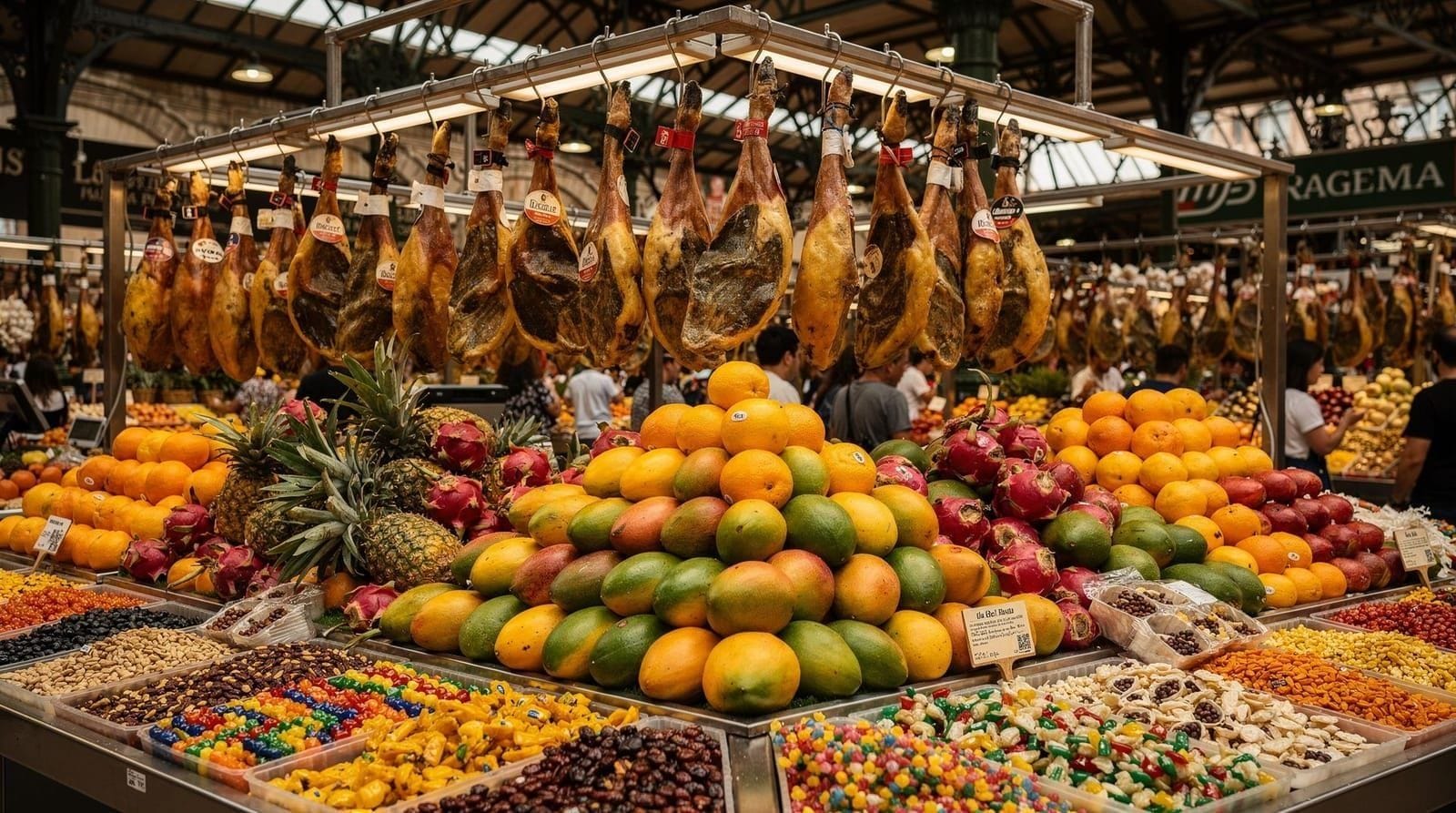
La Boqueria entrance: The market entrance from La Rambla is a visual spectacle — the display of produce, the interior light, the movement of people. See the honest assessment in the La Boqueria guide.
The Gran Teatre del Liceu: Barcelona’s main opera house, on the east side of the Rambla. It burned in 1994 and was rebuilt; the foyer and some public areas are open for short visits. Opera performances run September–June; the programme is at liceubarcelona.cat.
The Columbus Column: Worth standing at the base for the port view. The column itself (60 metres) has a lift to the viewing platform, costing approximately €7 — the view is adequate but not exceptional. The statue of Columbus points southeast; scholars have noted for decades that he is not pointing toward the Americas.
The tourist trap reality
Restaurants: La Rambla has no restaurant that a local Barcelonan would choose voluntarily. The standard model is a set menu (menú del día) advertised at what appears to be a reasonable price, served quickly and with minimal quality. Many restaurants display photographs of food outside — the closer the restaurant is to the Rambla, the more likely it is to be overpriced and mediocre. Go one block in either direction.
Touts: Human statues, flower sellers, people handing out flyers and anyone who makes unsolicited eye contact on La Rambla is part of the tourist economy. This is not invariably criminal — most are simply working — but the transition from “working” to “scamming” is gradual and common. The three-card trick operators near the lower end of the boulevard (apparent gaming, with observers making bets they win, drawing in tourists who then lose) are a specific variant.
Pickpockets: The professional pickpocket operations on La Rambla are not random criminals but organised groups. The standard method is the distraction technique: one person bumps into you (or asks for directions, or points at something) while an accomplice removes your phone or wallet from your bag or pocket. Keep everything in front pockets or a crossbody bag worn across the front.
Friendship bracelet: Someone wraps a coloured string bracelet around your wrist and ties it before you can stop them, then demands €5–20 payment. The correct response is to refuse before the bracelet is attached; once on, the social pressure to pay is significant.
The 2017 attack memorial
On August 17, 2017, a terrorist attack using a hired van killed 13 people and injured over 130 between La Boqueria and the Miró mosaic. A small memorial — a plaque and some flowers — exists at the location, roughly opposite the La Boqueria main entrance. It is not prominently signposted and is easy to miss without knowing where to look.
How to use La Rambla
The most practical approach:
- Walk from Plaça de Catalunya to the Columbus Column once, on the pavement (not the central strip where the crowd is thickest).
- Stop at the Font de Canaletes, the Miró mosaic and the La Boqueria entrance.
- Look at (not into) the Liceu opera house.
- Continue to the Columbus Column for the port view.
- Total time: 20–30 minutes.
For eating, the best nearby alternatives are: Carrer de Ferran or Carrer de la Boqueria (one block east, in the Gothic Quarter); Carrer de Blai in Poble-sec (10 minutes south of the lower Rambla by metro); or the El Born neighbourhood (15 minutes east on foot).
Getting around La Rambla
Metro: L3 to Liceu for the midpoint; L3 to Drassanes for the Columbus Column end; L1 or L3 to Plaça de Catalunya for the top.
Walking: La Rambla is a 15-minute end-to-end walk at a normal pace. The adjacent streets — the Gothic Quarter to the east, El Raval to the west — are each worth at least a short exploration.
See the getting around Barcelona guide for metro and transport card advice.
Combining La Rambla with a guided walk
If you would rather not navigate the history and the pickpocket geography solo, a guided walking tour that starts on La Rambla and continues into the Gothic Quarter covers the Font de Canaletes, the Miró mosaic and La Boqueria with a local guide explaining what you are looking at, then moves you off the boulevard into the old town’s Roman and medieval layers — the part of the visit that rewards having context.
For a shorter, more focused option that sticks closer to La Rambla and the Boqueria market itself:
La Rambla vs. the streets around it
| La Rambla | Gothic Quarter (east) | El Raval (west) | |
|---|---|---|---|
| Character | Tourist boulevard | Medieval lanes, Roman ruins | Multicultural, arty |
| Food quality | Poor, inflated prices | Good, normal prices | Good, cheapest in the old town |
| Crowd density | Very high | Moderate | Lower |
| Pickpocket risk | High | Moderate | Lower |
| Time worth spending | 20–30 minutes | Half a day or more | 1–2 hours |
This is the practical case for treating La Rambla as a corridor rather than a destination: everything either side of it — the Gothic Quarter’s Roman ruins and medieval lanes, or El Raval’s MACBA and multicultural food scene — rewards more time and carries less risk.
La Rambla is a necessary single walk on any Barcelona visit. It is also the street most likely to generate regret if you spend too much time on it — eating there, shopping there or lingering there after the single walk is done. Walk it efficiently, note the Miró mosaic and the Font de Canaletes, and move on to the far better streets one block in either direction.
Frequently asked questions about Las Ramblas
What is La Rambla?
La Rambla is a 1.2-kilometre pedestrian boulevard running from Plaça de Catalunya to the Columbus Column (Monument a Colom) at the port. It is divided into five sections that were once separate ramblas: Rambla de Canaletes, Rambla dels Estudis, Rambla de Sant Josep (La Boqueria section), Rambla dels Caputxins and Rambla de Santa Mònica. The name comes from the Arabic 'ramla' (sandy riverbed) — the street follows the course of a seasonal stream that was built over in the 18th century.What are the must-see things on La Rambla?
The Font de Canaletes (the fountain at the top where Barcelona FC fans gather to celebrate); the Miró pavement mosaic near La Boqueria (a large red and black tile design by Joan Miró embedded in the pavement, often missed by people walking over it); La Boqueria market entrance (the visual experience of the market is genuine even if the food is overpriced); and the Columbus Column view from the foot of the boulevard.How safe is La Rambla?
La Rambla is safe in the sense that violent crime is rare. It is extremely unsafe in the sense that it has the highest concentration of pickpockets in Europe. Standard risks: someone bumping into you while an accomplice takes your phone or wallet; the 'friendship bracelet' gambit (someone ties a bracelet on your wrist without asking, then demands payment); the three-card trick near the port end; restaurant touts who steer you into overpriced venues. Keep your phone in your pocket, bags in front and ignore all unsolicited approaches.Which restaurants on La Rambla are worth eating at?
None. The restaurants on La Rambla itself range from mediocre to extremely overpriced. Walk one block east (into the Gothic Quarter) or one block west (into El Raval) and quality improves dramatically and prices drop 30–50%. For specific restaurants, the streets around Carrer de la Boqueria (one block east of the market) have several genuinely local options.What happened on La Rambla in 2017?
On August 17, 2017, a terrorist attack using a vehicle killed 13 people and injured over 130 on La Rambla. A small memorial exists near the site between La Boqueria and the Miró mosaic. The boulevard was reopened within days; the memorial is modest and may be missed without knowing what to look for.What is the Columbus Column at the bottom of La Rambla?
The Monument a Colom is a 60-metre column topped by a statue of Christopher Columbus, pointing (controversially, given his actual route) southeast toward the Mediterranean. Built for the 1888 Exposition; a small lift inside gives views from the top. Worth knowing: Columbus had no connection to Catalonia and the monument is a Spanish nationalist gesture that Catalans view with varying degrees of ambivalence. The port view from the statue base is free and better than the lift view.
Top experiences
Bookable activities with verified prices and instant confirmation on GetYourGuide.