Barcelona Cathedral: visiting the Gothic Quarter's centrepiece
Barcelona: 2-hour Gothic Quarter walking tour
Duration: 2 hours
- Free cancellation
Is the Barcelona Cathedral free to visit?
Yes, partly. The cathedral is free for worship and free general entry most of the day, but visiting the choir (Cor), the crypt, the chapter museum and the rooftop requires a combined ticket of €7 (approximately 12:30–17:30 on weekdays). Outside these hours — mornings until 12:30 and evenings from 17:30 — all areas are generally accessible for free.
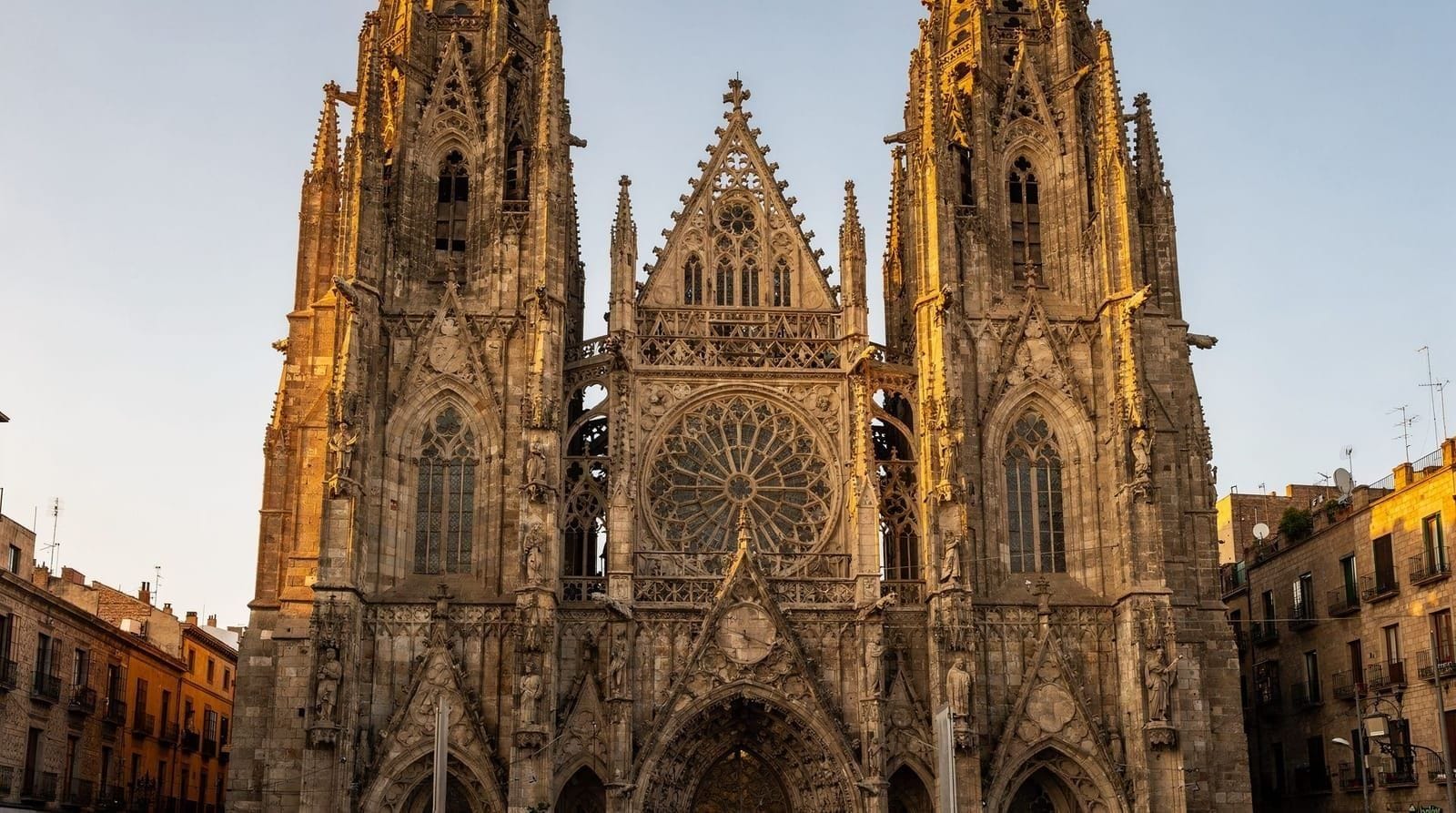
The Catedral de Santa Eulàlia sits at the highest point of the medieval city, on a Roman platform that has supported a place of worship since at least the 4th century. The current Gothic building was constructed between 1298 and the mid-15th century; the neo-Gothic facade was added in 1887–1890 using a design from 1408 that had never been built. The result is one of the finest Gothic cathedrals on the Iberian Peninsula — and because it functions as a living parish church rather than a museum, it carries a quality that many larger or more famous cathedrals lack.
| Where | Plaça de la Seu, Gothic Quarter |
| Cost | Free most of the day; €7 combined ticket for choir, crypt, museum and rooftop |
| Time needed | 30–45 min for nave and cloister; around 1 hour for the full visit |
| Getting there | Metro Jaume I (L4), 5 minutes’ walk |
| Best time | Sunday morning for the free access window and the sardana at 11:30 |
What to see inside
The nave: Three aisles of equal height, characteristic of Catalan Gothic, create a wide, luminous interior. Catalan Gothic rejected the vertical aspiration of French Gothic in favour of broad, stable structure — the effect is spacious rather than soaring, and the side chapels that line the perimeter walls are the main decorative focus.
There are 29 side chapels, each dedicated to a different saint and maintained by craft guilds and confraternities that have used them since the medieval period. The chapel of Sant Oleguer (patron of Barcelona’s taxi drivers) still has guild donations; the chapel of the Corpus Christi has an extraordinary silver processional monstrance.
The choir (Cor): The carved Gothic choir stalls in the centre of the nave are exceptional. The uppermost stalls were carved by Bartolomé Ordóñez in the 16th century and contain the coats of arms of the Knights of the Golden Fleece from the 1519 Chapter meeting held in the cathedral under Emperor Charles V. A small fee is charged to enter the choir separately.
The crypt: Below the main altar, the crypt contains the alabaster sarcophagus of Santa Eulàlia, co-patron of Barcelona alongside the Virgin of Mercy. Eulàlia was a 13-year-old Christian girl martyred in Barcelona in 304 AD, according to tradition subjected to 13 tortures — one for each year of her age. The sarcophagus is a 14th-century masterpiece of Gothic carving.
The cloister: The 15th-century cloister is one of the most pleasant spaces in the Gothic Quarter. Four galleries surround a garden of orange trees, magnolias and tall palms; a fountain at the centre contains the famous geese. The cloister museum (chapter house) displays medieval religious objects and a Pietà by Bartolomé Bermejo.
The 13 geese: A continuous tradition since the medieval period maintains 13 white geese in the cloister, one for each year of Santa Eulàlia’s life. They are housed in a pen at the cloister garden’s edge, fed daily and occasionally paraded. They serve no liturgical function but are maintained as living symbols of the city’s history. Genuinely one of the more memorable details of any Gothic Quarter visit.
The rooftop: The lift from inside the cathedral provides access to the rooftop terrace and the base of the bell towers. The view over the Gothic Quarter rooftops, with their irregular medieval silhouettes, is different in character from the panoramic city views available from Montjuïc or Tibidabo — more intimate, more architectural.
Free visit vs paid areas
Free: The main nave and side chapels are accessible for free during worship hours. The cloister and geese are free during visiting hours.
€7 combined ticket: During the tourist visiting hours (approximately 12:30–17:30 Monday to Saturday), a combined ticket covers the choir interior, the crypt, the chapter museum and the rooftop lift. Outside these hours — early morning until 12:30, Saturday evening from 17:30, Sunday mornings until 12:30 — all areas are typically accessible for free as a place of worship. Sunday is a good day to visit: Mass is at regular intervals, the sardana is danced outside at 11:30 and the free access periods are longer.
Hours: Monday–Saturday 09:30–18:30 (last entry 18:00). Sundays and holidays 14:00–17:00 for tourist visits (morning is reserved for Mass). Cloister open 09:00–18:00 daily.
The sardana outside
The Plaça de la Seu in front of the cathedral is the traditional location for the sardana — the Catalan circle dance that is one of the most visible expressions of Catalan cultural identity. It is danced on Sunday mornings (approximately 11:30–13:30) when a group of dancers forms a circle, join hands and perform the choreographed steps to the accompaniment of a cobla (a Catalan wind-and-percussion ensemble).
The sardana is neither tourist theatre nor religious ceremony — it is a social tradition, and anyone can join the circle. Locals do; some visitors do. It is free, requires no advance notice and is one of the most genuinely Catalan experiences available in the city without needing tickets or planning.
See also the best time to visit guide for seasonal events that use the cathedral square (La Mercè processions, Sant Jordi celebrations).
Getting to the cathedral
Metro: Jaume I (L4 yellow line) is the closest stop, approximately 5 minutes’ walk through the Gothic Quarter. Alternatively, Urquinaona (L1/L4) or Liceu (L3) and a 10-minute walk.
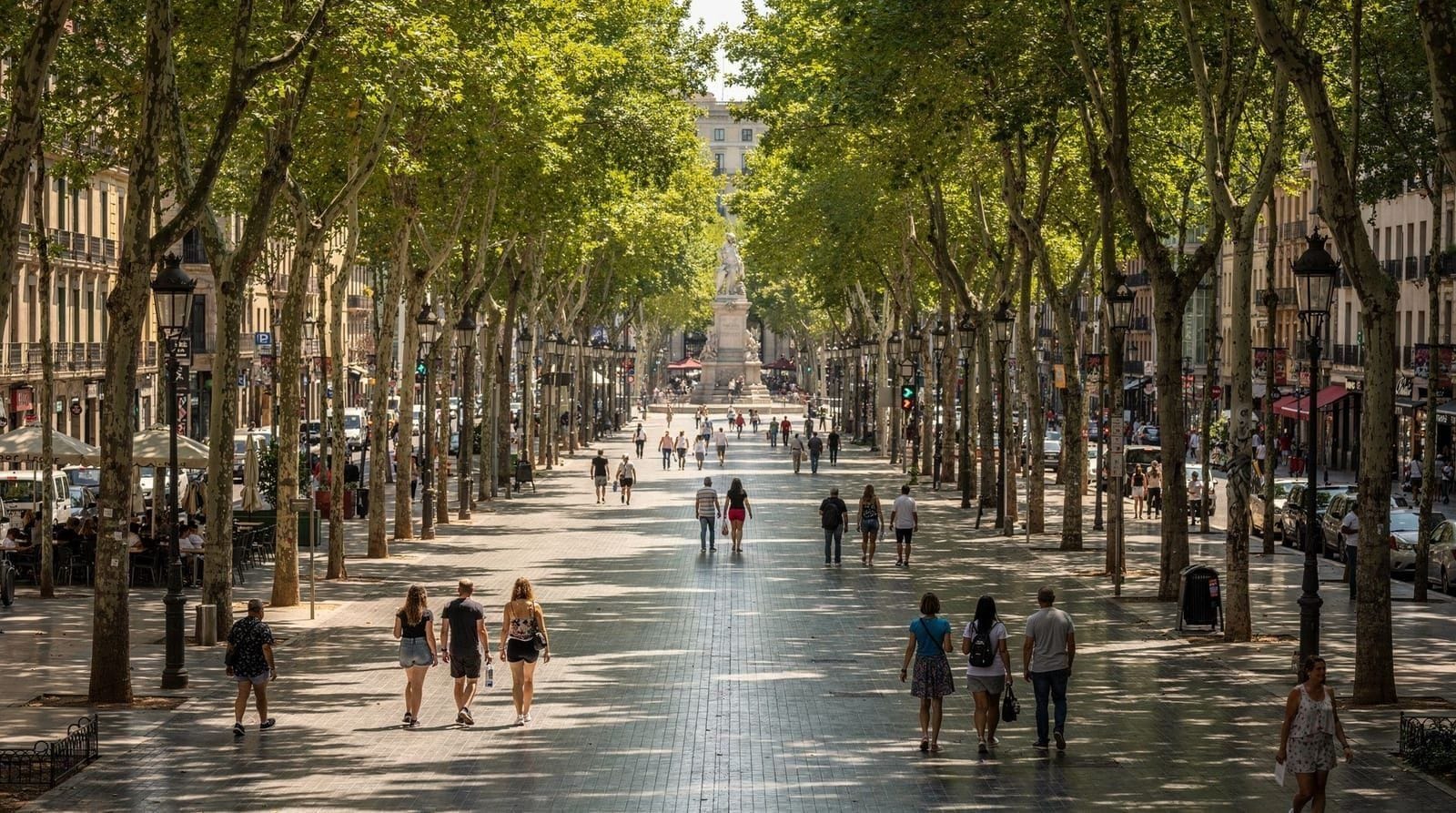
Walking from La Rambla: From Liceu metro, walk east through Carrer de la Boqueria or Carrer Ferran — both lead through the Gothic Quarter to the cathedral square in about 10 minutes.
Walking from El Born: From the Picasso Museum, the cathedral is about 10 minutes west through the medieval streets.
A cathedral built in stages
The current Gothic structure was not built in one continuous campaign. Construction began in 1298 under Jaume II, following the demolition of an earlier Romanesque cathedral on the same site (fragments of which are still visible in the cloister walls). The main body of the church — nave, aisles, chapels and the choir — was substantially complete by the mid-15th century, a construction period of roughly 150 years that was typical for a major Gothic cathedral of this scale.
What was not built for another four and a half centuries was the west facade. The medieval builders left the front of the cathedral largely unfinished, with a plain temporary wall. The elaborate neo-Gothic facade visitors see today — spires, sculpted saints, a rose window — was added between 1887 and 1890, funded by the industrialist Manuel Girona i Agrafel and based on a design drawn up in 1408 by the French architect Charles Galtier that had simply never been executed. This means the “medieval” facade photographed by every visitor is, technically, 19th-century work built to a 600-year-old plan — a detail almost no one notices and few guides mention.
Photography, etiquette and quiet hours
Photography is generally permitted inside the cathedral, though flash and tripods are discouraged out of respect for worshippers and to protect the interior stonework and stained glass. Because the building remains an active parish church, visits are paused during Mass — check the schedule at the entrance if you are visiting on a tight window. Modest dress (shoulders and knees covered) is expected, in line with most functioning churches in Spain.
The quietest time to photograph the nave without crowds is right at opening, 09:30 on weekdays, before tour groups arrive. The cloister, with its palm trees, orange trees and the 13 geese, is consistently one of the most photogenic and least crowded corners of the entire Gothic Quarter — worth a slow ten minutes even if you are not otherwise interested in ecclesiastical architecture.
The Roman foundations
The cathedral stands on the foundations of the Roman city of Barcino, founded around 10 BC. In the basement of the Cathedral Museum (accessed separately via Plaça del Rei, 200 metres away), the underground Roman city is partially accessible and includes remnants of the original late-antique basilica and baptistery that preceded the current cathedral. The Barcelona City History Museum (MUHBA) ticket covers these Roman remains. Our Barcelona history guide traces the full arc from Roman Barcino through the medieval city to today, with the exact streets where each layer is still visible.
Combining with the Gothic Quarter
The cathedral is the natural anchor of any Gothic Quarter walk. The Plaça de Sant Jaume (city and regional government square), Plaça del Rei (medieval palace complex) and the Roman temple of August (column ruins inside a medieval courtyard) are all within 5 minutes’ walk. The Las Ramblas guide covers the western approach through the neighbourhood.
The Barcelona Cathedral rewards a visit that combines the free cloister and nave with the combined ticket for the choir and rooftop. Timing the visit to coincide with the Sunday morning sardana adds a layer of authentic Catalan culture that no paid tour can replicate. Allow one hour for the interior and cloister, and add 20 minutes on the rooftop if the weather is clear.
If you are planning a full Gothic Quarter day, our Barcelona itinerary tips guide covers how to sequence the cathedral alongside nearby sights, and avoiding pickpockets has specific guidance for the narrow, crowded lanes around Plaça de la Seu.
Frequently asked questions about Barcelona Cathedral
What is the difference between the Barcelona Cathedral and the Sagrada Família?
The Barcelona Cathedral (Catedral de Santa Eulàlia) is the Gothic cathedral of the Diocese of Barcelona, completed in the 15th century after a 150-year construction period. It is a functioning religious building used for daily Mass and services. Sagrada Família is an expiatory basilica (privately funded, not a diocesan building) designed by Gaudí and still under construction. They are architecturally and administratively separate.How long does a visit to the Barcelona Cathedral take?
A thorough visit to the cathedral, cloister, crypt and rooftop takes about 1 hour. If you only want to see the interior nave and the cloister geese, 30–45 minutes is enough.What are the famous geese at the Barcelona Cathedral?
The cloister of the cathedral contains 13 white geese, kept as a living symbol of Sant Jordi (the city's patron) and, more specifically, of Santa Eulàlia — the co-patron of Barcelona, martyred at age 13, whose bones are in the crypt. The geese are a medieval tradition maintained continuously. They are fed in the cloister garden daily and are one of the more unexpected delights of the visit.Can you go on the Barcelona Cathedral rooftop?
Yes. A lift from the cathedral interior accesses the rooftop, which gives views over the Gothic Quarter rooftops and toward the sea. The rooftop is included in the €7 combined ticket. The view is more intimate than the panoramic views from Montjuïc or Tibidabo but is excellent for the detail of the medieval city.When is the sardana danced outside the cathedral?
The sardana — the traditional Catalan circle dance — is danced in the square (Plaça de la Seu) in front of the cathedral on Sunday mornings from about 11:30 to 13:30, and occasionally on Sunday evenings. This is a free, local tradition and one of the most authentic Catalan cultural experiences available without tickets or planning.Where is the Barcelona Cathedral?
The cathedral is at Plaça de la Seu, in the heart of the Gothic Quarter. The nearest metro is Jaume I (L4 yellow line), about 5 minutes' walk. From La Rambla, the cathedral is a 10-minute walk east through the Gothic Quarter streets.
Top experiences
Bookable activities with verified prices and instant confirmation on GetYourGuide.