Paella and sangria traps in Barcelona: what to eat and drink instead
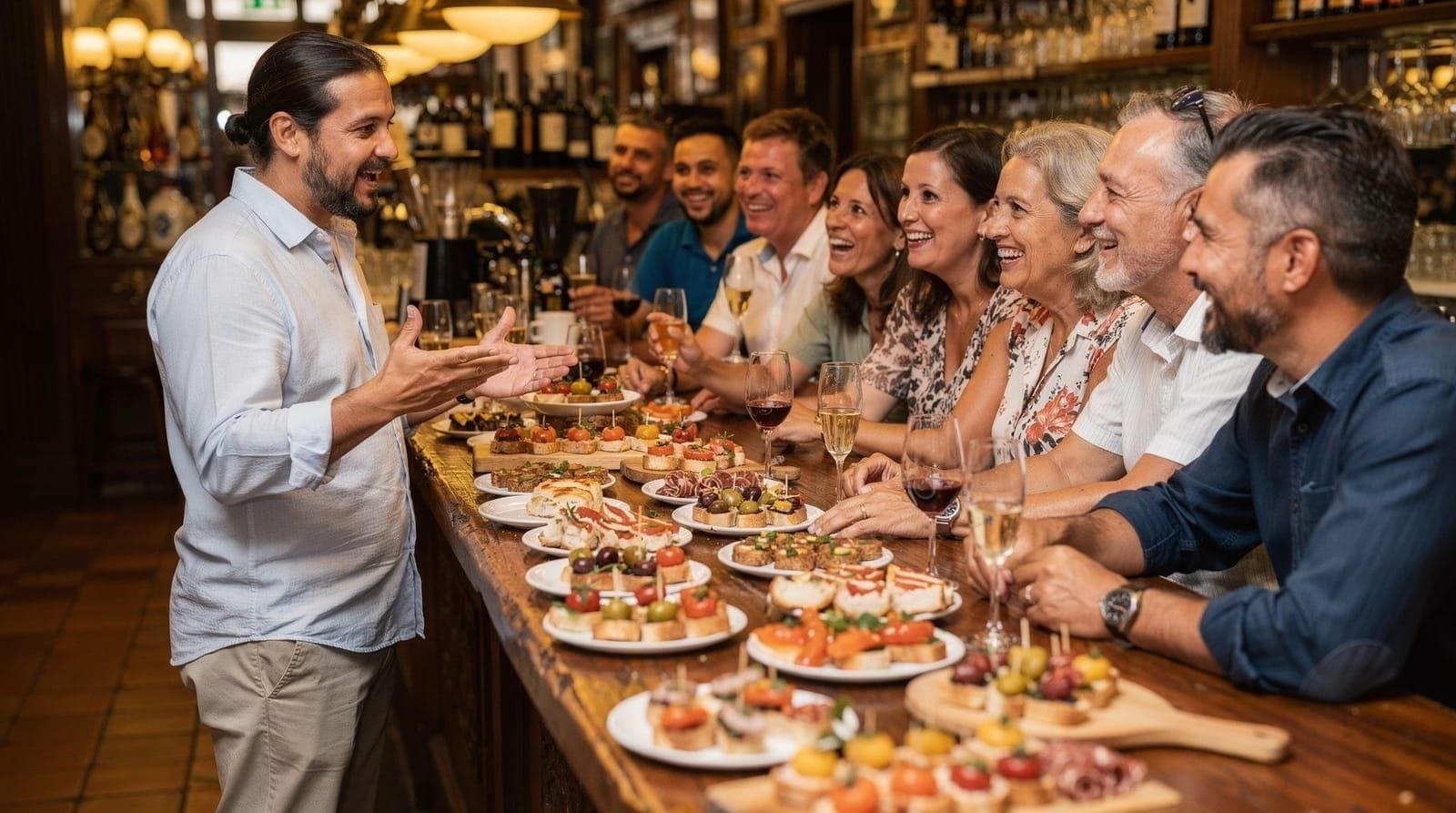
Barcelona: tapas walking tour with food, wine and vermouth
Duration: 3 hours
- Free cancellation
Is paella good in Barcelona and should I order sangria?
Beachfront paella at tourist restaurants is typically frozen and overpriced — avoid it. Real paella exists in Barcelona but requires going to the right restaurants. Sangria is not a Catalan drink — order cava, vermut, or Estrella Damm instead.
| Where to avoid | Barceloneta beachfront terraces |
| What to order instead | Cava, vermut, fideuà, Estrella Damm |
| Real paella cost | Around €18–25 per person, minimum 2 |
| Wait time for real paella | 30–45 minutes, always |
| Best areas for the real thing | El Born, Gràcia, Poble-sec, Eixample interior |
Two of the most persistent food and drink misconceptions in Barcelona share the same root cause: restaurants serving tourists what tourists expect to find in “Spain,” rather than what Catalans actually eat and drink. Both the paella situation and the sangria situation are worth understanding before you order. For the wider pattern of tourist-facing traps across the city, see our tourist traps guide, and for the specific case of La Rambla’s restaurants, the same beachfront logic applies to the boulevard’s terraces.
The paella problem, fully explained
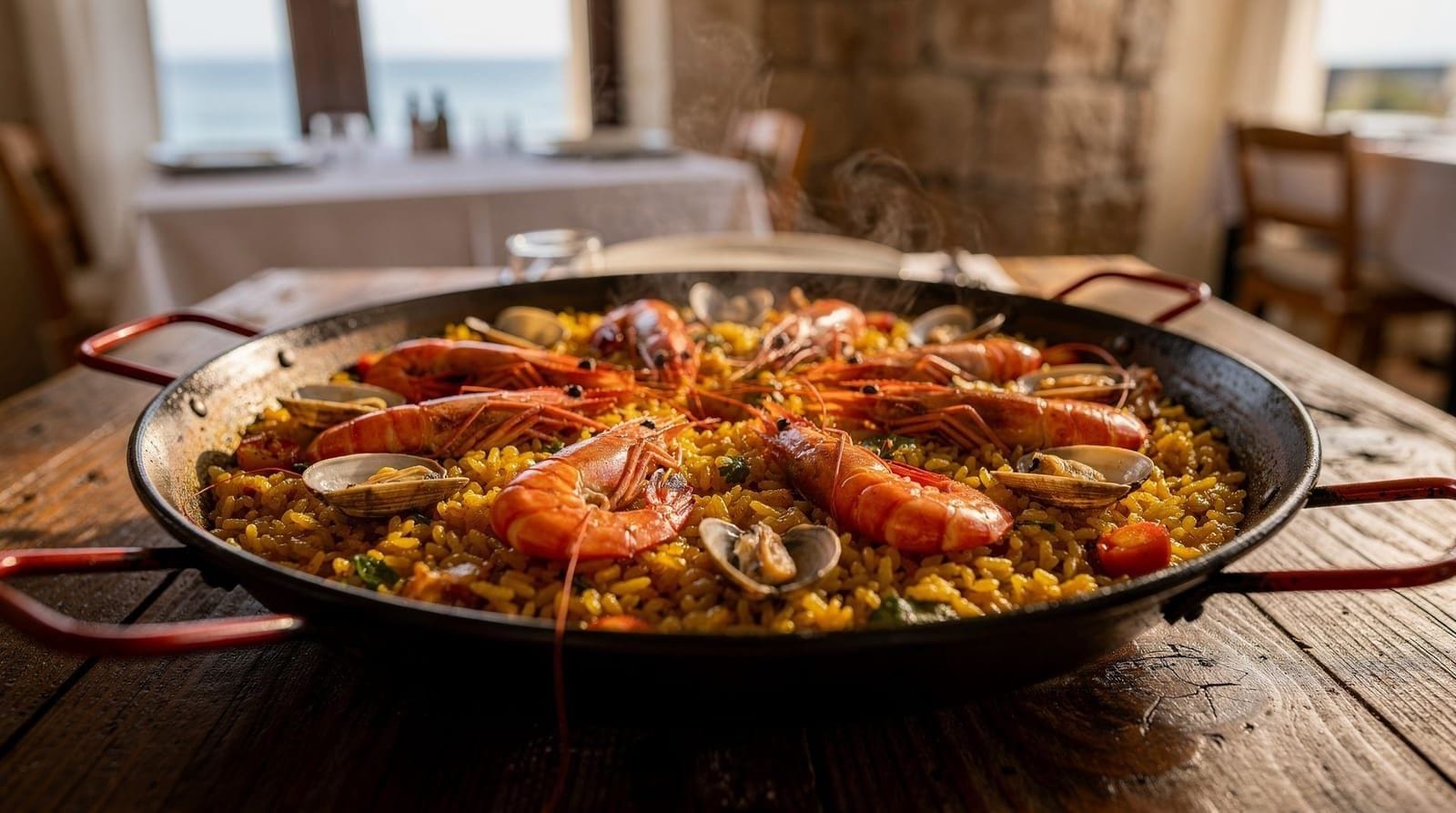
Paella is from Valencia. This is not a technicality — it matters because the dish’s technique, ingredients, and preparation are specific to Valencian cooking traditions, and restaurants that serve a genuine product must source it from that tradition (or build their kitchen around it deliberately). Most beachfront restaurants in Barceloneta have done neither.
The traditional paella Valenciana uses chicken, rabbit, green beans, garrofó (a local variety of flat white bean), tomato, saffron, and short-grain rice. It is cooked over a wood fire (or at minimum a gas burner calibrated for the large flat metal pan called a paellera) for 35–50 minutes. The rice is never stirred after the initial distribution — the crust that forms on the bottom, the socarrat, is a mark of quality. A proper paella cannot be made to order for one person; it requires a minimum of 2 portions and typically 3–4 or more for the pan to work correctly.
None of this describes what is served at the Barceloneta strip. The economics explain why the model persists: a beachfront location with heavy footfall does not need repeat local customers to survive, only a continuous supply of first-time visitors who do not yet know what to look for. A restaurant relying on locals for its survival cannot get away with pre-cooked, reheated rice at €25–30 a portion — locals simply would not return, and word travels fast in a dense city. The beachfront model works precisely because its customer base resets daily with new arrivals unfamiliar with the warning signs, which is exactly why this guide exists.
The beachfront model: A batch of rice is pre-cooked with a mixed seafood blend (usually frozen prawns, mussels, squid rings) and held in refrigerators. A single portion is portioned onto a smaller pan and either microwaved or briefly reheated. The result is gummy rice with seafood that ranges from adequate to poor, at €25–30 per portion, with “minimum 2 portions” signs making the minimum transaction €50–60.
The dead giveaways: photos of the dish on a board outside (no genuine paella restaurant needs this — people who know paella do not choose a restaurant based on a photo). Staff standing at the door actively inviting you in. Walk-in availability at any time of day. No specification of which type of paella. A paella menu item that includes a drink and dessert as a “deal.” Any one of these signs on its own is worth noting; two or more together is a reliable signal to keep walking.
Where to find real paella in Barcelona
Real paella exists in Barcelona. It requires a small amount of intention and, usually, advance planning to find:
Inland from Barceloneta: The streets one or two blocks back from the seafront strip (Carrer de la Balboa, Carrer del Mar) have some seafood restaurants with higher quality than the beachfront. Look for a menu that names the paella type (Valenciana, Marinera, Negra de calamar), requires minimum ordering for 2, and is prepared to wait 30–40 minutes. The wait is the quality signal.
Can Solé (Carrer de Sant Carles 4, Barceloneta) has been making real paella since 1903 and is one of the few seafood restaurants in the neighbourhood with a genuine preparation process. Expect €25–30 per person for the real product; expect a wait if you have not booked.
La Cova Fumada (Carrer del Baluard 56, Barceloneta) is where the bomba was invented and serves excellent seafood tapas. Their suquet de peix (fish stew in a tomato-saffron broth) is arguably a better representative of Barcelona’s actual seafood tradition than paella.
Catalan fideuà: For something genuinely regional and closer to what Barcelona’s own coastal towns actually cook, with a similar aesthetic to paella (cooked in the same flat pan), try fideuà — short noodles cooked with seafood in the same tradition. It is from Gandia, on the Valencia coast, but has been adopted into Catalan restaurant cooking with enthusiasm. Several restaurants in El Born and Gràcia do excellent fideuà. The technique is identical to paella but the noodles absorb flavour differently — the result is richer in umami from the way the pasta takes the stock. Ordering fideuà in a neighbourhood restaurant rather than paella signals to the kitchen that you know what you are looking for.
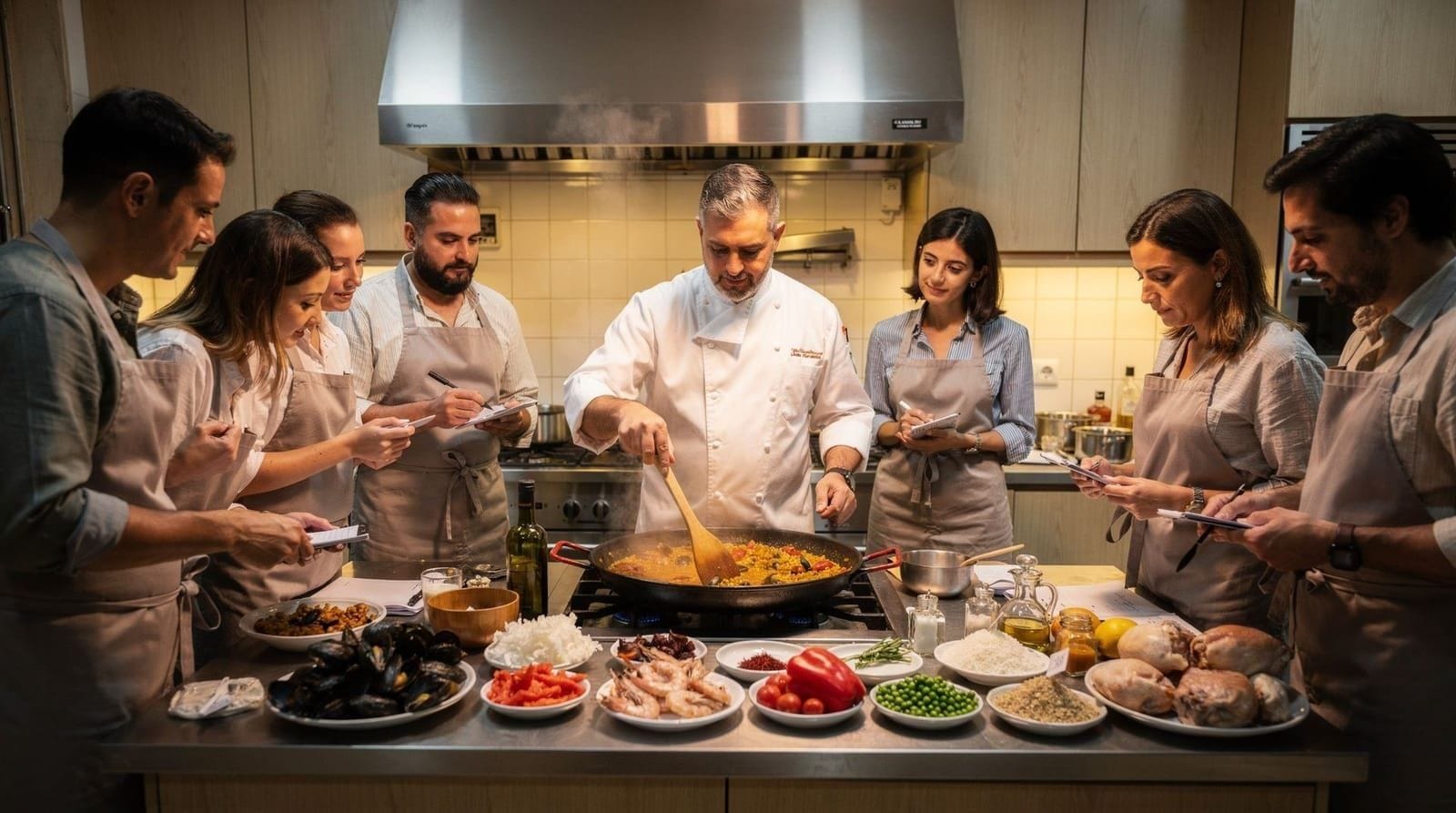
Cooking it yourself: A paella cooking class is an excellent alternative. Several Barcelona cooking schools offer full instruction on technique, market visits, and the proper preparation — you learn what the real dish requires, eat genuinely good food, and come away with a skill. This is also a significantly better value than a bad tourist restaurant experience at the same or higher price. See our cooking classes guide for the range of options.
A class that starts with a Boqueria market visit before cooking is a genuinely good use of a morning — you see the ingredients that make the difference between the real dish and the beachfront version, then cook and eat them.
For a more hands-on version taught by home cooks rather than a commercial school:
Real paella vs. beachfront paella at a glance
| Beachfront paella | Real paella | |
|---|---|---|
| Rice preparation | Pre-cooked, reheated | Cooked to order, 35–50 minutes |
| Wait time | None, walk-in | 30–45 minutes, always |
| Minimum order | 2 portions, enforced by price | 2 portions, enforced by kitchen logistics |
| Price per person | €25–30 | €18–25 |
| Where | Barceloneta seafront terraces | El Born, Gràcia, Poble-sec, Eixample interior |
| Signal of quality | Photo board, staff at the door | Named paella type, advance order |
Sangria: the tourist drink of a culture that doesn’t drink it
Catalan identity and Spanish national identity are distinct, and the food and drink culture reflects this. Sangria — which has no specific regional origin but became a pan-Spanish export to tourist markets — is not something you find in a Catalan neighbourhood bar.
Asking for sangria at a bar in Gràcia on a Sunday morning will result in a genuine look of confusion, possibly followed by a polite “we do not have it.” This is not hostility — it is honest. The bar does not make sangria because no one who comes to the bar orders it.
The problem for visitors is that sangria is cheap to make, has high margins for tourist restaurants (wine, fruit juice, and ice at restaurant prices), and satisfies a preconception about what a Spain trip should include. Tourist-facing restaurants stock it specifically for this reason. Ordering it marks you clearly as someone outside the local culture, which is not a moral failing — but it is a signal to the restaurant that tourist-tier service and pricing is appropriate.
Cava: the Penedès wine culture in depth
Cava is the correct answer to almost any celebratory or social drinking situation in Barcelona. The production region is the Penedès, an hour southwest of the city by car or train, centred on the towns of Sant Sadurní d’Anoia and Vilafranca del Penedès.
Catalan cava is made by the traditional méthode champenoise — exactly the same secondary fermentation in the bottle process used in Champagne — from the three native varieties Macabeu, Xarel·lo, and Parellada (sometimes with Chardonnay or Pinot Noir for rosé and prestige cuvées). The Brut Natur style (zero dosage, completely dry) is the reference point for quality — it shows the genuine character of the grapes and the region without added sugar. Brut is slightly sweeter and more forgiving. Extra Brut falls between.
At the commercial level, Codorníu and Freixenet produce reliable, genuinely good cava at €3–5 per glass in any bar. Many smaller artisan cellers (cellars) in the Penedès produce superior cava at comparable prices — the Recaredo, Gramona, and Llopart labels are consistently cited in quality assessments. These are available in better wine bars and specialist shops in Barcelona.
A Penedès cava day trip: If you have 4 or more days in Barcelona, the Penedès is an excellent and genuinely undervisited half-day trip. Rodalies R4 from Barcelona-Sants or Passeig de Gràcia to Sant Sadurní d’Anoia takes approximately 45 minutes. The town is dominated by cava cellars, several of which offer tastings (book in advance for the larger producers). Freixenet offers formal tours; Gramona is smaller and more intimate. Return the same afternoon. The combination of genuine wine culture, easy access, and low tourist density makes this a more rewarding experience than many better-known Barcelona day trips. See our full Penedès wine day trip guide for the complete planning detail, and our cava vs Champagne guide if you want the technical comparison explained.
The vermut ritual: what to order and where to go
Vermut (vermouth) is the defining Barcelona Sunday ritual. Between 11:00 and 14:00 on Sundays, the bars of Gràcia, Poble-sec, El Born, and Sant Pere fill with people having their pre-lunch vermouth — a glass of red or white vermouth, usually Martini Rojo or local brands like Zarro or Petroni, served on ice or chilled with a slice of orange, accompanied by a small plate of olives and boquerones (salted anchovies on bread).
This is not a tourist activity. It is what Barcelona residents do on Sunday mornings as a matter of cultural habit — the vermut del diumenge is as much a social institution as the Sunday roast in England or the Sunday passeggiata in Italy. The bars that serve it are not pretentious; they are neighbourhood bars that have been doing the same thing for decades. Our full vermut guide covers the ritual and specific bars in more depth than the summary below.
Specific vermut bars worth seeking:
Bar Calders (Carrer del Parlament 25, Poble-sec) — a classic neighbourhood vermut bar on one of Poble-sec’s best streets, adjacent to the Carrer de Blai pintxos strip. Opens from noon. Good vermouth selection, proper olives and boquerones, and a mix of locals and informed visitors.
El Xampanyet (Carrer de Montcada 22, El Born) — cava house and tapas bar in one of the most beautiful streets in El Born. The house cava is the thing to order; the vermut is also excellent. One of the few genuinely good bars in El Born that hasn’t been fully absorbed into the tourist circuit. The montaditos (small open sandwiches with anchovies or cheese) are good.
Bar Margarita (Carrer de Blai 50, Poble-sec) — on the best pintxos street in the city; the vermut here before the pintxos crawl is the correct sequence for a Sunday in Poble-sec.
Morro Fi (Carrer del Consell de Cent 171, Eixample) — a vermut bar in the Eixample with an extensive vermouth selection from across Spain and a knowledgeable staff. More curated than the neighbourhood versions, good for exploring the range.
Bar Marsella (Carrer dels Escudellers 65, Gothic Quarter) — a different category entirely: the oldest bar in Barcelona (operating since 1820), famous for its absinthe collection and its largely unchanged interior with dust-covered bottles on shelves that haven’t been moved in decades. Not primarily a vermut bar but a genuine historical experience.
Catalan food culture: the full picture
Catalan cuisine is one of the most distinct regional food traditions in Spain — a reflection of the region’s separate history, its Mediterranean coast, its Pyrenean interior, and the specific agricultural products of the inland plains. Here is the honest Catalan table.
Pa amb tomàquet (bread with tomato) is the foundational everyday food of Catalan culture. A slice of toasted or fresh bread is rubbed with the cut face of a ripe tomato until the flesh impregnates the surface, then drizzled with good olive oil and usually salted. It accompanies virtually every meal from breakfast through dinner in neighbourhood bars and family homes. If a restaurant does not offer it as a natural given, it is not primarily serving a local clientele. The quality varies with the tomato — in summer, the best pa amb tomàquet is made with a dark, ripe, heavily seeded variety that dissolves into the bread surface completely.
Botifarra is the Catalan sausage tradition. The fresh botifarra (white pork sausage) is typically grilled and served with mongetes (white beans dressed in olive oil), a combination so foundational to Catalan eating that it appears on menus at every level of the restaurant hierarchy from neighbourhood tavern to Michelin-starred kitchen. Black botifarra (blood sausage) is also made; the Christmas botifarra dolça (sweet, with spices including cinnamon) is a seasonal speciality.
Croquetes in Barcelona are a cut above the Spanish average. The Catalan version tends toward béschamel-based fillings of ham and cheese, or cod, or chicken — smooth, properly seasoned, with a thin crisp exterior. The tourist bar version of croquetes (mass-produced, frozen, reheated) is distinguishable by its oily exterior and dense, gummy interior. In a good bar — particularly in El Born and Gràcia — a plate of croquetes is genuinely excellent.
Crema catalana is the Catalan dessert tradition — a baked egg custard with a caramelised sugar surface, essentially the predecessor to the French crème brûlée. The Catalan version is typically flavoured with lemon zest and cinnamon rather than vanilla, and the custard is firmer. It appears on almost every Catalan restaurant menu. A good crema catalana is one of the simplest and most satisfying things on the Catalan table.
Calçots amb romesco is a seasonal winter and early spring tradition (January to March): calçots are a type of spring onion/green onion grown in Catalonia, grilled directly over a wood fire until charred on the outside, wrapped in newspaper to steam, then peeled at the table and dipped in romesco sauce (a rich red pepper, tomato, almond, and olive oil sauce from the Tarragona coast). The calçotada — an outdoor meal centred on grilled calçots — is one of the most distinctly Catalan eating traditions. In season, restaurants in Gràcia and the surrounding area advertise calçotades on their boards.
Local cheeses: Catalan cheese production concentrates on fresh and semi-cured varieties. Mató is the most distinctly Catalan — a fresh, mild ricotta-like cheese made from goat or cow milk, traditionally eaten with honey (mel i mató). Available at the market and at better cheese shops in El Born and the Eixample.
Catalan cuisine versus Spanish cuisine: the key differences
The distinction matters because tourist restaurants in Barcelona often serve a generic “Spanish” menu rather than a specifically Catalan one.
Catalan food uses more fruit and nuts in savoury cooking. Romesco sauce (almonds and hazelnuts), picada (ground almonds, garlic, and parsley as a thickener for stews), and the combination of meat with dried fruit (rabbit with prunes, duck with pears) are characteristic of the old Catalan kitchen. This is closer to medieval Mediterranean cooking than the more modern Castilian tradition of roasted meats and cold cuts.
Catalan food uses sofregit (softit in Catalan) — a long-cooked reduction of onion and tomato — as a base for almost everything. This is the foundational technique that distinguishes Catalan cooking from the olive-oil-and-garlic simplicity of southern Spanish cooking. A sofregit takes 30–45 minutes of low, careful cooking; shortcuts are immediately detectable.
Fish and seafood are treated differently. Barcelona and the Costa Brava have a strong tradition of simple grilled fish (fresh fish, olive oil, lemon, parsley) and fish stews (suquet de peix — similar to bouillabaisse but simpler) that reflect the daily catch tradition of fishing villages. The Barceloneta tradition specifically values smaller fish cooked whole: sea bream (dorada), sea bass (lubina), and red mullet (moll) are typical. Avoid restaurants that focus exclusively on large imported shrimp and lobster — these are high-margin tourist menus with no connection to the local tradition.
Where to find authentic Catalan food by neighbourhood
El Born is the best single neighbourhood for Catalan cuisine at genuine quality. The restaurants on and around Carrer de Montcada, Carrer del Rec, and the area between Plaça Santa Maria and the Mercat de Santa Caterina include some of the best mid-range Catalan cooking in the city. Look for menus that include pa amb tomàquet as a given, botifarra amb mongetes, and crema catalana.
Gràcia is the neighbourhood for locally-focused eating without tourist prices. The squares — Plaça del Sol, Plaça de la Virreina, Plaça de la Vila de Gràcia — are ringed with neighbourhood restaurants where the menú del día is €12–14 and the permanent card includes properly Catalan cooking. The Mercat de l’Abaceria on Travessera de Gràcia is the best market base for understanding what locals buy and eat.
Poble-sec around Carrer de Blai is the budget eating capital. The pintxos bars are not primarily Catalan — pintxos are Basque — but the neighbourhood restaurants one or two blocks off the main pintxos strip serve excellent Catalan food at menú del día prices.
Eixample inland streets (west of Passeig de Gràcia, between Gran Via and Diagonal) have a dense population of neighbourhood restaurants serving the resident and working population of the district. These are not tourist-facing and offer the best version of everyday Catalan cooking at ordinary prices. A simple heuristic that holds across all four neighbourhoods: the further a restaurant’s terrace sits from a major landmark’s direct sightline, the more likely its kitchen is cooking for people who live nearby rather than people who will never return.
The La Mercè and other festivals for Catalan food
The festivals of Barcelona are an underused opportunity to eat and drink authentically at no or minimal cost.
La Mercè (23–27 September): The patron-saint festival runs food and drink stalls across the city with local produce, Catalan wine, and traditional food producers. The stalls in the Parc de la Ciutadella and around the Ajuntament area typically feature local cava producers, artisan cheese vendors, and botifarra grills.
Sant Jordi (23 April): While primarily a books-and-roses celebration, Sant Jordi involves food culture through the market stalls that line La Rambla and Rambla de Catalunya — food producers, olive oil vendors, and wine from the Penedès are common additions to the book and rose stalls.
Festa Major de Gràcia (14–20 August): The neighbourhood festival includes extensive outdoor eating and drinking. The bars and restaurants of Gràcia set up outdoor terraces along the decorated streets, and the food is neighbourhood-quality (not tourist-facing) at normal Barcelona prices.
Calçotada season (January–March): In the late winter and early spring, restaurants across the city advertise calçotades — the traditional outdoor meal centred on grilled calçots. This is the most specifically seasonal Catalan food experience and one that is rarely on the tourist radar. A proper calçotada includes multiple rounds of calçots, grilled meats, and Catalan red wine from a porró (a glass decanter you drink directly from the spout). Some restaurants require advance booking for full calçotada service.
Sangria: what Catalan culture drinks: the real alternatives
Cava is the correct answer to almost any celebratory or social drinking situation in Barcelona. Made by the traditional méthode champenoise in the Penedès wine-growing region 50 km from the city, Catalan cava is made primarily from Macabeu, Xarel·lo, and Parellada grapes. The Brut Natur and Brut styles are excellent by any sparkling wine standard. At €3–5 per glass in a decent bar, it is significantly cheaper than Champagne for comparable or better quality.
Vermut (vermouth) is the ritual that defines Barcelona Sunday mornings. Between 11:00 and 14:00 on Sundays, bars across Gràcia, El Born, Poble-sec, and many other neighbourhoods fill with people drinking vermouth — red or white, on ice or chilled, with an orange slice and a plate of olives and boquerones (salted anchovies). This is not a tourist activity; it is what local Barcelona life looks like on a Sunday.
Estrella Damm is the local lager, brewed at the Estrella Damm brewery in the Poblenou neighbourhood of Barcelona. It is genuinely good lager and what locals order at a bar when they want a beer. Moritz (made in El Raval’s old factory, now a restaurant-brewery) is the other major Barcelona craft option with a longer heritage. For a broader sense of the city’s wine scene beyond cava specifically, our wine tasting guide covers tasting rooms and wine bars serving the Catalan reds and whites that rarely make it onto a tourist menu.
A quick test before you order
If you are unsure whether a restaurant or bar is worth your money for food or drink in Barcelona, two questions cover most of the ground. First: does the menu name specifics — the type of paella, the origin of the vermouth, the cava producer — rather than generic categories like “paella” or “sangria” with a photo? Specificity is almost always a sign that the kitchen or bar actually knows and cares about what it is serving. Second: is there a wait, a queue, or a booking involved? Genuine Catalan food and drink culture, from a proper paella to a Sunday vermut at a popular neighbourhood bar, usually asks something of you in time or advance planning — the beachfront and boulevard establishments that ask nothing of you beyond your money are, with very few exceptions, the ones to avoid. This test will not catch everything, but applied consistently across paella, sangria, tapas and wine, it steers you toward the Barcelona that Catalans actually eat and drink in — and, in most cases, toward better food and drink at a lower price than the version aimed at people who will only ever eat there once.
The menú del día and Catalan food culture
Beyond the drinks, understanding the structure of Catalan eating helps avoid tourist-restaurant dynamics entirely.
Menú del día (lunch set menu) is a Spanish institution running from approximately 13:00 to 15:30 on weekdays at the vast majority of neighbourhood restaurants. It includes 2–3 courses, bread, wine or soft drink, and dessert or coffee for €12–16. This is how working Barcelonans eat lunch. It is not a tourist offering — it is the dominant format for weekday lunch across the country. Finding a neighbourhood restaurant (not on La Rambla, not in the tourist corridor of the Gothic Quarter) and eating the menú del día is the best value meal in Barcelona and frequently the best tasting one.
Pa amb tomàquet (bread with tomato) is the everyday food of Catalan culture: a slice of toasted or fresh bread, rubbed with the cut face of a ripe tomato, drizzled with olive oil, and usually salted. It accompanies almost every meal from breakfast through dinner, particularly in neighbourhood bars and restaurants. If a restaurant does not offer it as a natural given, it is not primarily serving a local clientele.
Tapas culture in Barcelona is genuine — small plates of croquetes (croquettes), patatas bravas (fried potatoes with a spiced tomato and aioli sauce), pimientos de padrón (blistered peppers), tortilla española, and local charcuterie. The best tapas environments are in El Born, Poble-sec, Gràcia, and the interior of the Eixample — not on La Rambla or the Gothic Quarter’s tourist corridor. See our best tapas neighbourhoods guide for a street-by-street breakdown, and our dedicated best paella guide for a curated shortlist beyond the restaurants named above.
The Barcelona food and drink trap is primarily about expectation: visitors arrive expecting to find “Spanish” paella and sangria, and tourist restaurants accommodate this expectation profitably. The Catalan alternative — cava, vermut, fideuà, pa amb tomàquet, market-sourced tapas — is cheaper, better, and actually reflects where you are. The key is knowing that the alternative exists and where to find it.
Frequently asked questions about Paella and sangria traps in Barcelona
What is the beachfront paella scam?
Restaurants directly on the Barceloneta seafront serve paella that is typically pre-made, frozen, and reheated to order — at €25–30 per portion, minimum 2 portions. Signs of the scam: photos of paella outside, 'minimum 2 portions' signs, staff beckoning from the door, and walk-in availability (real paella must be ordered 30–45 minutes in advance). The product is edible but is a poor approximation of the real dish at an inflated price.Is paella originally from Barcelona?
No. Paella is Valencian — it originates from the Comunitat Valenciana, the region around Valencia, 350 km south of Barcelona. Traditional paella Valenciana uses chicken, rabbit, green beans, and butter beans with short-grain rice and saffron, cooked over a wood fire in a flat metal pan. Barcelona has no traditional paella culture; the dish arrived as a Spanish national export. Good paella exists in Barcelona at the right restaurants, but it is not a local specialty.Is sangria a traditional drink in Catalonia?
No. Sangria — red wine mixed with fruit, juice, and sometimes spirits — is a drink served in tourist-facing restaurants across Spain. It is not part of Catalan drinking culture. Local bars in Barcelona do not serve it or stock the ingredients for it. Ordering sangria in a neighbourhood bar in Gràcia or El Born will get you a polite confusion. It is designed to be purchased by visitors who expect a Spanish drink experience.What do locals actually drink in Barcelona?
Cava (Catalan sparkling wine made in the Penedès region), vermut (vermouth, drunk mid-morning on Sundays at a bar with olives and anchovies, a serious Catalan ritual), and Estrella Damm (the local Barcelona lager). Wine drinkers order a copa de vi or ask for the house wine (vi de la casa), which in most neighbourhood restaurants is a drinkable Catalan red or white. Craft beer (cervesa artesana) has strong local producers.Where can I eat real paella in Barcelona?
For paella in Barcelona that is genuinely made to order: look for restaurants inland from the seafront that list the type (Valenciana, Marinera/seafood, Negra/squid ink) and require advance ordering for a minimum of 2 people. Restaurants in Poble-sec, Eixample, and Gràcia are more likely to be serving a legitimate product than Barceloneta beachfront. Expect €18–25 per person for real paella.What is vermut and where can I try it?
Vermut (vermouth) is a fortified wine aromatised with botanicals, served chilled or on ice with a slice of orange and olives on the side. The Sunday morning vermut ritual (el vermut del diumenge) is genuine Catalan culture: cafés and bars in Gràcia, El Born, and Poble-sec fill from 11:00 to 14:00 on Sundays with locals having vermut before Sunday lunch. Bar Calders and Bar Margarita in Poble-sec, and Bar Calvet in Gràcia, are well-regarded vermut spots. Around €3–4 per glass.What is the best Catalan food to eat in Barcelona?
The honest Catalan table: pa amb tomàquet (bread rubbed with tomato and olive oil — the everyday staple), botifarra (pork sausage) with white beans, croquetes (croquettes, much better than the tourist bar version), crema catalana (the local custard dessert), fideuà (the Catalan noodle version of paella), and local seafood prepared simply. The best food in Barcelona is in neighbourhood restaurants without English menus displayed outside.What should I actually eat at Barceloneta beach?
The seafood tapas bars in the streets inland from the Barceloneta strip (Carrer de la Balboa, Carrer del Mar, Carrer de Sant Carles) are significantly better and cheaper than the beachfront. La Cova Fumada (Carrer del Baluard 56) is credited with inventing the bombas (potato croquette with meat filling) and is a genuine local institution. Expect a queue and cash only. The Barceloneta market on a morning visit has fresh produce if you are self-catering.
Top experiences
Bookable activities with verified prices and instant confirmation on GetYourGuide.