La Rambla: the honest guide to Barcelona's most famous street
Barcelona: Ramblas, old town & Gaudí houses walking tour
Duration: 2.5 hours
- Free cancellation
Is La Rambla worth visiting in Barcelona?
Yes, for one walk. The Miró mosaic, the Liceu opera house, the Font de Canaletes, and the boulevard's architecture are genuine sights. But do not linger, do not eat at any restaurant on the boulevard, and keep your bags secured — it is the highest-concentration pickpocket street in Barcelona.
La Rambla is, simultaneously, the most famous street in Barcelona, a genuinely historic boulevard worth one careful walk, and the highest-concentration pickpocket environment in the city. This guide covers what is actually worth your time, where the traps are, and what to do in the streets immediately around it instead.
| Where | Runs from Plaça Catalunya to the Columbus Monument, old town |
| Time needed | 25–30 minutes for the walk itself, more with detours |
| Cost | Free to walk; Boqueria snacks and sights extra |
| Getting there | Metro Catalunya, Liceu or Drassanes (L3) |
| Best time | Early morning (08:00–10:00) or after 19:00 |
What La Rambla actually is
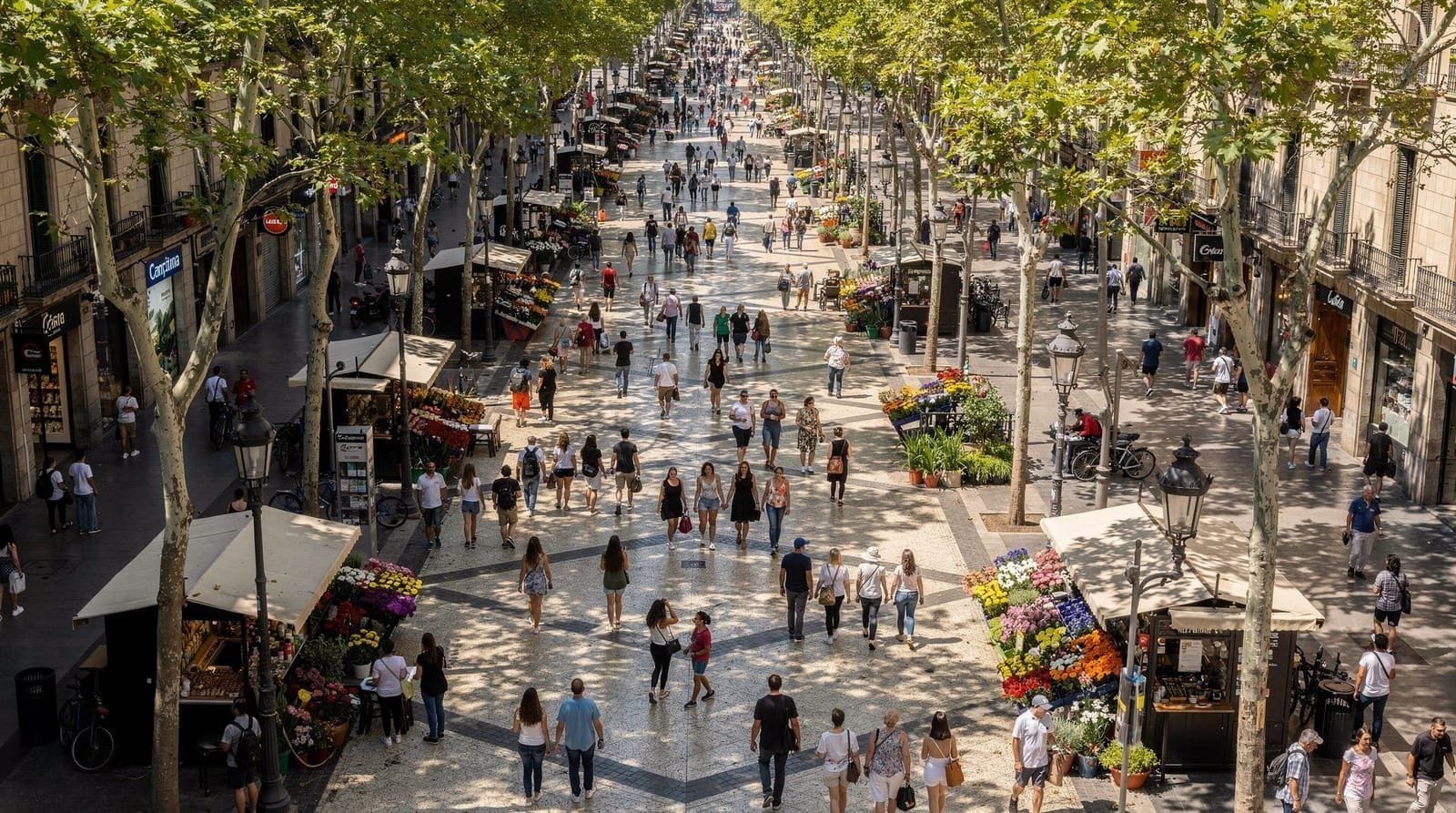
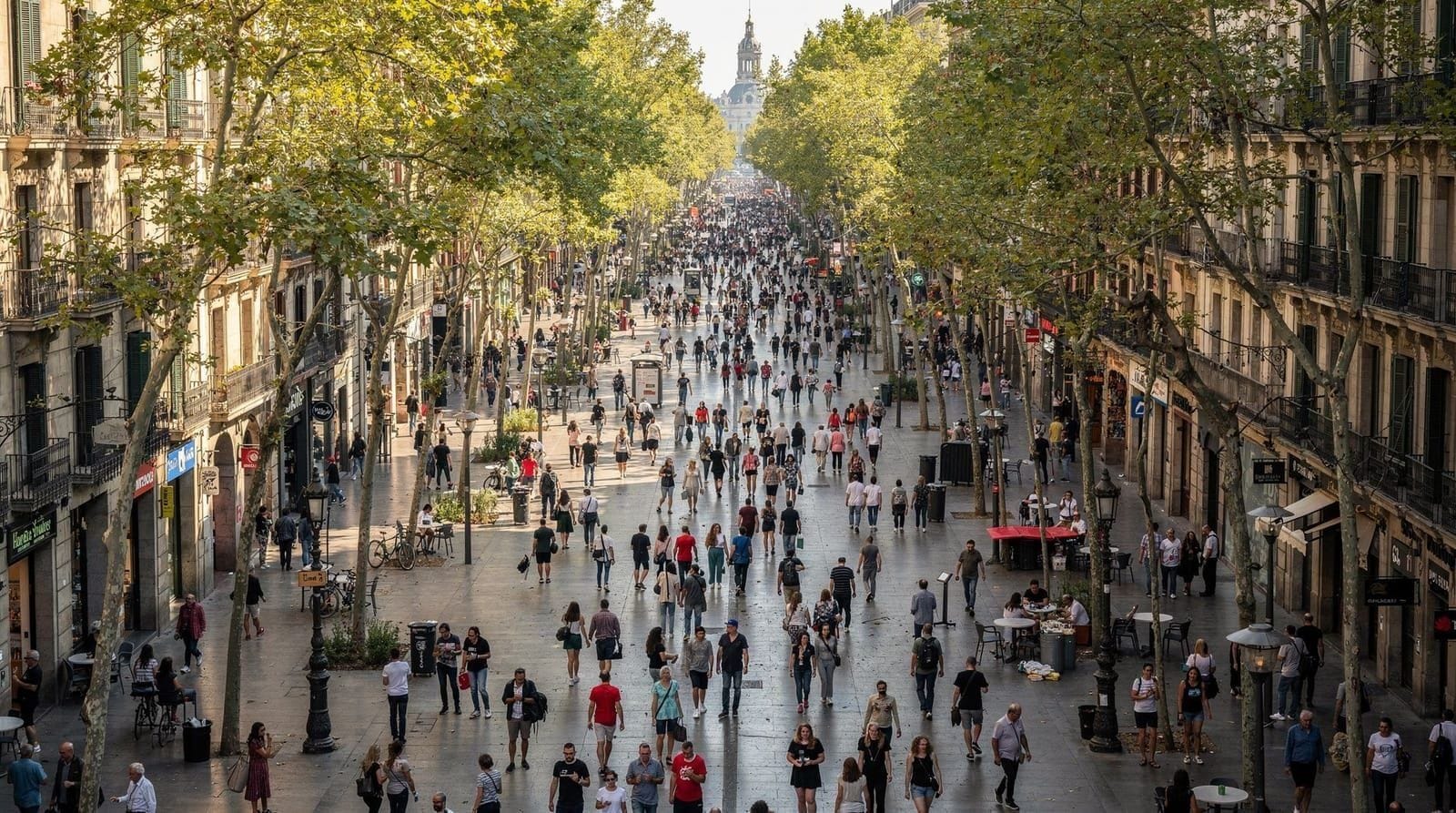
La Rambla (strictly speaking, Las Ramblas — a series of tree-linked pedestrian promenades linked end to end) runs 1.2 km from Plaça Catalunya at the city’s commercial heart to the old port and the Columbus Monument. It was developed from a seasonal stream bed in the 18th and 19th centuries, when grand residential palaces and commercial buildings were constructed on both sides to create the wide central walkway flanked by vehicle lanes.
The boulevard had genuine civic life for most of the 20th century — morning newspaper stalls, afternoon crowds, evening theatre audiences, bird sellers, flower stalls. Most of the newspaper stalls are gone; the birds are long-banned. What remains is the flower stalls (still operating), the human statues (a more recent phenomenon), and the architecture of the buildings on both sides, which is genuinely worth looking at.
The historical development of La Rambla
La Rambla’s origin is physical geography. The name comes from the Arabic “ramla” (river bed or sandy place), and the boulevard follows the line of a seasonal stream that drained the Collserola hills into the sea. The stream was outside the medieval city walls, making the rambla the traditional border between the city proper and the less regulated suburb of El Raval to the west.
In the early 18th century, the Bourbon king Philip V demolished a large section of the Ribera neighbourhood (including the El Born area) to build a military citadel after the fall of Barcelona in 1714. He also ordered improvements to the rambla as a public promenade — the earliest version of the current central walkway. The 18th century saw the major religious institutions along the eastern side (the Betlem church at the top, the Palau de la Virreina, the Carmen Convent) established or rebuilt in Baroque and neo-classical styles that still define the building facades.
The 19th century brought the decisive transformation: the opening of the Gran Teatre del Liceu opera house in 1847 (rebuilt after fires in 1861 and 1994), the establishment of La Boqueria market in its current form in the 1830s, and the construction of the Eixample expansion that connected the old city to the suburbs. By the mid-19th century, La Rambla was the social heart of bourgeois Barcelona — the promenade where the city’s affluent population walked, saw and was seen, and conducted the social business of a 19th-century European city.
The newspaper stall culture developed in the late 19th and early 20th centuries. Until the 1980s, the central walkway had dozens of kiosks selling newspapers, magazines, flowers, birds, and other small goods. The bird market specifically — caged birds sold from stalls along the central section — was a Barcelona institution until banned in the 1990s on animal welfare grounds. The flower stalls remain and are still operated by family vendors in the traditional kiosk format.
The things worth seeing, specifically
Miró mosaic — halfway down the boulevard, near the Liceu metro exit, look down at the pavement. Joan Miró designed a round mosaic in his characteristic primary-colour style set into the pavement. It is permanently overlooked by the vast majority of pedestrians who are looking ahead or at their phones. A genuine artwork in an unexpected location.
Font de Canaletes — at the very top of the boulevard where it meets Plaça Catalunya, a Victorian-style iron drinking fountain with four spigots. The tradition says drinking from it ensures you return to Barcelona. It is the spontaneous gathering point for FC Barcelona title celebrations, which is the main reason it appears in news photography.
Gran Teatre del Liceu — the opera house exterior on the right side (west, facing El Raval) as you walk south. One of the great opera houses of Europe, rebuilt after a fire in 1994. The facade is 19th-century neo-classical. Interior tours are available (book in advance); performances obviously require a programme ticket. Simply walking past the facade at a close look costs nothing.
Palau de la Virreina — the 18th-century Baroque palace on the right side, further south than the Liceu. Now functions as a cultural centre with free exhibition spaces. The courtyard is sometimes accessible.
The architecture of the lateral buildings — ignore the stalls in the centre and look at the buildings on both sides of the boulevard: the 18th and 19th-century mix of Gothic and Baroque residential facades, some with elaborate ironwork balconies, above the commercial ground floors. The buildings themselves are the historical fabric of Barcelona’s bourgeois city.
Mercat de la Boqueria entrance — the curved iron entrance arch to the market is on the right side (La Rambla’s west side), roughly a third of the way down. Worth a brief diversion into the market before 11:00 on a weekday. The genuine market vendors are toward the back. See the tourist traps guide for what to avoid inside. A guided food walk that starts at the Boqueria and continues into the Gothic Quarter’s food streets is a good way to eat properly instead of settling for the boulevard’s tourist menus.
El Raval: the neighbourhood on the west side
One block west of La Rambla — separated only by the vehicle lane that flanks the boulevard’s western edge — is El Raval, the city’s most culturally diverse neighbourhood and the location of Barcelona’s best contemporary arts institutions.
MACBA (Museu d’Art Contemporani de Barcelona) is in a Richard Meier-designed white building on the Plaça dels Àngels, a 5-minute walk from La Rambla. The collection covers contemporary art from the mid-20th century onward, with particular strength in Catalan and Spanish artists. The building’s exterior is worth seeing independently of the collection. Entry approximately €12 (free some Saturdays after 15:00 — check macba.cat).
CCCB (Centre de Cultura Contemporània de Barcelona) is adjacent to MACBA in a 19th-century converted poorhouse. It runs major temporary exhibitions, film programmes, and music events. A major Barcelona cultural institution with a strong critical programme. Entry €6–8 for temporary exhibitions.
The multicultural food scene of El Raval: The neighbourhood around Carrer del Robadors and Carrer de l’Hospital has the most international food diversity in Barcelona — Pakistani, South Asian, Filipino, and North African restaurants alongside traditional Catalan bars. This is the neighbourhood where menú del día runs to €9–11 at the most basic level, rather than the €12–16 of the tourist zone. The Filmoteca de Catalunya on Plaça de Salvador Seguí shows classic and art films with original audio and Catalan subtitles.
The Rambla del Raval: Three blocks west of La Rambla is a smaller internal boulevard — the Rambla del Raval — running through the heart of the neighbourhood. This is what La Rambla’s character felt like to locals a generation ago: a neighbourhood promenade with outdoor cafés, residents using the pavement for genuine daily social life, and none of the tourist concentration of the main boulevard. Bottero’s giant cat sculpture marks the northern end.
The Gothic Quarter: the east side
The east side of La Rambla is the Gothic Quarter, Barcelona’s medieval city core. From any point on La Rambla, walking east brings you into the Roman-medieval street network within 2–3 minutes.
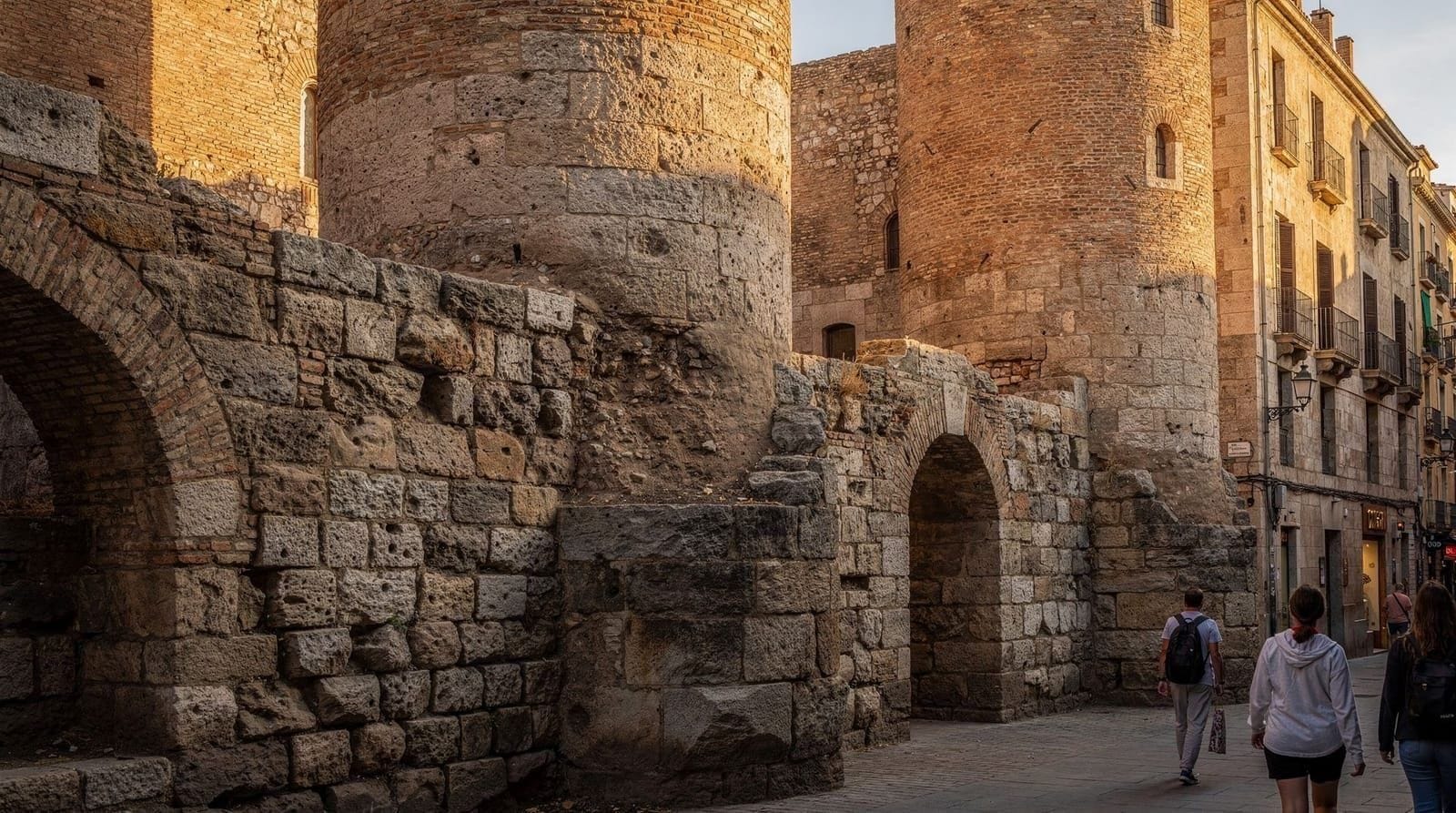
The Gothic Quarter is the genuine reason to be in this part of the city. Its layers — Roman foundations visible in the basement of buildings and in dedicated archaeological sites, medieval palace complexes and religious buildings, 20th-century construction that mimics Gothic style (some buildings that look medieval are actually 20th-century reconstructions), and contemporary neighbourhood life — require time and context to read properly.
The Roman temple of Augustus, in the courtyard of the Centre Excursionista de Catalunya on Carrer del Paradís, is one of the most significant Roman remains in Spain — four Corinthian columns from a 1st-century BCE temple to Augustus, standing to near-original height in the building’s internal courtyard. Entry free during opening hours (check ajuntament hours); the columns are visible through the gate when closed.
The Cathedral of Barcelona (Catedral de la Santa Creu i Santa Eulàlia) on Plaça de la Seu is free in the morning (08:30–12:30) and charges €9 in the afternoon. The Gothic cloisters are the highlight — a 14th-century arcaded courtyard with a small garden, a fountain, and 13 resident geese (kept as a tradition since the Middle Ages, representing the 13 years of the martyred St. Eulàlia’s life). The geese are visible from the cloister arcade without entering the paid section.
The port at the bottom: what to do at the Columbus Monument
La Rambla ends at the Columbus Monument (Monument a Colom), a 60-metre iron column erected in 1888 for the Universal Exhibition, with Columbus at the top pointing (incorrectly, ironically) toward the Mediterranean rather than the Atlantic.
The monument has a lift to a small observation deck at approximately 40 metres, with views over the port and back up La Rambla. Entry approximately €7. The views are decent but not exceptional compared to the Bunkers del Carmel (free) or Montjuïc (much higher, broader views). The monument is worth a photograph from street level; the interior lift is optional.
At the bottom of La Rambla, the pedestrian rambla continues under different naming toward the beach and the Barceloneta neighbourhood. The Barceloneta waterfront is 10–15 minutes on foot east of the Columbus Monument along the Port Vell promenade.
The Port Vell itself (the old inner harbour) is now a marina with the Maremàgnum shopping centre on an artificial island. The Maremàgnum is not worth a dedicated stop; the waterfront promenade alongside it has good views of the marina and the distant hills above the city.
What La Rambla looked like before mass tourism
Before the 1990s, La Rambla functioned differently than it does today. The central promenade was dominated by the newspaper and magazine kiosks that lined the entire length — dozens of stalls with the morning papers displayed in full front-page format, magazine racks on all sides, and a culture of morning street reading that Barcelona shared with Madrid, Paris, and other European cities of that era.
The bird stalls were an earlier institution — caged canaries, parrots, and other birds available for purchase from vendors occupying the Rambla dels Ocells section of the boulevard. This continued until environmental and animal welfare legislation in the 1990s ended the practice.
The flower stalls that remain today are the direct descendants of a much more extensive flower market tradition. In the mid-20th century, the Rambla de les Flors section of the boulevard was lined with cut flower vendors and seasonal plant sellers who served a genuinely local clientele — the neighbourhood apartment buildings on both sides bought flowers for religious observances, family events, and ordinary daily life.
The live theatre and cinema audiences that spilled out of the Liceu and the various theatres along the boulevard created a late-evening street culture oriented around performance culture rather than tourism. The Liceu, rebuilt after a 1994 anarchist bombing, reopened in 1999 and continues to operate but its audience now mixes genuine opera enthusiasts with visitors.
Understanding this history makes La Rambla’s current condition clearer: it is not a failed street but a street that succeeded so thoroughly as a tourist attraction that its function shifted entirely. The structures — the buildings, the market, the opera house, the boulevard layout — are genuine. The activity on top of them has changed.
Specific morning routine for a La Rambla walk
For a visitor wanting to experience La Rambla without being caught in its traps, a 25-minute morning walk starting at 09:00 is the approach:
Start at Plaça Catalunya (top of the boulevard). Find the Font de Canaletes — the iron fountain on the left side of the promenade as you face downhill. Walk south at a moderate pace, looking at the buildings on both sides rather than the stalls in the centre. At roughly the midpoint, find the Liceu metro exit sign and look down for the Miró mosaic on the pavement. Continue south past the Liceu opera house (right side, slightly past the mosaic). Note the Palau de la Virreina (right side). Turn into the Boqueria entrance for a brief market walk. Return to La Rambla and continue to the Columbus Monument. Total: 25–30 minutes, including the Boqueria detour.
Then leave La Rambla. Your day in the Gothic Quarter or El Born begins on the east side; your El Raval exploration on the west.
What to skip entirely
Every restaurant with terrace seating directly on the central promenade. No exceptions. The food is mediocre, the prices are inflated, and the service is oriented toward turning tables, not toward your comfort. This applies even to restaurants that look respectable from the menu boards. You are paying for the location premium, nothing else.
The human statue clusters — not because they are a scam per se, but because the crowd around them is the ideal pickpocket setup. Enjoy the statues from 3–4 metres back and then move on.
Any offer of “free” maps or tourist information from someone standing on the boulevard rather than behind a counter. These are generally preludes to reseller pitches or the bracelet approach.
The Columbus Monument interior lift is optional — the Bunkers del Carmel and Montjuïc provide far better viewpoints at lower or no cost.
The one block rule: where to actually eat and drink
Walk one block east from La Rambla (toward the Gothic Quarter) and you are in the restaurant zone that serves both locals and tourists at normal Barcelona prices. Walk one block west (toward El Raval) and you access the multicultural, affordable, and genuinely interesting restaurant scene of that neighbourhood.
Specific streets worth knowing:
- Carrer dels Escudellers (one block east, running parallel) — several mid-range Catalan restaurants at normal prices
- Carrer de la Boqueria (east, running off La Rambla at the market entrance) — quieter than La Rambla itself with better food options
- Carrer del Parlament and surrounding Poble-sec streets (15 minutes west and south) — one of the best restaurant neighbourhoods in the city
The pickpocket context
La Rambla concentrates pickpocket activity because it concentrates tourists, narrowed attention (looking at statues and stalls rather than surroundings), and crowd density in a linear configuration that makes approach and exit easy. The incidents are overwhelmingly non-confrontational — wallet or phone removed from a bag or pocket while attention is directed elsewhere.
Practical mitigations: bag carried in front or over one shoulder where contact is visible; phone not out except for specific purposeful use; wallet in a front trouser pocket rather than back pocket; nothing valuable in open bag pockets. Walking without stopping (except for deliberate pauses at the specific points noted above) reduces the opportunity window significantly.
For the full safety picture and scam-by-scam breakdown, see the safety and scams guide. For pickpocket-specific technique and mitigation, see the pickpocket guide.
Getting to and around La Rambla
The nearest metro stations are Catalunya (L1, L3) at the top, Liceu (L3) at the midpoint, and Drassanes (L3) near the bottom by the Columbus Monument — all put you within a minute’s walk of the promenade. If you are coming from Gràcia or the El Born side, walking is often faster than the metro given the short distances in the old town. There is no dedicated parking near La Rambla itself; if you are driving, use one of the underground car parks at Plaça Catalunya or Drassanes and walk in. A guided walking tour that starts on La Rambla and continues into the Gothic Quarter is a practical way to get the historical context without doing the background reading yourself.
Best time of day and season to walk it
| Time | Crowd level | Notes |
|---|---|---|
| 08:00–10:00 | Low | Best light for photos, flower and newspaper vendors setting up |
| 11:00–14:00 | Peak | Avoid if possible, especially in July–August |
| 17:00–19:00 | High | Boulevard fills again with the evening promenade crowd |
| 19:00–22:00 | Moderate | Well-lit, lively without the daytime crush |
| December–February | Low overall | Fewer crowds year-round, some stalls close earlier |
| June–September | Very high | Peak tourist season, worst pickpocket risk |
If your schedule allows only one visit, an early-morning walk before 10:00 gives the clearest views of the Miró mosaic and the building facades without dodging the crowd. Combining the walk with a stop at a genuinely good paella lunch a block off the boulevard makes better use of the same outing than eating on La Rambla itself.
What locals actually think of La Rambla
Ask a Barcelona resident about La Rambla and the answer is usually a shrug, not enthusiasm — most locals avoid it entirely except to pass through on the way somewhere else, precisely because it stopped serving a neighbourhood function decades ago. That is not a reason for a first-time visitor to skip it; the historical layers and the specific sights above are genuinely worth seeing once. It is a reason to treat local recommendations for restaurants, bars and cafés with real weight — if a Barcelona resident suggests somewhere near La Rambla, it will almost never be on the boulevard itself. The same logic applies across the old town: the streets one block back from any major landmark, whether that is Barceloneta’s seafront or Park Güell’s entrance, tend to serve locals better food at fairer prices than the streets facing the attraction directly.
The streets around La Rambla worth prioritising over it
Across the western side: El Raval — MACBA and CCCB (Barcelona’s main contemporary art institutions), the Filmoteca de Catalunya, multi-ethnic food scenes, a genuinely working neighbourhood that is gentrifying but not yet homogenised. The Rambla del Raval (a quieter internal boulevard a few blocks west) has the neighbourhood character that La Rambla itself lost a generation ago.
Across the eastern side: the Gothic Quarter’s Roman ruins, the Cathedral district, the medieval lanes of the Call (Jewish Quarter), and the transition into El Born’s restaurant and boutique concentration.
La Rambla is the threshold between two genuinely interesting parts of the city. Walk it once, then disappear into either side.
La Rambla is not optional — skipping it entirely means missing part of Barcelona’s civic character. But the experienced visitor treats it as a 25-minute morning corridor, not a destination in its own right. One walk, eyes open for the mosaic and the opera house, bags secured, then off into the streets that deserve more time.
Frequently asked questions about La Rambla
How long is La Rambla?
La Rambla runs 1.2 km from Plaça Catalunya at the top to the Columbus Monument (Monument a Colom) at the bottom, where it meets the port. A leisurely one-way walk from top to bottom takes 15–20 minutes. With stops to look at specific things, allow 30–40 minutes.What is worth seeing on La Rambla?
The Miró mosaic embedded in the pavement near Liceu metro station (look down as you walk — most people miss it), the Font de Canaletes at the top (the fountain where FC Barcelona fans traditionally celebrate titles), the exterior of the Gran Teatre del Liceu opera house (one of the most prestigious opera venues in Europe), the Palau de la Virreina cultural centre, and the architecture of the boulevard itself — a mix of 18th and 19th-century residential and commercial buildings lining both sides.Which restaurants on La Rambla are any good?
None of the restaurants directly on La Rambla represent good value. The food is mediocre, the prices are significantly above what you would pay one block away, and the service is calibrated for tourist turnover rather than dining quality. Walk one block east toward El Raval or one block west toward the Gothic Quarter and you enter a completely different restaurant ecosystem.Is La Boqueria on La Rambla worth visiting?
Worth a brief visit, especially the interior fish, meat and produce stalls which are still working market vendors. The stalls near the entrance facing La Rambla are tourist-facing and overpriced. The market is most enjoyable on a weekday morning before 11:00. Do not expect a quiet, authentic food experience — it is extremely crowded in season.Where does the bracelet scam operate on La Rambla?
Most commonly near the Liceu metro station area, roughly in the middle section of La Rambla, and around the flower stalls. People approach from the side, use compliments or conversation starters, and begin tying a bracelet on your wrist before you have consented. Firm, immediate refusal from the first contact ('No, thank you,' moving away clearly) is the correct response. They do not become physically aggressive.What is the Font de Canaletes and why do people gather there?
The Font de Canaletes is an ornate drinking fountain at the very top of La Rambla, near Plaça Catalunya. According to Barcelona tradition, anyone who drinks from it will return to the city. It is also the traditional gathering point for FC Barcelona fans celebrating Liga and Champions League victories — spontaneous crowds of thousands assemble here on championship nights.Are the human statues on La Rambla a scam?
They are legal street performers, but the economics are worth understanding. They perform for free and accept tips. The trap is the crowd that forms around them — this is the highest-risk pickpocket microenvironment on the boulevard. The crowd, the distraction, and the close physical proximity are the ideal conditions for bag and phone theft. Enjoy from the edges, do not enter the tight group, and check your belongings immediately after.What time is La Rambla most crowded?
11:00–14:00 is peak concentration on the boulevard, particularly in summer. Early morning (08:00–10:00) is the least crowded and the best time for photographs. Late afternoon (17:00–19:00) the boulevard fills again. At night La Rambla is well-lit and populated but the pickpocket presence continues and adds the additional variable of people who are intoxicated in the small side alleys.
Top experiences
Bookable activities with verified prices and instant confirmation on GetYourGuide.
Barcelona: 2-hour Gothic Quarter walking tour
- Free cancellation
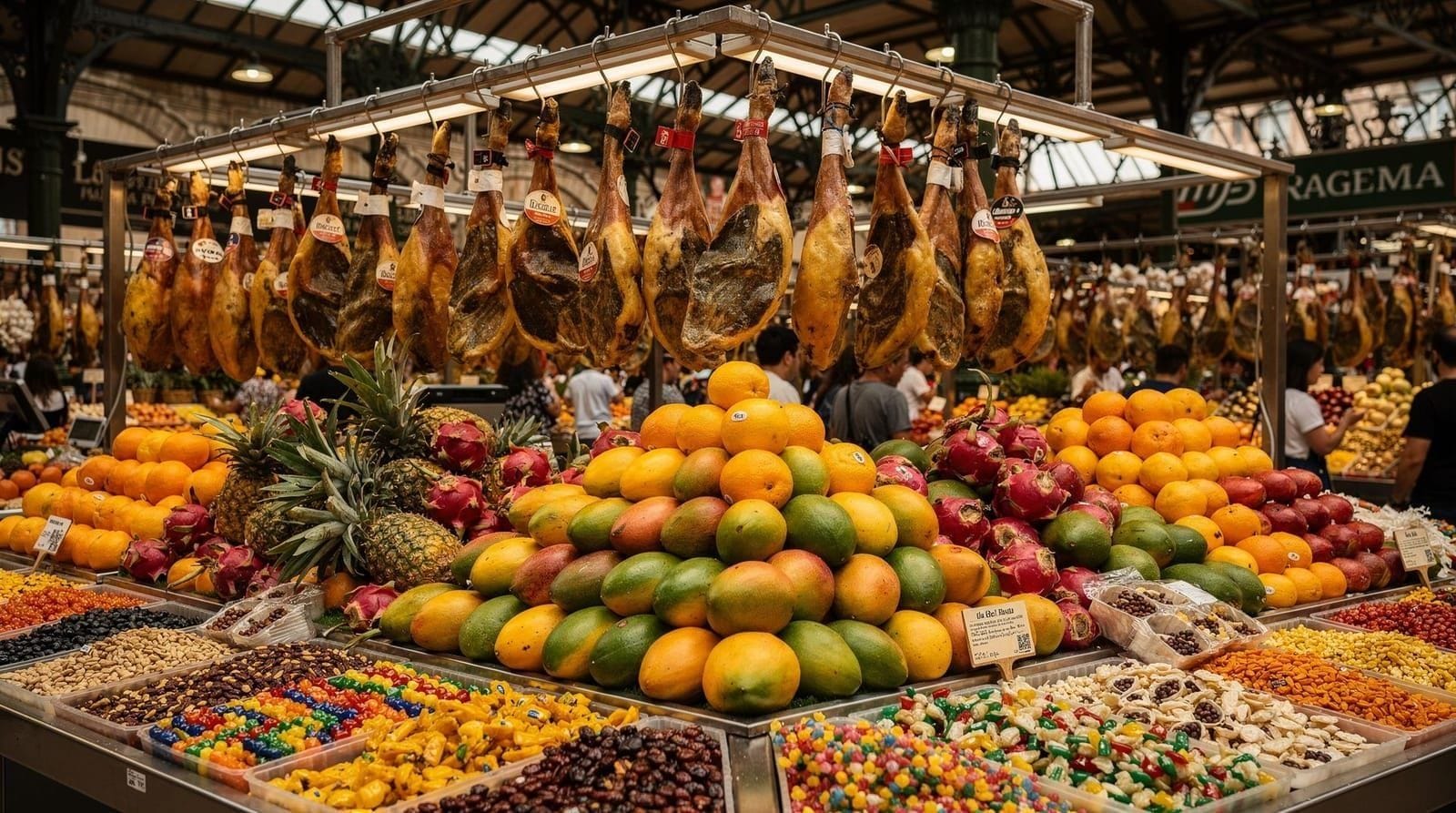
Barcelona: Boqueria market & Gothic Quarter street food tour
- Free cancellation
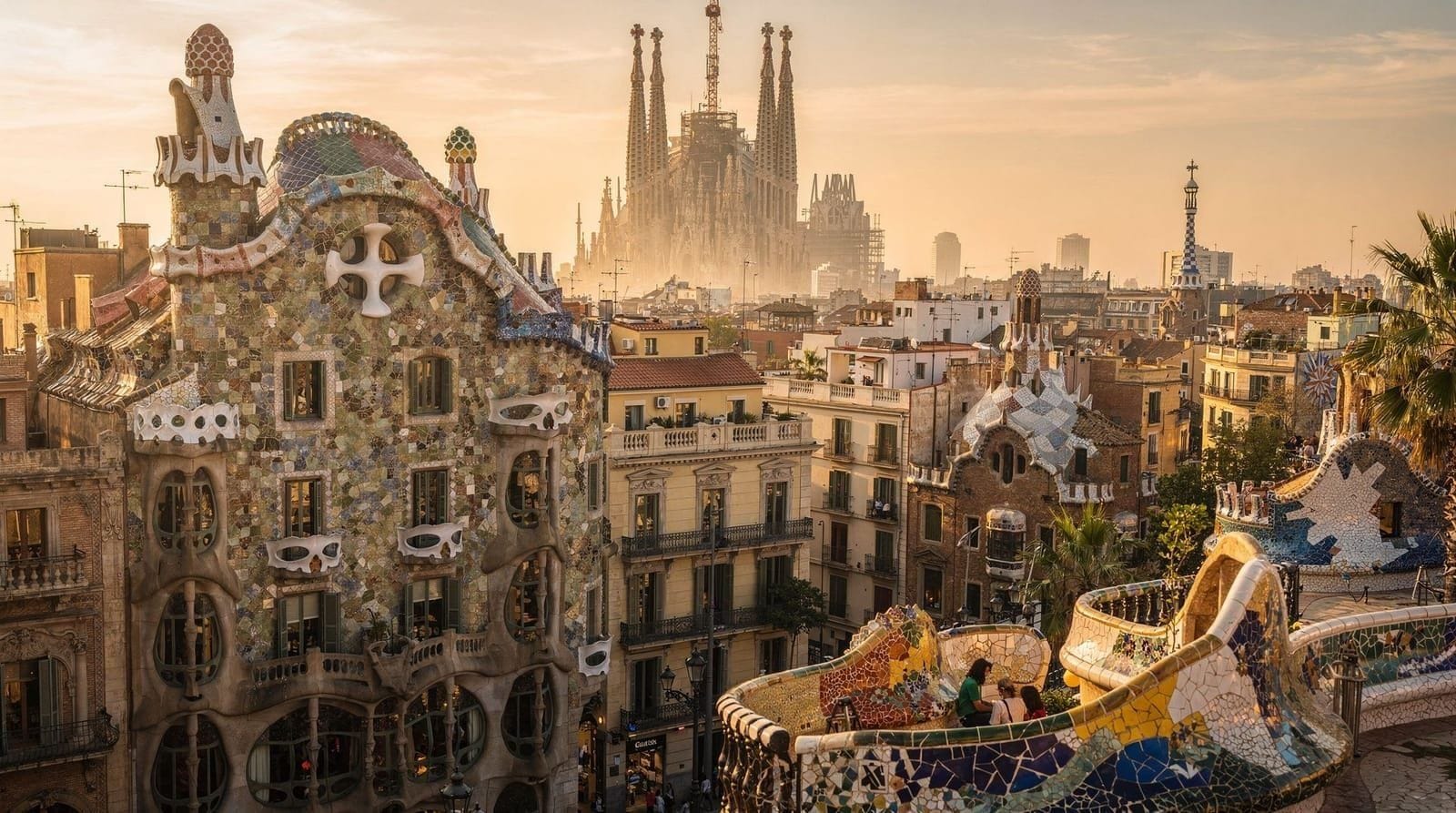
Barcelona: highlights walk – Ramblas, old town and Gaudí sights
- Free cancellation
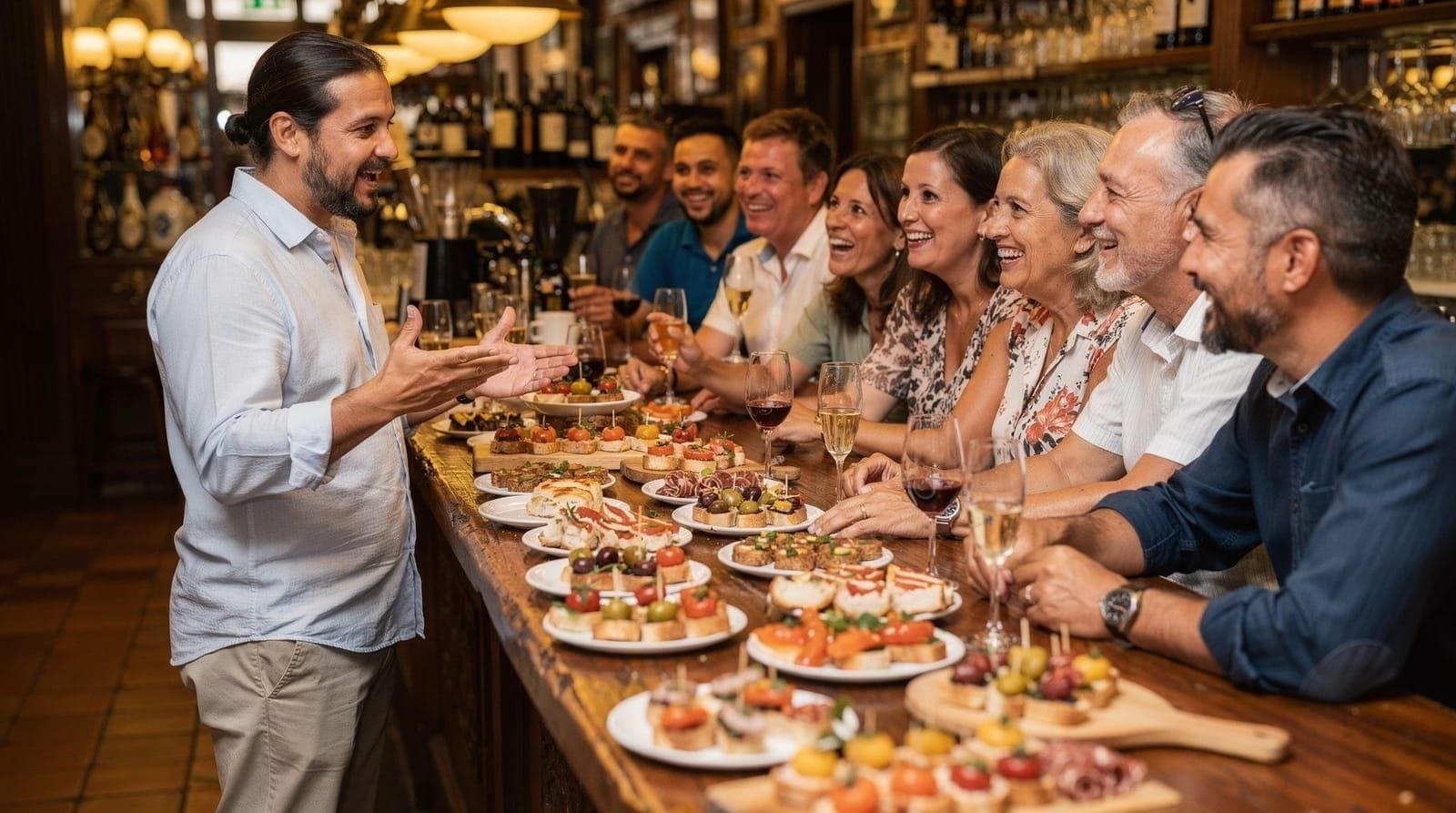
Barcelona: Gothic Quarter legends walking tour with tapas
- Free cancellation