Barcelona Zoo and Aquarium: complete visiting guide 2026
Barcelona: 1-day ticket to Barcelona Zoo
Duration: Full day
- Free cancellation
- Skip the line
Should we visit the Zoo or the Aquarium with kids, or both?
Both are worth doing, but they suit different ages and energy levels. The Zoo is larger (allow a full day) and better for children aged 4 and above who enjoy walking and outdoor exploration. The Aquarium takes 2-3 hours and is more manageable with toddlers. They are 15 minutes apart and genuinely combinable over two days, though doing both in a single day is possible if you are efficient.
Two of Barcelona’s most visited family attractions — the Zoo and L’Aquàrium — are less than 15 minutes apart and anchor the same corner of the city, making them natural companions in any family itinerary. They are also genuinely different experiences: the Zoo is an outdoor, all-day proposition across 13 hectares with 400 species and a strong emphasis on African wildlife; the Aquarium is a focused, air-conditioned 2-3 hour visit built around a spectacular underwater tunnel and 35 specialised tanks. Together they cover the interests of most children from ages 3 to 14, and the area around them — Parc de la Ciutadella, Port Vell, Barceloneta beach — provides additional free activities that round out a two-day programme.
This guide covers both attractions in full: what to see, when to go, how long to allow, how to get there and how to combine them effectively.
| Where | Parc de la Ciutadella (Zoo) and Port Vell (Aquarium), 15 min apart |
| Cost | around €22 adult / €14–17 child, each attraction |
| Time needed | Zoo: full day; Aquarium: 2-3 hours |
| Getting there | Metro L4 to Ciutadella-Vila Olímpica (Zoo) or Barceloneta (Aquarium) |
| Best time | Weekday mornings, spring or autumn |
Barcelona Zoo: what it actually is
The Zoo occupies 13 hectares of Parc de la Ciutadella, a 17-hectare public park just east of the Gothic Quarter. It is one of the older zoos in Spain — founded in 1892 — and houses around 400 species across a well-maintained outdoor environment with significant tree cover, which makes it more comfortable on hot days than an open-air zoo would be.
The scale matters for planning. Thirteen hectares is genuinely large. A motivated adult walking briskly could cover the main paths in two hours, but with children stopping at enclosures, watching feeding sessions and visiting the dolphin show, a full day is realistic and not at all wasteful. Families with children under 5 who tire quickly should plan to see roughly half the Zoo in a morning and treat the dolphin show as the centrepiece.
The main exhibits
Gorillas and great apes: The western lowland gorilla enclosure is one of the Zoo’s strongest exhibits — a substantial forested environment where the group’s social dynamics are often visible. The chimpanzee area is adjacent. These exhibits tend to be more engaging in the mornings when the animals are active.
Komodo dragons: One of the less expected highlights. Barcelona Zoo has maintained Komodo dragons for decades and the enclosure gives a close view of the animals. Children who have seen them in wildlife documentaries are often surprised by their size in person — adults reach 2.5-3 metres in length.
African savannah area: Giraffes, hippos and rhinos. The giraffe enclosure has a raised viewing platform that puts the animals at eye level. The hippo pool is partially underwater-viewable through glass panels.
Reptile house: Large and well organised, covering snakes, lizards, crocodilians and tortoises. Good for a hot afternoon when the outdoor areas are less comfortable.
Marine mammals and the dolphin show: The dolphin show is the Zoo’s most popular scheduled event. Shows run at 11:30, 13:30 and 16:00. The 16:00 show is often the most crowded; the 11:30 show is the calmest if you are arriving early. The show lasts around 20 minutes. The dolphin area also has a viewing gallery for the animals’ everyday behaviour between shows.
Farmyard area (la granja): Near the main entrance, designed for young children. Rabbits, goats, sheep and poultry in a hands-on setting. Reliably popular with the 2-5 age group.
Elephant area: Barcelona Zoo has been reducing its elephant programme in recent years in response to welfare debates. Check the current situation before visiting if this is a priority for your family.
Practical details for the Zoo
Opening hours are 10:00-18:00 in winter (roughly October to late February), 10:00-19:00 in spring and autumn, and 10:00-20:00 in summer. The Zoo does not admit new visitors in the final hour before closing.
Admission: adults €22, children 3-12 years €14, under 3 free. Buying online in advance avoids the ticket queue at the main entrance, which can be 15-20 minutes long in summer. There are no timed entry slots — arrival is flexible throughout the day.
There are three food points inside the Zoo: a central cafeteria near the dolphin show, a kiosk near the African area, and a smaller bar near the entrance. Quality is adequate rather than good. If you are visiting on a warm day, bringing water and snacks reduces dependence on these facilities.
The Zoo has a dedicated buggy park near the entrance where you can leave strollers while navigating narrower paths, though most main routes are stroller-accessible.
Getting to the Zoo: Metro L4 (yellow line) to Ciutadella-Vila Olímpica. Exit the station and walk through the park entrance — the Zoo gates are around 5 minutes through the park. If you are using the hop-on hop-off bus, there is a stop on Passeig de Pujades adjacent to the park’s northern edge.
Parc de la Ciutadella: free time before or after the Zoo
The park surrounding the Zoo is open to the public at no charge and worth an hour in its own right, either before entering the Zoo or after leaving.
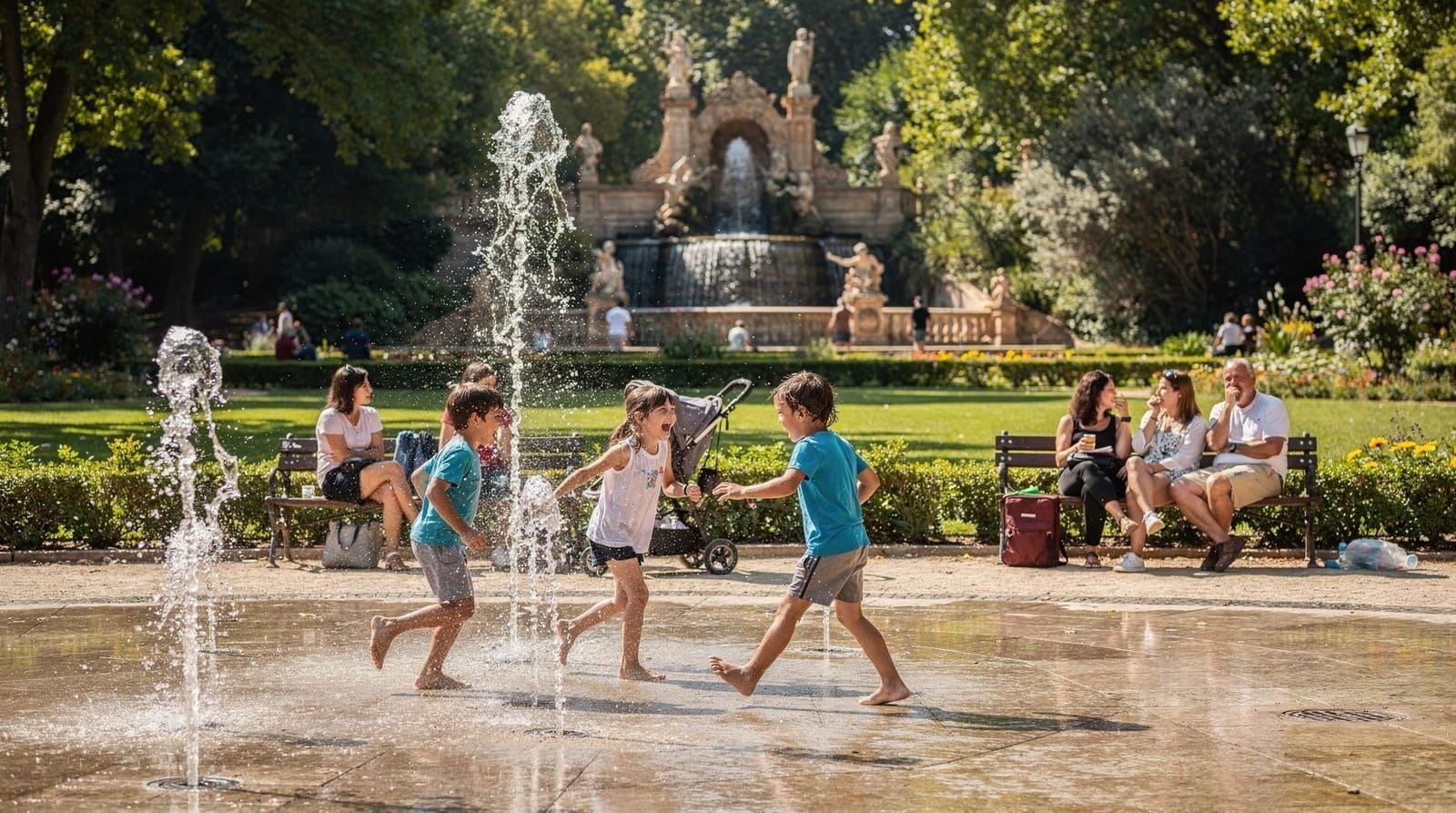
The ornamental lake in the centre of the park has rowing boat hire (around €6-8 for 30 minutes) which is a straightforward pleasure for families and usually has minimal queuing. The Cascada Monumental — a large neo-baroque waterfall and pond complex at the park’s northern end — is worth finding. It was designed in the 1870s and partly attributed to a young Antoni Gaudí during his student years, though historical accounts vary on the extent of his involvement.
The park has good shade, lawns suitable for picnicking and a general relaxed atmosphere on weekday mornings. Weekend afternoons are significantly busier with local families.
L’Aquàrium Barcelona: what it actually is
L’Aquàrium is at the southern end of La Rambla, on the Port Vell waterfront next to the Maremàgnum shopping centre. It opened in 1995 and remains one of the largest aquariums in Europe. The building is compact relative to the Zoo — a single building with 35 tanks over two floors — and the visit is correspondingly focused: 2-3 hours is the right allocation.
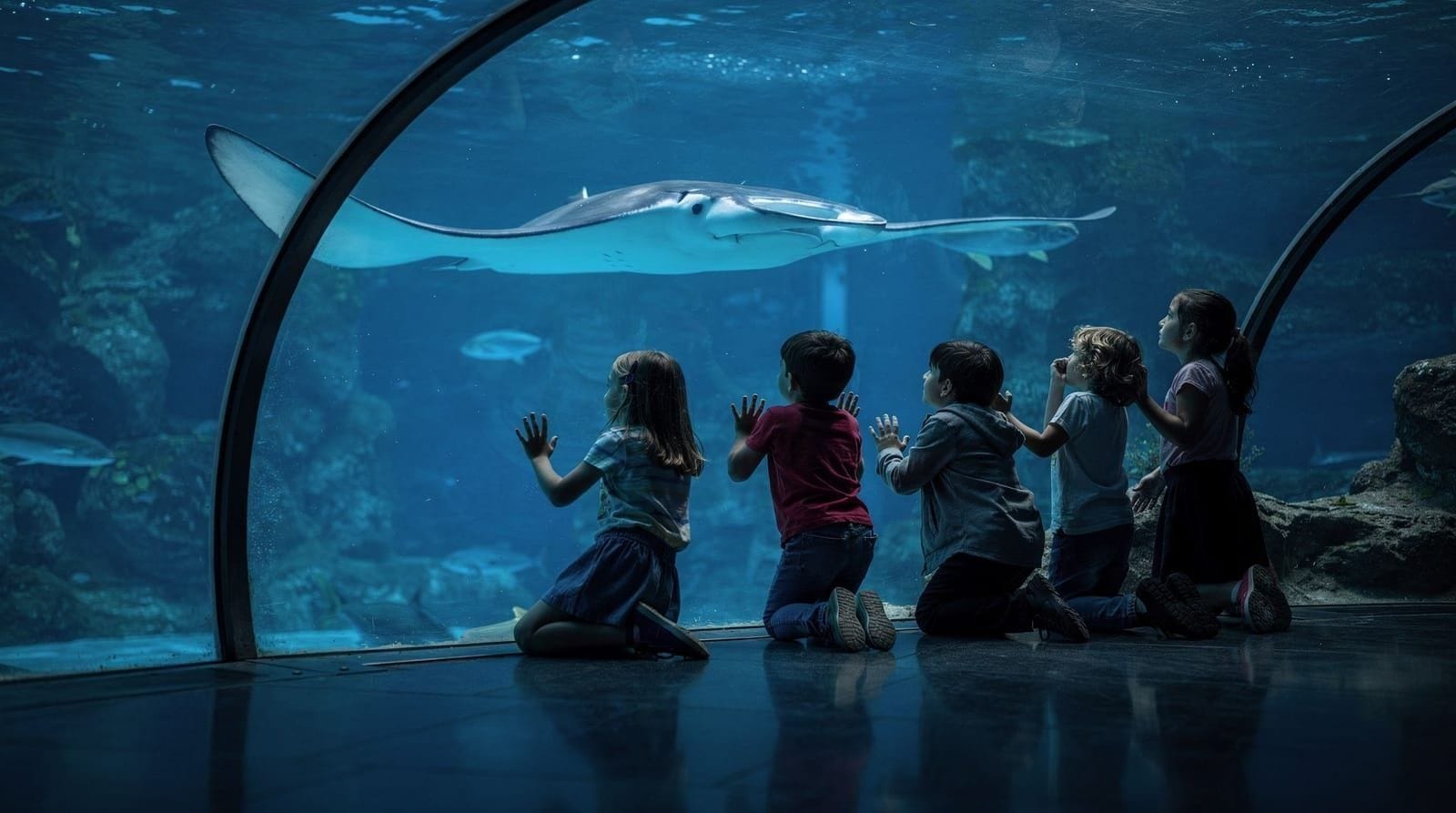
The attraction’s centrepiece is the Oceanari, an 80-metre glass tunnel running through a 4-million-litre tank housing sharks (including sand tiger sharks), rays, large sea turtles, groupers and numerous other species. Visitors walk through the tunnel on a moving walkway, with marine life passing on both sides and overhead. The effect is consistently impressive and the tunnel is long enough that it does not feel rushed. Children who are ambivalent about aquariums generally respond to this.
The 35 tanks
Beyond the main tunnel, the Aquarium’s tanks cover:
Mediterranean sea life: The largest section, covering the full range of species found in the Western Mediterranean — sea bream, dentex, groupers, moray eels, octopus, sea horses and extensive coral formations. Several tanks are open-topped with the ability to feel the water.
Tropical fish: Two large tanks dedicated to Indo-Pacific species, covering the colour range that most children associate with aquariums — clownfish, angelfish, surgeonfish, lionfish and reef formations.
Rockpools (Explora): An interactive section where children can touch starfish, sea cucumbers and other tactile species under staff supervision. Well designed and genuinely popular with the 4-10 age group.
Jellyfish tanks: A dedicated jellyfish gallery with backlighting that makes it the most photogenic section of the Aquarium. Moon jellyfish, lion’s mane jellyfish and other species in floor-to-ceiling cylindrical tanks.
Rays: A separate shallow tank where rays swim close to the surface, occasionally breaking the water. Feeding sessions take place here several times daily — check the board at the entrance for times.
Sharks: The main tunnel contains most of the shark species, but there are supplementary tanks with smaller species and information panels on shark biology and conservation.
Practical details for the Aquarium
Opening hours are 10:00-19:30 in winter and 10:00-21:00 in summer. The Aquarium is fully air-conditioned and the late opening in summer makes it a practical option for the 14:00-17:00 heat window that is otherwise difficult outdoors.
Admission: adults €22, children aged 3-10 €17, under 3 free. Note that the children’s age cut-off here (10) is different from the Zoo (12). Children aged 11 and 12 pay adult rate at the Aquarium.
There is a café and a larger restaurant inside the Aquarium, both of which are more pleasant than the Zoo’s food options. The Maremàgnum shopping centre adjacent to the Aquarium has a food court if you need more options.
Getting there: Metro L4 to Barceloneta, then a 5-10 minute walk along the waterfront. The Aquarium entrance is well signposted from the station. If you are coming directly from the Zoo, you can also walk along the waterfront from Ciutadella-Vila Olímpica to Port Vell in around 20 minutes on flat ground.
The combination ticket that includes the hop-on hop-off bus and Aquarium entry (€40) is worth considering if you are planning to use the bus during your stay. The bus route covers most major tourist areas and the Aquarium entry is then a bonus rather than an add-on cost. See our full hop-on hop-off bus guide for route details.
How to combine Zoo and Aquarium: realistic planning
The most common question from families is whether to do both in a single day. Here is an honest assessment.
Single day (possible but full): Arrive at the Zoo at 10:00 when it opens. Spend the morning covering the priority exhibits — gorillas, giraffes, reptile house — and attend the 13:30 dolphin show. Leave the Zoo around 14:30-15:00. Walk or take one metro stop to Barceloneta, then continue to Port Vell. Enter the Aquarium around 15:30 and allow 2-2.5 hours, finishing around 18:00. This works if your children have good energy and you move purposefully through the Zoo. It is too much for children under 4 or families who move slowly.
Two days (recommended): Zoo on one day, Aquarium on the other. This lets you spend a relaxed full day at the Zoo — including the 11:30 dolphin show, a proper lunch, and the further enclosures — and gives the Aquarium proper time rather than treating it as a rushed add-on. Use the second day to combine the Aquarium with a morning on Barceloneta beach or a walk through El Born.
With the hop-on hop-off bus: The bus + Aquarium combo ticket simplifies navigation if you are doing both in a single day, removing the need to plan metro connections. You can board the bus outside the Zoo (Passeig de Pujades stop) and disembark at the Aquarium/Port Vell stop without working out transfers.
Getting around: the L4 line and Port Vell area
Both attractions are served by the L4 Metro line (yellow), which runs from Trinitat Nova in the north through central Barcelona to La Pau in the south. The key stations:
- Ciutadella-Vila Olímpica: 5-minute walk to Zoo entrance through Parc de la Ciutadella
- Barceloneta: 5-10 minute walk to Aquarium; also the closest station to the beach
A T-Casual 10-trip card costs €13 and covers unlimited rides per tap (i.e., each trip costs €1.30 within Zone 1). Two adults making 10 trips each over a week’s stay would buy one card each. Children under 4 travel free. For more on transport options and passes, see our transport pass comparison and getting around Barcelona guide.
The area around Port Vell — the old harbour — is itself pleasant to walk through, with the Columbus monument, the covered Palau de Mar buildings and the waterfront promenade. If you are visiting the Aquarium in the evening in summer, the harbour at dusk is a good place to be before or after.
Honest tips for each attraction
Zoo: Go on a weekday if possible. Weekend mornings from 11:00 onward can be very crowded at the dolphin show and the most popular enclosures. The Zoo is also more enjoyable in spring (March-May) and autumn (September-October) than in midsummer — heat reduces animal activity and the lack of shade on the African savannah section becomes noticeable.
Zoo: Buy tickets online the day before. Not because they sell out (they rarely do), but because the ticket queue at the door on a busy Saturday in August can add 20 minutes to an already full day.
Aquarium: The moving walkway through the main tunnel is slow by design. If the children want to go back through, staff will usually let you re-enter the tunnel section. It is worth asking.
Aquarium: The most crowded time is 11:00-14:00 on weekends and public holidays. A late afternoon visit on a weekday is significantly calmer.
Both: Food inside either attraction is overpriced for what it is. The Barceloneta neighbourhood, a 10-minute walk from the Aquarium, has a wider range of restaurants at better prices — particularly on the streets one block back from the beach. The Parc de la Ciutadella has benches and lawns suitable for picnicking if you bring your own food.
Extending the day: what else is nearby
The Zoo and Aquarium sit within a cluster of family-friendly options. Within easy walking distance:
El Born neighbourhood: 5-10 minutes walk from the Zoo. One of Barcelona’s best-preserved medieval quarters with a central market hall (the Mercat de Santa Caterina) and the Born Cultural Centre built over archaeological remains. Good for a half-morning of exploration.
Barceloneta beach: 10 minutes walk from the Aquarium. The main city beach is serviceable rather than spectacular, but children who need a couple of hours in the sea after indoor attractions will be satisfied. Facilities are good (lifeguards, showers, beach bars).
Barceloneta market (Mercat de la Barceloneta): A small, working neighbourhood market on Plaça del Poeta Boscà, good for picking up fruit and provisions.
For a broader plan covering the full range of family activities in Barcelona, including Tibidabo amusement park and CosmoCaixa, our Barcelona with kids guide builds a complete week-by-week programme. For the CosmoCaixa science museum, which pairs naturally with a Tibidabo visit on the same day, see our CosmoCaixa and Tibidabo guide.
A few points worth knowing before you book: both attractions accept online booking and walk-up on the day; neither requires booking weeks in advance except in the busiest weeks of July and August. The Zoo is significantly larger and more demanding of energy than the Aquarium, so sequence them accordingly — Zoo first, Aquarium second, whether that is in the same day or spread across two.
Barcelona’s Zoo and Aquarium represent two distinct ways of spending a day with children, and they complement each other well precisely because they are so different in character. The Zoo’s scale and outdoor environment suit children who want to roam; the Aquarium’s concentrated, air-conditioned structure suits shorter attention spans or hot afternoons. Together, and with Parc de la Ciutadella as a free connector between them, they anchor a solid two days in the eastern part of the city — which can then be extended with Tibidabo, CosmoCaixa or a day at PortAventura depending on how much of the family’s appetite for organised attractions remains.
A sample two-day plan
Day one — Zoo and Parc de la Ciutadella: Arrive at 10:00 when the Zoo opens and head straight for the gorillas and great apes while the animals are most active. Work through the African savannah area and reptile house before lunch at the central cafeteria, or bring your own food for the park’s lawns. Time the early afternoon around the 13:30 dolphin show, then spend the final hour at the farmyard area if you have younger children, or the Komodo dragon enclosure if older kids want one more highlight. Leave the Zoo by mid-afternoon and spend the last hour of daylight in Parc de la Ciutadella itself — the rowing boats on the ornamental lake are a good way to wind down a full day without asking for more walking.
Day two — Aquarium and Barceloneta: Sleep in a little, since the Aquarium needs only half a day. Arrive mid-morning, before the 11:00-14:00 weekend crowd if it’s a Saturday or Sunday, and allow 2-2.5 hours to move through the tunnel and the 35 tanks at a relaxed pace. Finish around lunchtime and walk 10 minutes to Barceloneta for food and beach time — the neighbourhood’s streets one block back from the sand have better and cheaper options than anything inside either attraction. This sequencing avoids the single long day described above entirely and works well for families with children of any age, including toddlers who would struggle with a full Zoo day.
Weather and seasonal planning
The Zoo rewards seasonal thinking more than the Aquarium does, since it’s an outdoor attraction. Spring (March-May) and autumn (September-October) offer the most comfortable walking conditions and the most active animals — heat noticeably reduces activity in the African savannah section during midsummer, and the lack of shade there becomes a real factor on a 35°C August afternoon. If your trip falls in July or August, plan the Zoo visit for the morning and treat the Aquarium as the natural afternoon retreat into air conditioning; the guide’s opening comparison table reflects this trade-off in the “weather-proof” row. Winter visits (November-February) are the quietest at both attractions and the Zoo’s shorter opening hours (10:00-18:00) still allow a full visit if you arrive close to opening.
Accessibility and visiting with very young children
Both attractions are stroller-accessible on their main routes, though the Zoo’s paths are wider and easier to navigate with a buggy than the Aquarium’s tunnel, which narrows in places and can feel crowded with strollers during peak hours. The Zoo’s buggy park near the entrance is useful if you want to carry a toddler through the narrower side paths rather than pushing a stroller the whole way. Baby-changing facilities exist at both sites. For families travelling with a child under 2, the Aquarium’s shorter, climate-controlled format is generally the easier of the two attractions, and it pairs naturally with a stroller-friendly stretch of the getting around Barcelona guide’s recommended routes if you’re combining it with other flat, walkable sights that day.
Zoo vs Aquarium: quick comparison
| Zoo | L’Aquàrium | |
|---|---|---|
| Time needed | Full day | 2-3 hours |
| Best age range | 4+ | Any, including toddlers |
| Setting | Outdoor, 13 hectares | Indoor, air-conditioned |
| Adult ticket | €22 | €22 |
| Child ticket | €14 (3-12) | €17 (3-10) |
| Weather-proof | No | Yes |
| Nearest metro | Ciutadella-Vila Olímpica | Barceloneta |
Booking tickets: online vs at the gate
Neither attraction uses timed entry, so buying online mainly saves queuing rather than guaranteeing a slot. For the Zoo, the ticket line at the main gate can run 15-20 minutes on a busy summer Saturday; for the Aquarium, queues build fastest between 11:00 and 14:00. If your trip includes several paid family attractions, it’s worth checking whether a combined pass makes sense — our Barcelona Card guide and Hola Barcelona card guide cover which multi-attraction passes are actually worth the money for a family itinerary, since neither the Zoo nor the Aquarium is included on every pass.
If you only have time for one
Families with a single free day and children under 4 generally get more out of the Aquarium — shorter, air-conditioned, and less physically demanding. Families with children aged 5 and up who enjoy walking and animals get more out of the Zoo, particularly if you time it around the dolphin show. If you’re also weighing Tibidabo or CosmoCaixa against this choice, the Aquarium is the easiest to combine with either on the same day since it needs only half a day itself.
Frequently asked questions about Barcelona Zoo and Aquarium
What are the opening hours for Barcelona Zoo?
The Zoo opens at 10:00 year-round. Closing time varies by season: 18:00 in winter (roughly October to February), 19:00 in spring and autumn, and 20:00 in summer (July and August). Check the official website before visiting as hours can shift by a week or two around seasonal transitions.What are the opening hours for L'Aquàrium Barcelona?
L'Aquàrium opens at 10:00 daily. It closes at 19:30 in winter and at 21:00 in summer. The later summer closing makes it one of the better options for a hot afternoon, as the building is fully air-conditioned.How much do tickets cost at Barcelona Zoo?
Adult tickets are €22; children aged 3-12 pay €14; children under 3 enter free. These prices are at the gate. Buying in advance online can save a few euros and avoids queuing at the ticket desk in peak season.How much do tickets cost at L'Aquàrium Barcelona?
Adult tickets are €22; children aged 3-10 pay €17; under 3 is free. There is no significant discount for buying online versus at the door, though advance purchase avoids ticket queues in summer.Can we do the Zoo and Aquarium in the same day?
Technically yes, but it is a long day for children. The Zoo alone warrants a full day if you want to see everything. A realistic same-day combination means arriving at the Zoo at opening (10:00), spending the morning through to early afternoon, then taking the 15-minute walk or metro ride to the Aquarium for a late afternoon and early evening visit. Prioritise the dolphin shows (11:30, 13:30, 16:00) when planning your Zoo timing.What is the best way to get to Parc de la Ciutadella and the Zoo?
Take Metro L4 (yellow line) to Ciutadella-Vila Olímpica. The Zoo entrance is a 5-minute walk through the park from the station. For the Aquarium, take L4 to Barceloneta — the Aquarium is at the end of La Rambla, on the Port Vell waterfront, a 5-10 minute walk from the station.Is the dolphin show at Barcelona Zoo included in the ticket?
Yes, the dolphin show is included in the standard Zoo admission. Shows run at 11:30, 13:30 and 16:00. Arrive 10-15 minutes before your chosen time to get a good position. The 11:30 show tends to be the least crowded.Are there any combo tickets covering both Zoo and Aquarium?
There is no official Zoo + Aquarium combo ticket. Each attraction is sold separately. The hop-on hop-off bus does offer a combo with Aquarium entry (€40) which can be useful if you are using the bus to get around the city anyway, but it does not include Zoo admission.
Top experiences
Bookable activities with verified prices and instant confirmation on GetYourGuide.