Catalan music and culture vs flamenco: what's actually local
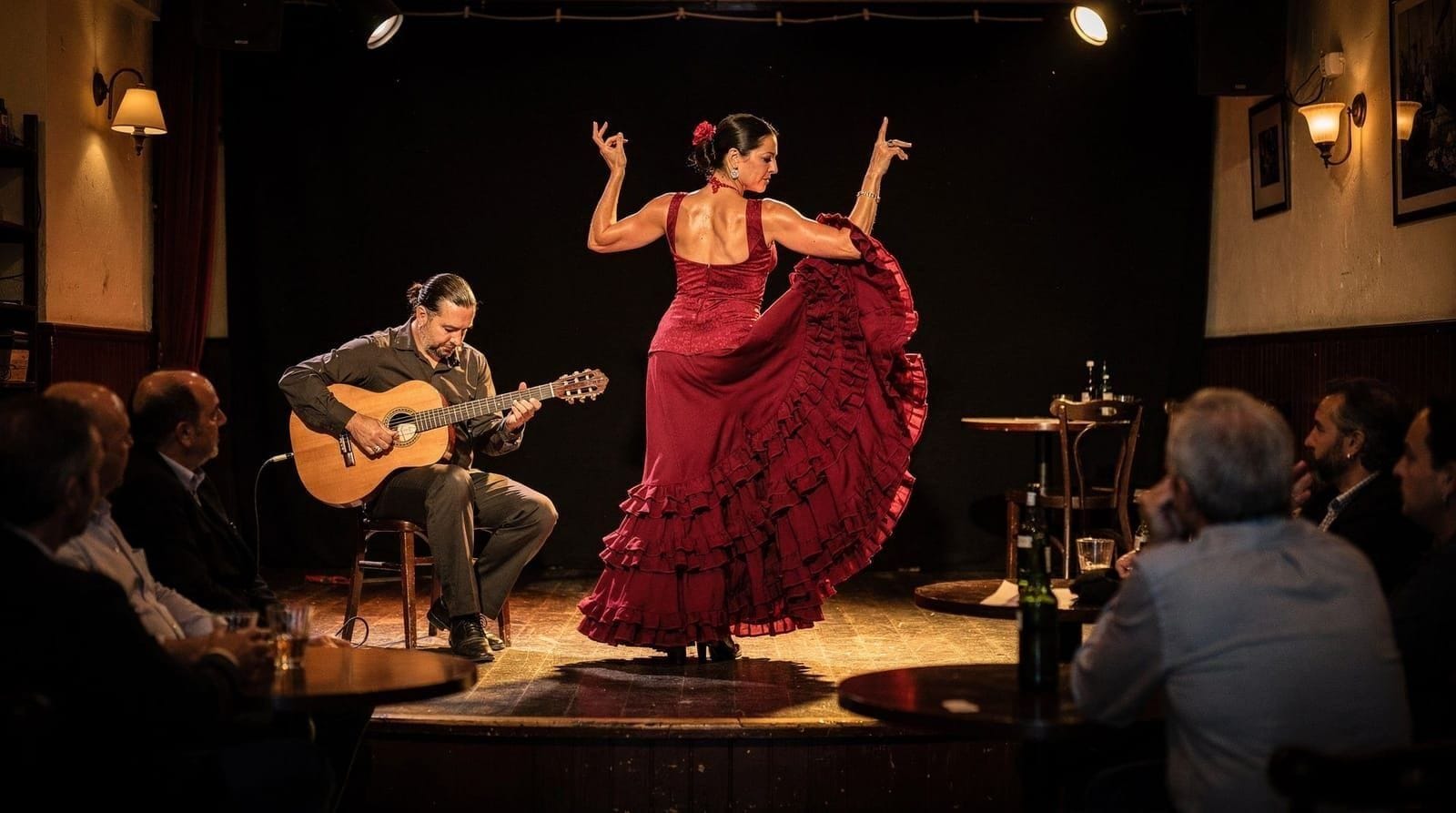
Barcelona: flamenco show at Tablao Flamenco Cordobes
Duration: 1 hour
- Free cancellation
Is flamenco from Catalonia or Andalusia?
Flamenco is Andalusian — from Seville, Cádiz and Jerez in southern Spain. It is not a Catalan tradition. The shows in Barcelona are performed by professional artists but represent an imported art form. Genuinely Catalan musical and performance culture includes sardana dancing, castellers (human towers), havaneres sea shanties and concerts at the Palau de la Música Catalana.
Barcelona is in Spain. But Barcelona is also in Catalonia. The distinction matters more than most travel media acknowledges, and it matters a great deal when you are trying to understand what is genuinely local versus what is packaged for tourists who conflate the two.
| Genuinely Catalan | Sardana, castellers, havaneres, Palau de la Música |
| Not Catalan | Flamenco (it’s Andalusian) |
| Best free option | Sardana, Sunday noon, Plaça de la Catedral |
| Best paid option | Concert or guided tour at the Palau de la Música |
| Best annual week | La Mercè, 23–27 September |
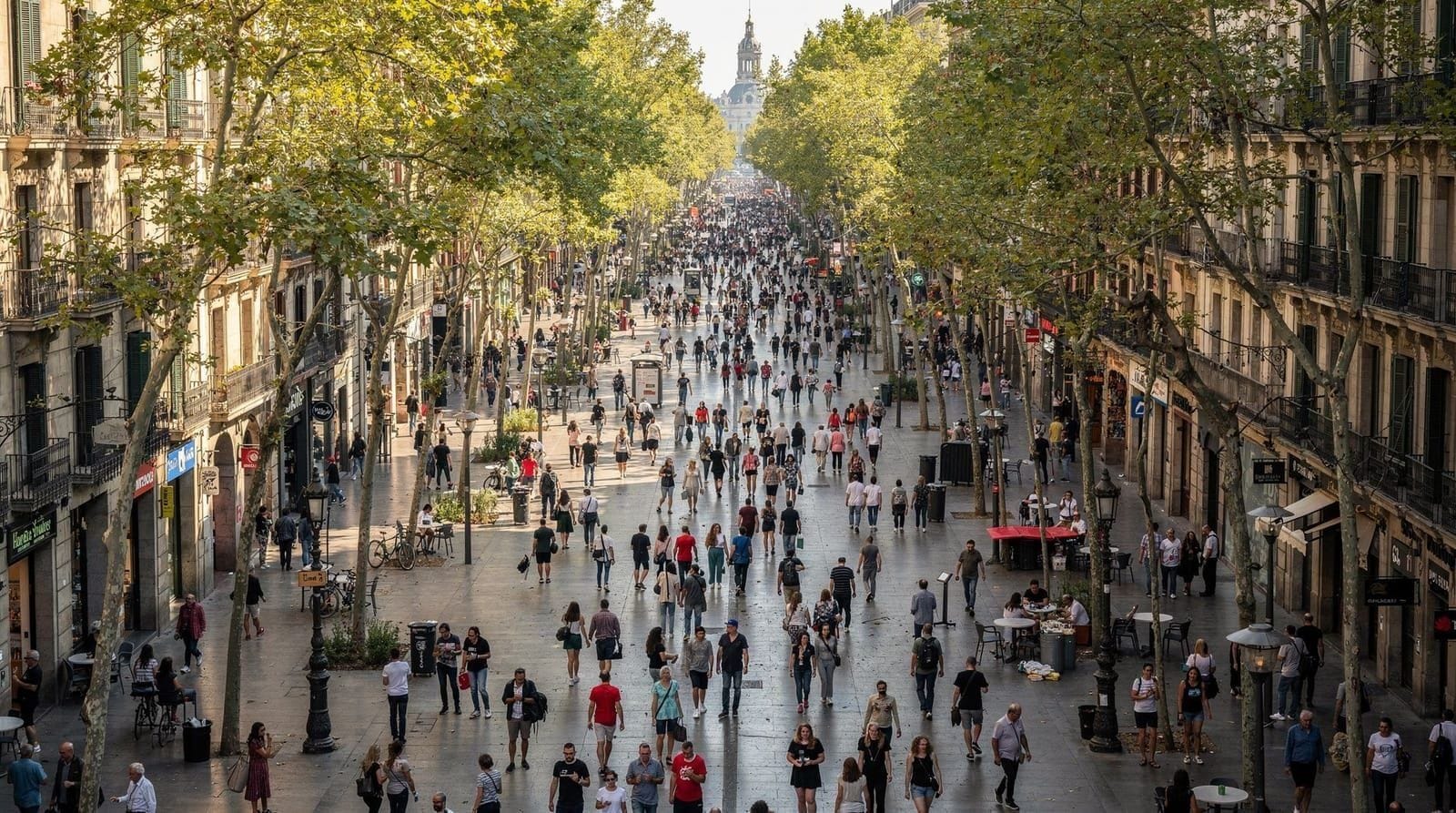
Flamenco is the most prominent example. Every tourist strip from La Rambla to the Gothic Quarter is lined with flamenco show advertisements. Most general Spain travel content presents flamenco as representative of the country as a whole. Catalan people — the majority of Barcelona’s residents — will often correct you firmly and politely if you suggest flamenco is their tradition.
This guide covers what flamenco actually is, why it is not Catalan, and what the genuine performing traditions of Catalonia look like.
What flamenco is — and where it is from
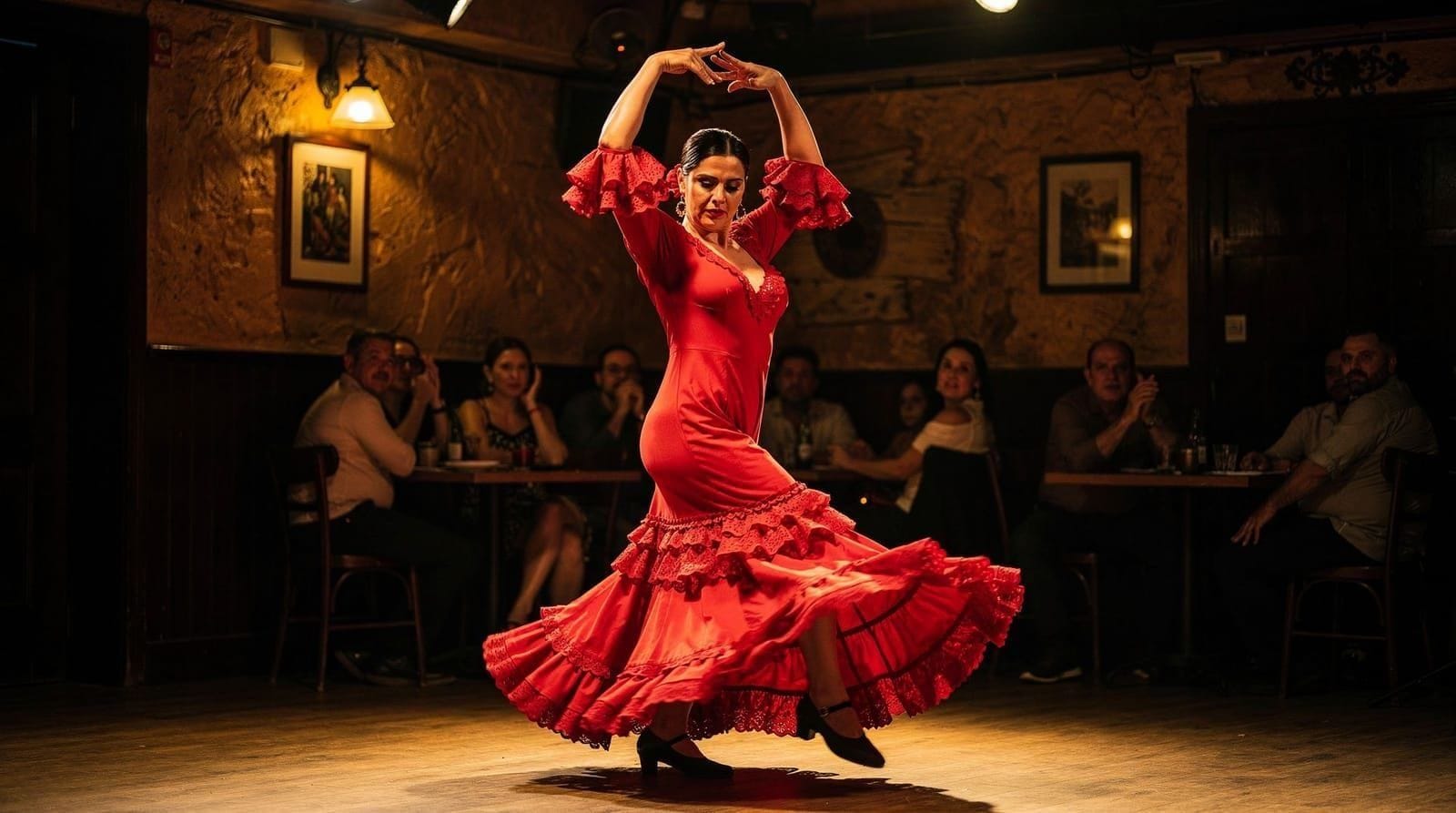
Flamenco is a UNESCO-designated Intangible Cultural Heritage originating in Andalusia — southern Spain. Its three components (cante, baile and toque — singing, dance and guitar) developed over centuries from Romani, Moorish, Jewish and Castilian musical influences in the towns and cities of Seville, Cádiz, Jerez de la Frontera and Córdoba.
The flamenco tradition is as specifically Andalusian as fado is Portuguese or the corrido is Mexican. Transplanting it to Barcelona for tourist consumption does not change its origins — it simply makes it an imported art form performed in a foreign city.
The shows in Barcelona’s tablaos (see our flamenco venues guide) are performed by professional artists. Many of the best performers are from Andalusia specifically. The art form itself is worth experiencing. What it is not is something native to the city you are visiting.
What is actually Catalan
Sardana
The sardana is the national dance of Catalonia. It is performed in a circle — sometimes two concentric circles — with interlocking arm holds, to the music of a cobla ensemble. The cobla is a distinctive Catalan wind band: flabiol (a small flute), tamborí (drum), tible and tenora (double-reed instruments unique to Catalonia), trumpets, trombones and a bass.
The dance has a specific structure: a sequence of curts (short phrases, small steps) and llargs (long phrases, large steps) that repeat in a pattern. The counting is not obvious to observers but the dance is participatory — anyone can join an existing circle as a dancer arrives, which is the social invitation. Dancers place their belongings — bags, jackets — in a small pile at the centre of the circle before starting, a practical custom that also visually marks the circle’s centre and gives the dance its characteristic look from a distance.
Wear comfortable flat shoes if you intend to join a circle rather than just watch, since the steps involve small hops and precise footwork that’s harder in sandals or heels.
Where to see sardana in Barcelona:
- Every Sunday at noon in the Plaça de la Catedral (the square in front of the Cathedral) — completely free, open to all. A group of serious dancers forms, usually 20–50 people. Visitors are welcome to join if they can follow the pattern; watching from the perimeter is fine.
- Saturday evenings in summer in various neighbourhood squares (Plaça de Sant Jaume, Plaça del Rei). Check the Federació Sardanista website for the current schedule.
The sardana is not spectacular in the way that flamenco is spectacular. It does not have the fire, the stamping, the castanets or the theatrical costume. It is a communal, collective, deeply Catalan practice — and one that has persisted through periods when the Catalan language and cultural expression were officially suppressed.
Castellers (human towers)
Castellers are human tower builders. Colles castelleres (competing groups, each from a specific town or neighbourhood) stack members on each other’s shoulders in towers of increasing complexity and height. The towers are measured in pisos (floors) and discs — a “4 de 8” means 4 people per floor across 8 floors, which is a high intermediate level. The best colles achieve 9 and 10 pisos.
The tradition is strongest in central Catalonia — Vilafranca del Penedès, Valls, Tarragona — but Barcelona has its own main colla (Castellers de Barcelona) and several neighbourhood colles. Castellers are inscribed on UNESCO’s Intangible Cultural Heritage list.
Where to see castellers in Barcelona:
- La Mercè festival (September 23–27): The city’s main patron saint festival features the most significant casteller performances of the year in Plaça de Sant Jaume. The best colles from across Catalonia compete in the open plaza. This is the most accessible annual performance for visitors.
- Festa Major de Gràcia (August 14–20): The Gràcia neighbourhood festival includes casteller performances alongside its famous street decorations.
- Sant Jaume day (July 25): Plaça de Sant Jaume.
The experience of watching castellers is extraordinary. The base (pinya) is a compressed human mass of hundreds of people providing stability; the castle rises above with alarming speed; the enxaneta (the small child who crowns the tower and signals success with a raised four-fingered salute) climbs to the top in seconds. The collective silence during the ascent, the explosion of celebration when the enxaneta reaches the top, and the controlled dismantling back down are among the most genuinely affecting public spectacles in Spain.
Palau de la Música Catalana
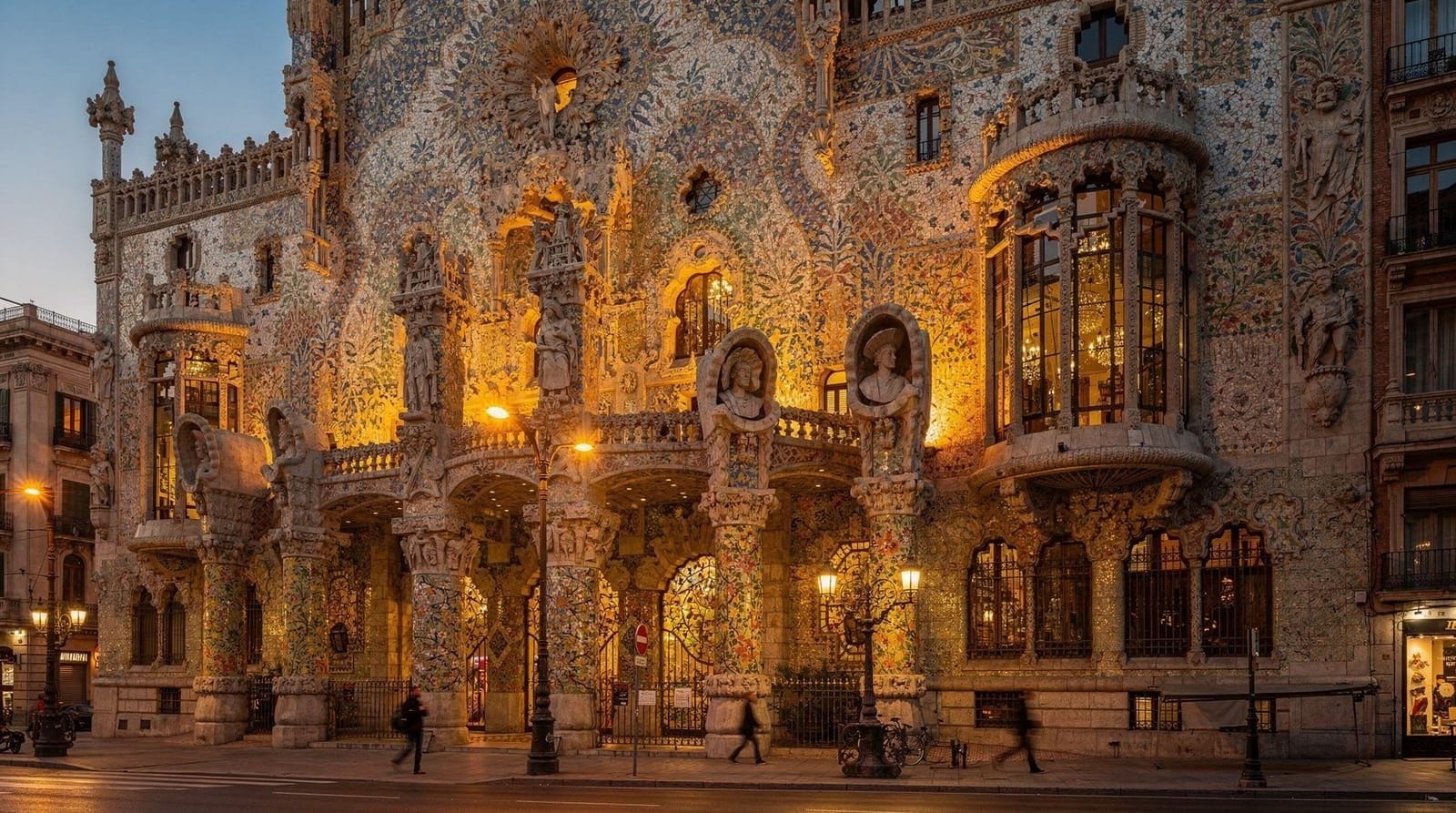
Designed by Lluís Domènech i Montaner and completed in 1908, the Palau de la Música is a UNESCO World Heritage Site and one of the most spectacular concert halls in the world. The main auditorium is lit entirely by natural light through a stained glass ceiling; every surface is covered in floral Modernisme decoration in ceramic, ironwork, and sculpture.
The Palau was commissioned by the Orfeó Català — the Catalan choral society founded in 1891 as part of the Renaixença (cultural and linguistic revival) of Catalan identity. Music and Catalan cultural identity have been inseparable here since the building opened.
Concerts: The Palau hosts the Barcelona Symphony Orchestra (OBC), chamber music, choral performances, flamenco (as a programmed guest art form, not a resident tradition), jazz and international artists. Programme at palaumusica.cat.
Guided tours: The building itself can be visited on daily tours even without attending a performance. Seeing the Domènech i Montaner interiors — the glass ceiling, the ceramic column details, the sculpted arches — is one of the most worthwhile non-Gaudí Modernisme experiences in Barcelona.
Havaneres — the Costa Brava sea shanty tradition
Havaneres are slow, melancholic songs in Catalan, performed in a choral style, with roots in the musical exchange between Catalonia and Cuba in the 19th century. Catalan sailors brought back Habanera rhythms from Havana (the connection is direct — the word havanera is Catalan for habanera/Havana-style), and the tradition took root in the fishing towns of the Costa Brava.
The canonical setting for havaneres is a fire on the beach at night, with a pot of cremat (rum, water, coffee, lemon peel and sugar, flambéed) warming beside it. The performance is communal — professional groups perform, but the audience knows the songs and joins in. The Cuban connection is not incidental — Catalonia had substantial trade and emigration ties to Cuba throughout the 19th century, and many families in Costa Brava fishing towns have direct ancestral links to that period, which is part of why the tradition carries genuine emotional weight locally rather than functioning as folklore performed for outsiders.
Cantada d’Havaneres de Calella de Palafrugell: The most famous havaneres festival, held on the beach at Calella de Palafrugell (Costa Brava, near Palafrugell) on the first Saturday of July each year. Multiple groups perform outdoors from approximately 21:00 until past midnight. An extraordinary and completely authentic local experience that no tourist marketing has yet turned into a packaged product.
Nova Cançó and contemporary Catalan music
The Nova Cançó movement — Catalan singer-songwriters who used Catalan language music as cultural resistance during the Franco dictatorship (when Catalan was banned in public) — produced artists including Joan Manuel Serrat, Maria del Mar Bonet and Lluís Llach. This tradition continues in contemporary Catalan popular music, though its political urgency has softened with restored Catalan autonomy.
L’Auditori (Plaça de les Arts 1, Glòries) is Barcelona’s main contemporary music venue, hosting everything from electronic to chamber music to folk and popular Catalan artists.
Flamenco shows: a fair recommendation
If you want to see flamenco in Barcelona — which is a reasonable choice, since it is a great art form and the professional venues do it well — see our flamenco shows guide for the best venues. Go knowing it is Andalusian, not Catalan.
If you want to experience something genuinely from the city and region you are visiting, attend sardana on a Sunday morning, find a castellers performance at La Mercè, book a concert at the Palau de la Música, and look for havaneres on the Costa Brava. You will be further from the tourist strip and closer to the culture that has persisted here for a thousand years.
The Catalan language and music as political resistance
Language as identity
Catalan is a Romance language distinct from Spanish — not a dialect of Castilian, not an intermediate form, but a separate language with its own grammar, literature and spoken tradition stretching back to the medieval troubadours. Approximately 10 million people speak it across Catalonia, Valencia, the Balearic Islands, Andorra and parts of France. In Barcelona it is co-official with Spanish; most Catalans are bilingual.
This matters for understanding Catalan music because the language and the music have been inseparable from Catalan identity — and from political resistance — for most of the 20th century. When language is suppressed, songs become one of the few forms in which it can persist.
The Franco years and the suppression of Catalan
The Francoist victory in the Civil War (1939) brought an immediate and systematic suppression of Catalan cultural expression. The Catalan language was prohibited in public use, in schools, in official communications, and in publications. Street signs were changed to Spanish. The name “Catalonia” was banned from official usage; the territory was referred to only as “the four provinces of Spain.”
This suppression was not cultural neutrality — it was an active project of cultural erasure. Catalan publishing, theatre, radio and civic organisations were shut down or brought under state control. The consequences were generational: children born in the 1940s and 1950s were educated entirely in Spanish and many grew up without formal Catalan literacy even if they spoke the language at home.
In this context, every Catalan song performed in public was an act of cultural resistance. The persistence of sardana dancing, of Catalan folk music, of anything in the language carried a meaning that equivalent activities in a free society would not have.
Nova Cançó — song as resistance
The Nova Cançó (New Song) movement emerged in the late 1950s and reached its peak influence in the 1960s and 1970s. The context: by the late 1950s, the Franco regime had partially relaxed its cultural controls under international economic pressure, but Catalan public life remained highly restricted. A generation of young Catalan musicians decided to record and perform in Catalan explicitly as cultural and political assertion.
The foundational group was Els Setze Jutges (The Sixteen Judges), formed in 1961 by Miquel Porter and Remei Margarit, whose name was a Catalan tongue-twister — “setze jutges d’un jutjat” — chosen partly because it was impeccably Catalan and partly because it was impossible to mispronounce as Spanish. The group’s purpose was to demonstrate that Catalan could be a modern song language, not merely a folk relic.
Els Setze Jutges disbanded in the early 1970s, but the network of musicians it launched continued individually for decades, and its influence on Catalan popular culture is comparable to what the folk revival movement meant in other suppressed-language contexts across Europe during the same period.
The most internationally known figure to emerge from this milieu is Joan Manuel Serrat — a Barcelonan who wrote and performed in both Catalan and Spanish throughout his career (a source of controversy among Catalan nationalists, who preferred total linguistic commitment). His Catalan-language recordings, particularly his settings of poems by the Valencian poet Joan Salvat-Papasseit and the Catalan poet J.V. Foix, are among the most significant popular music of the 20th century in Catalonia.
Lluís Llach took a more overtly political approach. His song “L’Estaca” (The Stake, 1968) — about a collective effort to bring down a rotting stake that holds everyone in bondage — became one of the most recognised songs of anti-Franco resistance in Spain and was adopted as an anthem by the Solidarity trade union movement in Poland in the 1980s. Llach was at various points banned from performing in Spain and exiled to France.
Maria del Mar Bonet, from Mallorca, brought Balearic folk traditions and Mediterranean musical influences into the Nova Cançó framework, producing work that remains among the richest Catalan popular music of the era. Her recordings drew on traditional Balearic songs alongside original compositions, broadening the Nova Cançó movement beyond its initial Barcelona-centric focus to encompass the wider Catalan-speaking Mediterranean.
The movement did not end with Franco’s death in 1975. The restored autonomy of the Generalitat de Catalunya in 1980 changed the political urgency, but the tradition of Catalan-language music as cultural identity has continued through successive generations.
Contemporary Catalan music: Barcelona’s current scene
Electronic music and the Barcelona club scene
Barcelona is one of Europe’s major cities for electronic music — a scene that developed from the late 1980s onward and has remained internationally significant. The city’s geography (Mediterranean climate enabling outdoor venues) and its concentration of young population from across Spain and Europe created a distinctive scene that is not specifically Catalan in language but is deeply local in character.
The Razzmatazz complex in Poblenou is the largest club venue in the city — five rooms running simultaneously with different music programming. It hosts international artists across electronic, indie, rock and hip-hop. Sala Apolo in the Raval neighbourhood is older (1940s ballroom converted to music venue in the 1990s) and programmes a mix of live concerts and club nights.
Primavera Sound
The Primavera Sound festival, held annually in late May or early June at the Parc del Fòrum (the waterfront industrial site northeast of the city), has grown since 2001 into one of the most respected music festivals in Europe. Its programming is deliberately eclectic — indie, electronic, hip-hop, experimental, folk, and always a significant representation of Spanish and Catalan artists alongside international names.
Primavera Sound’s distinctive quality is its curatorial taste: the festival consistently books significant artists before or after their commercial peak, creates unusual programmatic juxtapositions (a headliner followed by an obscure ambient set at the same stage), and maintains a reputation for genuine music discovery. Its attendance has grown to approximately 220,000 over five days, making it one of Barcelona’s largest annual cultural events.
Tickets for Primavera Sound sell out months in advance. A multi-day pass is required to fully experience the programming. Day tickets are occasionally released closer to the event.
Sónar — music, creativity and technology
The Sónar festival (Festival Internacional de Música Avanzada i Art Multimèdia) began in 1994 and runs for three days in mid-June at venues including the Museu d’Art Contemporani (MACBA) and the Fira Gran Via exhibition centre. It is specifically focused on electronic music and its intersections with art, technology and experimental practice.
Sónar’s daytime programme (SónarDía) is held at the MACBA complex and emphasises conferences, installations and more accessible programming. The overnight programme (SónarNoche) at the Fira is the large-scale club format — major electronic artists playing extended sets for a crowd that runs into tens of thousands.
The festival’s global reputation attracts producers and DJs from across electronic music’s major scenes (techno, ambient, experimental club, noise). It has consistently championed artists from Catalonia and Spain alongside international names, contributing to Barcelona’s reputation as an electronic music city. Tickets at sonar.es.
Cobla instruments explained
Understanding the cobla’s unusual instrumentation deepens an appreciation of sardana beyond just the dance steps. The tenora, invented in Catalonia in the 1850s specifically for cobla music, is a double-reed instrument with a piercing, distinctive tone that carries the melody above the rest of the ensemble — it’s the sound most people remember after hearing a cobla for the first time. The tible is its smaller, higher-pitched sibling. The flabiol, a small three-holed flute played one-handed (the other hand plays a small drum, the tamborí, simultaneously), opens each sardana with a short improvised introductory phrase that signals the dancers to prepare. This combination of instruments exists nowhere else in European folk music in quite this configuration, which is part of why cobla music is instantly recognisable to anyone who has spent time in Catalonia.
Why the confusion happens in the first place
It’s worth understanding why so much Barcelona tourism marketing leans on flamenco despite it not being local, since knowing the mechanism makes it easier to filter out. Flamenco is internationally recognisable in a way sardana or havaneres are not — decades of Spain-wide tourism branding, from posters to films to the Olympic-era international image campaigns of the 1990s, used flamenco imagery (the dress, the castanets, the guitar) as shorthand for “Spain” generally, and Barcelona’s tourist industry absorbed that shorthand rather than resisting it. It’s also simply easier to sell: flamenco shows are theatrical, ticketed, and fit neatly into an evening itinerary, whereas genuinely Catalan traditions like sardana are participatory, often free, and don’t lend themselves to a packaged product in the same way. None of this makes flamenco shows in Barcelona bad — the performers are frequently excellent — but it explains why a visitor relying on street advertising alone would come away with a skewed sense of what’s actually local.
A one-week itinerary for genuine Catalan culture
For visitors with a full week and a specific interest in going beyond the standard sights, a rough sequence: start with sardana on the first Sunday you’re in the city (free, an hour, no planning required). Mid-week, book a Palau de la Música concert or daytime tour — check the programme in advance since popular concerts sell out. If your dates allow, prioritise being in the city for any part of La Mercè (23–27 September), which alone delivers castellers, correfoc and free concerts across multiple days. If your itinerary includes a Costa Brava day trip and falls in early July, route it through Calella de Palafrugell for the havaneres festival. Round out the week with an evening at Sala Apolo or L’Auditori for contemporary Catalan and Spanish live music, which gives a sense of where these older traditions have led musically today.
Where to experience Catalan culture this week
A practical guide for visitors who want genuine Catalan cultural experience rather than tourist-packaged Spain:
If you are here on a Sunday: Sardana at noon in front of the Cathedral is free, always happening (weather permitting), and takes less than an hour. Combine with a walk through El Born neighbourhood and coffee in a bar where you hear Catalan spoken around you.
If you are here in late September (La Mercè, 23–27): This is the single best week to be in Barcelona for genuine local culture. Free outdoor concerts across the city, the best casteller performances of the year at Plaça de Sant Jaume, fire runs (correfoc) through the streets on Saturday night, and human towers at night against the backdrop of the Ajuntament. Most events are free and require no advance booking.
If you want a concert with genuine Catalan connection: Book tickets for any performance at the Palau de la Música Catalana (palaumusica.cat) — the building alone justifies the visit, and the programming covers classical, jazz, choral and popular music year-round. The Orfeó Català choir performs there regularly; seeing a Catalan choral concert in Domènech i Montaner’s extraordinary hall is as specifically Catalan an experience as it is possible to have.
If you want live popular music in Catalan: Check the programme at Sala Apolo (Avinguda del Paral·lel 62) or the Palau de la Música’s popular programme. Catalan rock, folk and singer-songwriter acts perform regularly at both venues; the Sala Apolo programme mixes Spanish, Catalan and international artists across genres.
If you are visiting the Costa Brava in July: The Cantada d’Havaneres de Calella de Palafrugell (first Saturday of July) is an outdoor beach concert of traditional Catalan sea shanties — genuinely extraordinary and not targeted at tourists. Take a bus from Barcelona to Palafrugell (approximately 2 hours), walk 3 km to Calella, and find a spot on the beach for the evening. The performance runs from approximately 21:00; bring something warm.
Barcelona is a culturally rich city with its own living traditions that are distinct from generic “Spain” tourism. The tourist traps guide covers the broader picture of what to skip and what to seek out. For the performing arts in Girona and the Costa Brava region, our Girona day trip guide touches on regional cultural events.
Frequently asked questions about Catalan music and culture vs flamenco
What is sardana dancing?
Sardana is the national dance of Catalonia — a circular, participatory folk dance performed to a cobla (a specific ensemble of wind instruments and drums). It is performed in public plazas, usually free, and anyone can join the circle. Every Sunday at noon, sardana groups gather in front of the Cathedral of Barcelona. It is one of the most accessible windows into genuine Catalan culture for visitors.What are castellers?
Castellers build human towers — colles castelleres (competing groups) stack people on each other's shoulders in towers that can reach 9 or 10 human stories. The tradition is centuries old, strongest in central Catalonia (Vilafranca del Penedès, Valls), and performed at major festivals. At La Mercè (September 23–27), the best colles perform in Plaça de Sant Jaume. Castellers are inscribed on the UNESCO Intangible Cultural Heritage list.When can I see castellers in Barcelona?
The most reliably accessible performances are at La Mercè (last week of September), Festa Major de Gràcia (August), and Sant Jaume (July 25). Outside festivals, the main Barcelona colla (Castellers de Barcelona) practices on Sunday mornings and occasional performances are listed on the Barcelona Castellers de Barcelona website.Where can I hear classical or contemporary Catalan music?
The Palau de la Música Catalana (a UNESCO Modernisme landmark designed by Lluís Domènech i Montaner) hosts world-class concerts year-round including the Barcelona Symphony Orchestra, choral performances and visiting international artists. L'Auditori is the city's main contemporary concert hall. Both are worth attending independently of any tourist package.What are havaneres?
Havaneres are a distinctive tradition of the Costa Brava fishing towns — slow, melancholic sea shanties in Catalan, influenced by Cuban musical tradition brought back by sailors in the 19th century. Traditionally sung at outdoor fires on the beach while drinking cremat (rum flambéed with coffee and citrus). The Cantada d'Havaneres de Calella de Palafrugell (usually first Saturday of July) is the most famous annual performance.
Top experiences
Bookable activities with verified prices and instant confirmation on GetYourGuide.