Poblenou travel guide
Poblenou: Barcelona's design district with a local Rambla, uncrowded beaches and a creative scene in converted factories — ahead of the tourist wave.
Barcelona: 3-hour daily electric bike tour
Duration: 3 hours
- Free cancellation
Quick facts
- Metro
- L4 Poblenou, L4 Bogatell
- Character
- Industrial-chic, emerging, local, beach-adjacent
- Best for
- Design lovers, digital nomads, quieter beach
- Key street
- Rambla del Poblenou (Rambla with locals)
Every city has a neighbourhood that the current tourist wave has not yet fully reached — and in Barcelona in 2026, that neighbourhood is Poblenou. The former industrial district northeast of the centre, wedged between the Olympic Port and the Forum, is in the process of becoming a design-tech hub while simultaneously maintaining the characteristics that make it worth visiting: a working local Rambla, uncrowded beaches, creative businesses in converted factories, and restaurants that charge for food rather than location.
| Where | Northeast of the centre, between Eixample and the Forum; Metro L4 |
| Cost | Free to walk; museum €6–9; beach access free |
| Time needed | Half a day |
| Getting there | Metro L4 to Poblenou or Bogatell, ~20 min from the old city |
| Best time | Year-round; beach season May–September |
From industrial district to 22@ zone
Poblenou’s history is fundamentally industrial. Throughout the 19th and early 20th centuries, the neighbourhood contained the highest density of factories in Catalonia — textiles, chemicals, engineering, printing — earning it the nickname “the Manchester of Catalonia.” The combination of industrial collapse from the 1960s onward and the 1992 Olympic redevelopment (which cleared the waterfront and created the Port Olímpic) left Poblenou with a landscape of beautiful neglected industrial architecture and cheaper-than-central rents.
The 22@ project, launched in 2000, has since converted large portions of this industrial land into office space for technology, media and design companies. The results are visible in the architecture: converted factory lofts with glass mezzanines inserted, contemporary office towers rising between brick chimneys, design hotels in former printing works. The neighbourhood is still mid-transformation — warehouses still under conversion stand beside finished redevelopments — which gives it an energy that more finished neighbourhoods lack.
The Rambla del Poblenou: the antidote to La Rambla
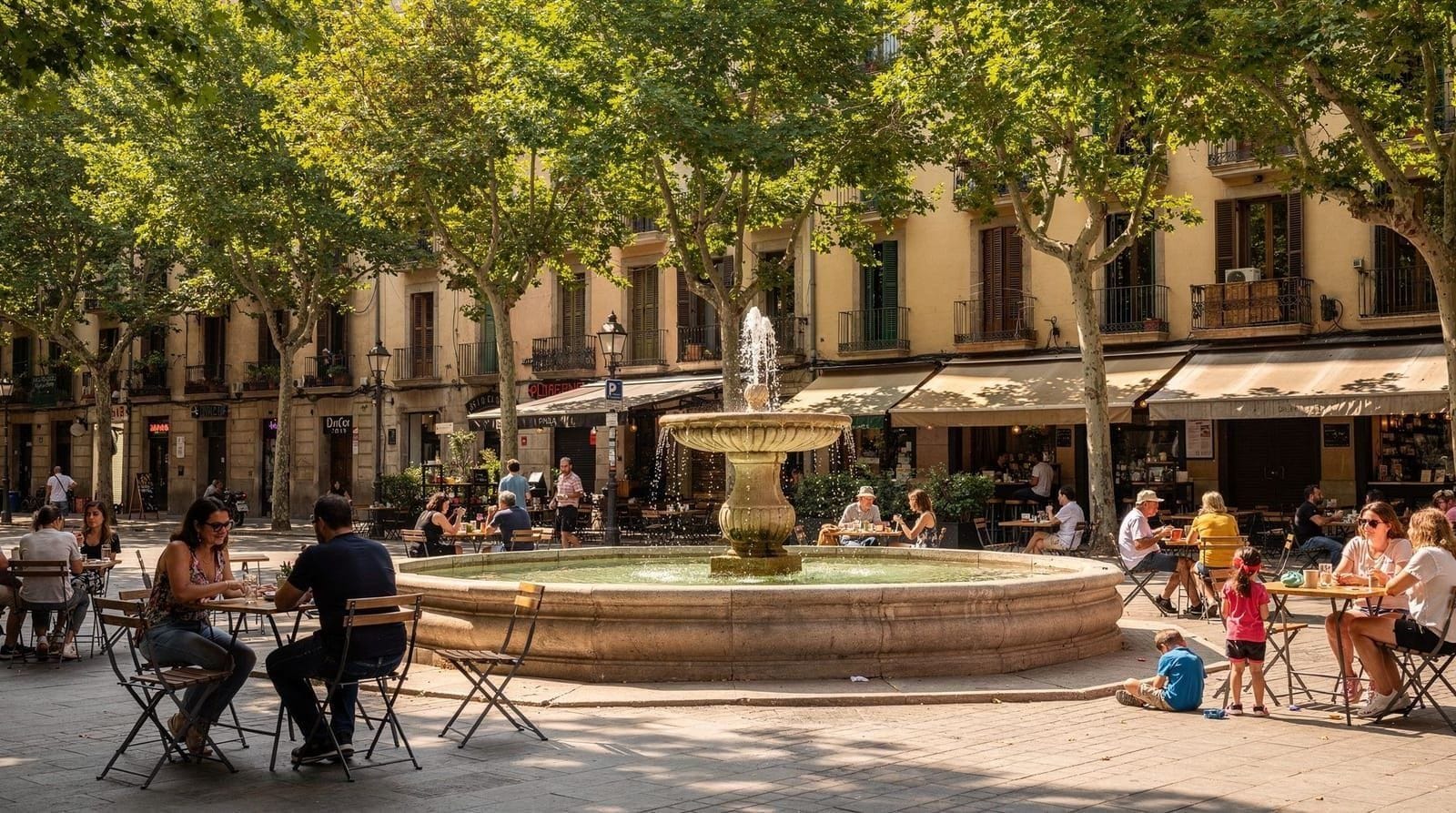
The Rambla del Poblenou is the strongest argument for visiting the neighbourhood. Running from Plaça de les Glòries Catalanes to the beach, this wide pedestrianised boulevard is everything that La Rambla used to be before it became a tourist operation: café terraces with neighbourhood regulars, elderly residents on benches, children on bicycles, market stalls selling actual goods.
The bars and restaurants on the Rambla del Poblenou are priced for local residents — coffee is €1.80, a caña (small draught beer) is €2–3, and a menú del día runs €11–13. There are no human statue performers, no friendship bracelet scams and no overpriced seafood restaurants. Sitting at a terrace on the Rambla del Poblenou on a weekday morning and watching the neighbourhood live its actual life is one of the most Barcelona experiences available in 2026.
Beaches beyond Barceloneta
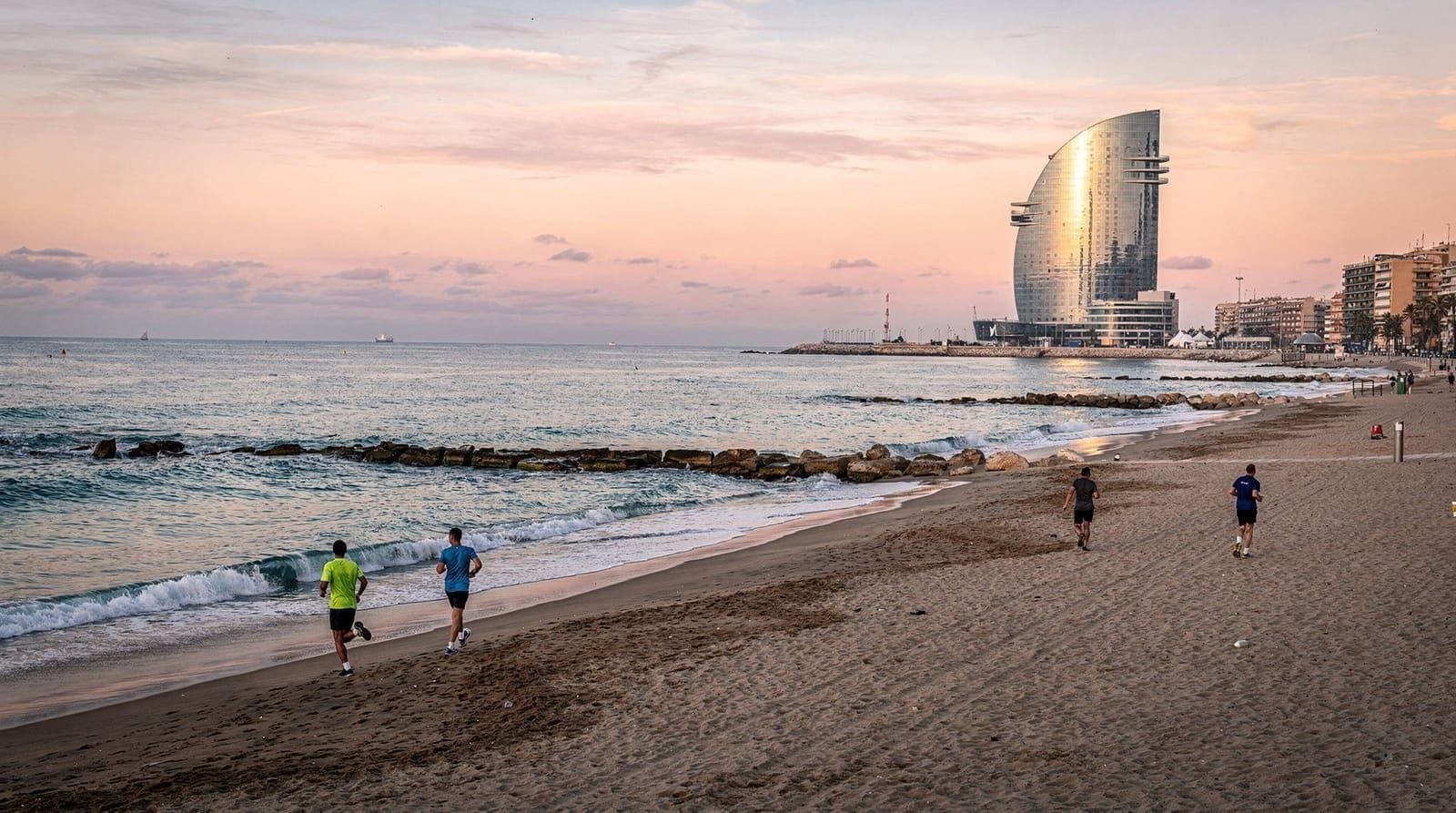
Poblenou’s beach access is a significant practical advantage over the old-city neighbourhoods. The Bogatell and Mar Bella beaches, directly accessible from the neighbourhood via Avinguda de Bèlgica or Rambla del Poblenou, are consistently less crowded than Barceloneta — particularly on weekdays and in early morning or late afternoon slots when the sun is lower.
Bogatell is a standard Barcelona beach: wide sandy strip, clean water, good facilities, volleyball courts, and the characteristic chiringuitos serving drinks and simple food. Mar Bella is similar with the addition of a clothing-optional section at its southern end and a reputation as a LGBTQ+ friendly beach. Both have lifeguards on duty May through September and sun lounger hire at around €6 per unit.
The water quality across all Barcelona’s beaches is consistent — blue flag standard, monitored daily in summer. Sea temperature peaks at 24–25°C in late September, making early autumn (when Barceloneta is significantly less crowded) the best time for a beach visit.
For Barceloneta and the older beaches, see the dedicated guide and the full Barcelona beaches guide — the comparison in terms of crowd levels makes Poblenou’s beaches a clear preference for anyone with flexibility.
Museu del Disseny and Glòries
Plaça de les Glòries Catalanes is the current construction site and eventual urban focus of Poblenou’s regeneration. The Gran Via, Avinguda Diagonal and Carrer de la Gran Via converge here, and the neighbourhood hub is intended to replace the long-demolished Plaza of Spain as Barcelona’s urban centre-of-gravity. Currently the area has the Museu del Disseny (2014, MBM Arquitectes), the Torre Agbar (Jean Nouvel’s bullet-shaped 2005 tower, now Torre Glòries and a headquarters for the Catalan tourism agency), and ongoing construction.
The Museu del Disseny — housed in a building local wags called “la escarpa” or “the stapler” for its angular protrusion — is an undervisited gem. Four permanent collections cover product design and everyday objects, graphic design and visual communication, fashion across five centuries, and decorative arts from ceramic to furniture. Admission from €6; free Sunday afternoons from 15:00. Combine with a walk through the surrounding Glòries area to see urban regeneration in process.
Palo Alto Market
The Palo Alto Market (Carrer dels Pellaires 30–38) operates on the first weekend of every month in a complex of converted industrial spaces and courtyards. Around 80–120 designers, artists and food producers sell directly — clothing, ceramics, leather goods, plants, food products — in a setting that manages to be both commercial and genuinely creative. Entry is €5, partially contributed to local social projects. One of Barcelona’s better weekend markets and far less crowded than the Sant Antoni Sunday market. Check dates on paltomarketbarcelona.com before planning a visit around it.
Poblenou vs Barceloneta beaches
| Poblenou (Bogatell/Mar Bella) | Barceloneta | |
|---|---|---|
| Crowds | Lower, especially weekdays | Heavy, especially summer weekends |
| Access | Metro L4, ~20 min from centre | Metro L4 or walk from old city |
| Atmosphere | Quieter, more local | Lively, more facilities and bars |
| Nearby food | Neighbourhood restaurants, lower prices | Seafood restaurants, higher prices |
| Notable feature | Mar Bella’s clothing-optional section | Closest beach to the old city |
Accommodation and practical access
Poblenou has developed some of Barcelona’s most interesting design hotels in converted industrial spaces. The neighbourhood’s relative distance from the old city (20 minutes on the metro, 40 minutes on foot) translates to noticeably lower room rates compared to Eixample or El Born at equivalent quality levels.
Metro L4 (Poblenou and Bogatell stations) provides direct access to the Jaume I and Barceloneta stops (old city) in under 15 minutes, making the neighbourhood a viable base for the whole city. From Eixample, take L1 to Glòries and transfer to L4 for Poblenou.
The transport guide covers the metro network in full. For the comparison with other Barcelona neighbourhoods as a base, the neighbourhood guide and where to stay in Barcelona provide the full picture.
Poblenou rewards visitors on longer stays or those who specifically want to see a Barcelona neighbourhood in active transformation — a design-led version of gentrification that has not yet erased the industrial working-class character that made the area interesting in the first place.
Top experiences
Bookable activities with verified prices and instant confirmation on GetYourGuide.