El Raval travel guide
El Raval: MACBA, CCCB, La Boqueria market and a creative arts scene — with honest advice on where the neighbourhood works and where to be cautious at
Barcelona: old town tapas & paella food tour with 8 tastings
Duration: 3 hours
- Free cancellation
Quick facts
- Metro
- L3 Liceu, L2 Sant Antoni
- Character
- Edgy, multicultural, gentrifying, arts-focused
- Best for
- Contemporary art, independent culture, La Boqueria
- Safety note
- Variable by area; port end less safe at night
El Raval has always been the city’s uncomfortable neighbourhood — the one where Barcelona’s contradictions are most visible and least resolved. West of La Rambla and La Boqueria, it spent most of the 20th century as the Barri Xino (Chinese Quarter, though never Chinese): a rough district of workers’ housing, brothels and anarchist political clubs. Since the 1990s it has gentrified in parts — dramatically in the upper section around MACBA, partially in the middle, and barely at all in the lower streets near the port. The result is a neighbourhood that is simultaneously one of Barcelona’s most culturally interesting and most uneven.
| Where | West of La Rambla, between El Raval and Sant Antoni; Metro L3 Liceu or L2 Sant Antoni |
| Cost | Free to walk; MACBA €14, CCCB €6–10, Filmoteca €5 |
| Time needed | Half a day for the cultural axis and La Boqueria |
| Getting there | 5-minute walk from Liceu metro (L3) or Universitat (L1/L2) |
| Best time | Weekday mornings for MACBA and CCCB; before 09:00 for La Boqueria’s quieter side |
The cultural axis
The upper Raval’s transformation centres on Plaça dels Àngels and the two major institutions that anchor it. MACBA (Museu d’Art Contemporani de Barcelona) opened in 1995 in a Richard Meier building — all white planes and natural light — that was specifically intended to trigger gentrification by cultural investment. It worked, gradually. The museum’s permanent collection is strong, particularly in Spanish and Catalan art from the 1960s onward, and the temporary exhibition programme is consistently ambitious. General admission is €14; the last Monday of each month is free from 15:00.
The MACBA forecourt (Plaça dels Àngels) immediately became a skateboarding space when the building opened, and it has remained one ever since — the flat, wide plaza and smooth marble surfaces attract skaters from across the city and beyond. This collision between the institutional and the subcultural is entirely characteristic of how El Raval functions.
Next door, the CCCB (Centre de Cultura Contemporània de Barcelona) occupies a converted 1802 workhouse with a spectacular glass-and-steel courtyard that reflects the older stone buildings. The CCCB’s programme is less conventional than MACBA’s — it covers architecture, urbanism, technology, music and thought rather than visual art primarily — and it organises the Sónar festival (June) and a strong series of free public events. Worth checking the programme before any visit; entry varies from free to €10 depending on the exhibition.
The Filmoteca de Catalunya (Plaça de Salvador Seguí 1) completes the cultural axis with daily screenings of classic and archive cinema at €5 per ticket. Few visitors know it exists; it is one of the best cultural bargains in the city.
La Boqueria: honest assessment
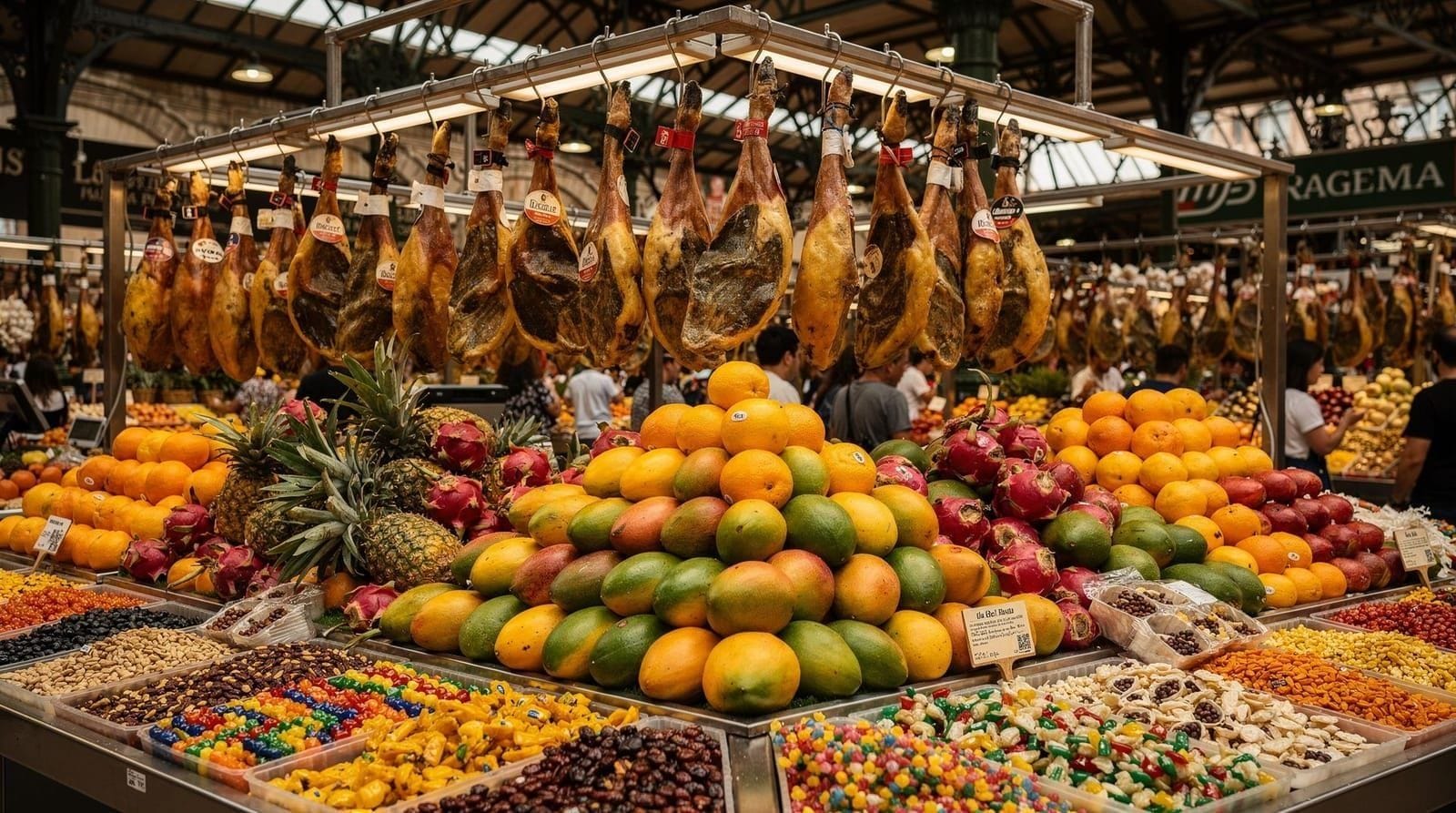
Mercat de la Boqueria is on La Rambla, just inside El Raval’s eastern boundary. The 1840 cast-iron market hall is architecturally significant and the interior — coloured glass, elaborate wrought iron, the radiating stall layout — is worth seeing. That said, the market has been functioning primarily as a tourist attraction rather than a working food market for at least two decades.
Most stalls now sell cut fruit (priced at €6–10 for a small cup), prearranged seafood platters (€20–40), Iberian ham displays that prioritise photography over purchase, and tourist-oriented snacks at substantially inflated prices. Local residents shop elsewhere — Mercat de Santa Caterina in El Born and Mercat de l’Abaceria in Gràcia are the working alternatives. La Boqueria is worth a 20-minute architectural visit, ideally before 09:00 when it is quieter and some genuine market commerce is still visible, but for actual food purchasing it is not the right choice.
A guided market tour (€35) can be worthwhile for historical context on the market’s evolution and the stalls worth engaging with — but this is an editorial luxury, not a necessity. The La Boqueria market guide and what to eat there cover the stalls that are still worth your money.
Contemporary art beyond MACBA
El Raval’s arts scene extends beyond the two flagship institutions. Independent galleries cluster around Carrer dels Àngels and Carrer del Doctor Dou, showing emerging Catalan and international artists in small, often free-entry spaces — a useful counterpoint to MACBA’s larger, more curated programme. Street art is also part of the neighbourhood’s identity: several buildings around Carrer de la Riera Baixa carry large-scale murals commissioned as part of the area’s ongoing gentrification-through-culture strategy, the same logic that placed MACBA here in the first place.
For visitors interested in Barcelona’s Picasso connections, the Picasso Museum in nearby El Born is a 15-minute walk east and pairs naturally with an El Raval art morning — Picasso lived briefly on Carrer de la Riera de Sant Joan as a young man, and the Modernisme route guide notes several buildings in the wider old city from the same period as MACBA’s cultural neighbours.
Eating in El Raval
El Raval’s restaurant scene is more diverse and lower-priced than the Gothic Quarter, reflecting the neighbourhood’s multicultural demographics. The area has historically housed immigrant communities from Pakistan, the Philippines, Morocco and Latin America, and the resulting food culture — halal restaurants, South Asian grocery shops, Moroccan pastry counters — is genuinely interesting and available at realistic prices.
Bar Marsella (Carrer de Sant Pau 65) is one of Barcelona’s genuine originals: a bar family-run since 1820 that serves house absinthe and wine in a space that has barely changed in a century, with bottles green with age on the shelves and a mirror that has not been cleaned since the First World War. It is narrow, often full, cash only, and worth seeing.
The Mercat de Sant Antoni (Carrer del Comte d’Urgell 1) sits at El Raval’s western boundary, in a regenerated 1882 iron market hall. The weekday food market is a proper neighbourhood market; the Sunday morning book and collectibles market surrounding the building is one of Barcelona’s better weekend markets. The surrounding streets have developed a strong café and restaurant cluster since the market’s renovation.
For a more substantial meal, the streets around Carrer del Carme and Carrer de l’Hospital have a growing number of neighbourhood restaurants that serve a mix of local and international cooking at fair prices. The tapas tours guide covers the best food walking options in the old city, including Raval options.
Neighbourhood character and safety
El Raval’s safety profile is genuinely uneven by area. The upper Raval (north of Carrer del Carme, around MACBA and CCCB) has gentrified substantially and feels comfortable at all hours. The middle section between Carrer del Carme and Carrer de Sant Pau is mixed — busy enough during the day to feel safe, quieter at night. The lower Raval (south of Carrer de Sant Pau, towards the port) retains some of its historic rough character and is less comfortable for unfamiliar visitors at night.
Standard precautions apply throughout: bags in front, no phone displays in crowds, awareness of your surroundings. The safety and scams guide has the full picture.
By day, El Raval is entirely navigable and the cultural institutions make it worthwhile for any visitor interested in contemporary art and architecture. The neighbourhood’s creative energy — street art, independent galleries, cultural programming — is some of the most genuine in the city.
La Rambla and its problems
El Raval’s eastern edge runs along La Rambla, Barcelona’s most famous and most misrepresented street. The 1.2 km boulevard is worth walking once for the atmosphere, the Miró pavement mosaic, the Font de Canaletes and the Liceu opera house. It is also the most pickpocketed street in Barcelona, concentrated particularly around the flower stalls, La Boqueria entrance and the human statue areas.
Do not eat in La Rambla restaurants — they are uniformly overpriced and poor quality. Walk one block into El Raval on the west side or the Gothic Quarter on the east side for dramatically better food at lower prices. The scams guide covers the specific tactics used on La Rambla.
Combining with adjacent areas
El Raval connects naturally with the Gothic Quarter via La Rambla (they share La Rambla as a boundary and the Liceu metro stop). For a cultural day that combines both, start at MACBA and CCCB in the morning, cross La Rambla for the Gothic Quarter’s medieval lanes and cathedral in the afternoon, and eat in El Born in the evening. The neighbourhood guide explains how all the old-city areas connect.
El Raval is best experienced as a half-day cultural circuit — MACBA, CCCB, La Boqueria (for the architecture), the Filmoteca — combined with honest eating in the neighbourhood’s multicultural restaurant scene rather than the tourist strip along La Rambla. For the wider question of which old-city neighbourhood suits your trip, see the neighbourhood comparison guide and the tourist traps guide, which covers La Rambla’s specific pitfalls in more depth.
Top experiences
Bookable activities with verified prices and instant confirmation on GetYourGuide.