Casa Batlló: tickets, tips and what to expect inside
Barcelona: Casa Batlló fast-track tickets and architecture tour
Duration: 2 hours
- Free cancellation
How much does Casa Batlló cost and do you need to book in advance?
Standard adult entry starts at €29 online and rises to €43–53 for premium tiers. Book at least a week ahead in shoulder season; peak summer weekends sell out 2–3 weeks out. Box-office prices run €4–15 higher than online rates, and the most popular afternoon slots vanish earliest.
On a single city block of Passeig de Gràcia — the grandest boulevard in the Eixample — three of Barcelona’s most celebrated modernisme architects placed three masterpieces next to each other. Casa Batlló, at number 43, is Antoni Gaudí’s contribution to what Barcelonans call the Manzana de la Discordia: the Block of Discord, named for the friendly architectural argument that played out in brick and tile at the turn of the twentieth century.
| Where | Passeig de Gràcia 43 (metro L2/L3/L4) |
| Cost | from around €29 standard entry |
| Time needed | around 1–1.5 hours |
| Booking | 1 week ahead shoulder season; 2–3 weeks summer weekends |
| Best time | first slot of the morning for fewer crowds |
What Gaudí built — and why it looks the way it does
Josep Batlló was not starting from nothing. He owned a conventional 1877 building and commissioned Gaudí in 1904 to renovate it so thoroughly that nothing of the original structure would be visible from the street. Gaudí worked on it for two years.
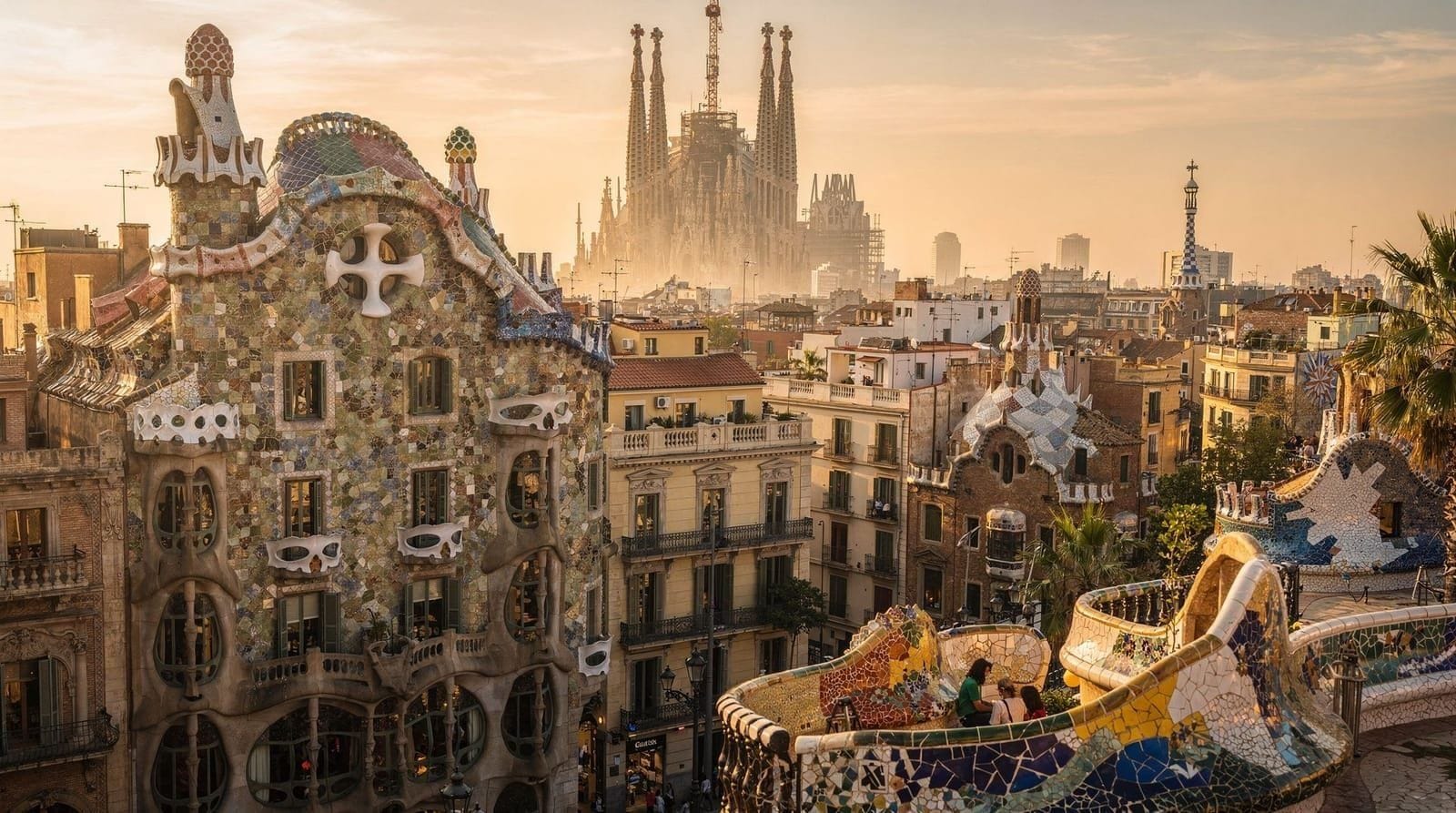
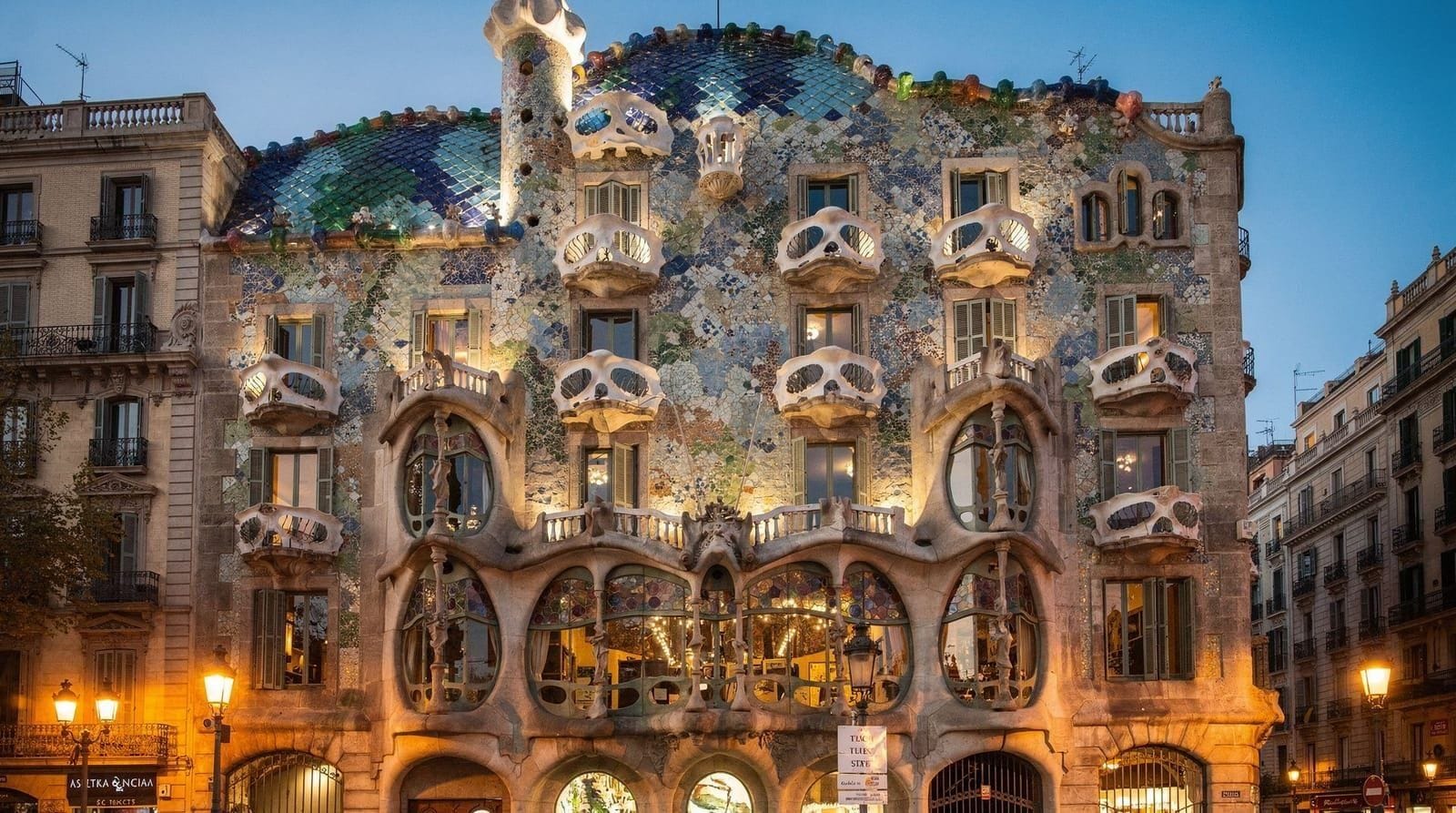
The facade is covered in fragments of ceramic disc — green, blue and turquoise — that shift in colour depending on the angle of light and the time of day. Up close, the effect is almost reptilian. The columns on the ground floor are shaped like bones; the balconies above them resemble skulls. The whole building looks like something living, which was entirely Gaudí’s intention.
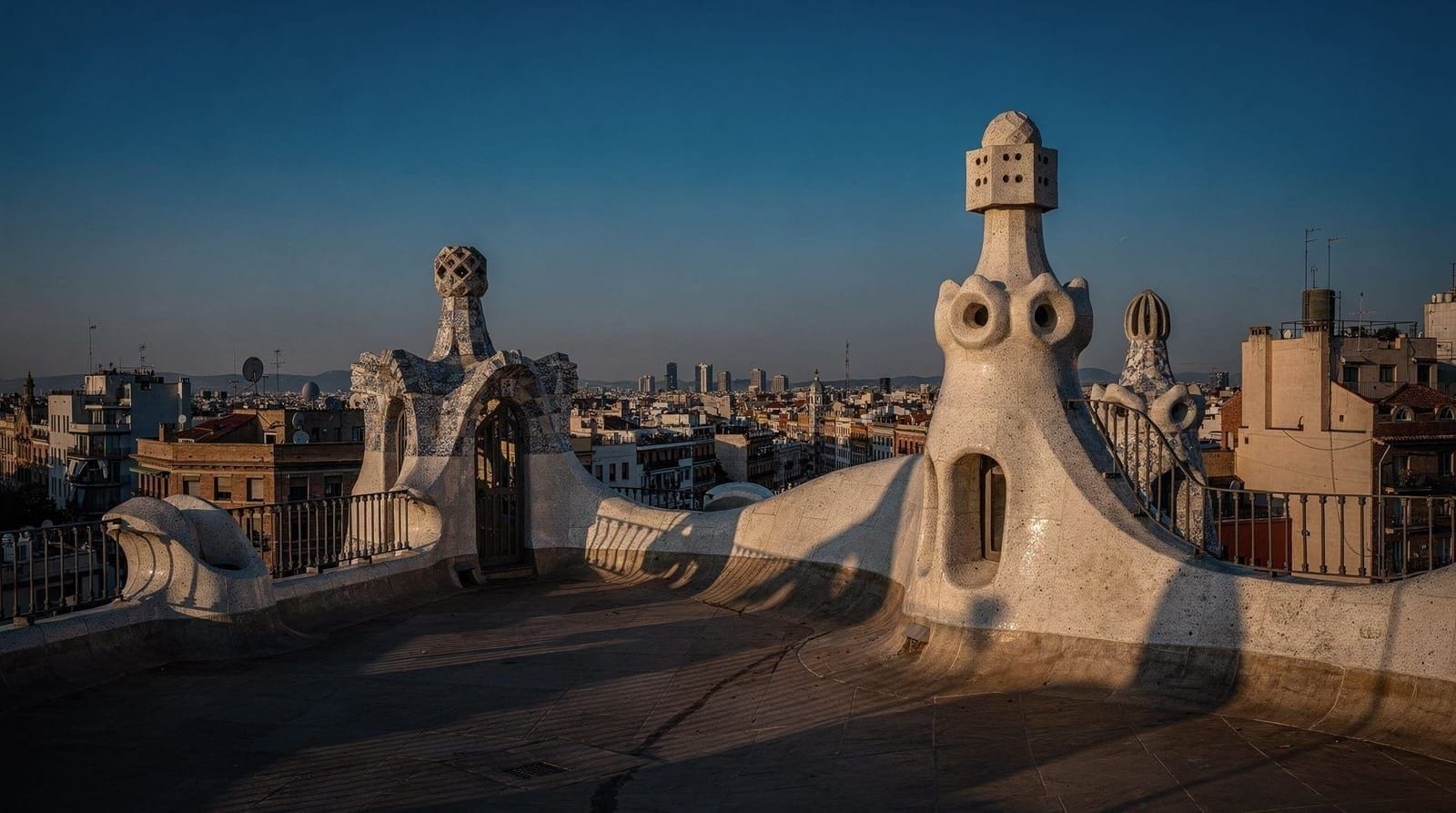
The roof, covered in ceramic scales that refract afternoon sunlight, is the part most visitors remember. The chimney pots at the rear are twisted and polychrome. The cross at the peak points toward Montserrat.
Multiple interpretations of the iconography circulate. The most popular holds that the building depicts Sant Jordi slaying the dragon — the patron saint of Catalonia, whose feast day (Sant Jordi, April 23) is still the most important cultural event in the Catalan calendar. The cross is the lance; the roof scales are the dragon’s back; the bones are the dragon’s victims. Gaudí never confirmed this interpretation in writing.
Ticket tiers explained
Casa Batlló operates dynamic pricing, meaning the cheapest tickets are available furthest in advance and prices rise as the date approaches.
Standard daytime entry starts at around €29 and includes the AR experience with headset. It is the best value for most visitors.
Silver (approximately €38) adds flexible cancellation and additional digital content.
Gold (approximately €43) adds a guided tour element.
Platinum (approximately €53) is a fully flexible skip-the-line ticket with the shortest queues — useful on busy weekend afternoons when entry waits can reach 45 minutes even with a timed slot.
Be the First (approximately €45) is a limited early-access experience with a maximum of 100 guests, available at opening. Includes a light breakfast.
Magic Nights (from around €39) is the evening experience available on selected nights, with the rooftop transformed by illuminations and music. Not available every evening — check casabatllo.org for the current calendar.
All prices above reflect mid-2026 ranges; dynamic pricing means what you find on any given day may differ by €3–8.
What to see floor by floor
Ground floor and main hall: Gaudí reshaped this space around a central light well tiled in gradations from deep marine blue at the top to pale sky blue at the bottom — the technique creates the impression of looking up through clear water, which is exactly how Gaudí described it.
Noble floor: This is the main residential storey where the Batlló family lived. The central room has mushroom-shaped arches and a fireplace in organic ceramic. The doors and frames throughout are made from oak shaped in continuous curves without visible right angles.
Attic: The parabolic brick arches of the attic are purely structural and are some of the most satisfying spaces in the building — quiet, pale and strangely calming after the colour-saturated floors below.
Roof terrace: The climax of the visit. The ceramic-scale roof rises to the cross; the twisting chimneys cluster at the rear. Views extend across the Eixample grid toward the sea and uphill toward the hills of Collserola. It is the best rooftop view on Passeig de Gràcia.
Casa Batlló versus La Pedrera: which one first?
Visitors with limited time often ask whether to prioritise Casa Batlló or La Pedrera if they can only manage one. They are different experiences rather than a strict better-or-worse comparison.
| Casa Batlló | La Pedrera | |
|---|---|---|
| Architect | Antoni Gaudí | Antoni Gaudí |
| Character | Residential house, colour and biomorphic facade | Apartment building, undulating stone facade |
| Highlight | Roof terrace, dragon-back tiles | Roof terrace, chimney “warriors” |
| Interior | AR-enhanced noble floor and attic | Furnished apartment, attic exhibition |
| Typical visit | 1–1.5 hours | 1–1.5 hours |
If you can only do one, Casa Batlló’s interior is generally considered the more visually striking of the two, with the colour and light-well effects on the main floor. La Pedrera’s rooftop chimney “warriors” are the more instantly recognisable image, and its stone facade offers a different, cooler counterpoint to Gaudí’s ceramic work at Casa Batlló. Doing both in one afternoon is entirely feasible given the 500-metre distance — see the La Pedrera guide for combined-visit logistics.
Accessibility
Casa Batlló has made significant accessibility investments relative to many heritage buildings of its age: lifts serve all main visitor floors including the roof terrace, and staff can assist with specific mobility needs if contacted ahead of a visit. Some transition points between floors involve short ramps rather than stairs. Visitors with visual or hearing impairments should ask about adapted versions of the AR content when booking, as availability and format vary by ticket tier.
How far ahead to book
Casa Batlló does not have the same selling-out crisis as the Sagrada Família, but popular afternoon slots disappear in peak season.
In low season (November–March, excluding Christmas), you can often book same-day online. In spring and autumn, a week ahead is comfortable. In summer (July–August), weekend afternoon slots — the most popular — can sell out 2–3 weeks ahead. Early morning and evening slots remain available longer.
Box-office tickets cost €4–15 more than the same tier booked online. There is no good reason to buy at the door.
Getting there and what’s nearby
Casa Batlló is at Passeig de Gràcia 43, accessible directly from Passeig de Gràcia metro station (L2 purple, L3 green, L4 yellow — the three-line interchange makes it one of the most connected stations in the city).
On the same block, Casa Amatller (number 41) and Casa Lleó Morera (number 35) are worth five minutes of attention from the outside even if you do not enter. The architectural contrast between all three — Gaudí’s biomorphic organicism, Puig i Cadafalch’s Gothic-influenced geometry and Domènech i Montaner’s floral rationalism — is one of the densest concentrations of modernisme in the world.
La Pedrera is 500 metres further north on Passeig de Gràcia and is almost always paired with Casa Batlló on the same half-day. Our La Pedrera guide covers the rooftop warriors, the apartment floors and the night experience.
For the full sequence, the Gaudí trail guide maps all the major sites across two or three days.
Honest planning notes
Photography: The facade is in shade until early afternoon and in direct sun from about 15:00. Midday light is flat. The most photogenic window is golden hour, roughly 19:00–20:30 in summer. The pavement fills with people continuously throughout the day.
Crowds: Even with timed entry, the interior can feel congested at the noble floor and on the roof terrace between 12:00 and 17:00. The Be the First or first standard slot of the day gives significantly more space.
The AR experience: The mixed-reality headsets are a genuine differentiator. They overlay Gaudí-era imagery and explain the design reasoning for each room. If you find technology distracting in heritage buildings, you can set the headset aside at any point — the rooms are beautiful without augmentation.
Scams to avoid: Ticket touts operate on Passeig de Gràcia and claim to sell “fast-track” tickets. Decline and buy online. Resellers add €8–20 per ticket for the same experience.
Combination passes: The Articket does not cover Casa Batlló. If you want to combine Gaudí’s three houses in one purchase, look for the Three Houses guided tour (Casa Vicens, La Pedrera and Casa Batlló from around €75) — see the Modernisme route guide for details.
Barcelona for families: Casa Batlló has minimum interaction with children below about 8, as the AR experience is not child-specific. For family-oriented Gaudí content, Park Güell works better with younger children.
The right time to book Casa Batlló is now — especially for summer weekend afternoons, which vanish well in advance. The building is unlike anything else in Barcelona, and the roof terrace alone justifies the ticket. Build a minimum of 1.5 hours into your schedule and consider arriving at the first slot of the morning if you want the best photographs without a crowd.
Frequently asked questions about Casa Batlló
What is Casa Batlló?
Casa Batlló is a private residential building on Passeig de Gràcia designed and renovated by Antoni Gaudí between 1904 and 1906. Gaudí transformed an existing building for the textile industrialist Josep Batlló, covering the facade in polychrome ceramic scales and reshaping the interior around flowing organic forms. It is a UNESCO World Heritage Site and is considered one of the finest examples of Catalan Modernisme.How long do you need at Casa Batlló?
The standard visit takes 1–1.5 hours with the included Magic Nights mixed-reality headset. Allow up to 2 hours if you are interested in the architecture in detail or want to linger on the roof terrace.Is the Magic Nights experience worth it?
The Magic Nights evening experience (available selected nights year-round) transforms the rooftop into an illuminated show with music and projections. Tickets start around €39–45 and the atmosphere is genuinely distinctive. It is best suited to couples or those with a particular interest in Gaudí's symbolism beyond daytime content.What is 'Be the First' early access?
The 'Be the First' ticket (around €45) grants entry before the standard opening time, with a maximum of 100 visitors inside. It is the least crowded experience available and includes a small breakfast. Worth considering if crowds bother you or if you want the best photographs.How do I get to Casa Batlló?
Metro L2 or L3 to Passeig de Gràcia. Casa Batlló is at No. 43 Passeig de Gràcia, directly on the Manzana de la Discordia block alongside Casa Amatller (Puig i Cadafalch) and Casa Lleó Morera (Domènech i Montaner).Is the mixed-reality headset experience included in the ticket?
Yes. All standard daytime tickets include the mixed-reality device (called the 'Magic Nights' headset for the evening, and a standard AR guide for daytime visits). The technology overlays Gaudí's original design intentions onto what you see — useful for understanding why the rooms look the way they do.
Top experiences
Bookable activities with verified prices and instant confirmation on GetYourGuide.
Barcelona: Casa Batlló "Be the First" early entry ticket
- Free cancellation
- Skip the line
Barcelona: Casa Batlló entry with self-audio guide
- Free cancellation
Barcelona: Casa Batlló entry ticket
- Free cancellation
Barcelona: the 3 Gaudí houses tour (Vicens, Milà and Batlló)
- Free cancellation
- Small group