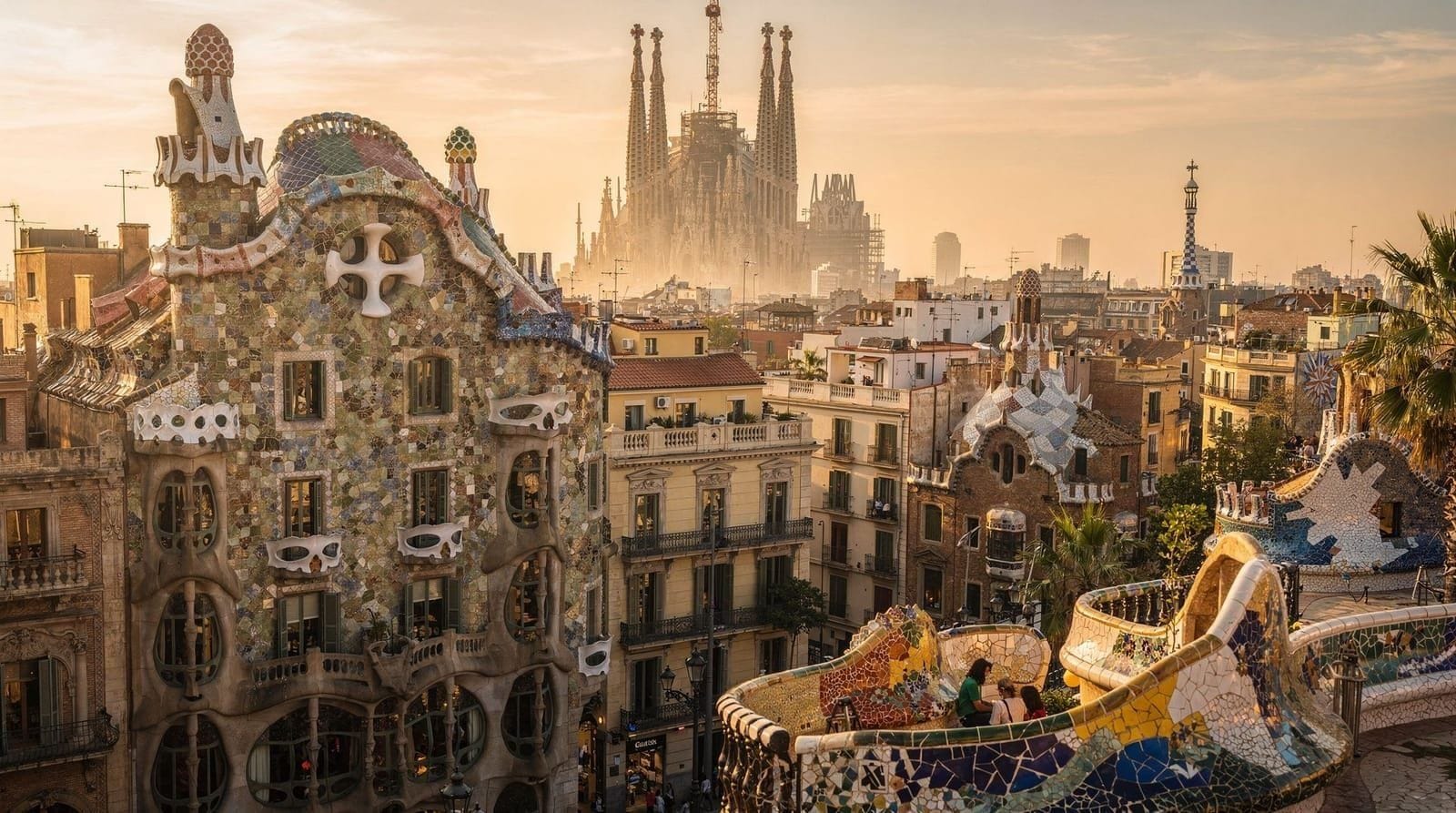
La Pedrera–Casa Milà: rooftop warriors, tickets and visit tips
Barcelona: La Pedrera–Casa Milà skip-the-line ticket with audio guide
Duration: 1.5 hours
- Free cancellation
Is La Pedrera worth visiting and how much does it cost?
Yes — the rooftop chimneys and attic are genuinely extraordinary. The essential daytime ticket starts at €25 (dynamic pricing, cheapest furthest in advance). Allow 1.5 hours minimum, or 2 hours if you explore the apartment floor. Note that La Pedrera closes January 12–18 and has reduced winter hours.
Among all of Antoni Gaudí’s buildings open to the public, La Pedrera–Casa Milà is the one that rewards the slowest visitors. The rooftop chimneys are the image that appears on every poster, but the attic below them — a vaulted catenary corridor of 270 parabolic arches — and the meticulously restored apartment floor together make this the most complete Gaudí experience in the city after the Sagrada Família.
| Where | Passeig de Gràcia 92, Metro L3 Diagonal |
| Cost | Around €25–39 (dynamic pricing) |
| Time needed | 1.5–2 hours |
| Getting there | Direct on Metro L3, or 10-min walk from Passeig de Gràcia |
| Best time | First or last hour of opening for rooftop light |
Why it looks like this
Pere Milà was a wealthy lawyer who commissioned Gaudí in 1906 for what became the last secular building Gaudí would complete. By this point Gaudí had stopped caring what critics thought. The undulating limestone facade of Casa Milà — with no straight lines visible on the exterior — drew ridicule from the Barcelona bourgeoisie on Passeig de Gràcia and adulation from progressive architects across Europe.
The nickname La Pedrera — “the quarry” in Catalan — was applied ironically by neighbours who complained that the building looked like a cliff face of unhewn stone. Gaudí said the curves came from his observation of the sea: the building was an ocean of stone, and its movement was the movement of waves and kelp.
Structurally, La Pedrera was revolutionary. Gaudí abandoned load-bearing walls entirely and used a steel frame, which allowed him to create floor plans without interior walls. Each apartment could be subdivided however the occupant wished. This was not standard practice in 1906. It became standard practice decades later.
The rooftop: what to expect
The rooftop terrace is the highlight of any visit and the reason La Pedrera occupies its own category in Barcelona’s tourist hierarchy.
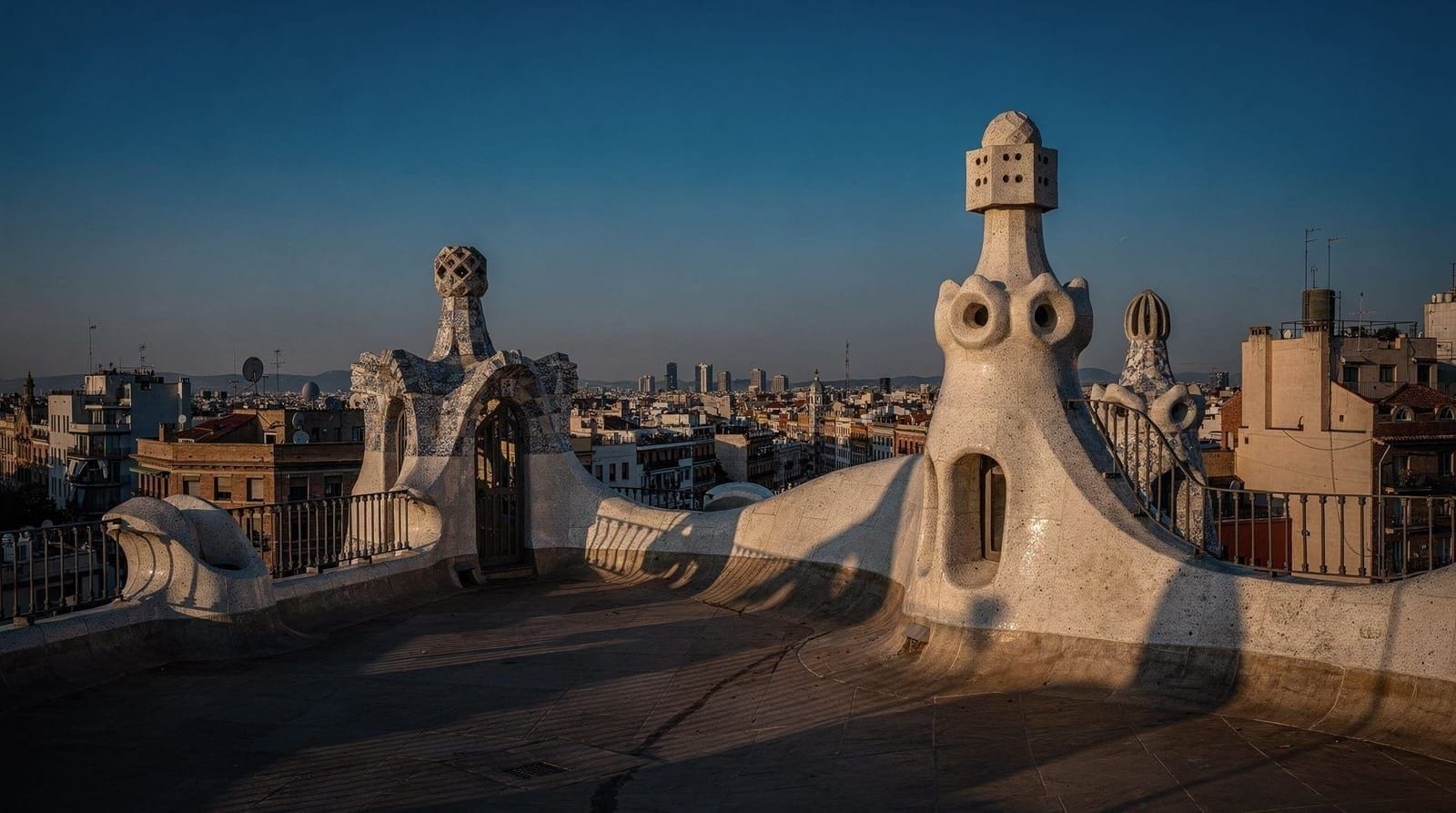
The 28 chimneys and 8 ventilation towers were designed to serve the building’s internal systems, but Gaudí treated them as sculpture. Each chimney is unique. The white ceramic cladding (broken tiles applied in the trencadís mosaic method, here more monochrome than on Casa Batlló) reflects light differently in morning and afternoon. Some chimneys are twisted; some are grouped in clusters; some are topped with crosses.
The ventilation towers are the “warriors” — helmet-shaped structures with slit openings that look startlingly like medieval soldiers. At a distance, the rooftop reads as a landscape with its own internal logic; close up, each element is surprising.
Photography on the rooftop is best in the first hour after opening or the final hour before closing when the light is directional. Midday in summer produces flat, harsh shadows and crowds that make the narrow paths between chimneys feel congested.
The attic and the Espai Gaudí
Directly below the rooftop is the attic floor, which now houses the Espai Gaudí — the museum section of the visit. Gaudí used parabolic catenary arches throughout the attic, creating a vaulted space of 270 identical arches that function as load-bearing ribs for the curved roof above. The effect is of standing inside a spine. The ribs are brick, unplastered, and painted white.
The museum exhibits drawings, models and documentation of Gaudí’s working methods. Scale models of the Sagrada Família towers are here alongside catenary chain models showing how Gaudí derived his structural arches — he would hang chains from a frame and photograph the inverted curve to determine the exact geometry of his arches, since a catenary curve under compression is the most efficient structural form.
The apartment floor
One full floor of the building has been restored as a period apartment — furnished as it would have appeared in a wealthy Barcelona household of around 1910. The floor plan is the most instructive part: there are no load-bearing interior walls, so the rooms are separated only by furniture and sliding doors. Gaudí’s innovation here is more radical than the exterior suggests.
The ceilings of each room were modelled by hand in plaster, creating the wavy, organic forms that look decorative but actually serve to direct airflow and distribute the structural loads of the floor above. The door handles are ergonomic castings in polished bronze — also Gaudí’s design.
Tickets and pricing
La Pedrera uses dynamic pricing, so the cheapest tickets are available furthest in advance.
Essential (full visit with audio guide): from €25 in advance, rising toward €39 as the date approaches. This is the standard daytime visit.
Guided tour: approximately €38, adding a live guide to the audio experience.
Night experience (El Pedrera de Nit): approximately €38 on selected summer evenings. This is a rooftop-only experience with multimedia projections on the chimneys. Different from the daytime visit; both are worth doing if you can manage only one.
Private with Casa Batlló: a combined private guided tour of both buildings costs significantly more (from €85) but provides access with a dedicated guide and smaller group sizes.
Ticket tiers compared
| Ticket | Approx. cost | What you get | Best for |
|---|---|---|---|
| Essential (audio guide) | From €25 | Full visit, rooftop, attic, apartment | Most visitors |
| Guided tour | From €38 | Essential plus a live guide | First-time visitors wanting context |
| Night experience | From €38 | Rooftop-only, multimedia show, evening | Photographers, repeat visitors |
| Private with Casa Batlló | From €85 | Both buildings, dedicated guide, small group | Visitors with limited time and higher budget |
Rooftop photography by season
The chimneys photograph very differently depending on time of year and time of day. In summer, the low midday sun creates flat light and the rooftop is at its most crowded between 11:00 and 15:00; arriving at opening (typically 09:00) gives directional light and thinner crowds. In winter, the sun sits lower throughout the day, which can work in your favour for longer stretches of good light, though the shorter opening hours (09:00–18:30) compress your window. Overcast days, common in Barcelona’s shoulder seasons, actually suit the rooftop well — the diffused light removes harsh shadows between the chimney clusters and lets the trencadís mosaic read more evenly.
Planning notes and honest tips
How far ahead to book: A week ahead is comfortable in spring and autumn. In summer, book 2–3 weeks ahead for popular morning slots; the night experience sells out faster on good-weather evenings.
January closure: La Pedrera closes January 12–18 every year for maintenance. If you are visiting Barcelona in mid-January, check lapedrera.com for the exact 2026 dates.
Winter hours: The building closes at 18:30 in winter (09:00–18:30 daily) versus 20:30 in summer. The last entry is 1 hour before closing.
Combining with Casa Batlló: Both buildings are 500 metres apart on Passeig de Gràcia. Allow half a day for both, starting at La Pedrera in the morning and walking south to Casa Batlló for an afternoon slot. Or reverse the order — Casa Batlló’s first slot is better photographed in the afternoon, while La Pedrera’s rooftop is best in morning light.
The Eixample neighbourhood: La Pedrera sits in the Eixample grid. The wide pavements of Passeig de Gràcia make walking comfortable; there are good coffee stops within a few metres of the entrance.
The Gaudí trail: La Pedrera is stop three or four on the standard sequence (after Sagrada Família and Park Güell, alongside Casa Batlló). See the trail guide for daily sequencing options.
Reseller scams: La Pedrera tickets are sold on third-party sites at markup, typically €5–12 over the official price. Buy from lapedrera.com. The “skip-the-line” GYG options that appear on this site use verified tour operators and are a reasonable choice when official timed slots have filled.
The Modernisme route: Beyond Gaudí, the same neighbourhood contains Palau de la Música and Hospital de Sant Pau — two buildings by Lluís Domènech i Montaner that are UNESCO-listed and dramatically undervisited relative to their quality.
Checking the best time to visit: La Pedrera is open year-round and genuinely rewarding in winter when the crowds thin and the architecture reads more clearly. October and November are excellent months.
La Pedrera is the Gaudí building that most architecture enthusiasts rate as the more structurally radical achievement — more so even than Sagrada Família, because it was completed in a single lifetime and without religious symbolism to carry the visitor’s interpretation. The rooftop warriors, the catenary attic and the period apartment together make it a half-day that most visitors do not regret.
Frequently asked questions about La Pedrera
What is the difference between La Pedrera and Casa Milà?
They are the same building. Casa Milà is the official name given by Gaudí's client Pere Milà, while La Pedrera — meaning 'the quarry' in Catalan — is the nickname given by incredulous neighbours who watched the undulating stone facade being assembled in 1906–1912. Today the two names are used interchangeably.What is on the La Pedrera rooftop?
The rooftop is the main event: an otherworldly landscape of twisted chimneys in white ceramic mosaic, ventilation towers shaped like helmeted warriors, and curving stairwells. Gaudí designed the structures to appear deliberately unsettling close up but coherent from distance. It is unlike any other rooftop in the world.How much does La Pedrera cost?
The essential daytime ticket (main tour + rooftop + attic) starts at €25 with advance booking and rises to around €39 depending on tier and proximity to the date. The night experience (El Pedrera de Nit) costs approximately €38. Dynamic pricing means booking early always saves money.What is the La Pedrera night experience?
El Pedrera de Nit is an evening multimedia show held on the rooftop on selected summer nights (typically June to September). The chimneys are lit and animated with projections while music plays. It is atmospheric and far less crowded than the daytime visit. Tickets sell out in advance — check lapedrera.com for dates.When is La Pedrera closed?
La Pedrera closes January 12–18 for annual maintenance. Winter hours run 09:00–18:30; summer hours extend to 09:00–20:30. The building is open every day of the year except this January closure window.Can I see a real apartment at La Pedrera?
Yes. One floor of the building has been restored and furnished as it would have appeared in the early twentieth century, showing how Gaudí designed the floor plans around the central light wells and how the wavy ceilings were the result of load-bearing innovation rather than decoration.How do I get to La Pedrera?
La Pedrera is at Passeig de Gràcia 92, directly on the metro line L3 (Diagonal station) or a 10-minute walk north from Passeig de Gràcia station. It is 500 metres from Casa Batlló.Should I do the guided tour or the audio guide?
The audio guide (included in the Essential ticket) covers the same content as the live guided tour for most visitors, at a lower price and your own pace. The guided tour adds real-time Q&A and is worth the upgrade mainly for visitors who want to go deeper into Gaudí's structural engineering than the audio track allows.
Top experiences
Bookable activities with verified prices and instant confirmation on GetYourGuide.
Barcelona: La Pedrera–Casa Milà ticket with audio guide option
- Free cancellation
Barcelona: La Pedrera fast-track guided tour
- Free cancellation
Barcelona: La Pedrera night experience with multimedia show
- Free cancellation
- Night show
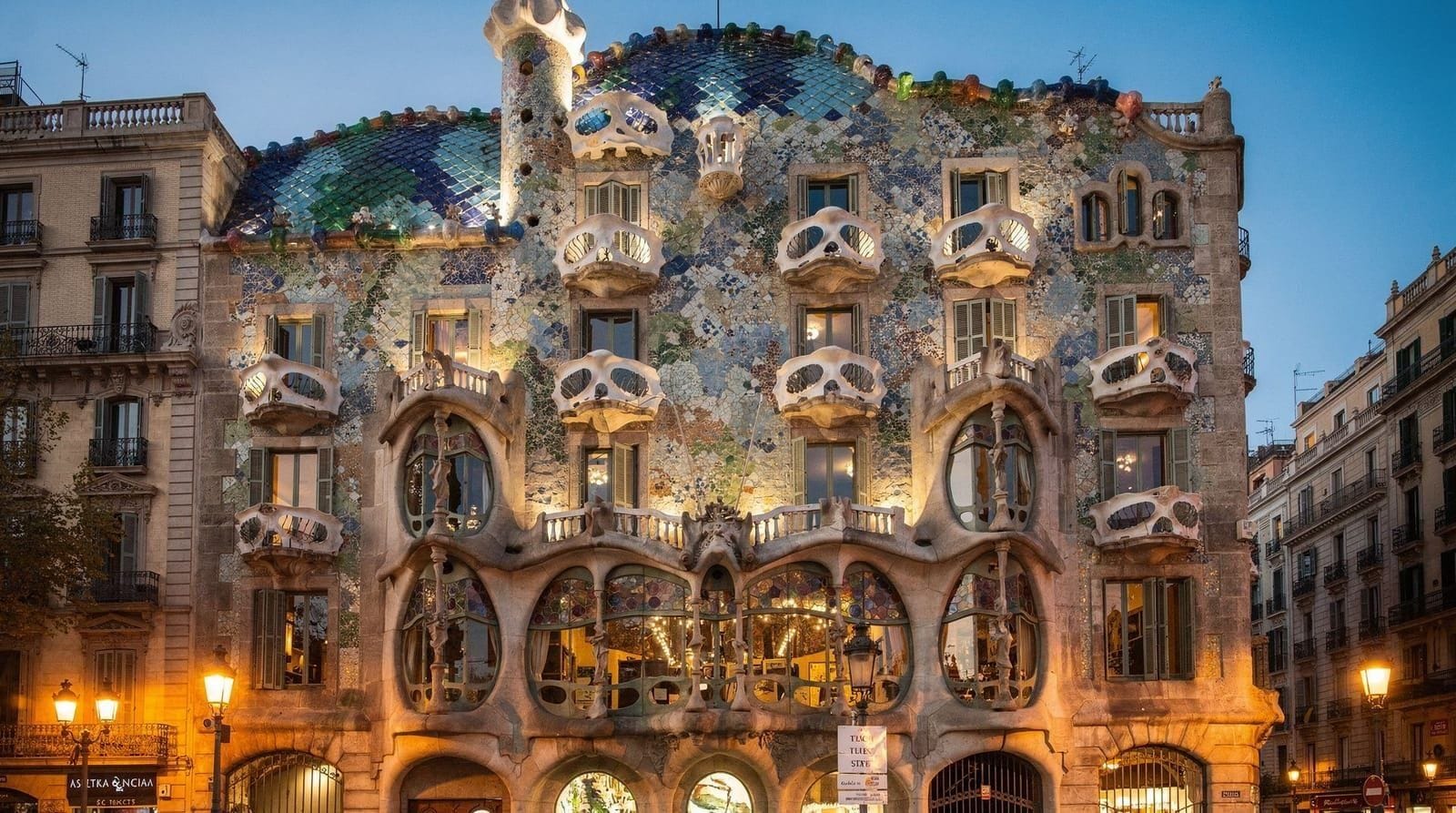
Barcelona: the 3 Gaudí houses tour (Vicens, Milà and Batlló)
- Free cancellation
- Small group