A day trip to Girona: medieval city, Jewish quarter and game of thrones
There is a city 100 kilometres northeast of Barcelona that doesn’t get nearly the attention it deserves. Girona is medieval in a way that Barcelona, for all its Barri Gòtic heritage, cannot quite match — a compact, largely intact walled city sitting above the Onyar river, with a Jewish quarter that predates most of what survives in the rest of Spain, a cathedral that took six centuries to complete, and a riverside view that has become one of the most photographed in Europe. It takes 37 to 40 minutes by fast train from Barcelona Sants. There is almost no reason not to go.
| Where | Girona, 100km northeast of Barcelona |
| Cost | Train €9–35 return; museums €4–7 each |
| Time needed | Half a day for Girona alone; a full day paired with Figueres |
| Getting there | AVE/Avant high-speed train, 37–40 min from Barcelona Sants |
| Best time | Early morning (first train) to beat the crowds and summer heat |
Getting there: faster than you think
The easiest option is the regional or high-speed train from Barcelona Sants station. Regional services (Rodalies or regional trains run by Renfe) take about 1 hour 15 minutes and cost roughly €9-14 return depending on the service. The fast AVE or Avant high-speed trains do the journey in 37-40 minutes for €15-35 return depending on advance booking.
The AVE option is worth the modest premium: arriving in Girona by 9am means you have the old city largely to yourself for the first hour. Tourists arriving from the regional trains or by coach tend to arrive later, and the cathedral steps and Jewish quarter fill up by 11am.
Girona station is a 10-minute walk from the old city walls and the main sights. There is no need for a taxi. Exit the station, cross the modern boulevard and follow the signs up to the walls.
For a comparison of Girona with other regional options, the best day trips from Barcelona guide lays out the full range.
If you’d rather not manage train timetables and connections yourself, a guided day trip that covers Girona alongside the wider Costa Brava region handles the logistics in one booking:
Walk the city walls
The first thing to do in Girona is walk the walls, and this advice is both practical and aesthetic. The walls give you a map of the whole city at height — the old town on your right, the river below, the newer city spreading south — and they’re free to walk. Access points are scattered around the old quarter; the most convenient is near the Cathedral.
The walkable section covers roughly 1.5 kilometres and takes 30 to 40 minutes without stopping. Along the way you pass over the rooftops of the Jewish quarter, get a bird’s-eye view of the Onyar houses, and approach the Cathedral from above, which is a better angle than the frontal view from the square below. Do this first, before the sun gets high and the walls fill with other walkers.
There are several access and exit points along the route, so if time is tight it’s fine to walk only a section rather than the full 1.5 kilometres — the Cathedral-to-Sant Domènec stretch alone covers the best views in about 15 minutes.
The Jewish Quarter (El Call)
Girona’s El Call is one of the best-preserved medieval Jewish quarters in Europe. Jews lived here continuously from at least the 9th century until the expulsion of 1492, and the narrow lanes of the quarter — some barely wide enough for two people to pass — survive largely unchanged. The alley names tell the history: Carrer de la Força (the main street), Carrer de les Escoles.
The Museu d’Història dels Jueus de Girona on Carrer de la Força is a quiet, well-organised museum covering the Sephardic Jewish community that lived here, their relationship with the city’s Christian authorities, and the fate of the community during the expulsion. Admission is around €4. The permanent collection includes a rare medieval matzevot (Jewish tombstone) collection and documentation of the community’s intellectual tradition — Girona was a centre of Kabbalistic study in the 12th and 13th centuries.
Allow an hour for the museum. The streets of El Call around it are worth wandering without a fixed route — the architecture rewards slow attention.
The Cathedral: steps, nave and all
The Cathedral of Girona sits at the top of a dramatic baroque staircase — 86 steps from the square below — and the facade and steps have become instantly recognisable since they appeared in Game of Thrones (more on that below). But the interior is more impressive than the exterior suggests.
The nave is the widest Gothic nave in the world: 22.98 metres, completed in the 14th to 15th centuries in a decision that was apparently controversial at the time — the architects’ guild was asked whether a single nave of that span could be safely built, and they gave a divided verdict. It was built. It has stood for over 600 years. The effect is one of enormous, slightly vertiginous space.
Inside the Cathedral museum, the Tapestry of Creation — an 11th-century Romanesque embroidered textile — is extraordinary and chronically undervisited compared to better-publicised medieval artworks elsewhere in Europe. Entry to the Cathedral and museum costs around €7.
The Onyar houses: the iconic photo
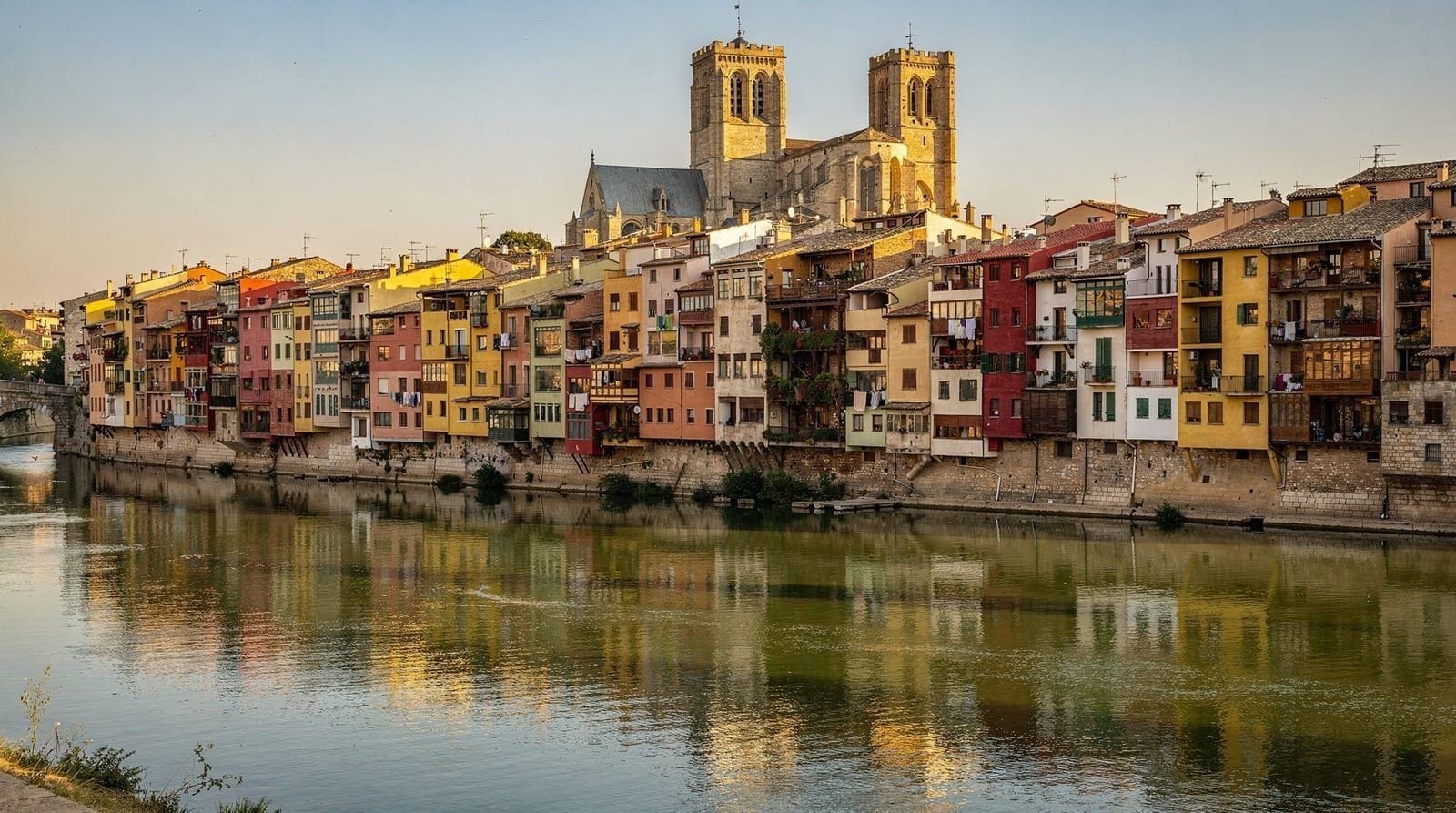
The row of brightly painted houses along the east bank of the Onyar river is the image most people associate with Girona even before they know where it’s from. The houses — in terracotta, ochre, orange, yellow and the occasional improbable pink — were originally built over the city walls that ran along the riverbank, which is why they look as though they’re stacked directly on the water.
The best view is from the Pont de Pedra (the main stone bridge across the Onyar, closest to the old town), mid-morning when the light is on the facades and before the tourist boats and kayaks fill the river below. The Pont de les Peixateries — the iron bridge upstream, popularly attributed to Gustave Eiffel’s workshop though the connection is more complicated than that — gives an alternative angle.
The riverbank walk itself, on the newer western side of the Onyar, is pleasant: small restaurants, outdoor tables, a local rather than tourist atmosphere. Lunch here is better value than in the old city restaurants.
Game of Thrones locations
If you watched Game of Thrones, you will recognise Girona. The show used the city extensively in series six to represent the city of Braavos, where Arya Stark trained as an assassin. The Cathedral steps appear as the House of Black and White; the Banys Àrabs (Arab baths) was used for interior scenes; Els Alemanys street and the old city lanes stood in for various Braavos exteriors.
The tourist office sells a Game of Thrones map for around €2, which marks each filming location with a still from the show and the address. It’s earnest and slightly silly, but it works as a walking tour structure for the whole old city. Following it takes you to corners of the medieval quarter you wouldn’t otherwise think to visit.
The honest assessment: Girona is half a day, not a full day
There is a common mistake in planning the Girona day trip, which is treating it as a full-day destination when it’s really a half-day one. The walls, El Call, the Cathedral and the river view take about three to four hours if you’re a deliberate walker who stops for coffee. By early afternoon you’ll have seen the main sights and be wondering what to do with the rest of your time.
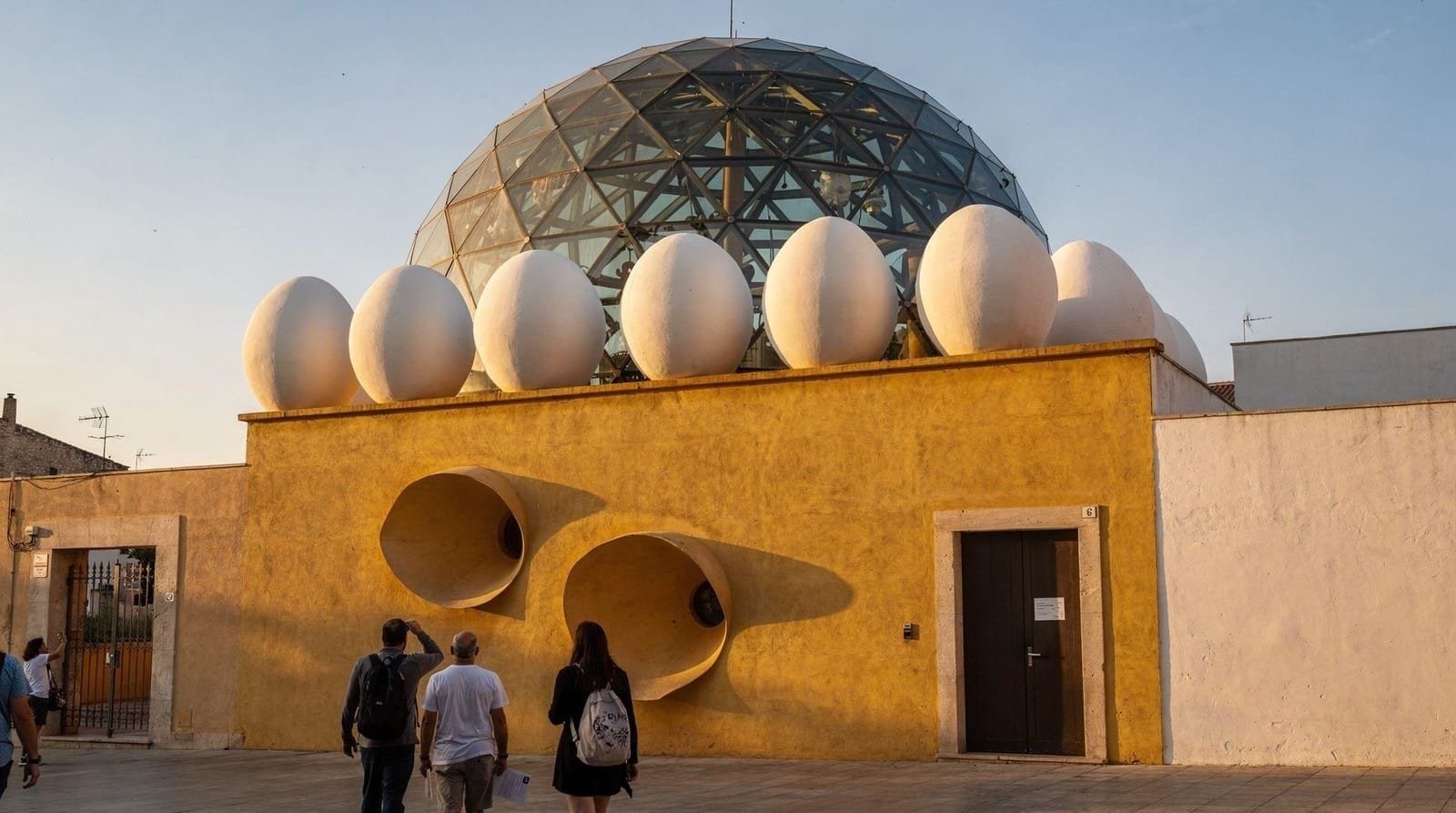
The answer is Figueres, 40 kilometres north of Girona, where the Dalí Theatre-Museum is located. Combining Girona in the morning with Figueres in the afternoon makes a genuinely satisfying full day: catch the train from Barcelona by 8:30am, spend the morning in Girona, take the regional train to Figueres (35 minutes), spend the afternoon in the surrealist madhouse that Dalí built himself, and return to Barcelona by early evening.
A full Girona + Figueres day, step by step
| Time | Activity |
|---|---|
| 8:30am | Train from Barcelona Sants to Girona |
| 9:15am–1:00pm | City walls, El Call, Cathedral, Onyar houses |
| 1:00pm | Regional train to Figueres (35 min) |
| 1:45pm–4:30pm | Lunch and the Dalí Theatre-Museum |
| Early evening | Train back to Barcelona |
For those who’d rather skip the second train connection, a guided small-group tour covers both Girona and the Dalí Museum with transport included:
An alternative pairing for a second visit: Besalú, a smaller medieval town with a striking fortified bridge, 25 kilometres from Girona and a good half-day add-on if you’ve already done the Girona-Figueres combination.
The restaurant that most visitors don’t get into
El Celler de Can Roca, located in a modern building on the north side of Girona, has spent extended periods ranked as the best restaurant in the world by the World’s 50 Best Restaurants list. It is run by the three Roca brothers — Joan (head chef), Josep (sommelier) and Jordi (pastry chef) — and it is genuinely extraordinary by any standard.
Reservations open roughly 11 months in advance and are gone within hours of opening. Unless you are very organised or very lucky, you will not get a table. This is worth knowing both so you can try (set a calendar reminder for 11 months before your trip and try exactly when bookings open) and so you don’t feel you missed something when you’re already in Girona. Most visitors to Girona do not eat at Can Roca. They eat in the pleasant but ordinary restaurants of the old city, which is perfectly fine.
Practical details
The old city of Girona is compact and entirely walkable. Comfortable shoes are essential — the streets are cobblestone throughout and the Cathedral steps are steep. The main sights are clustered tightly enough that you won’t need transport within the city.
Water and sunscreen in summer: Girona in July and August can reach 35°C in the old city’s narrow lanes, which hold heat. The best summer strategy is early arrival (first train) and retreating to a riverside lunch spot by noon.
The best day trips from Barcelona guide includes Girona alongside Montserrat, Sitges and the Penedès wine region, with honest notes on how each compares for different types of traveller.
FAQ
How long does it take to get to Girona from Barcelona? The fast AVE or Avant train from Barcelona Sants takes 37-40 minutes; regional trains take about 1 hour 15 minutes. The fast train is worth the modest fare premium for the extra time it buys you in the old city.
Is Girona worth visiting if I’ve already seen Barcelona’s Gothic Quarter? Yes — Girona’s walled old city, intact Jewish quarter and cathedral are on a different scale of preservation than anything comparable in Barcelona, and the city has a genuinely distinct medieval character rather than feeling like a smaller repeat.