Barcelona airport private transfer: is it worth it over public transport?
Barcelona airport private transfer – arrival or departure
Duration: 45 minutes
- Free cancellation
The question of how to get from El Prat Airport to central Barcelona is one that repays honest comparison — the city is served by four distinct options at very different price points, and the “correct” answer depends entirely on group size, luggage volume and your tolerance for navigating public transport with bags.
| Cost | Around €35–42 per car (up to 3–4 passengers) |
| Time needed | Around 40–45 minutes to the city centre |
| Getting there | Pre-booked driver meets you at arrivals with a name sign |
| Best for | Groups of 3+, families with luggage, early or late flights |
| Booking | Book online in advance; confirm your terminal (T1 or T2) |
The honest comparison: all your options
Before reviewing the private transfer, here is the full picture of what is available:
Aerobus (35–40 minutes to Plaça de Catalunya; the current fare is on the operator’s official site): A dedicated airport bus with luggage space, air conditioning and straightforward boarding from both T1 and T2. No booking required; buses depart every 5 minutes peak and every 10 minutes off-peak. Drops you at Plaça de Catalunya (and stops en route at Plaça d’Espanya and Plaça Universitat). Does not go to your hotel.
R2 Nord train (€4.90, 26 minutes, T2 only): The cheapest option and the fastest journey time. However, it only serves Terminal 2. If you land at T1 (which handles most international flights), you need to take the free shuttle bus between terminals first, adding 15–20 minutes. Drops at Passeig de Gràcia or Barcelona Sants. Luggage space is shared carriage seating — manageable for one suitcase per person, uncomfortable with more.
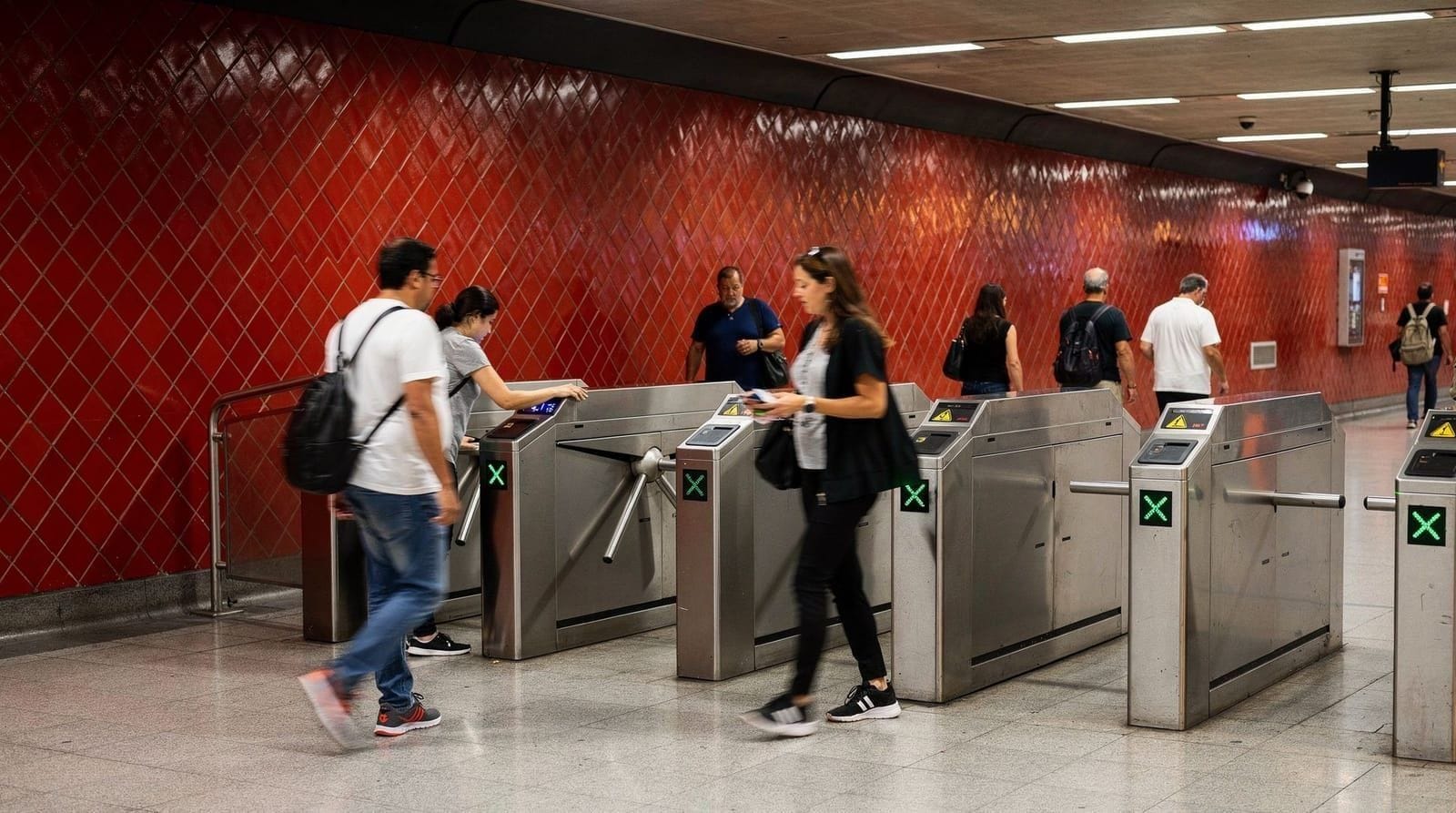
L9 Sud metro (€5.90, variable — around 45–55 minutes into the centre): Direct metro from both terminals, but the L9 is slower than it sounds — multiple stops, no express section, and requires a change at most city-centre destinations. Not recommended for arrivals with significant luggage, but fine for departures from a central hotel if you can manage steps and turnstiles.
Official taxi (flat rate ~€39, 30–40 minutes): White official taxis with meters, available from the rank outside the terminal. The Barcelona flat rate to and from the airport means you know the price in advance. No booking required. Comfortable, direct, door-to-door. For solo travellers or couples, the cost-per-person is high; for groups of 3–4, it approaches the cost of the Aerobus for each person.
Private transfer via GYG or similar (~€35, 40–45 minutes): Pre-booked vehicle with named driver at arrivals. Comparable price to the taxi flat rate but includes flight tracking, a guaranteed meeting point, and the certainty of someone with your name at the arrivals hall. Does not save money over a taxi for most journeys; saves uncertainty and effort.
All four options at a glance
| Option | Price | Journey time | Best for |
|---|---|---|---|
| Aerobus | See operator’s official site | 35–40 min | Solo travellers, couples, light luggage |
| R2 Nord train | €4.90/person | 26 min (T2 only) | Budget travellers at Terminal 2 |
| L9 Sud metro | €5.90/person | ~45–55 min | Departures from a central hotel |
| Official taxi | ~€39 flat rate | 30–40 min | No pre-booking needed, door-to-door |
| Private transfer | ~€35–42/car | 40–45 min | Groups of 3+, families, early/late flights |
If you plan to rely on public transport for the rest of your stay rather than one-off taxis, our transport pass comparison guide and the Hola Barcelona travel card guide explain which passes are worth buying once you are in the city.
When the private transfer makes sense
Group of 4+ with luggage: The per-person cost of the private transfer (€35 ÷ 4 = €8.75) is low per person, and the vehicle takes you to your specific hotel address. Clear winner over public transport.
Early-morning departure (before 6am): The Aerobus starts at 5:30am but runs less frequently. Taxis exist but availability varies and the app-based services work better in daylight hours. A pre-booked private transfer is the most reliable early-morning option.
Late-night arrival: If you land after midnight, the Aerobus stops at 1am and the metro at midnight. The taxi is always available but requires finding the rank in the dark with luggage. A pre-booked driver with your name at arrivals removes that uncertainty.
Travelling with young children or elderly passengers: The private transfer eliminates the bus or metro navigation entirely. Worth the premium.
First-time Barcelona visit: If you are unfamiliar with the city, a private transfer removes the chance of ending up on the wrong bus or getting off at the wrong metro stop with three suitcases. Pair the transfer with a look at our where to stay in Barcelona guide before you land, so the driver’s destination address is already decided.
When to take the Aerobus or train instead
Solo traveller or couple without excessive luggage: The Aerobus is a no-brainer. Frequent, fast, reliable, no booking required. Takes you to Plaça de Catalunya in the centre of everything.
Staying near Passeig de Gràcia or Sants: The R2 Nord train is the fastest and cheapest option if you are at Terminal 2. A 26-minute journey directly to the centre for under €5 per person beats everything else if you can manage your luggage.
Budget-focused travel: No shame in the Aerobus. It works efficiently and the Barcelona city transit system is excellent. Spending €35 on a transfer when you could pay the Aerobus fare and arrive at the same time is not obviously a better decision.
What private transfer operators do well
The key genuine advantages of a pre-booked private transfer over a taxi:
Flight tracking: The driver monitors your flight status and adjusts pickup time if you are delayed. A taxi at the rank cannot offer this.
Guaranteed meet-and-greet: A driver with your name on a sign at the arrivals hall is visible and stress-free after a long flight. The taxi rank requires finding and queuing.
Fixed confirmed price: No meter anxiety. The price you book is the price you pay. Taxis use meters from the city boundary, though the flat rate from the airport is regulated.
Luggage capacity: Operators are told your luggage in advance and send an appropriate vehicle. Easier than hoping a taxi has boot space.
Taxi versus private transfer: the honest nuance
The official Barcelona white taxi flat rate to or from the airport is approximately €39 (2026 rate, subject to annual adjustment). This covers any destination within the city centre — no meter until you cross the city boundary on the return journey.
A pre-booked private transfer typically costs €35–42 for a standard saloon car. The price difference is marginal and comes down to the certainty of the pre-booked experience versus the simplicity of hailing a taxi at the rank.
One honest note on taxis: Barcelona has a strict official white-taxi-only system. Never accept an offer from someone approaching you inside the arrivals hall or just outside the exit — these are illegal tout taxis. Use the marked official taxi rank outside the terminal only. Our transport pass comparison guide covers the full system.
Currency, tipping and paying the driver
Private transfer bookings are prepaid online in euros, so there is no cash negotiation on arrival — the price you confirmed at booking is the price charged, with no surcharges for luggage or the time of day. Tipping is not expected for airport transfers in Spain, though rounding up a few euros for a driver who has handled several heavy suitcases is appreciated, not required. If you are also planning to use taxis or ride-hailing apps once you are in the city, keep a small amount of cash on hand — some older official taxis still prefer cash, though card readers are now standard in most vehicles. Our getting around Barcelona guide covers payment methods across the whole city transport network, not just the airport leg.
Getting to and from El Prat
Terminal 1 (T1): Handles most international flights. Aerobus stops directly outside. No direct train — shuttle bus to T2 required for R2 Nord.
Terminal 2 (T2): R2 Nord train connection direct. Shorter journey to the city but some airlines require the free shuttle bus from T1 first.
The free shuttle bus between terminals runs every 10 minutes and takes about 10 minutes.
For departures: booking ahead
Pre-booked private transfers for departure are particularly valued by travellers with early-morning or late-night flights. The alternative is:
- Booking a taxi via app the evening before (not always reliable very early in the morning).
- Walking to a taxi rank from your hotel.
- Taking the Aerobus from Plaça Catalunya.
All of those work fine. The private transfer adds a confirmation in your calendar, a driver who will find you, and no stress about availability on the morning of departure. For a trip where the airport logistics are the final piece of a well-planned visit, it is a clean way to close.
Combining with a city travel card
If you are using the Hola Barcelona travel card for your city transit during your stay, remember that this card is not valid for the Aerobus or the airport metro (L9 Sud) — those use separate ticketing. The R2 Nord train uses the standard metro/rail ticketing system and may be covered depending on the zones included in your travel card.
Our transport pass comparison guide maps which cards cover which services.
The verdict
Private transfer is worth booking for groups of 3 or more, families with luggage, early or late flights, or anyone who values certainty over optimization. It is not cheaper than public transport and rarely faster — it is more comfortable and more reliable.
Solo travellers and couples on a normal schedule: take the Aerobus. It is frequent, comfortable, and deposits you at the centre of Barcelona without any logistics to manage.
El Prat airport layout: what to know on arrival
Barcelona El Prat has two terminals — T1 and T2 — which are physically separate buildings about 4 kilometres apart, connected by a free shuttle bus. Understanding which terminal your flight uses before you arrive eliminates a significant source of confusion.
Terminal 1 (T1) handles the majority of international flights, including virtually all long-haul routes from outside Europe and most intra-European flights on airlines other than Iberia and Vueling. If you are arriving from London, New York, Doha, Dubai or any other non-Spanish point of origin on a non-Iberia/Vueling carrier, you are almost certainly arriving at T1. The terminal has a single arrivals hall on the lower ground level. Baggage reclaim at T1 typically takes 20–40 minutes from landing for long-haul flights, longer during peak periods.
Terminal 2 (T2) handles primarily Iberia and Vueling flights — domestic routes and some intra-European Vueling connections. It is an older, smaller facility. T2 has its own R2 Nord train connection, which is one reason the train appears on so many comparison lists: it is the fastest surface option, but only if you land at T2. Travellers who land at T1 and take the shuttle to T2 to use the train typically spend 25–30 minutes in transit before the train even departs, which makes the Aerobus a better choice for T1 arrivals.
The free inter-terminal shuttle runs every 10 minutes between T1 and T2. It departs from outside the arrivals level at each terminal. Journey time is approximately 10 minutes. You do not need a ticket; it is a free airport service. If you have pre-booked a private transfer and land at T1, your driver will meet you at T1 — you do not need to take the shuttle; the driver comes to your terminal.
The taxi rank and Aerobus stops at T1: Exiting the arrivals hall, the official white taxi rank is directly outside the terminal to the left. The Aerobus stop is a short walk further along the exterior — follow the clearly marked “Aerobus” signs. Both are within a 5-minute walk of the exit. Do not accept transport offers from anyone approaching you inside the terminal building.
The Aerobus in detail
The Aerobus is the most widely used transfer option for individual travellers and couples, and it merits a thorough description because several details are not obvious when you first use it.
The route: The Aerobus from T1 and T2 runs to central Barcelona with stops in this order: Plaça d’Espanya, Plaça Universitat, and Plaça de Catalunya. If your hotel is in the Gothic Quarter, the Eixample or anywhere near Las Ramblas, Plaça de Catalunya is your stop — it is the main gateway to the city centre. If you are staying near the trade fair (Fira de Barcelona) or Montjuïc, Plaça d’Espanya is useful. Plaça Universitat serves the area around the Universitat de Barcelona and the lower Eixample.
Frequency: Every 5 minutes during peak hours (approximately 6am–9pm); every 10 minutes off-peak. First bus around 5:05am from the airport; last bus around 1:05am. The service is reliable — it runs even on public holidays, though frequency may reduce slightly.
Buying tickets: The cheapest way is online in advance via the official Aerobus website or app, where prices are occasionally reduced with a multi-trip or round-trip option. At the airport, tickets can be bought from machines near the Aerobus stop or from staff at the counter. Do not attempt to pay the driver on board — the Aerobus does not accept payment on the bus itself. Cash and card both work at the airport machines.
The Aerobus app: The operator (Transports Metropolitans de Barcelona) has an app that shows real-time bus positions and departure countdowns, which is useful if you have data connectivity on arrival. It also stores digital tickets.
Luggage space: The bus has designated luggage storage on the lower level for large suitcases, plus overhead racks for smaller bags. The storage is ample for 1–2 pieces per person under normal conditions. In peak summer, with a full bus and passengers carrying ski-bag-sized luggage, it can get tight — arriving at T1 and boarding at the first stop gives you the best position.
The round-trip Aerobus ticket is worth buying if you plan to use it for both arrival and departure.
Booking a transfer for groups, families and business travel
The calculation changes materially for groups of three or more, families with children, or business travellers on a tight schedule.
What to look for in a provider: Not all private transfer operators are equivalent. When comparing options, the key features to check are:
- Flight tracking: The operator should monitor your flight number and adjust the driver’s arrival time automatically if you are delayed. This is standard among reputable operators but not universal. If a provider cannot confirm flight tracking, book elsewhere.
- Name-sign meet and greet: The driver should be waiting in the arrivals hall with your name displayed. Some budget operators send a driver to the taxi rank and text you a description of the car — this is inferior and requires you to navigate the exterior chaos with luggage.
- Child seat options: If you are travelling with children under 12, Spanish law requires appropriate child restraints. Most private transfer operators offer child seats as a bookable add-on (typically €5–10 extra per seat); confirm this at the time of booking, not on the day.
- Luggage capacity: Standard saloon cars (4-door sedan) hold 3–4 passengers and 3–4 medium suitcases comfortably. For 4 passengers with 6 large suitcases, a minivan or MPV is necessary. State your luggage quantity when booking — reputable operators ask for this information and send the appropriate vehicle.
- Maximum wait time policy: If your baggage takes 45 minutes instead of 20, is the driver still there? Standard policy among good operators is 60 minutes of free waiting after the flight lands. Confirm this before booking.
Group of 4 with 6 large suitcases: private transfer vs taxi. The official taxi flat rate covers the journey to any city-centre address at approximately €39 (2026 rate). A standard Barcelona taxi is a saloon car: 4 passengers, but luggage space for 3–4 suitcases at best. A group of 4 with 6 large cases cannot fit in a single taxi. Two taxis cost roughly €78 and still require someone to manage the coordination. A pre-booked minivan private transfer for the same group runs approximately €55–65 and carries all passengers and all luggage in one vehicle, with the driver handling the luggage. The arithmetic favours the private transfer clearly in this scenario.
For business travel, the calculation is less about money and more about predictability. A pre-booked transfer with a name-sign, a confirmed vehicle and flight tracking is the appropriate choice when the arrival needs to be smooth regardless of what the airport throws at you. The cost difference between a transfer (€35–45) and a taxi (€39) is not the relevant variable — the relevant variable is whether you spend 5 minutes in the arrivals hall or 15 minutes finding the taxi rank and negotiating luggage into a car.
Book the private transfer when the alternatives feel complicated. Take the Aerobus when they do not. Both get you to Barcelona; one just removes the uncertainty that a long flight can make unwelcome.
Compare alternative tours
Frequently asked questions about Barcelona airport private transfer
How much does a private airport transfer cost in Barcelona?
Private transfers from El Prat Airport to the city centre start at €35 per car (up to 3–4 passengers). For a group of three or four people, this is comparable to taking individual public transport tickets.Is private transfer worth it over the Aerobus?
The Aerobus takes 35–40 minutes (the current fare is on the operator's official site), but requires a walk with luggage and drops you at Plaça de Catalunya rather than your hotel. For solo travellers or couples, the Aerobus is almost always better value. For families with luggage, a private transfer to your specific address is worth the premium.What is the difference between a private transfer and a taxi?
A private transfer pre-books a specific vehicle with a named driver and a confirmed meeting point (typically in arrivals, with a name sign). A taxi is hailed outside the terminal — no pre-booking, meter runs from airport to your destination. Taxis have a flat rate to/from city centre (€39 fixed, 2026 rate).Does the driver wait if my flight is delayed?
Reputable private transfer operators track your flight and adjust the pickup time automatically. This is one of the key advantages over a taxi.Can I book a private transfer for departure?
Yes — pre-booked private transfers for departure are particularly useful for early-morning flights when taxis are harder to find. Most operators cover both arrival and departure.What are the alternatives from El Prat Airport?
Aerobus (35 min to Plaça de Catalunya; current fare on the operator's official site), R2 Nord train (€4.90, 26 min, T2 only), L9 Sud metro (€5.90, direct but slow with luggage), official white taxi (€39 flat rate, metered after city boundary). All are good options depending on your group size and luggage situation.