Dalí triangle and Cadaqués tour: what to expect
From Barcelona: Dalí triangle and Cadaqués tour
Duration: Full day
- Free cancellation
- Hotel pickup
Salvador Dalí was a Catalan surrealist who spent much of his life in and around the Costa Brava fishing village of Cadaqués. The three museums he created and donated to his foundation after his death in 1989 — the Theatre-Museum in Figueres, the Portlligat house, and the Púbol castle — form what his foundation calls the “Dalí triangle.” A guided tour from Barcelona covers at minimum the Figueres museum and the Cadaqués area in a single, long day.
| Where | Figueres and Cadaqués, Costa Brava (around 2–2.5hrs north) |
| Cost | Around €80–110/adult tour + €15–17 Figueres entry + lunch |
| Time needed | Full day, 5–6 hours of it in transit |
| Getting there | Coach pickup from central Barcelona, or RENFE train independently |
| Best time | Book weeks ahead in summer; shoulder season has more Portlligat availability |
What the tour covers
Figueres and the Theatre-Museum Dalí: The surrealist theatre-museum is one of the most visited museums in Spain and the largest surrealist object in the world — Dalí’s own description. The building is a converted municipal theatre (where Dalí had his first public exhibition as a teenager) redesigned by Dalí himself with a geodesic dome ceiling, enormous painted murals, and theatrical spaces where the artworks are inseparable from the architecture.
Inside: the Cadillac in the rain (an actual car with a real rain installation); the Mae West room (a furniture arrangement visible as a face from a specific point on the staircase); the Apotheosis of the Dollar ceiling painting; and the crypt where Dalí is buried beneath the stage. The museum takes 1.5–2 hours to see properly.
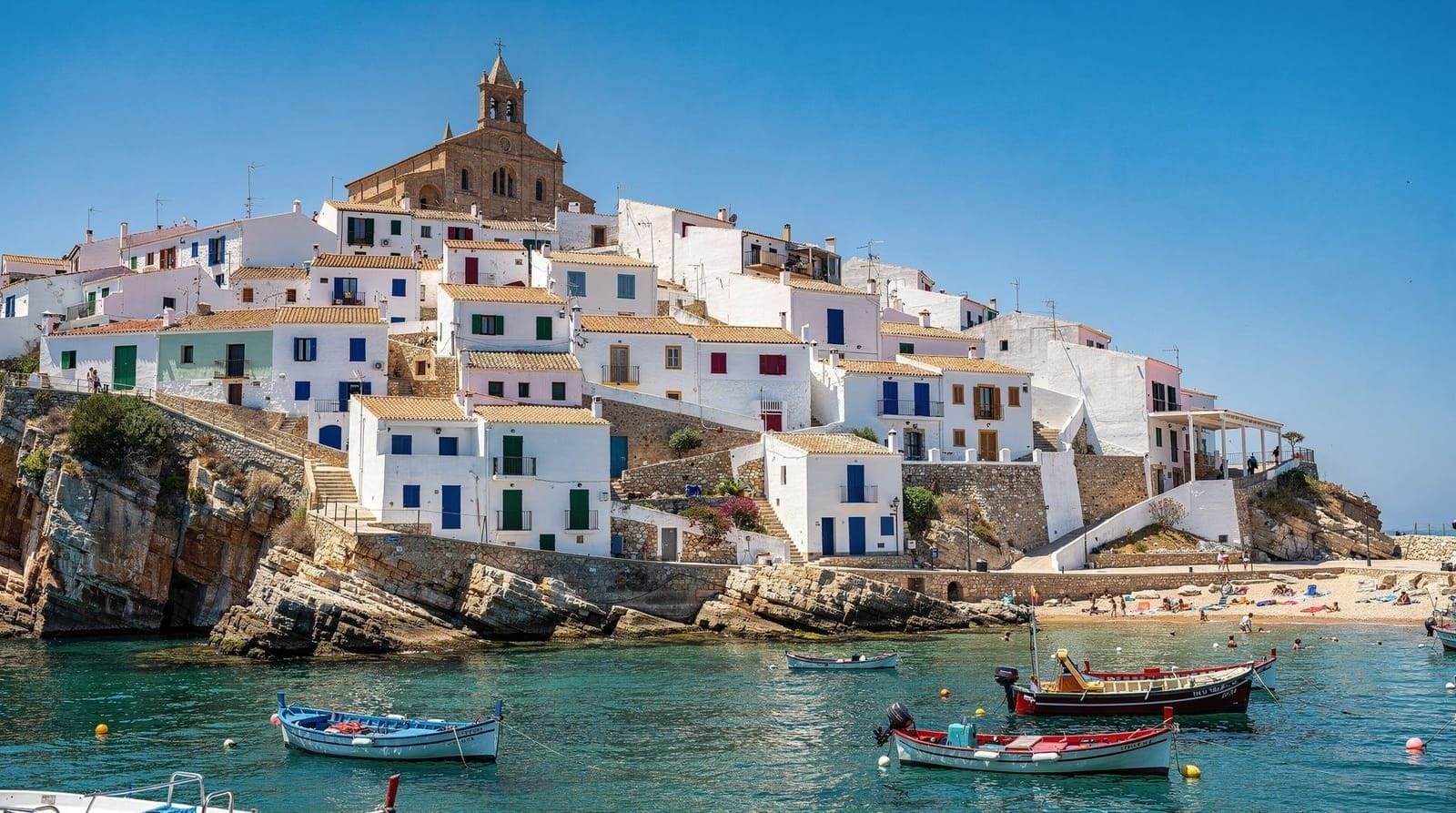
Cadaqués: The village where Dalí lived for most of his adult life (in the adjacent hamlet of Portlligat). It is also where Marcel Duchamp and Man Ray visited, where Federico García Lorca spent summers, where Picasso first visited Cubism. The white-walled village on a sheltered bay surrounded by rocky outcrops is one of the most atmospheric places on the Costa Brava.
Most tours allow 1.5–2 hours in Cadaqués: time to walk the waterfront promenade, see the 18th-century Church of Santa Maria on its hilltop, eat at a waterfront restaurant and take in the view that appears in at least a dozen of Dalí’s paintings.
Casa Salvador Dalí – Portlligat: The house where Dalí and Gala lived for 40 years, directly accessible from Cadaqués on foot (15 minutes). Entry is by timed ticket (€14) for small groups of 8 at a time. The house is extraordinary — a jumble of connected fishermen’s cottages converted into a living surrealist environment. Not all tours include Portlligat (access requires a specific advance reservation); check the description carefully.
The real cost
Tour pricing: €80–110 per adult for the full day with transport and guide. This typically does not include museum entry fees:
- Figueres Theatre-Museum: €15–17
- Portlligat house (if included): €14
- Lunch: €15–25 at a Cadaqués restaurant
Total budget for the full day: €120–160 per person. Not cheap, but comparable to a similar independent day using RENFE + taxi + bus to reach both Figueres and Cadaqués.
The transit reality
From Barcelona to Figueres: 2 hours by coach. Figueres to Cadaqués: 45 minutes over the Cap de Creus mountain road (winding and impressive; some passengers get car-sick on the bends). Cadaqués to Barcelona: reverse the journey. Total transit: 5–6 hours of a full day.
That means roughly 3–4 hours at the two destinations combined. It is a long day for the amount of time you are not in the vehicle. If you have flexibility, spending a night in Cadaqués and exploring the area more slowly rewards the effort considerably. Our Cadaqués destination guide covers the village in detail.
The Figueres Theatre-Museum in more detail
Dalí designed the museum as a total artwork rather than a collection of paintings in white-walled rooms. The effect is deliberately disorienting — you are inside a surrealist environment, not observing one. Highlights:
The Rainy Cadillac: A Cadillac with a mannequin inside, a column of tyres above it, and real rain falling inside the car when you insert coins. The tableau includes Ernst Füchsel’s portrait of Queen Esther on the pillar. Bizarre, theatrical, absolutely Dalí.
Mae West’s Face: From the landing of a flight of stairs, a series of furniture pieces (a sofa for lips, paintings for eyes) resolve into a face recognisable as Mae West. One of the most successful visual jokes in modern art.
The Dalí Jewels Room: A collection of jewelled objects Dalí designed — including the famous melting watch brooch. Not to be confused with the Portlligat house jewellery display.
The Crypt: Below the stage, Dalí’s remains lie beneath a plain marble slab. The gravitas is genuine — despite the theatrical excess everywhere else, this room is quiet.
Cadaqués: managing your time
The village is small (about 2,700 permanent residents) and the centre is fully pedestrianised. The waterfront promenade (Passeig del Mar) is where almost everyone ends up — cafés, fishing boats and the distinctive Cap de Creus headland in the background.
Eat: Els Pescadors (seafood, moderate price, good anchovies) or any of the restaurant terraces on the waterfront serve decent food. Avoid the menu turístic at the worst tourist-facing restaurants — the overcrowded places directly on the promenade at peak times.
Walk: The 15-minute path to Portlligat from the main village square is flat and attractive. If your tour does not include Portlligat entry, you can still walk to the house exterior and see the bay where Dalí set many of his olive-oil-lit sea paintings.
See: The Church of Santa Maria — a simple baroque interior but perched on a hilltop with views back over the bay that explain exactly why Dalí chose to stay.
Who this tour suits
Strong fit: Art enthusiasts with a specific interest in Surrealism or Dalí. Anyone who wants to see the Costa Brava’s most beautiful village without navigating the infrequent bus from Figueres. Pairs or small groups who can split the transit time with conversation.
Not the best fit: Travellers who want more time at the museum and less in the coach. Families with restless children (the coach transit is long). Anyone who has already been to the Figueres museum and primarily wants the Cadaqués experience — in that case, the RENFE-to-Figueres-then-bus option or a private driver is more flexible.
Booking essentials
Book as early as possible in summer. The Portlligat house is the bottleneck — groups of 8 at a time with specific slot allocations. If the tour description says “Portlligat included,” confirm that means a guaranteed entry, not a “subject to availability” clause.
Most tours depart from a central Barcelona meeting point at 8–9am and return by 8–9pm. It is a full day.
Alternatives to consider
RENFE to Figueres independently (55 minutes, €17–25): The museum is walkable from the station. This works perfectly if you only want Figueres. Add the Cadaqués bus (Sarfa company, 1 hour from Figueres, infrequent in low season) for a more complex but possible independent day.
Full-day Costa Brava with boat trip: Some operators combine the coast with a boat excursion along the rocky cliffs. This replaces the Dalí museum focus and is a better choice for travellers who want swimming and scenery rather than art. Our Costa Brava boat trips guide covers the dedicated water-based options in detail.
Combining with Girona: If your interest leans more toward medieval architecture than surrealist art, our Girona and Costa Brava day trip guide covers a different itinerary that swaps Figueres for Girona’s walled old town — see our best day trips from Barcelona guide for the full comparison of northern Catalonia excursions.
For more on the Costa Brava region, including independent day-trip options, see our destination guide.
Salvador Dalí’s life in Cadaqués
Dalí first came to Cadaqués in the summer of 1916, aged twelve, when his father — a notary from Figueres — rented a house in the village as was fashionable among the Catalan bourgeoisie of the period. The family returned every summer. By his student years in Madrid, Cadaqués had become the place Dalí returned to with his friends: Federico García Lorca arrived in 1927 and later described the weeks he spent at the Dalí family house as among the most intense of his life, writing much of his Romancero gitano and falling — apparently hopelessly — for Dalí himself. Luis Buñuel visited too, and it was in Cadaqués that the trio planned the scenario for Un Chien Andalou, the 1929 surrealist short film that announced the movement to cinema.
Gala — born Elena Ivanovna Diakonova in Kazan in 1894 — arrived at the village with her then-husband, the Surrealist poet Paul Éluard, in 1929. She left with Dalí. The relationship that followed was the defining fact of both their lives: Gala became his muse, his business manager, his gatekeeper, and later — legally, formally — his wife. It is difficult to overstate how central she was to his work during the Cadaqués decades. Many of his most obsessively repeated figures — the woman seen from behind, the silhouette against the water — are her. The painting he gave her name to, Galarina (1945), hangs in the Figueres museum.
After 1930, Dalí began extending a group of fishermen’s cottages in Portlligat, the tiny hamlet just across the headland from Cadaqués, into the labyrinthine house-studio that would be their base for forty years. He worked there almost every morning; the afternoons were for the social theatre of the village promenade. The landscape he lived inside is inseparable from the paintings: the flat limestone rocks at the water’s edge, the double-image reflections in the sheltered bay on still days, the harsh north-facing light in winter. The surrealist distortions in works like The Persistence of Memory or The Disintegration of the Persistence of Memory are not abstract fantasies — they are that specific bay, rendered by a mind that looked at it every day and kept seeing it break apart.
The Cap de Creus natural park
The helicopter of rock and scrubland that forms the far north-eastern tip of the Costa Brava — and indeed the easternmost point of the entire Iberian Peninsula — is Cap de Creus. It is now protected as a natural park and the landscape is extraordinary in a way that makes conventional scenic beauty feel tidy: the limestone karst terrain has been shaped by the Tramuntana wind (the cold, dry northerly that comes off the Pyrenees and can gust to 100km/h) into a succession of eroded ridges, sea-sculpted boulders and isolated coves. Dalí called the cape’s rocks “geological delirium” and borrowed their forms — melting, doubled, morphing between one thing and another — throughout his career.
The lighthouse at Cap de Creus sits at the very tip of the headland, reached by a winding road through the park. A small restaurant operates there with views over the coast in both directions; on clear days you can see the French coast beyond the Pyrenean foothills to the north. It is 45 minutes from Cadaqués by car or a full-day hike on the coastal path.
The Portlligat house, sitting in its bay just below the cap, is one of the most visited sites in the park. The Gala-Salvador Dalí Foundation, which manages all three Dalí museum sites, limits entry to groups of eight at a time in timed slots — not for commercial reasons but because the house is genuinely small and because the foundation takes seriously its role in preserving what Dalí left rather than wearing it away. Slots book out weeks ahead in July and August. If Portlligat is the specific reason you want to make this trip, book it first and arrange the rest of the day around the confirmed slot. There is no queue-jumping mechanism for this one.
Eating and drinking in Cadaqués
The village is famous for anchovies in a way that people who have only eaten the canned Italian variety may find surprising. The anchovies of the Costa Brava — specifically those from the nearby town of L’Escala, 20km to the south — are cured for a minimum of six months in salt, filleted by hand and preserved in olive oil. The result is firm, meaty, intensely savoury and completely unlike the thin, mushy versions sold in supermarkets. On the promenade at Cadaqués, a plate of anchovies with bread and tomato and a glass of local white wine is as close to a perfect simple meal as the Costa Brava offers. Order them wherever you see them described as anxoves de l’Escala.
The restaurant culture on the waterfront Passeig del Mar runs from acceptable to excellent, with prices that reflect the village’s cult status. For fish: La Galiota (traditional, solid, moderately priced) and Casa Anita (old-school, reservations essential in summer) are both consistently good. For something lighter — a glass of wine, a plate of cheese and local cold cuts — the bars on the lower promenade are a better option than the restaurant terraces at midday when the tourist tide is at its highest.
The evening culture in Cadaqués centres on the passejada — the evening walk along the promenade — and a pre-dinner aperitivo that typically runs from 7pm. This is the hour when the village becomes itself: the art crowd, the long-term summer residents, the locals who have watched tourist fashions come and go, all circulating on the same waterfront. A glass of cava or local vermouth, anchovies, the particular evening light on the headland. Whatever else you do in Cadaqués, try to be there for this hour.
The Dalí triangle tour is a genuinely immersive day into one of the 20th century’s most theatrical artistic legacies — plan for the transit, book Portlligat access early, and leave Cadaqués for the late afternoon when the light on the bay is at its most extraordinary.
Compare alternative tours
Frequently asked questions about Dalí triangle and Cadaqués tour
What is the Dalí triangle?
The Dalí triangle refers to the three museum sites created by Salvador Dalí in northern Catalonia: the Theatre-Museum in Figueres (his most famous work), the Dalí House-Museum in Portlligat near Cadaqués, and the Dalí Castle in Púbol. Most tours include Figueres and either Cadaqués or Portlligat.How much does the Dalí triangle tour cost?
Full-day tours with transport and hotel pickup run €80–110 per adult. Entry to the Theatre-Museum in Figueres costs an additional €15–17 per adult on top of most tour prices.How long is the journey from Barcelona?
Figueres is about 2 hours north of Barcelona by coach. Cadaqués adds another 45 minutes from Figueres over a winding mountain road. The full round trip is approximately 5–6 hours of transit.Do I need to book Dalí museum tickets in advance?
Yes, strongly recommended. The Figueres Theatre-Museum sells out weeks ahead in summer. Most tours pre-book your entry, but verify this when booking.Is Cadaqués worth the extra travel time?
Yes if whitewashed coastal villages are your thing. Cadaqués is one of the most beautiful villages in Spain — but reaching it from Figueres on a touring coach over a narrow mountain pass takes 45 minutes each way. Budget your expectations accordingly.Can I visit independently?
RENFE trains run Barcelona to Figueres in 55 minutes (€17–25 each way). Cadaqués by public transport requires a bus from Figueres that runs infrequently. A tour is significantly more practical for the Cadaqués section.