Girona and Costa Brava day trip from Barcelona: is it worth it?
From Barcelona: Costa Brava and Girona small-group tour
Duration: Full day
- Free cancellation
- Small group
- Hotel pickup
Girona is the most complete medieval city in Catalonia, and the Costa Brava is the region’s most beautiful coastline. Combining them in one guided day trip from Barcelona is logistically logical — both are 1–1.5 hours north — but the combination also means spending less time in each place than either deserves. Whether the trade-off is worth it depends on what you want from the day.
| Where | Girona old town + one or two Costa Brava villages |
| Cost | Around €70–85/adult, transport and guide included |
| Time needed | Full day; around 2–3 hours in Girona |
| Getting there | Small-group coach with hotel pickup from Barcelona |
| Best time | Book at least 1 week ahead; summer dates sell out 2–3 weeks out |
What the tour actually covers
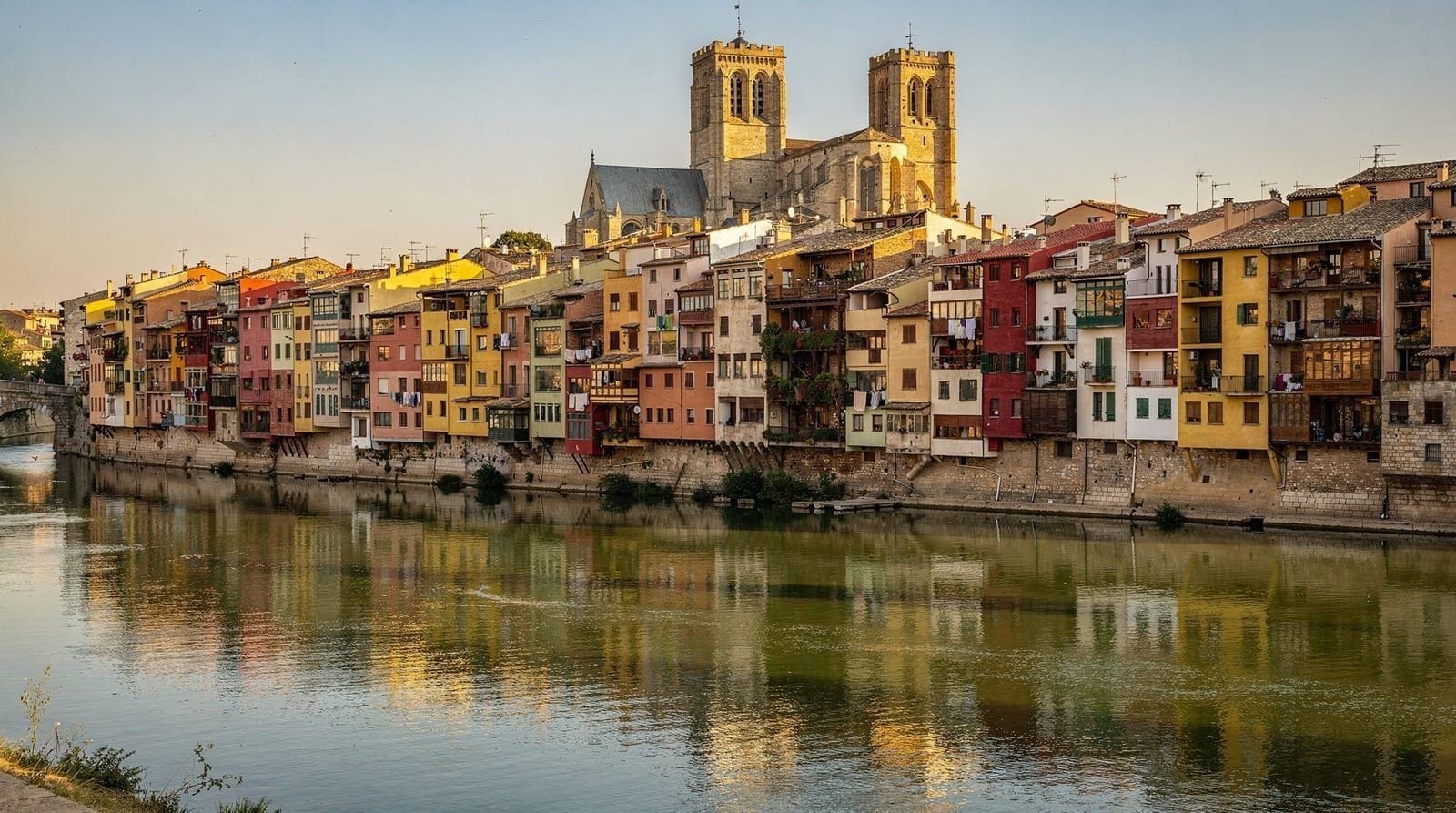
Girona: The walled medieval city on the Onyar river, with a Jewish Quarter that dates back to the 9th century, one of Europe’s best-preserved medieval walls, a Romanesque cathedral (Gothic façade) with the second-widest nave in Christendom, and the coloured houses overhanging the river made famous by travel photography.
Most guides spend 2–3 hours here, covering:
- The Jewish Quarter (Call) — narrow medieval lanes around Carrer de la Força, now home to the Museum of Jewish History.
- The Cathedral of Santa Maria — 90 steps to reach the entrance, monumental Gothic interior. Entry to the museum inside costs €7 separately.
- The city walls (Passeig Arqueològic) — walkable ramparts with views over the old city.
- Pont de Pedrera and the coloured houses along the Onyar — the classic Girona photograph.
- Game of Thrones sites — Girona stood in for King’s Landing in seasons 6 and 7. The Cathedral steps became the Great Sept of Baelor, the Call’s lanes became the House of Black and White. Most guides point these out as part of the walk.
Costa Brava: The afternoon stop varies by operator but typically involves one or two towns on the rugged northern coast. Common choices include:
- Pals — a beautifully preserved medieval hilltop village with panoramic views.
- Begur — a castle-topped town above several idyllic coves.
- Calella de Palafrugell — a whitewashed fishing village on a sheltered bay.
- Tossa de Mar — a fortified medieval town with a walled beach; some tours include a boat trip from here.
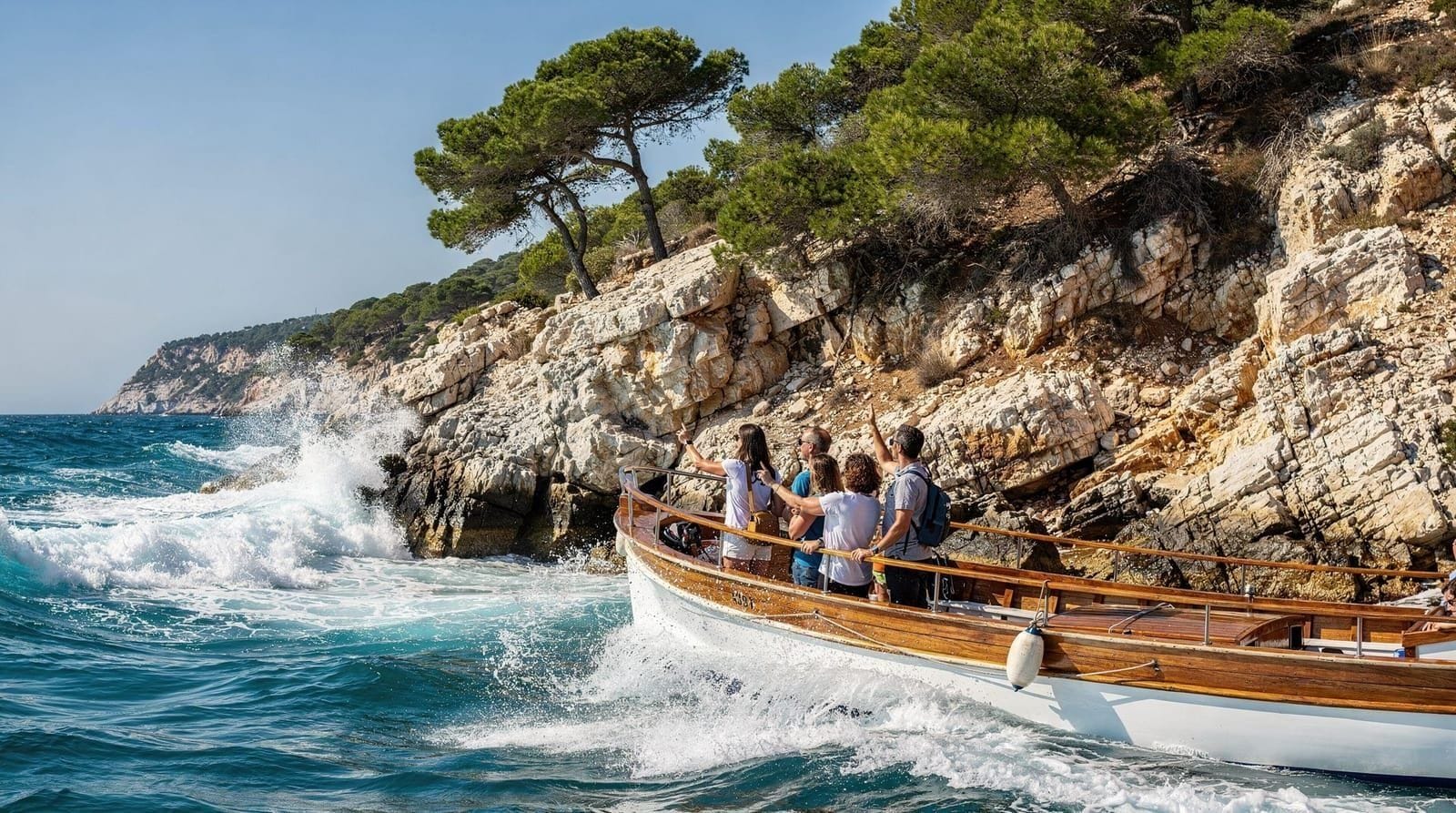
Some tours include a short boat excursion along the Costa Brava’s rocky cliffs, which gives you a perspective on the coastline that is impossible to get from the road.
Real prices and what you pay for
Small-group tours: €70–85 per adult, including air-conditioned transport (usually a minibus for groups of 8–16), bilingual guide and hotel pickup from central Barcelona. What is NOT typically included: museum entry fees in Girona (€7–15 each), lunch (expect €15–25 in a Girona restaurant), and any Costa Brava boat trip surcharge.
The train alternative for Girona alone: under €20 return from Barcelona Sants, with trains running every 30 minutes from 6am. Costa Brava by public transport is significantly harder — buses are infrequent and a rental car is the practical independent option.
Where the tour earns its price: the guide-provided context, the elimination of the car rental, and the logistics of combining two destinations efficiently in one day.
The Game of Thrones factor: honest assessment
Girona was used heavily as King’s Landing in Game of Thrones seasons 6 and 7 (approximately 2016–2017). If you are a fan, the sites are genuinely recognisable — especially the cathedral steps (the Great Sept bombing sequence), Carrer de la Força (Arya Stark’s time with the Faceless Men), and the bridge scenes along the Onyar.
But here is the honest note: the real Girona is more interesting than the Game of Thrones version. The city has been a living medieval space for 2,000 years, predating Westeros by some distance. The Jewish community that flourished here from the 9th to 15th century left a more durable legacy than any television show. The best tour guides use GoT as a hook but spend more time on actual history.
If GoT is your primary motivation, the tour still delivers. If medieval history is what you are after, the GoT framing will not diminish the experience.
What the tour rushes past
Two to three hours in Girona is not enough to do it properly. What gets skipped on a combined day:
- The Arab Baths (Banys Àrabs) — 12th-century baths, one of the best-preserved in Europe.
- The Monastery of Sant Pere de Galligants — a 12th-century Benedictine monastery with a good cloister.
- Lunch in a proper Girona restaurant (the city has serious food culture, including El Celler de Can Roca, three Michelin stars — though booking that requires months of advance planning).
- Enough time to walk the full city walls.
If Girona is your primary interest, consider taking the RENFE train independently and spending a full half-day or full day there. Our Girona destination guide covers the full city in detail.
The Costa Brava section
The Costa Brava stretch from Blanes to the French border is 200km of the most photogenic coastline in Spain — rocky promontories, clear turquoise water and whitewashed fishing villages that have changed relatively little since the mid-20th century. Unlike the overdeveloped Costa del Sol, the Costa Brava retains most of its character.
The guided day trip typically gives you 2–3 hours at a single town or two quick stops at different villages. The scenery is gorgeous. The time constraint means you experience it more as a visual highlight than an immersive stay.
For a deeper Costa Brava experience, look at Costa Brava boat trips — dedicated half-day coastal excursions that focus entirely on the water.
Small-group versus private tour
This tour format runs in groups of 8–16, which is comfortable — enough people to generate energy on the bus, small enough that the guide can address individual questions. The group is internationally mixed; most operators run in English and Spanish.
Private versions are available for families or groups wanting full flexibility on timing and stops. Expect to pay €150–250 for a private van plus guide for the day.
Who this tour suits
Good fit: First-time visitors to Catalonia who want to see the north efficiently. Game of Thrones fans. People who prefer not to drive or navigate train schedules. Groups of 2–4 people who find private tours too expensive.
Not the best fit: Serious history or food travellers who want depth in Girona. Families with young children who may find the day too long and varied. Anyone wanting to swim on the Costa Brava — most tours do not include beach time. For a beach-focused alternative, see our Costa Brava best beaches guide.
Booking advice
Book at least 1 week ahead. Small-group tours (8–16 people) fill faster than large-coach options. Summer dates often sell out 2–3 weeks in advance.
Choose a tour that specifies hotel pickup from your accommodation area — some only collect from a central meeting point, which adds 20–30 minutes transit time at both ends of the day.
Check whether lunch is included or an additional cost. If you are on a tight budget, eating in Girona is significantly cheaper than restaurants near tourist sites in Barcelona.
Girona’s Jewish history in depth
The Jewish community of Girona — known in Catalan as the Call — is one of the best-documented and most significant medieval Jewish communities in the Iberian Peninsula. Its history stretches from the 9th century to the forced expulsion of 1492, a period of over six hundred years during which Girona’s Jews contributed substantially to Catalan intellectual, commercial and religious life.
The Call’s geography: The Call occupied the northeast corner of the walled city, in the area now bounded by Carrer de la Força, Carrer de Sant Llorenç and the cathedral hill. Medieval Calls (from the Hebrew kahal, meaning community assembly) were not always walled ghettos in the way the term implies in Northern Europe — in early medieval Catalonia, they were more often self-administered quarters chosen for proximity to commercial routes and communal institutions. Girona’s Call had its own synagogue, butcher, bakery and communal baths, making it functionally self-sufficient.
The community at its height: By the 13th and 14th centuries, Girona’s Jewish community numbered approximately 300–500 people in a city of perhaps 3,000–4,000 total, making it roughly 10–15% of the population — a significant minority with considerable presence. The community produced notable figures in Kabbalistic scholarship: the 13th-century rabbi Nahmanides (Moses ben Nachman) was born in Girona and studied here before his famous disputation in Barcelona in 1263. His writings on Torah commentary remain studied today. Girona was a centre of the Kabbalah — Jewish mystical tradition — in ways that influenced later European Jewish thought.
The 1391 pogrom and the decline: In June 1391, anti-Jewish violence swept through Castile and then Aragon. In Barcelona, Valencia and dozens of smaller cities, Jewish quarters were attacked and communities forced to choose between baptism and death. Girona’s community was assaulted; many converted under duress, becoming what were called conversos or, disparagingly, Marranos. The community that survived was diminished and increasingly subject to suspicion about whether conversions were sincere.
The 1492 expulsion: In March 1492, the same year Columbus sailed, Ferdinand and Isabella signed the Alhambra Decree, expelling all practising Jews from the Spanish kingdoms. Approximately 40,000–100,000 Jews left from across Spain (estimates vary widely); those in Girona had until the end of July. Some converted and remained; others left for Italy, the Ottoman Empire and North Africa, taking with them documents, memories and in several cases the keys to houses they expected to return to. Many never did.
The Museum of Jewish History (Museu d’Història dels Jueus): Located at Carrer de la Força 8, the museum occupies a building that was part of the medieval Jewish quarter and may have been a synagogue or communal building. The permanent collection traces the history of the Girona community through documents, artefacts, gravestones and audio-visual reconstructions. The gravestones in the lapidarium — recovered from the old Jewish cemetery on the hill of Montjuïc — are among the most affecting exhibits: inscriptions in Hebrew, names, dates, the evidence of individual lives. Entry costs €7.
Specific streets to walk: Carrer de la Força (the Roman-era main road, later the Call’s main street) retains much of its medieval width and atmosphere. The entrance to the museum is here. The small lanes running east off Carrer de la Força — Carrer de les Escales, the stepped alleys climbing toward the cathedral — are the medieval network of the Call at its most intact. Most guided tours of Girona cover this area, but walking it slowly on your own, particularly in the morning before tour groups arrive, is worth the time.
Costa Brava landscape and geology
The Costa Brava coastline looks dramatically different from other Spanish coasts, and the reason is geological. Where the Costa Daurada south of Barcelona runs in long sandy beaches backed by flat land, the Costa Brava is characterised by rocky headlands, small coves cut into cliffsides, and forest descending almost to the water. This is a coastline shaped by ancient rock rather than sediment.
The geology in brief: The Costa Brava’s bedrock is predominantly schist and granite of Hercynian origin — approximately 300 million years old, formed during a mountain-building event that predated the Alps. These are hard rocks that erode slowly and irregularly, producing the jagged, indented outline that characterises the coast from Blanes northward. The schist areas tend to produce the distinctive grey-brown cliff faces; granite outcrops appear whiter and more rounded. Where softer rock or fault lines intersect the harder substrate, the sea has carved the narrow coves (calas) that make the coast famous.
Cap de Creus natural park: The northernmost point of the Costa Brava, Cap de Creus is the easternmost point of the Iberian Peninsula and a natural park covering approximately 14,000 hectares of land and sea. The landscape here is extraordinary in its austerity — wind-sculpted rock formations, sparse Mediterranean scrub, a lighthouse at the cape, and water colour that shifts from dark blue in deep water to bright turquoise in the sandy shallows of protected coves. Salvador Dalí lived and worked nearby at Port Lligat (his house is now a museum) and the Cap de Creus landscape directly influenced his Surrealist imagery — the melting, rocky dreamscapes of several major paintings are literal transcriptions of what he saw walking here.
Day tours from Barcelona rarely reach Cap de Creus — it is too far north (approximately 170km from Barcelona). What they do reach — Pals, Begur, Calella de Palafrugell, Tossa de Mar — are in the central Costa Brava section where the geology is similar but the tourist infrastructure more developed.
The Pyrenees-to-sea gradient: One of the distinctive features of Catalonia’s north is the compressed transition from high mountain to Mediterranean coast. The Pyrenees reach over 3,000 metres within 100km of the sea, and rivers like the Ter and the Fluvià drain east through the Empordà plain before reaching the coast. This means the Costa Brava’s hinterland contains an unusually diverse range of landscapes within a short distance: from the Cap de Creus scrubland to the rice paddies of the Empordà to the oak forests of the pre-Pyrenees. The day trip covers a slice of this gradient, but seeing the full transition requires several days and ideally a car.
Food stops on the day
Girona is a serious food city. It contains El Celler de Can Roca — three Michelin stars, held by the Roca brothers for over a decade, and multiple times voted best restaurant in the world (booking requires planning six to twelve months ahead and the waiting list remains long). But the everyday food culture in Girona is also worth paying attention to, and a day-trip lunch in the city is one of the genuine pleasures of this itinerary.
What to order in Girona:
- Xuixos (pronounced roughly SHOO-shos): A deep-fried pastry filled with crema catalana, specific to Girona. The correct version is made fresh and consumed immediately; the warm, crispy outside and cool cream inside is a combination the city has been refining since at least the 19th century. Buy them from a pastry shop (pastisseria) rather than a café chain. They cost €1.50–2.50 each and are consumed standing at the counter or walking.
- Botifarra: Catalan pork sausage, coarser and more deeply flavoured than most Italian sausages, typically grilled and served with white beans (mongetes). This is the default order in any restaurant with a Catalan menu in the region. The version in the Girona area often uses local pig breeds with higher fat content than the coastal variants.
- Pa amb tomàquet: Everywhere in Catalonia but worth noting specifically because the tomatoes in the Girona hinterland — particularly the deep-red cor de bou variety — produce an exceptional result. The correct preparation involves rubbing a halved tomato directly onto toasted bread, adding olive oil and salt. No tomato sauce is involved. Any restaurant that serves tomato sauce on toast is doing it wrong.
- The Roca brothers’ influence: Joan, Jordi and Josep Roca grew up in Girona and their cooking philosophy — local Catalan ingredients, seasonal technique, creative interpretation — has influenced the whole city’s restaurant culture. Even mid-range restaurants in Girona tend toward better sourcing and more careful cooking than equivalent venues in Barcelona. If you have a free choice for where to eat lunch on the tour, ask your guide for a recommendation in the old city rather than eating at the nearest restaurant to the tourist sites.
June-specific note — the Nit de l’Àlbaida festival: If you are visiting Girona in June, the Nit de l’Àlbaida (Night of Weld) festival typically takes place on a mid-June weekend in the Jewish Quarter. The festival celebrates the medieval history of the Call with performances, historical re-enactment, music and the illumination of the old quarter by candlelight. The name refers to the weld plant (reseda luteola) used historically for yellow dye, which grows on the old city walls. The event draws significant local attendance rather than primarily tourist audiences, which makes it one of the more authentically celebratory things to witness in Girona. Check the exact dates before your visit as the festival scheduling shifts year to year.
On the Costa Brava section: Food options at the afternoon stop depend entirely on which town your tour visits. In Calella de Palafrugell and Begur, the harbourside restaurants serve good grilled fish (especially lluc, Catalan for hake, and rap, monkfish) at prices higher than Girona but competitive with Barcelona’s tourist-facing restaurants. In Pals, the options are more limited but the town has a bakery producing local coca (a flatbread) worth stopping for. Your guide will typically indicate which stops have good food options built into the schedule.
The Girona and Costa Brava combination is the smartest way to see northern Catalonia in a single day from Barcelona — as long as you accept that you are getting a curated highlight rather than a deep dive into either destination. Our best day trips from Barcelona guide compares this itinerary against other northbound options if you are still deciding.
Compare alternative tours
Frequently asked questions about Girona and Costa Brava day trip from Barcelona
How much does the Girona and Costa Brava day trip cost?
Small-group tours run €70–85 per adult including transport, guide and hotel pickup. Entry fees to the Jewish Quarter museum or cathedral are usually optional extras.Does the tour include Game of Thrones filming locations in Girona?
Yes. Most operators point out the Cathedral steps, Carrer de la Força and the Old Bridge (Pont de Pedrera) that featured as King's Landing in seasons 6 and 7. Some include a dedicated GoT walking section.How much time do you get in Girona?
Most full-day tours spend 2–3 hours in Girona. That is enough for the cathedral exterior, the Jewish Quarter, the medieval walls and a quick lunch. For a deeper visit, Girona deserves its own half-day by train.Which Costa Brava town does the tour visit?
Most tours include Pals, Calella de Palafrugell or Begur — medieval hilltop towns overlooking the coast. Some include time at a beach. The exact stop varies by operator.Is the tour suitable for solo travellers?
Yes — small-group format (typically 8–16 people) works well for solos who want structure without committing to a private tour.Can I visit Girona independently instead?
Easily. RENFE high-speed trains run from Barcelona Sants to Girona in 37–40 minutes for under €10 each way. If you only want Girona, the train is the better option.