Camp Nou stadium tour: is it worth visiting in 2026?
Barcelona: Camp Nou stadium tour
Duration: 1.5 hours
- Free cancellation
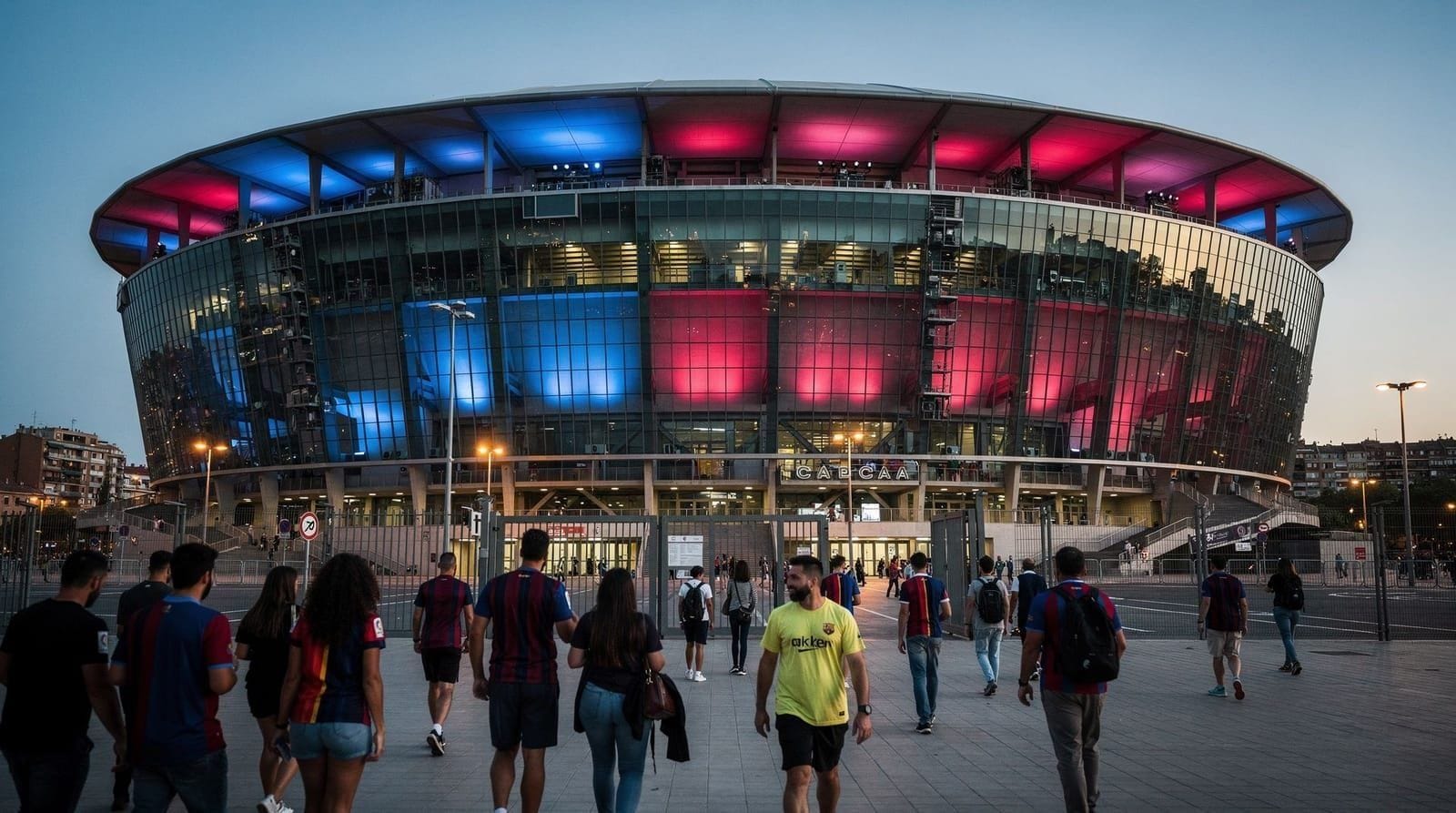
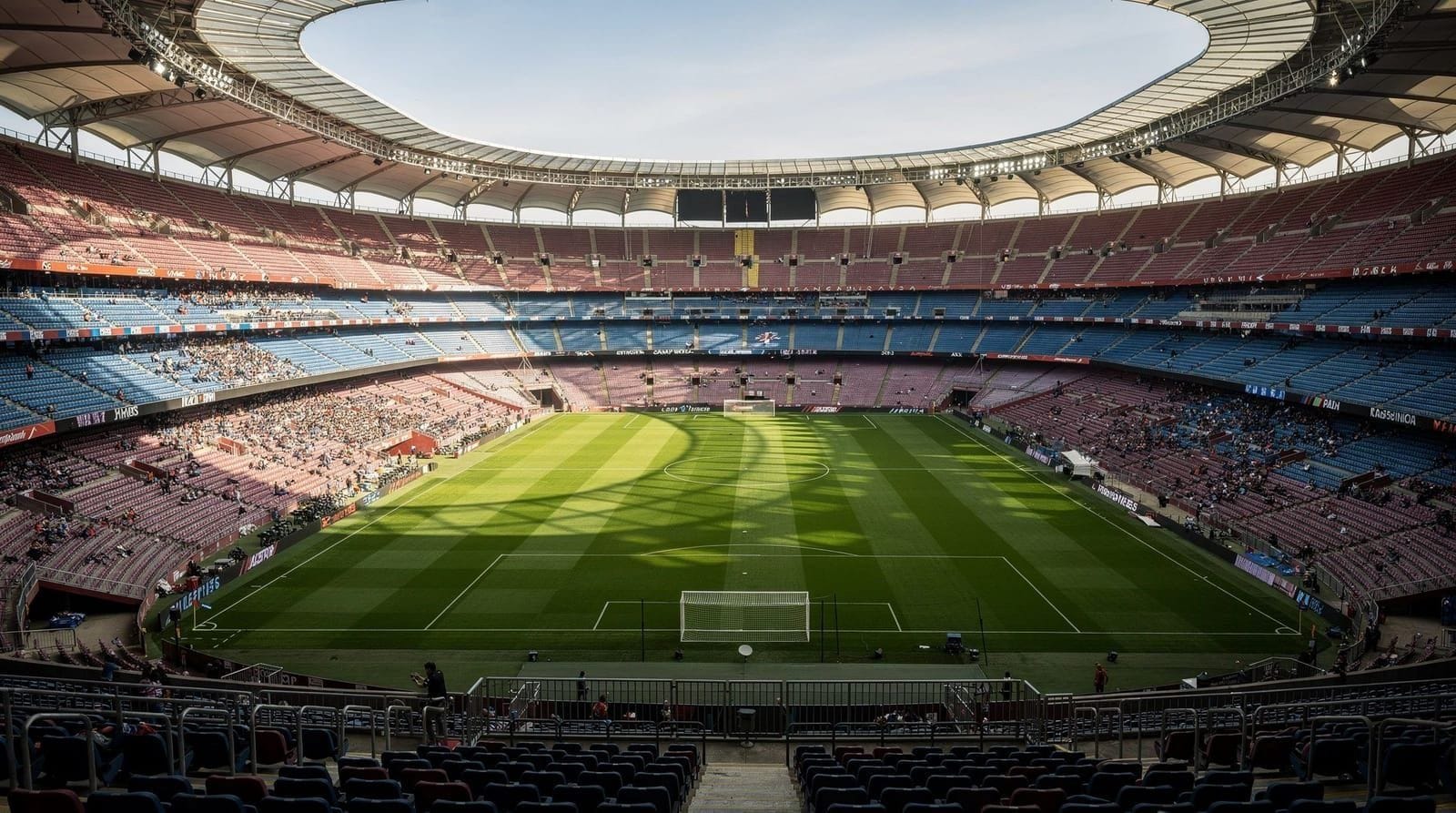
Camp Nou, home to FC Barcelona, is the largest football stadium in Europe with a capacity of 99,354. It is also, as of 2023, a building site. The Espai Barça project — a comprehensive renovation that includes an expanded retractable roof, expanded capacity, and upgraded facilities — has transformed the stadium tour experience significantly. Before booking, you need to know what the current experience actually offers.
| Where | Les Corts district, west of the city centre |
| Cost | Around €29 (standard tour or Immersive Tour); €85 (Players Experience) |
| Time needed | 1.5–2 hours |
| Getting there | Metro L5 (Les Corts / Maria Cristina) or L3 (Maria Cristina) |
| Best time | Weekday mornings, away from matchday crowds |
The renovation situation in 2026
The Espai Barça renovation, begun in 2023, is the most extensive stadium transformation in European football. The project involves installing a retractable roof, expanding the third tier, adding commercial space and creating new visitor facilities. During construction, FC Barcelona has been playing at the Estadi Olímpic Lluís Companys on Montjuïc.
For visitors in 2026, this means:
- The traditional “full stadium tour” with unrestricted access to all stands is not available in the same format as before construction.
- A modified stadium tour is operational, covering sections of Camp Nou that are accessible during the renovation phase. This includes the playing surface viewing area, the press box, the presidential box, and the players’ tunnel.
- The Barça Immersive Tour — an innovative museum experience — runs from a facility adjacent to the stadium and is the primary cultural experience for visitors in 2026.
- Access changes as construction phases progress. What is open in January 2026 may differ from what is open in October 2026.
Always check the current tour description on GetYourGuide before booking — the tour operator updates access information as renovation phases change.
What the standard stadium tour includes
The modified stadium tour (approximately €29) typically covers:
The presidential box and press facilities: The area from which club officials and media watch matches. Standard corporate-style facilities, but the sense of occasion is there.
Visiting team changing rooms: A proper professional changing room with wooden lockers, a medical room and a tactical briefing area. More interesting than it sounds — professional sports infrastructure at this scale is unusual to see up close.
The players’ tunnel: The narrow corridor from the changing room to the pitch, flanked by the Camp Nou crest and tunnel artwork. One of the most recognisable tunnels in football; walking it as Neymar or Messi once did is the tour’s emotional peak.
Pitch-side access: Viewing the pitch from the player and coach level, rather than from the stands. The scale of Camp Nou is more impressive from this level than from the upper tiers.
Variable access: Depending on the renovation phase, sections of the stands, dugouts or media facilities may be accessible or off-limits. Check before you go.
The Barça Immersive Tour
The “Barça Immersive Tour” is a museum-format experience rather than a physical stadium walk. Housed in facilities designed for the renovation period, it covers:
- Trophy room: La Liga titles, Copa del Rey trophies, Champions League cups. The six Ballons d’Or won by Messi are here. For any Barcelona fan, this is a serious exhibit.
- Interactive digital experience: Large-format projections, touchscreen archives, match recreations. The production values are high.
- Personal history exhibits: On legendary players (Cruyff, Ronaldinho, Messi, Pedri), historical managers, and the club’s political history during the Franco era — when supporting Barça was an act of Catalan identity, not just football allegiance.
- Current squad section: Player profiles, training footage and match highlights from the current team.
Ticket price: €28–29 per adult. Duration: 1.5–2 hours. This is genuinely worth it for anyone with a serious interest in the club.
The Players Experience upgrade
For €85, the Players Experience adds a private guide, access to areas not on the standard route, and a photo opportunity in the home team changing room in full match configuration (kit on hooks, boots by the bench). It is aimed at committed fans who want something beyond the standard tour.
Whether it is worth the additional €55 over the standard tour depends entirely on your level of investment in FC Barcelona. For a devoted Barça supporter, the extra access is memorable. For a general tourist interested in football history, the standard tour delivers the same level of architectural and sporting context at significantly lower cost.
Attending a match instead
If FC Barcelona is playing during your visit and attending a match is possible, that experience outweighs any stadium tour by a significant margin. Camp Nou — even mid-renovation — in full voice during a La Liga match is one of the great football experiences in Europe.
Ticket prices: from €50–60 for upper-tier seats to €200+ for lower-tier centrals. High-demand matches (Clásico against Real Madrid, Champions League knockout rounds) sell out immediately. Check the official FC Barcelona ticket site and official authorised resellers only — tout prices for clásicos are extreme.
Our Camp Nou tickets guide covers the legitimate booking process.
Getting there
Camp Nou is in Les Corts district, west of the city centre. Metro L5 (Maria Cristina or Les Corts), L3 (Maria Cristina), or bus connections from Plaça de Catalunya. The journey from the city centre takes approximately 20 minutes by metro. There is no practical reason to take a taxi or Uber — the metro is direct and reliable. Our getting around Barcelona guide covers ticket types if you have not yet bought a metro pass for the rest of your stay.
During renovation, the visitor entrance may have changed from the traditional main entrance. Check the current meeting point in your booking confirmation.
Camp Nou and Barcelona itinerary planning
The stadium is most logically combined with a visit to the Eixample neighbourhood or the Gràcia area — both are 15–20 minutes from Camp Nou. Do not try to combine it with the city centre, Montjuïc and Gaudí sights in the same day: Barcelona’s geography means the stadium is a deliberate detour westward.
For families, the stadium tour is genuinely excellent — interactive exhibits, no language barrier for the football content, and something to say at school on Monday. Our Barcelona with kids guide recommends it as a half-day activity for football-interested children aged 7 and up.
Is it worth it in 2026?
For FC Barcelona fans: yes, absolutely. Even in its modified renovation state, Camp Nou has accumulated so much sporting history that the physical experience — the tunnel, the pitch level, the changing rooms — is meaningful. The Barça Immersive experience is a serious museum.
For general visitors without strong football allegiance: mixed. The stadium is impressive architecturally and the history is extraordinary, but if you are not an FCB supporter, €29 for a modified tour during construction might feel like a premium for partial access. Consider waiting for the full reopening (projected 2026–2027 season) if your visit timing is flexible.
For families: yes. Children who follow football at all will be delighted. The accessible route, the interactive content and the sheer scale of the experience makes it one of the better family activities in Barcelona.
FC Barcelona’s history at Camp Nou
Camp Nou opened on 24 September 1957 — a new stadium for a club that had outgrown its previous ground at Les Corts. The original capacity was 93,053, making it immediately the largest stadium in Europe. The opening fixture was a friendly against Legia Warsaw; the league era at Camp Nou began that same autumn.
The stadium as political symbol: Under Francisco Franco’s dictatorship (1939–1975), Catalan language, culture and identity were actively suppressed. Regional languages were banned in public, Catalan institutions dissolved, and expressions of Catalan nationalism could result in imprisonment. FC Barcelona became one of the few legal spaces in which Catalan identity could be publicly affirmed. Chanting in Catalan at Camp Nou when Catalan was forbidden on the street was an act of quiet defiance. The club’s motto — “Més que un club” (more than a club) — dates from this era and carries a specific political weight that English-speaking fans often underestimate.
Real Madrid, by contrast, benefited from Franco’s favour — the regime used Madrid’s European Cup successes in the 1950s and 1960s as international propaganda. The El Clásico fixture has therefore always contained a dimension beyond football; even a meaningless league game carries the residue of that history.
Key moments in the stadium’s history:
- 1982 FIFA World Cup: Camp Nou hosted the final and several group-stage matches, the first major international tournament to use the stadium.
- 1999 UEFA Champions League final: Camp Nou staged the final that Bayern Munich dominated and Manchester United won with two injury-time goals — considered by many the most dramatic conclusion in European cup history.
- The Ronaldinho years (2003–2008): The Brazilian’s arrival transformed a club that had won nothing major for several seasons. His peak performance — a hat-trick at Camp Nou against Chelsea in 2005 — produced one of the stadium’s most celebrated atmospheres.
- Messi’s era and the 2009 sextuple: Pep Guardiola’s 2008–09 team won every competition they entered — La Liga, Copa del Rey, Champions League, Spanish Supercopa, UEFA Super Cup, FIFA Club World Cup. Messi scored 38 goals that season. The parade through Barcelona attracted approximately a million people.
- La Masia graduates: Camp Nou has been the primary stage for the products of the club’s famous youth academy — Xavi Hernández, Andrés Iniesta, Messi, Pedri and many others developed here from childhood. The stadium tour includes references to this production line at several points.
The Espai Barça project in detail
The Espai Barça project, approved by club members in 2021 and begun in earnest in 2023, is the largest sports infrastructure project in European football. It is not simply a renovation — it is effectively rebuilding Camp Nou around a preserved structural core.
What is being built: The project involves adding a third tier to the stadium bowl, enclosing the top of the structure with a retractable roof, installing a new facade, rebuilding all internal circulation and hospitality areas, and creating a new entertainment and commercial district around the stadium called the Barça District.
The new capacity: When complete, Camp Nou will hold approximately 105,000 spectators — up from the pre-renovation 99,354. This will remain the largest club football stadium in the world by capacity. The closed roof will also allow the stadium to host concerts and other large-scale events that were previously impractical due to noise regulations in the surrounding Les Corts neighbourhood.
The retractable roof: The roof is the project’s most technically complex element. The design involves a translucent membrane that can open and close, regulating light and noise while maintaining an open-air feel for standard matches. It draws comparisons with the Tottenham Hotspur Stadium in London and the Allegiant Stadium in Las Vegas, though Camp Nou’s roof will cover a significantly larger surface area.
Cost and timeline: The project was initially budgeted at approximately €900 million, revised upward through the construction period. The financing mechanism involves a bond issue (the “Barça Bonds” package), naming rights negotiations, and institutional lending. The full stadium is projected to reopen for the 2026–2027 season, which would coincide with the club’s 127th anniversary. Construction projects at this scale consistently encounter delays — the current timeline should be read as an estimate rather than a guarantee.
The temporary home at Estadi Olímpic: During the Camp Nou closure, FC Barcelona has been playing at the Estadi Olímpic Lluís Companys on Montjuïc, the venue built for the 1992 Olympic Games. The Olympic stadium holds approximately 55,926 people — roughly half of Camp Nou’s capacity — and the acoustic experience is noticeably different. Attending a match at the Olympic stadium during this period is its own historical experience, but the return to Camp Nou will be a significant moment for the club and the city.
Planning your visit around a match
If there is any possibility of attending a live match during your Barcelona visit, structure your itinerary around that first. The stadium tour experience — even at its best — does not approximate the experience of 90 minutes of top-level football at Camp Nou or the Olympic stadium.
How to check the fixture calendar: The official FC Barcelona website publishes the full fixture list for La Liga, Copa del Rey and Champions League once the season schedule is released (typically August for the domestic league). Fixtures are listed in Central European Time. The site also sells official tickets directly — always the safest purchase route.
Ticket categories and realistic prices: Standard La Liga matches start at €50–60 for upper-tier positions (“Gol” end sections) and rise to €150–200+ for central lower-tier (“Tribuna” or “Preferencia”). Champions League group-stage matches are similar in price. Knockout-round matches and El Clásico (the twice-yearly fixture against Real Madrid) are a different matter — these routinely sell out instantly and secondary market prices frequently reach €400–800 per seat for decent positions.
Official channels versus touts: Buy only through FC Barcelona’s official website, the official app, or explicitly authorised resellers listed on the club’s ticketing page. Ticket fraud is common for high-demand matches, and the secondary market operates largely in a grey zone. Physical touts outside the stadium on match day do exist, but the risk of counterfeit tickets is real and the police presence around match days is significant.
What to expect on matchday: Camp Nou (and currently the Olympic stadium) generates significant transport pressure on matchdays. The metro lines that serve both venues become crowded in the 90 minutes before kickoff. Allow 45 minutes extra travel time. Do not drive — parking is almost non-existent at practical distance. Stadiums open approximately 90 minutes before kickoff; arriving early gives you time to find your section, use the concessions without queuing and absorb the pre-match atmosphere.
Match day in the city: La Liga matches typically kick off at 9pm or later on weekdays, and at 4pm or 9pm on weekends. The late kickoff times (reflecting Spanish broadcast schedules) mean you can comfortably have dinner before a match. The pre-match bars around the Olympic stadium in the Sants and Poble Sec areas have developed quickly since the temporary relocation and offer good value options for pre-match food.
Combining Camp Nou with the rest of your trip
Because Camp Nou sits west of the centre, it rarely fits naturally into a walking day that also includes the Gothic Quarter or Gaudí sights. The cleanest way to schedule it is as a dedicated half-day: metro out in the morning, tour or museum for 1.5–2 hours, then either lunch in Les Corts itself or a metro ride back into town for the afternoon. Travellers doing a tight 3–4 day visit sometimes skip Camp Nou entirely for this geographic reason, even as committed football fans — if that’s a risk for your itinerary, book the tour for your first or last morning rather than trying to slot it between other sights.
Should you wait for the full reopening?
The honest answer depends on how flexible your travel dates are and how much the “complete” experience matters to you. If you are visiting before the 2026–2027 season and have no flexibility, the modified tour and Immersive Tour are still worthwhile — the club’s history does not disappear because a third tier is under construction. If your trip dates are flexible and full stadium access (unrestricted stand-to-stand walking, the completed retractable roof) matters more to you than seeing Camp Nou at all in 2026, it is reasonable to postpone. Most fans, however, find that the tunnel walk and the trophy room deliver the emotional payoff regardless of which construction phase is underway.
Camp Nou at any phase of its existence is one of the great sports venues in the world — visit with appropriate expectations for the 2026 renovation context, and the experience delivers.
Compare alternative tours
Frequently asked questions about Camp Nou stadium tour
Is Camp Nou open to visitors in 2026?
Yes, but the stadium is undergoing major renovation as part of the Espai Barça project. The 'Barça Immersive Tour' museum-style experience at nearby facilities is open. Full Camp Nou stadium tours with pitch access are limited — check current availability before booking.How much does the Camp Nou stadium tour cost?
The standard stadium tour is around €29 per adult. The FC Barcelona Museum 'Barça Immersive Tour' (a separate experience) also starts at €29. The Players Experience VIP tour runs €85.What can you see on the stadium tour?
Currently: the press box, the presidential box, the visiting team changing room, the players' tunnel and the pitch-side dugouts. The pitch itself is typically viewable from ground level. Access varies based on current renovation phases.Is there a museum included?
The FC Barcelona Museum is a separate ticket or included in some combo packages. It covers the club's history, trophies, and a digital immersive experience. It has moved to temporary facilities during the renovation.Who is the stadium tour best for?
FC Barcelona fans who want to experience the club's history and infrastructure. Non-fans will find it less compelling — without emotional connection to the club, the spaces are impressive but generic.When will Camp Nou reopen fully?
The full stadium is projected to reopen for the 2026–2027 season, though renovation projects of this scale often run behind schedule. Check current news before planning your visit around the full stadium.