Casa Batlló Barcelona: what the fast-track ticket actually includes
Barcelona: Casa Batlló fast-track tickets and architecture tour
Duration: 2 hours
- Free cancellation
Casa Batlló is the most theatrical of all Gaudí’s Barcelona buildings — a private apartment house on Passeig de Gràcia that he transformed between 1904 and 1906 for textile industrialist Josep Batlló. Where the Sagrada Família communicates through scale and light, Casa Batlló works through intimacy and surrealist detail: every surface, every door handle, every floor tile is part of a coherent vision. Walking through it is less like visiting a museum than entering a building that is itself the artwork.
| Where | Passeig de Gràcia 43, Eixample |
| Cost | Around €35 (fast-track), €45 (“Be the First”), €75 (VIP breakfast) |
| Time needed | 1.5–2 hours |
| Getting there | Metro L2 or L3 (Passeig de Gràcia) |
| Best time | Early morning slot for fewer crowds |
What the fast-track experience includes
The standard fast-track ticket gives you:
Timed entry to the building: You skip the queue at the exterior (significant in summer) with a time-slot booking. Inside, movement is your own pace — this is not a guided group tour; it is individual exploration using the B-Experience technology.
The B-Experience augmented-reality guide: A tablet (collected at the entrance) with an AR overlay that animates each room as you move through it. You hold the tablet up to a wall or ceiling and see Gaudí’s original designs appear over the existing space, or watch an animated interpretation of how the room was intended to be experienced. The technology is more integrated than most museum audio guides — this is a proper spatial experience, not a linear commentary.
Full building access: From the basement exhibition to the rooftop terrace. The route is not rigidly enforced, and you can revisit rooms.
The building floor by floor
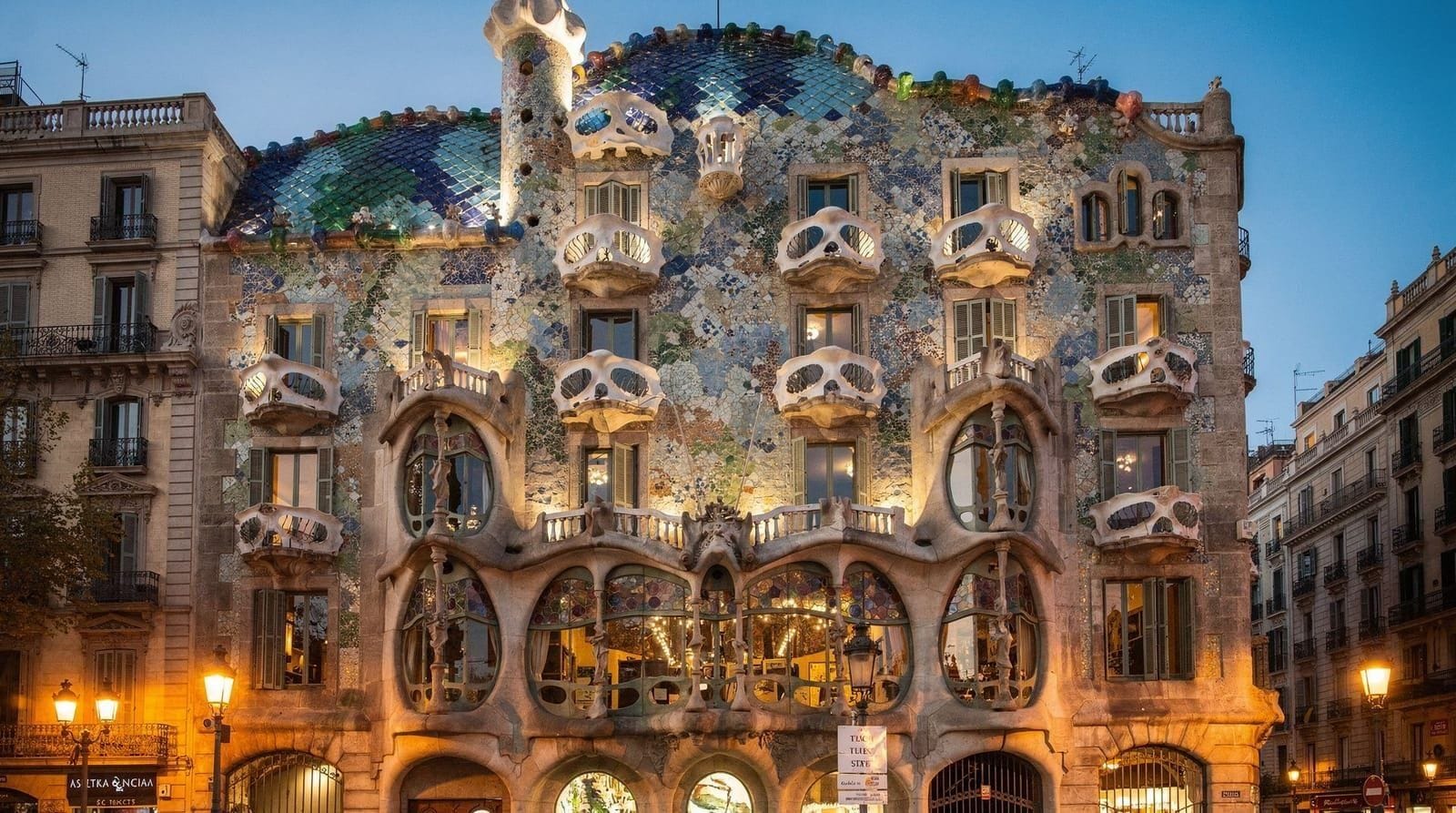
Noble floor (first floor): This was the original Batlló family apartment, now preserved as the building’s most spectacular domestic space. The main salon faces Passeig de Gràcia through the building’s signature undulating balconies — the wrought iron shaped to suggest carnival masks or skeletal bones, depending on your interpretation. The ceiling is a vortex of plaster spiralling upward, derived from a nautilus shell. The fireplace alcoves branch in mushroom shapes. Nothing is straight.
Interior light well: Accessing the service staircase gives you a view of the central airshaft — tiled in a gradient from dark blue at the bottom to white at the top, designed by Gaudí to distribute light evenly despite the depth of the shaft. This is the kind of engineering detail that separates Gaudí from decorators who merely apply organic forms to conventional structures.
Upper floors: The building housed six apartments stacked above the Batlló family; the upper floors show the evolution of the building’s style with height. The attic space — a series of parabolic arches in whitewashed brick — has a structural elegance that feels more Gothic than moderniste.
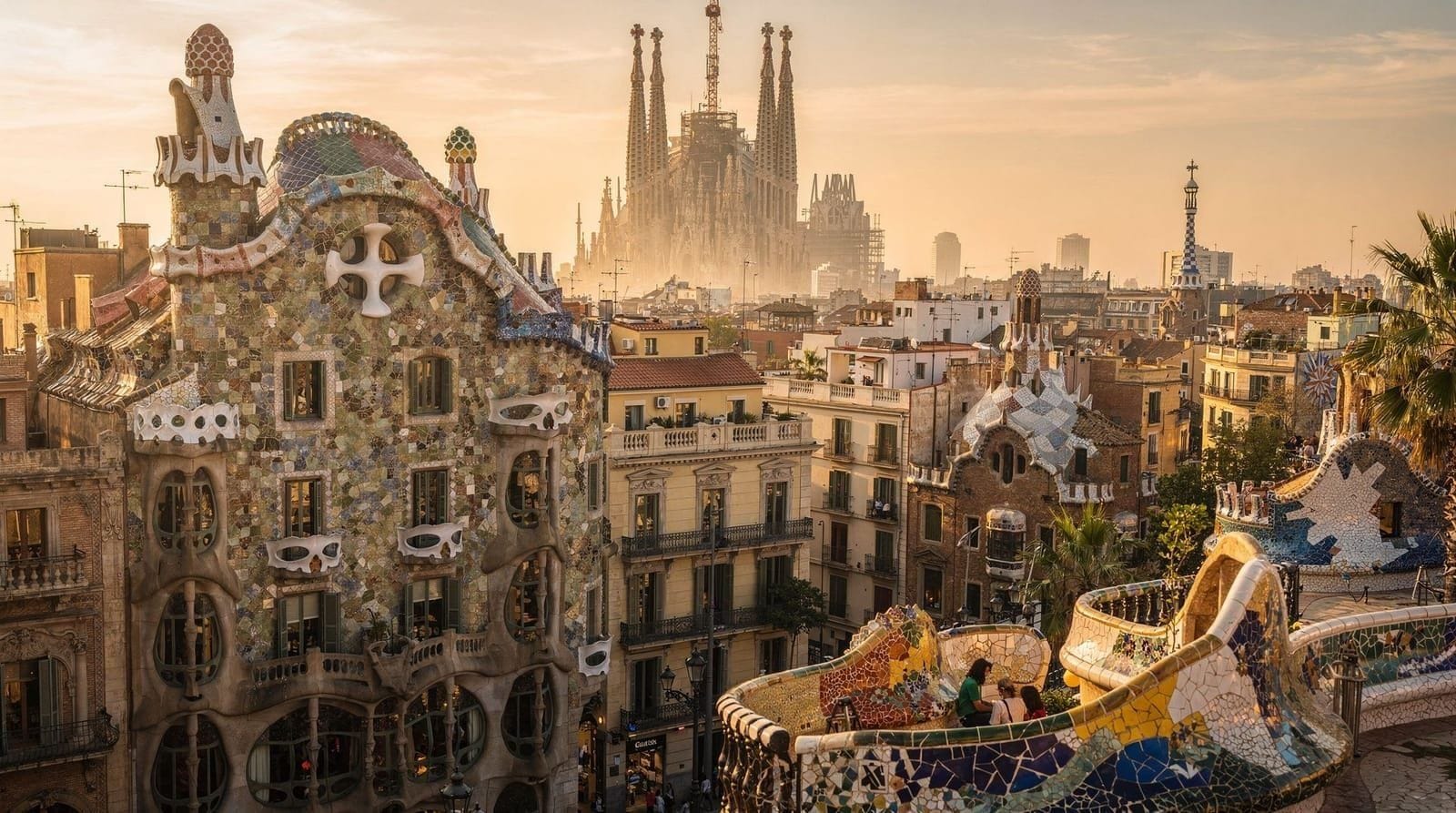
The roof terrace: The building’s most recognisable element from the outside is visible from up close at roof level. The “dragon’s spine” ceramic ridge, the tiled dome in blue-green scales (the dragon’s back, per the most common interpretation), and the four warrior towers capped with multicoloured spheres. The city views from the terrace are excellent — Passeig de Gràcia running straight down to the sea, La Pedrera visible to the north, the Sagrada Família towers on the horizon.
The “Be the First” morning experience
For €45 (€10 more than the standard fast-track), the “Be the First” ticket gives you entry at 9am before the building opens to general visitors. For the first 30 minutes, you share the building with only a small number of other early-entry ticket holders — typically 20–30 people.
This makes a significant difference to the photography experience and to the general atmosphere of the visit. The noble floor and the rooftop are the rooms that crowd most in normal visiting hours. Having them to yourself for 30 minutes is worth the premium if photography or contemplation is important to you.
The “Be the First” experience also includes a welcome glass of cava or juice on the rooftop, which is a pleasant touch.
The VIP breakfast experience
At €75, the VIP breakfast adds a full breakfast service in one of the private salons before the building opens to general visitors. The breakfast is continental-quality: pastries, fruit, juice, coffee. The experience is more social than the standard ticket — it is designed for couples or small groups who want a theatrical morning occasion.
Whether €75 is justified compared to €35 depends entirely on whether you find the breakfast-in-a-Gaudí-building framing compelling. The building itself is the same; the breakfasting part is a luxury add-on, not an upgrade to the architecture.
Casa Batlló versus La Pedrera: which to prioritise
Both are on Passeig de Gràcia, 400 metres apart. Both were built by Gaudí for wealthy Barcelona industrialists. Both are extraordinary. The question of which to visit — or whether to do both — depends on what you want:
Casa Batlló (€35 standard): More intimate, more theatrical, more overtly organic in design. The B-Experience technology is better than La Pedrera’s audio guide. The rooftop is more dramatic.
La Pedrera (€25–27): A larger building, a more “architectural” experience in the traditional sense, an extraordinary rooftop of undulating chimneys (the “warriors”). The night experience (€38) transforms the rooftop into a multimedia show — the best evening activity at any Gaudí building. See our La Pedrera guide for the full comparison.
If you can only visit one: Casa Batlló for the theatrical experience; La Pedrera for the rooftop night show. If your budget stretches further, our Gaudí three houses tour comparison covers combining Casa Batlló, La Pedrera and Casa Vicens in one guided day.
Where Casa Batlló sits in the Gaudí trail
Passeig de Gràcia is the spine of the Eixample — the 19th-century grid district designed by Ildefons Cerdà. Casa Batlló is at number 43; La Pedrera is at number 92, a 400-metre walk north. The “Block of Discord” (Mançana de la Discòrdia) at numbers 35–43 contains three moderniste masterpieces by three different architects: Casa Lleó Morera (Domènech i Montaner), Casa Amatller (Puig i Cadafalch) and Casa Batlló (Gaudí). The exterior comparison alone is worth 15 minutes on the street.
Our Gaudí trail guide and Modernisme route sequence these buildings into a logical walking circuit.
Booking tips for 2026
Summer: Book 3–4 weeks in advance. Morning slots (9am–11am) for the “Be the First” experience sell out earliest.
Shoulder season (April–May, September–October): 1–2 weeks sufficient, though the most popular Saturday morning slots still go fast.
Cancellation: Most GYG-listed tickets include free cancellation up to 24 hours before the time slot — genuinely useful if Barcelona weather or your plans change.
The address and getting there
Casa Batlló: Passeig de Gràcia 43, Eixample. The building is unmissable — the shimmering blue-green facade is the most photographed stretch of any street in Barcelona.
Metro: L2 or L3 (Passeig de Gràcia). Walking from the Gothic Quarter: 15–20 minutes north up Las Ramblas and through the grid.
You cannot miss the queue outside if you arrive at the wrong time without a time-slot ticket. With the fast-track entry, follow the signs for the separate “booked visitors” entrance, which moves significantly faster.
Is it worth €35?
Yes. Casa Batlló is one of the most original interiors in Europe. The standard ticket at €35 includes the B-Experience technology, full building access and the rooftop — there is no equivalent in the world. It is more expensive than, say, the Picasso Museum (€15/€19) and cheaper than a full-day Gaudí combo, and it sits comfortably at the right price for what it offers.
The “Be the First” upgrade at €45 is also worth it if you have any interest in photography or quiet contemplation. The extra €10 for 30 minutes without crowds is a reasonable premium.
The VIP breakfast at €75 is for a specific kind of traveller. Most people do not need it.
Gaudí’s renovation process: what he actually changed
Casa Batlló is often described as a Gaudí building, which is slightly misleading. The structure Gaudí transformed was an existing apartment house built in 1877 by Emilio Sala Cortés — who happens to have been one of Gaudí’s professors at the Barcelona School of Architecture. Josep Batlló i Casanovas purchased the building in 1900 and approached Gaudí in 1904 to renovate it, having initially considered demolishing it entirely.
Gaudí’s brief was a comprehensive renovation, not a rebuild from scratch. He kept the original load-bearing walls and the basic footprint of the building — the six storeys plus attic were already there. What he changed was essentially everything else: the facade, the interior layout of the ground floor and the Batlló family’s noble floor apartment, the airshaft tiling, the attic structure, and the roof terrace. He also added the loft level and redesigned the building’s structural columns on the ground floor from conventional masonry piers to the bone-like stone columns that give the building one of its nicknames.
The renovation took two years and was completed in 1906. The budget was significant but not unlimited, and Gaudí had to work within the physical constraints of the existing shell. This context matters when you are inside the building: the slightly irregular floor plans and the relationship between the new interior surfaces and the older structural bones are visible if you know to look for them. The noble floor, in particular, shows how Gaudí created an entirely new spatial experience within pre-existing room volumes — the ceilings, walls and floors are all his, but the room boundaries largely were not.
The choice of materials was partly governed by cost and partly by Gaudí’s established aesthetic. The facade’s iridescent ceramic discs (trencadís mosaic) were made from broken Murano glass and local ceramic fragments — a technique Gaudí had already developed at Park Güell. The main structure of the facade is Montjuïc sandstone for the sculptural elements and iron for the balconies. The combination of handmade ceramic and industrial iron, unified by the organic form, is characteristic of his mature period.
The building’s nicknames and interpretations
Casa Batlló acquired its popular nicknames quickly after completion — the Barcelona public had strong opinions about the building from the moment it appeared on Passeig de Gràcia.
Casa dels ossos (house of bones): The most literal reading of the facade. The ground-floor columns are sculpted in a form that closely resembles femur bones — smooth, tapering, with slight articulations that suggest joints. The iron balconies on the upper floors repeat a skeletal profile: irregular, organic, vaguely anatomical. The effect, particularly on the lower two storeys, is of a building whose structural members are legible as bones under the stone skin.
Casa del drac (house of the dragon): The rooftop interpretation. The ceramic ridge along the roof peak suggests a spine; the tiled dome — covered in scaled polychrome ceramics — reads as the curved back of a large reptile. The four pointed warrior towers are, in this reading, the creature’s limbs. The cross at the peak of the ridge is a lance driven through the beast — which connects directly to the Sant Jordi legend.
The Sant Jordi (Saint George) interpretation: The most elaborate and culturally resonant reading, and the one most often offered by guides. According to this interpretation, the entire building is a representation of the legend of Sant Jordi killing the dragon: the blue-green scaled roof is the dragon; the cross at the apex is the lance; the skulls and bones of the facade are the dragon’s victims; and the building’s owner — the Batlló family, patron of Barcelona, living at the building’s peak — represents the rescued princess. Sant Jordi is the patron saint of Catalonia, and the legend’s resonance with Catalan national identity gives this reading a political as well as aesthetic dimension.
The Carnival interpretation: A more secular reading, particularly associated with the balconies on the upper floors, which resemble carnival masks — the eye-socket shapes, the painted colours, the theatrical exaggeration. Carnival was suspended under the Franco dictatorship, and this reading (whether or not Gaudí intended it) carries a subversive cultural charge.
The sea: Another frequent interpretation of the facade, in which the lower portion — the wave-like undulation of the stone, the blue-green colour, the light refracting through the ceramic tiles — is read as an underwater seascape. The building appears to be submerged, or to be the petrified form of an ocean wave.
Gaudí never publicly confirmed any of these interpretations. Asked about the building’s symbolism, he consistently declined to specify — saying that the building could bear multiple meanings simultaneously and that fixing one interpretation would diminish the others. This was not evasion. It was consistent with his architectural philosophy, in which ambiguity was a structural feature rather than a problem to be solved.
Photography at Casa Batlló
Casa Batlló presents a genuine photographic challenge: it is visually extraordinary and photographically difficult, because the interiors are heavily visited, the light is moody and variable, and the most compelling spaces are exactly the ones that fill with tour groups between 10am and 5pm.
The noble floor is the key room. The main salon on the first floor — the former Batlló family reception room — has the ceiling vortex that is the most reproduced interior image of the building. To photograph it well, you need to be close to the centre of the room with the spiral above you, with no other visitors visible. This is only possible in the early-morning slot.
Best angle for the ceiling vortex: Stand directly beneath the centre of the spiral and shoot straight up with a wide angle. The spiral pulls the eye from the periphery to the central oculus. Any person visible in the frame unless intentionally composed disrupts the effect. The B-Experience tablet, if other visitors are using it, also intrudes photographically — another argument for the early slot.
The rooftop at blue hour: The “Be the First” ticket does not include sunset access, but the building does offer a dedicated evening experience in summer that opens the rooftop at dusk. The dragon-spine ridge photographed against a blue sky — or, better, against the first stars — with the Sagrada Família visible on the horizon is one of the city’s more distinctive urban photographs. Check the building’s current evening event schedule, as this is not always available.
The problem with selfie-sticks and group tours: Large tour groups that visit on standard tickets tend to cluster on the noble floor and the rooftop simultaneously, and the combination of group selfie sessions and extended audio-guide stops can make it difficult to photograph the interiors without waiting. The bottleneck on the noble floor is particularly acute because the room is not large and the natural flow of visitors tends to concentrate in the centre — exactly where you want to be.
How the “Be the First” early ticket solves this: For the first 30 minutes after the 9am opening, the building is shared with only around 20–30 other early-entry holders rather than the several hundred that pass through in a normal morning hour. The noble floor, the staircase, and the rooftop are all accessible without waiting. For anyone who intends to photograph the building seriously, the €10 premium over the standard fast-track ticket is the most cost-effective photography upgrade in Barcelona. The alternative — arriving at a standard time slot and waiting for gaps — works in principle but is not reliable in summer.
Book the fast-track ticket early, use the B-Experience fully (do not skip the AR elements), and save time for the rooftop — Casa Batlló’s exterior is famous, but the interior is what makes it exceptional.
Compare alternative tours
Frequently asked questions about Casa Batlló Barcelona
How much does the Casa Batlló fast-track ticket cost?
The fast-track ticket with architecture tour starts at around €35 per adult. The 'Be the First' early entry experience costs €45. The VIP breakfast experience runs €75. All include the B-Experience audio-visual guide.What is the B-Experience?
Casa Batlló's proprietary immersive experience — a tablet-based audioguide with augmented reality overlays that animate the rooms and explain Gaudí's design decisions. Included in all ticket types. One of the better museum tech implementations in Barcelona.How long does the visit take?
Budget 1.5–2 hours for a thorough visit with the B-Experience. The 'Be the First' morning slot gives the building to yourself for the first 30 minutes, which is worth the extra €10 if you want undisturbed photography.Is Casa Batlló as impressive as the Sagrada Família?
Different experience. The Sagrada Família is transcendent in scale. Casa Batlló is intimate — a private house, floor by floor, with Gaudí's attention to detail visible in doorknobs, flooring and ventilation shafts. Many people find Casa Batlló more surprising than the basilica because the scale is human rather than monumental.Do I need to book in advance?
Yes. Casa Batlló has timed entry and sells out weeks ahead in summer. Book as early as possible, especially for the morning slots.Is there a rooftop at Casa Batlló?
Yes — the famous terrace with its dragon-spine tiled roof and warrior towers is the tour highlight for most visitors. Access is included in all ticket types.