Barcelona helicopter coastline flight: what to know before booking
Barcelona: helicopter flight over the coastline
Duration: 6 minutes
- Instant confirmation
A six-minute helicopter flight over Barcelona’s coastline is one of the most efficient ways to spend €75 in the city — and one of the easiest to feel ambivalent about afterward. The experience itself is extraordinary: the city grid below you, the Mediterranean ahead, the Sagrada Família towers and the Montjuïc headland banking through your window. The question is whether six minutes justifies the price, the transit to the heliport, and the administrative overhead of an activity that is over before most things begin.
What six minutes actually looks like
The helicopter lifts from the heliport in the Zona Franca south of the city and follows the coast northward. In six minutes at cruise speed, the route typically covers:
Port de Barcelona: The commercial port and ferry terminals, the Rambla del Mar bridge and Port Vell visible as you climb out.
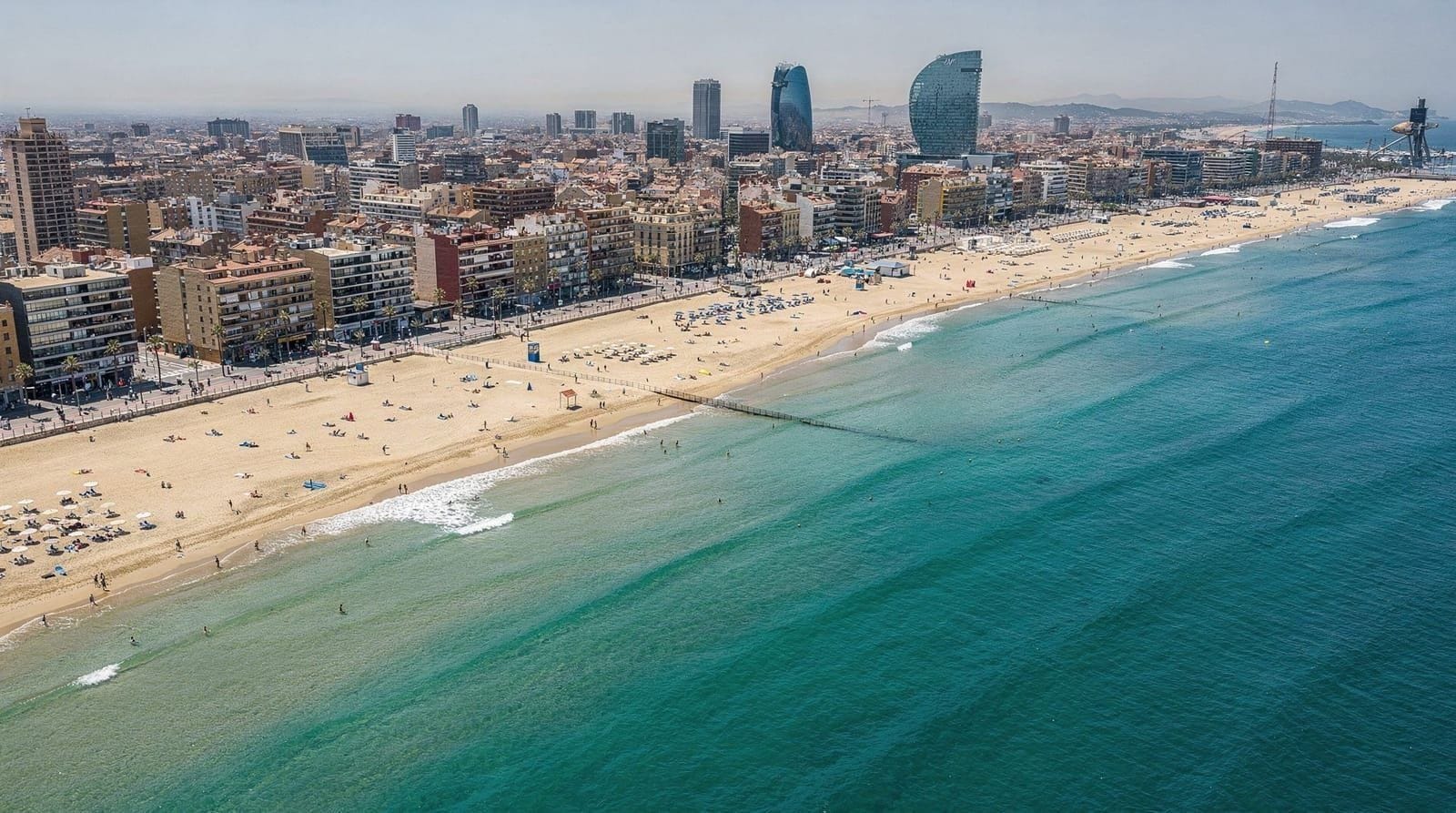
Barceloneta: The grid of the old fishermen’s neighbourhood, the beach stretching northward, the geometric contrast between the 18th-century housing block and the 21st-century sail tower of the Hotel W.
Port Olímpic: The twin towers (Hotel Arts and Torre Mapfre) and the Olympic harbour built for 1992. From above, the scale of the Olympic transformation of the waterfront is impressive — the entire Poblenou waterfront was industrial landfill before 1992.
Upper coastline: Depending on the route, the Fòrum complex and the northern beaches may be visible before the turn back.
The return pass: Coming back south over the city grid gives you the inverse view — the Eixample’s 19th-century blocks visible in their hexagonal perfection from above, the Sagrada Família towers rising above the roofline, and the Montjuïc headland with the castle visible at the top.
The 12-minute version extends the route to include a pass over Montjuïc and the stadium complex, giving significantly more context.
The honest value calculation
€75 for 6 minutes works out to €12.50 per minute, or roughly four times what you pay per minute for the Montjuïc cable car experience. The helicopter gives you something the cable car absolutely cannot: the feeling of flight over the city, the dynamic 360-degree view, the physicality of a machine climbing and banking.
What you do not get: lingering, contemplating, or understanding what you are looking at. Six minutes does not permit that. The helicopter is a physical experience, not an educational one.
The case for booking it: Once. You will remember it. The city from 500m is genuinely beautiful and the sensation of banking over the Mediterranean is not replicated by any other city activity.
The case against: €75 buys you 2 hours on a catamaran, 5 hours on the hop-on hop-off bus, or entry to four major museums. If you are budgeting carefully, the helicopter is a splurge with zero practical sightseeing value beyond the memory.
The heliport logistics
The Heliport de Barcelona is in the Zona Franca industrial area, approximately 7km south-west of the city centre — not walkable and not easily reachable by metro (there is no nearby metro station). The practical options:
- Taxi or rideshare: 20 minutes from the city centre, approximately €15–18.
- Bus (L88 or L89): Runs from Plaça d’Espanya to the Zona Franca, but infrequent and takes 25–30 minutes. Fine if you have time; impractical if you are on a schedule.
Include the transfer cost in your real-cost calculation: a 6-minute flight with two 20-minute taxis is a 60-minute excursion costing €105–115 total per person. Still memorable; just less impulsive than a browsable GYG listing suggests.
Meeting at the heliport: Arrive 15–20 minutes before your scheduled flight. Safety briefing, equipment check and manifest confirmation take 10–15 minutes before boarding. The operation is professional — this is not an adventure park activity.
Weather considerations
Helicopters fly in most weather but high winds, low cloud or coastal fog ground the operation. Barcelona’s summers are reliably clear; spring and autumn occasionally see mistral conditions. The operator’s weather policy typically offers a rescheduling option or refund if they cancel due to conditions.
Check the forecast for the coastal area, not just the city — conditions at 500m over the sea can differ from ground level in the city.
Seasonal patterns worth knowing: Summer (June–August) offers the most reliable flying weather but also the haziest air by mid-afternoon, since heat and humidity build up visible haze over the coastline from around 1pm onward. Spring and autumn tend to have clearer air overall but occasionally bring the tramuntana or mistral-style winds that can ground flights for a day at a time — build a spare morning into your itinerary if you are visiting in April, May, September or October and the flight matters to you. Winter has the clearest air of all on calm days, since cold fronts scrub haze from the atmosphere, but the shorter daylight hours narrow your booking window and cancellations for wind are more frequent.
The combination tours: helicopter plus boat, plus walking
For visitors who want to turn the helicopter into a longer experience, combination packages exist:
Helicopter + boat ride + old town walking tour (€120, 4 hours): This makes the most logistical sense. The helicopter excursion fills the transit time with something else, and the old town walk gives the aerial experience context when you see the streets you just flew over. The boat portion is typically a 1-hour harbour cruise. Four hours is a more comfortable commitment for the €120 price.
Helicopter with local guide (€95, 12 minutes): Doubles the flight time and adds narration. Worth the extra €20 if you want to understand what you are looking at as you fly.
Choosing between the three flight options
The decision usually comes down to how much of the coastline you want narrated versus simply experienced.
| Option | Duration | Price | Best for |
|---|---|---|---|
| Coastline flight (solo) | 6 min | ~€75 | First-timers who want the sensation without extra spend |
| Flight with local guide | 12 min | ~€95 | Visitors who want the landmarks identified in real time |
| Helicopter + boat + old town walk | 4 hrs | ~€120 | Anyone who wants the transfer time turned into a full day |
If your budget only stretches to one option, the plain 6-minute flight delivers the core sensation — banking over the Mediterranean — for the lowest outlay. The guided 12-minute version is the better choice for a first Barcelona trip, since it turns the flight into an orientation lesson you can use for the rest of your stay. The combination package makes the most sense for travellers who dislike feeling rushed and would rather spend a whole afternoon on the coast, pairing the flight with a catamaran sailing session and a walk through the old town.
The altitude and sensory experience
Cruising altitude is typically 150–300m over the city and sea — low enough to see individual buildings and streets clearly, high enough that the scale of the urban grid becomes apparent. The sensation is similar to a slow, low-altitude light aircraft but with better forward visibility (the helicopter cockpit is predominantly glass).
Noise inside is significant even with headsets — conversation requires the intercom system. The vibration is minimal in modern helicopters, and the ride quality is smooth in calm conditions. People who are nervous about heights generally do fine once airborne — the cabin is fully enclosed and the experience does not feel exposed in the way a cable car or cliff walk might.
Pairing with other activities
Good combinations with the helicopter:
- Montjuïc cable car (€14) on the same day — one gives the elevated urban view, the other gives the aerial coastal view. Together they provide a comprehensive sense of Barcelona’s geography.
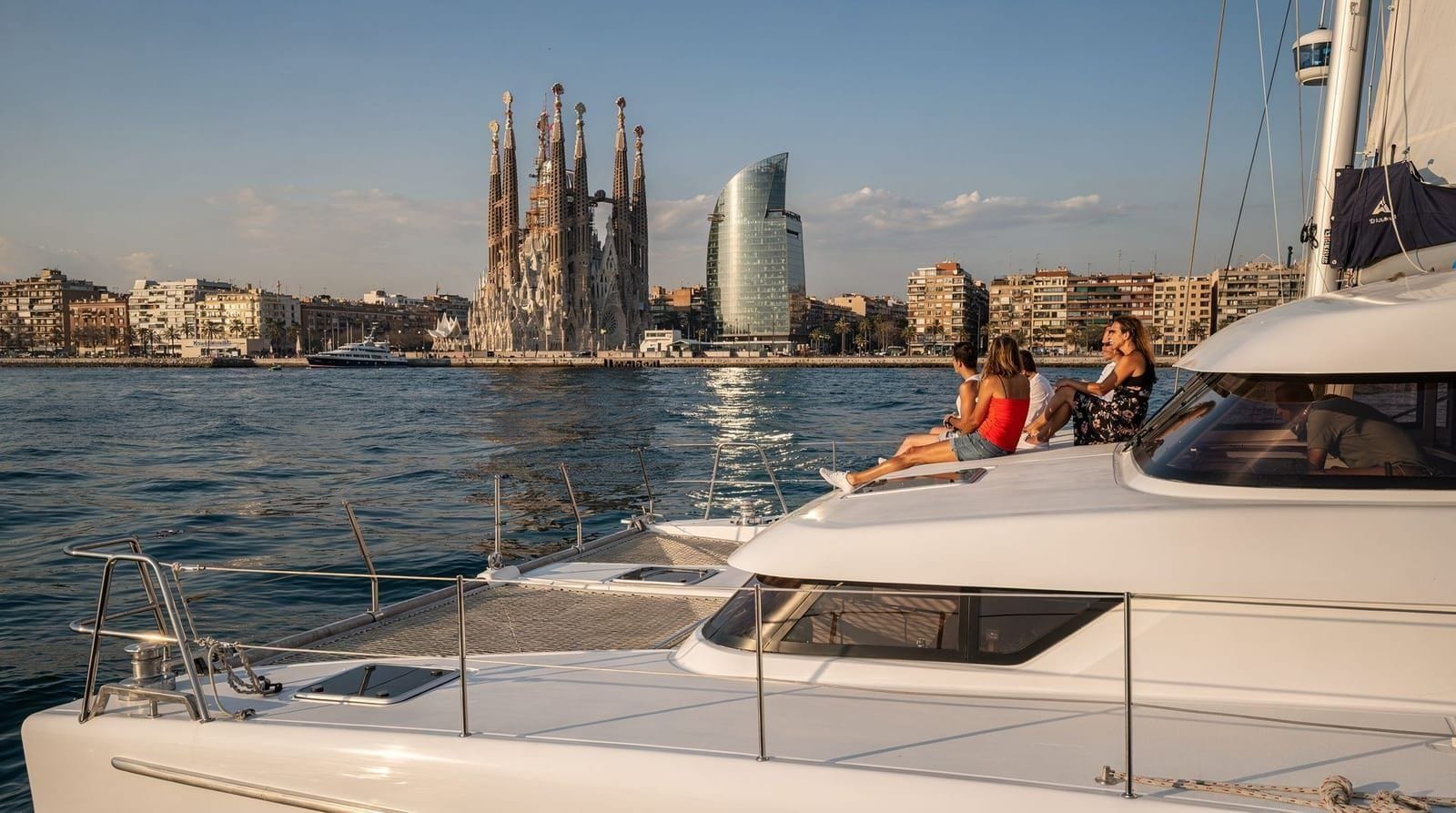
- Catamaran sailing in the afternoon — after the aerial perspective, seeing the same coastline at sea level from a catamaran is a natural complement. Our sailing catamaran guide covers the best options.
- Barceloneta beach in the afternoon — you will want to see at ground level what you just saw from above.
Not a great combination with: The Sagrada Família or Gaudí sights, which require focused attention and feel disconnected from the aerial coastal experience. Keep those for a different day.
Booking tips
Book at least 24–48 hours in advance. Helicopter capacity is small (4–6 seats per flight) and popular morning slots sell out. Check whether your tour includes insurance (it should) and what the weather rescheduling policy is.
Instant confirmation is standard for this type of experience — if you do not receive immediate confirmation, contact the operator before the day.
Operator credentials and safety
Barcelona’s tourist helicopter operations fly under standard Spanish civil aviation rules, with pilots holding commercial licences and aircraft subject to the same maintenance regime as any charter operation. Ask (or check the listing) whether the operator carries passenger liability insurance as standard — reputable operators do, and it should be included in the price rather than sold as an add-on. Group bookings above 4 passengers may need to be split across two aircraft, which can affect departure timing if you are travelling with a larger party.
Cancellation for safety reasons is at the pilot’s discretion on the day, not negotiable, and should never be treated as an inconvenience rather than a safety decision. If wind or visibility is marginal, expect delays of 15–30 minutes while the operator monitors conditions rather than an outright cancellation — patience here is normal, not a sign of a poorly run operation.
Who this experience suits
The helicopter flight rewards travellers who value a single, concentrated sensation over sustained sightseeing. It suits honeymooners and anniversary trips looking for one memorable splurge, photographers who want a genuinely different angle on the city after days at street level, and anyone who has already covered the major sights and wants a distinctive finale. It suits families with young children less well — the noise, the safety briefing and the short duration relative to the cost make it a harder sell for a group where not everyone will retain the memory. For families, the Montjuïc cable car or an afternoon on Barceloneta beach usually gives better value per euro.
Is it worth it? The final word
Yes, once, for the right kind of traveller. The helicopter flight over Barcelona’s coastline is an experience, not a sight. If you are the kind of person who values physical sensation and novel perspectives over accumulated sightseeing, €75 is reasonable for something you will genuinely remember.
No, if: You are budget-conscious, you prefer activities with more duration or educational content, or you have not yet seen Barcelona from the ground. The cable car on Montjuïc, the panoramic views from Bunkers del Carmel, or a walk along the Barceloneta waterfront give you a sense of the city at a fraction of the cost.
The Barcelona skyline from the air: a geography lesson
Barcelona sits on a coastal plain roughly 4km wide, bounded by the sea to the east and a series of ridges and hills to the north and west. Understanding that basic geography — which is invisible from the street level because the city is dense and flat — transforms what you see from the helicopter into something comprehensible rather than simply spectacular.
Looking north: The most immediately identifiable landmark is the Sagrada Família, whose eight completed towers (and the four crossing towers added after 2021) rise to between 100m and 172m — tall enough to stand above the Eixample roofline by a significant margin. The Eixample itself — the 19th-century expansion district designed by Ildefons Cerdà — is visible as a grid of octagonal city blocks, each block with chamfered corners creating the distinctive hexagonal intersections that make the district look, from above, like a honeycomb laid over the slope between the old city and the hills.
The grid was designed with a 113m×113m block module and streets 20m wide; from 300m up, the regularity is striking in a way it never is from the pavement. Further north and west, the Gràcia neighbourhood’s tighter medieval street pattern marks the older village that the Eixample absorbed, and beyond that the Collserola range rises steeply — forested, with the spire of the Torre de Collserola communications tower visible against the skyline.
Looking west: Montjuïc — the 173m hill that anchors the south-western corner of the city — is the most prominent natural landmark visible from the helicopter. The castle on the summit (Castell de Montjuïc, now a municipal museum) is visible from almost anywhere on the flight path. Below the castle, the 1929 International Exposition complex spreads along the hillside: the Palau Nacional, the Olympic Stadium (used again for the 1992 games), the Fundació Joan Miró. The port stretches west from the base of Montjuïc, the ferry terminals and container cranes of the Zona Franca occupying the industrial south of the city — which is also, practically, where the heliport sits.
Looking east and south: The coastline runs south-east from the city toward Sitges (35km away) and the Costa Daurada. From altitude, the coastal development is visible as a near-continuous line of urbanisation along the shoreline, interrupted only by the delta of the Llobregat river (wetlands, protected, visible as a green gap in the urban fabric near the airport) and the resort towns of Castelldefels and Gavà. On exceptionally clear days — October mornings are best — the Tarragona promontory may be visible at the edge of perception, 100km south.
Other perspectives on the Barcelona skyline
The helicopter offers one answer to the question of how to see Barcelona from above. There are four others worth knowing, spanning a significant range of cost and effort.
Bunkers del Carmel (free): The former anti-aircraft gun emplacements on the Turó de la Rovira hill in Gràcia, 262m above sea level, offer what many residents consider the best 360-degree panoramic view in the city. The view north over the Eixample grid, with the Sagrada Família in the middle distance and Montjuïc on the horizon behind it, is the classic Barcelona panorama photograph. There is no fee, no queue (outside sunrise and sunset, when photographers gather), and no infrastructure beyond a flat paved platform. Getting there requires a walk from the Carmel neighbourhood; the L4 metro to Joanic and then 25–30 minutes on foot is the practical route. The view is the city laid flat below you, which is different from the helicopter’s diagonal perspective — more contemplative, less physical.
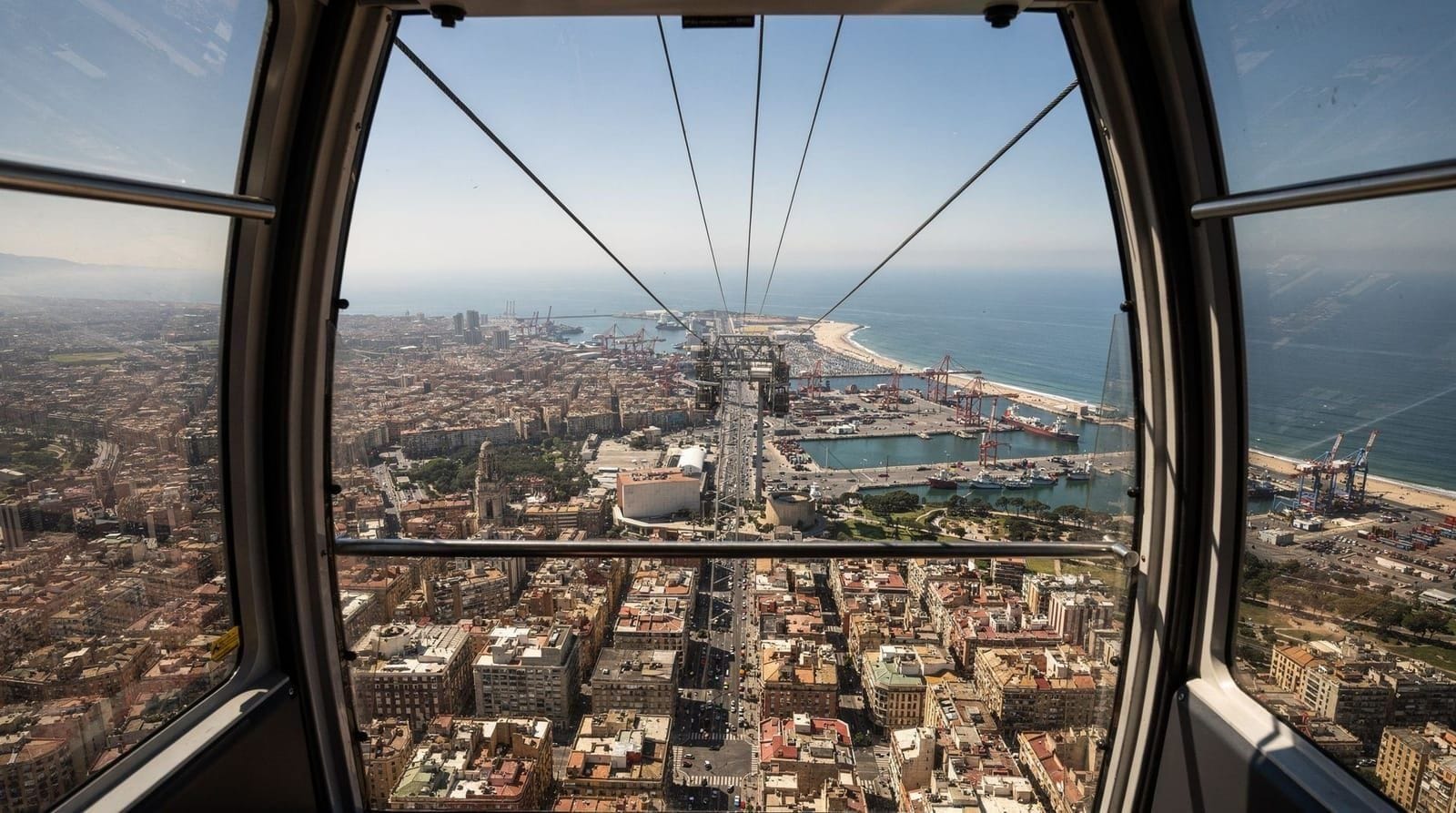
Montjuïc cable car (€14 return): The Transbordador Aeri del Port is actually two cable car segments: the lower segment runs from the Barceloneta tower to the midpoint at Miramar on the Montjuïc hillside; the upper segment (Telefèric de Montjuïc) continues to the castle summit. The return ticket covers both. The lower segment is the more dramatic: crossing the port from 75m above the water, with container ships and superyachts visible below and the city grid on one side and the open sea on the other. This is not a high-altitude view — it is a suspended view across the city at moderate height. Queue times in summer can be 45–60 minutes; go early or late in the day.
Roof of La Pedrera — Casa Milà (included with entry, €28): Antoni Gaudí’s apartment building on Passeig de Gràcia is one of the most visited buildings in Spain. The rooftop terrace — where the building’s famous undulating chimneys and ventilation shafts create an almost lunar landscape of whitewashed forms — also offers views over the Eixample toward the Sagrada Família. The view itself is relatively contained (the building is not especially tall), but the architectural context is unique. If you are entering La Pedrera anyway, the roof is part of the experience.
Torre de Collserola (€12): The communications tower designed by Norman Foster for the 1992 Olympics sits at 415m elevation on the Collserola ridge, which means the observation deck at level 10 sits at roughly 560m above sea level — significantly higher than anything else on this list. The view encompasses the entire city, the Penedès plain to the south-west, and on clear days the Pyrenees to the north. Access requires the FGC train to Peu del Funicular and the Tibidabo funicular to the summit, then a short walk. It is not commonly visited by tourists, which means it is rarely crowded. The tower itself is also architecturally interesting — a needle with a glass observation pod — and worth the trip independently of the view.
Photography from the helicopter
Six minutes is not long enough to settle into a photographic rhythm. The approach that works best is to prepare before you board and then respond quickly rather than plan carefully once you are airborne.
Lens choice: A 35mm or 50mm equivalent focal length (on a full-frame sensor) is the right range — wide enough to capture a neighbourhood in context, not so wide that the distortion at the edges misrepresents the scale. On a phone camera, the standard lens (not the ultra-wide) is usually the correct choice. Telephoto lenses produce camera shake from helicopter vibration and limit your field of view to fragments; leave them in the bag.
Avoiding reflections: Helicopter interiors are predominantly glass, and glass produces reflections of the cabin interior — your own face, the seat, the instrument panel — that land directly on the cityscape you are trying to photograph. The technique that works is to hold the lens element as close to the glass as possible without touching it (touching creates vibration blur). Polarising filters help but are rarely worth attaching in the time available. A lens hood reduces but does not eliminate the problem.
Light timing: Early morning (7–9am in summer) gives the softest, most directional light and the cleanest air. The city faces east, so morning light catches the facades of the Eixample grid directly and creates the long shadows that make architecture readable from above. Late afternoon (6–8pm in summer) gives warmer colour but the coastal haze that builds through the day often reduces visibility by this point. Midday in July or August is the worst option — flat, harsh, high-haze.
Setting expectations: Six minutes at 150–200km/h means you are covering roughly 15–20km of flight path. The camera will record something from almost every moment, but most of it will be transition rather than composition. Accept that you are shooting a record of an experience rather than producing considered landscape photography. The best shots from a short helicopter flight are usually the ones taken in the first 90 seconds and the last 90 seconds — departures and arrivals, when the altitude change creates the most dynamic perspectives.
The helicopter flight is Barcelona’s most time-efficient luxury — book it on a clear morning, transit early, and arrive back in the city centre ready for a proper day of exploration.
Compare alternative tours
Frequently asked questions about Barcelona helicopter coastline flight
How much does the Barcelona helicopter flight cost?
The 6-minute coastline flight costs around €75 per person. The 12-minute tour with a local guide costs €95. A combination helicopter-plus-boat-plus-walking tour runs €120 for 4 hours.Is 6 minutes long enough to be worthwhile?
It depends on your expectations. Six minutes at 100–150km/h covers significant ground — the beaches, the Port Olímpic, the Barceloneta waterfront, the Montjuïc headland and the city grid are all visible. It is an experience, not a tour. If you want leisurely sightseeing from the air, book the 12-minute option.Where does the helicopter depart from?
From the Heliport de Barcelona in the Zona Franca industrial area, south of the city near the port. It is about 20 minutes from the city centre by taxi. Transport to and from the heliport is not included — budget €15–20 each way.Are there age or weight restrictions?
Children are typically permitted with parental consent. Weight limits apply per helicopter configuration — usually a combined weight limit for the flight manifest. Check with the operator when booking if this is a concern.When is the best time to fly?
Early morning for clearest air and softest light. Late afternoon for golden light on the city. Midday in summer tends to have haze. Wind is the primary limiting factor — check the operator's weather cancellation policy.Is it better than the Montjuïc cable car for aerial views?
Very different experiences. The cable car (€14 return) gives sustained views of the city and harbour from Montjuïc. The helicopter gives a dynamic, 360-degree aerial experience at higher altitude. Both are worth doing but for different reasons and very different budgets.Can I book the helicopter flight with a hotel or airport pickup?
Most operators do not include hotel pickup for the standard coastline flight — you make your own way to the Heliport de Barcelona in the Zona Franca. Some of the longer combination packages (helicopter plus boat plus walking tour) include a central meeting point in the old town, which is more convenient than the heliport itself.What happens if my flight is cancelled for weather?
Reputable operators offer a free rebooking to another available slot within your trip dates, or a full refund if no slot works. Confirm the specific policy before booking, since informal listings sometimes only offer credit rather than cash refunds.