Catalan language basics for Barcelona visitors
Do you need to speak Catalan to visit Barcelona?
No. Spanish is universally understood in Barcelona, and English is widely spoken in tourist areas, hotels, restaurants and most shops. That said, attempting even a single phrase in Catalan — 'bon dia' (good morning), 'gràcies' (thank you) — earns immediate goodwill from locals and signals that you see the city as more than a tourist backdrop. Catalan is not a dialect of Spanish; it is a separate Romance language with its own grammar, vocabulary and literary tradition, and locals notice and appreciate when visitors treat it as such.
Walking into a Barcelona café and saying “bon dia” instead of “hola” takes exactly the same amount of effort and produces a noticeably different response. This is not performance or politics — it is simply acknowledging that you have arrived somewhere with its own language and its own long history, and that you have noticed.
This guide gives you everything you need to engage with Catalan at a useful visitor level: why it matters, how it sounds, 30+ essential phrases with pronunciation guides, menu vocabulary, and a few cultural points that will make your time in Barcelona warmer and more honest.
| Do you need it | No — Spanish and English work everywhere |
| Worth learning | Bon dia, gràcies, si us plau (3 words) |
| Where it matters most | Outer neighbourhoods, older residents, public signage |
| Best free tool | Google Translate (camera mode works well) |
| Common mistake | Calling Catalan “a dialect of Spanish” |
What Catalan is — and what it isn’t
Catalan is a Romance language descended directly from Vulgar Latin. It developed in the territories that formed the medieval County of Barcelona and spread with Catalan expansion across the Mediterranean, which is why Catalan is also spoken in Valencia (where it is called Valencian), the Balearic Islands, parts of Sardinia, Andorra (where it is the only official language), and a strip of southern France. You can read more about this expansion in our guide to Barcelona’s history.
The crucial point for visitors: Catalan is not a dialect of Spanish, and the suggestion that it is will be poorly received. Linguistically, Catalan sits closer to Occitan (the historical language of southern France) and shares substantial vocabulary with Portuguese and Italian. Spanish and Catalan are both Romance languages and share a common Latin ancestor, but so do French and Romanian — and nobody calls Romanian a dialect of French.
Catalan has its own literary tradition dating to the 12th century. The troubadour poetry of the medieval Crown of Aragon was written in Catalan and Occitan. Ramon Llull (1232–1316) wrote philosophy, poetry and prose in Catalan at a time when Castilian literature was in its infancy. The language was the vehicle of one of the great medieval Mediterranean cultures.
Under Francisco Franco’s dictatorship (1939–1975), Catalan was banned from schools, public administration, the media and all official contexts. The phrase reportedly used by officials enforcing the ban — “speak the language of the empire” — captures the political nature of the suppression. Despite four decades of prohibition, the language survived in homes, in clandestine publications, in songs and in the memory of a generation who had grown up speaking it freely. Its survival was an act of collective cultural resistance, which is part of why it carries the weight it does today.
Since Franco’s death, Catalan has been progressively restored. It is now the primary language of the Catalan government, public schools and public institutions. Street signs across Catalonia are in Catalan. The revival has been so effective that children in Barcelona today grow up in a bilingual environment where Catalan is often the first language of instruction. You can read more about how this connects to living Catalan culture in our Catalan culture guide.
How Catalan sounds: pronunciation essentials
Catalan sounds different from Spanish in ways that may surprise visitors who are expecting something Spanish-adjacent. It has sounds that Spanish lacks, vowels that reduce in unstressed positions (like English), and consonant combinations that look unusual on the page. Here is what to know.
Vowels
Catalan has seven vowel sounds, compared to Spanish’s five. The crucial difference is that unstressed vowels reduce: unstressed “a” and “e” tend toward a schwa sound, like the “uh” in English “about.” This is why Catalans sound different from Spanish speakers even when saying similar words.
- Stressed “a” = as in “father”
- Unstressed “a” = reduced toward “uh”
- “e” (stressed, open) = as in “bed”
- “e” (unstressed) = reduced toward “uh”
- “i” = like English “ee”
- “o” (stressed) = like English “awe” (open) or “oh” (closed)
- “u” = like a short French “ou” (pursed lips, not like English “you”)
Consonants to watch
- “c” before e or i = like English “s” (Barcelona = “Bar-su-LO-nuh” in Catalan, not “Bar-the-LO-na” as in Castilian Spanish)
- “ç” = always “s” (regardless of what follows)
- “g” before e or i = like French “j” or English “zh” (as in “measure”)
- “j” = also like French “j” / English “zh”
- “l·l” (L with a raised dot, known as the “ela geminada”) = two distinct L sounds with a slight pause between them, distinct from a single long L
- “ny” = like Spanish “ñ” or the “ni” in English “onion”
- “r” at the start of a word = trilled/rolled (like Spanish “rr”)
- “r” between vowels = a brief tap (like a very short “d” in American English “butter”)
- “rr” = always trilled
- “x” at the start of a word or after a consonant = “sh” sound: so “Xavi” = “SHA-vee”, “Eixample” = “Ay-SHAM-pluh”
- “x” between vowels = usually “sh” or occasionally “ks” — context-dependent
- “tg” or “tj” = like English “dj” in “adjust”
- “ll” (double L) = in Catalan, like a single English “L” (unlike Spanish “ll” which sounds like “y”)
Stress
Stress in Catalan usually falls on the second-to-last syllable if the word ends in a vowel, “n” or “s”. Words ending in other consonants are typically stressed on the last syllable. Written accent marks (à, é, è, í, ï, ó, ò, ú, ü) indicate stress or vowel quality when the default rule would not apply.
Essential phrases with pronunciation guides
The pronunciation guides below use English sounds as approximations. Capital letters mark the stressed syllable.
Greetings and partings
- Bon dia — Good morning | [bon DEE-uh]
- Bona tarda — Good afternoon | [BOH-nuh TAR-duh]
- Bona nit — Good night | [BOH-nuh NEET]
- Hola — Hello (informal, used any time) | [OH-luh]
- Adéu — Goodbye | [uh-DAY-oo]
- Fins aviat — See you soon | [feenz uh-VEE-uht]
- A reveure — Until we meet again (more formal goodbye) | [uh ruh-VAY-oo-ruh]
- Bon profit — Enjoy your meal (said before eating) | [bon pruh-FEET]
Politeness essentials
- Si us plau — Please | [see oos PLOW — rhymes with “cow”]
- Gràcies — Thank you | [GRAS-ee-us]
- Moltes gràcies — Thank you very much | [MOL-tus GRAS-ee-us]
- De res — You’re welcome | [duh RESS]
- Perdona — Excuse me (to get attention or apologise) | [pur-DOH-nuh]
- Disculpa — Excuse me / Sorry (slightly more formal) | [dees-COOL-puh]
Communication
- Parla anglès? — Do you speak English? | [PAR-luh ung-LESS]
- Parla castellà? — Do you speak Spanish? | [PAR-luh kus-tuh-YAH]
- No entenc — I don’t understand | [no un-TENG]
- Podeu repetir, si us plau? — Could you repeat that, please? | [puh-DAY-oo ruh-puh-TEER see oos PLOW]
- Parla més a poc a poc, si us plau? — Could you speak more slowly, please? | [PAR-luh mess uh pok uh pok]
- Sóc de… — I am from… | [sock duh]
Practical
- On és…? — Where is…? | [on ess]
- Quant costa? — How much does it cost? | [kwant KOS-tuh]
- Quin preu és? — What is the price? | [keen PRAY ess]
- Té…? — Do you have…? | [teh]
- Voldria… — I would like… | [vul-DREE-uh]
- Una taula per a dos, si us plau — A table for two, please | [OO-nuh TOW-luh pur uh doss]
- El compte, si us plau — The bill, please | [ul KOMP-tuh see oos PLOW]
- On és el lavabo? — Where is the bathroom? | [on ess ul luh-VAH-bo]
Yes, no and basic responses
- Sí — Yes | [see]
- No — No | [no]
- Potser — Maybe | [pot-SER]
- No ho sé — I don’t know | [no oo say]
- D’acord — OK / Agreed | [duh-CORD]
Menu and food vocabulary
Catalan food culture is rich and distinct, with a vocabulary that does not map neatly onto Spanish. See our best tapas neighbourhoods guide for where to eat — here is what to order with.
Structure of a meal
- Esmorzar — Breakfast
- Dinar — Lunch (the main meal of the day; typically 14:00–16:00)
- Sopar — Dinner (typically 21:00 onwards)
- L’entrada / El primer plat — Starter / First course
- El plat principal / El segon plat — Main course / Second course
- La postres — Dessert
- La nota / El compte — The bill
Proteins and mains
- Pollastre — Chicken
- Vedella — Beef
- Porc — Pork
- Xai — Lamb
- Bacallà — Salt cod (a Catalan staple; do not confuse with fresh fish)
- Rap — Monkfish
- Llobarro — Sea bass
- Sípia — Cuttlefish
- Cloïsses — Clams
- Musclos — Mussels
Vegetables, dairy and bread
- Pa — Bread (pa amb tomàquet — bread with tomato and oil — is the Catalan bread staple)
- Formatge — Cheese
- Ou / Ous — Egg / Eggs
- Tomàquet — Tomato
- Albergínia — Aubergine
- Espinacs — Spinach
- Bolets — Mushrooms (used broadly; includes wild varieties)
- Patata — Potato
- Enciam — Lettuce
Drinks
- Aigua — Water
- Aigua amb gas — Sparkling water
- Vi — Wine (vi negre = red, vi blanc = white, vi rosat = rosé)
- Cava — Catalan sparkling wine (produced in the Penedès region; Catalan in origin, even if the production method resembles Champagne)
- Cervesa — Beer
- Cafè — Coffee
- Cafè amb llet — Coffee with milk (like a café au lait)
- Suc de taronja — Orange juice
- Xocolata — Chocolate (hot chocolate is a popular breakfast drink)
Dietary and allergy vocabulary
- Sóc vegetarià / vegetariana — I am vegetarian (masculine/feminine)
- Sóc vegà / vegana — I am vegan
- Sóc al·lèrgic/a a… — I am allergic to…
- Sense gluten — Gluten-free
- Sense lactosa — Lactose-free
- Conté fruits secs? — Does it contain nuts?
- Sense carn — Without meat
Numbers and time
Numbers come up constantly — prices, addresses, phone numbers, times — and are worth having ready even if you rely on gestures or a phone screen as backup.
- U/Un, Dos, Tres, Quatre, Cinc — 1, 2, 3, 4, 5
- Sis, Set, Vuit, Nou, Deu — 6, 7, 8, 9, 10
- Onze, Dotze, Tretze, Catorze, Quinze — 11, 12, 13, 14, 15
- Vint — 20 | Trenta — 30 | Quaranta — 40 | Cinquanta — 50
- Cent — 100 | Mil — 1,000
- Quina hora és? — What time is it? | [KEE-nuh OH-ruh ess]
- És la una — It’s one o’clock | [ess luh OO-nuh]
- Són les dues — It’s two o’clock | [son lus DOO-us]
Directions and transport phrases
Useful for navigating beyond a translation app, especially when asking a local rather than reading a screen.
- A l’esquerra — To the left | [uh less-KEH-ruh]
- A la dreta — To the right | [uh luh DRAY-tuh]
- Tot recte — Straight ahead | [tot RECK-tuh]
- On és l’estació de metro? — Where is the metro station? | [on ess less-tuh-see-OH duh MEH-tro]
- Un bitllet, si us plau — One ticket, please | [oon bee-YET see oos PLOW]
- Quin autobús va a…? — Which bus goes to…? | [keen ow-toh-BOOS va uh]
A note on regional variation
Catalan is not fully uniform across the territories where it’s spoken, and visitors who notice this shouldn’t be confused. Central Catalan, spoken in Barcelona, is what this guide covers and what you’ll hear in the city. Valencian (spoken in Valencia) and the dialects of the Balearic Islands use some different vocabulary and pronunciation, though speakers of each generally understand one another without difficulty. If you’ve picked up a phrase or two while researching a wider Spain trip and it sounds slightly different from what you hear in Barcelona, that’s likely regional variation rather than an error on either side.
Catalan and Spanish signs: what you will see
Street signs throughout Barcelona are in Catalan only — this has been the case since Catalan autonomy was restored in the late 1970s. Carrer de Provença, not Calle de Provenza. Avinguda Diagonal, not Avenida Diagonal. Plaça de Catalunya, not Plaza de Cataluña. If your phone map or GPS spells things in Spanish, the signs on the wall will be different — this is normal and nothing is wrong.
Metro signs, announcements and published maps are in Catalan. Audio announcements on the metro play in Catalan first and Spanish second (English is added on the airport and tourist-heavy lines). The RENFE train network uses both Catalan and Spanish. For navigating the city, see our getting around Barcelona guide.
In tourist contexts — menus, hotel signage, major museum labels — English is typically present alongside or instead of Catalan or Spanish. In outer neighbourhoods and in non-tourist shops, the default is Catalan (and sometimes Spanish for interactions with non-Catalan speakers). Do not assume a notice you cannot read is in Spanish and try to parse it as such; it is probably Catalan, and Google Translate’s camera function handles it well. Official government and administrative signage — town halls, public health centres, tax offices — is Catalan-only in most cases, which is worth knowing if you need to navigate any formal business during a longer stay.
Reading a Catalan menu with confidence
Menus are where visitors most often encounter Catalan cold, without a person to ask, and a few structural patterns help beyond the vocabulary lists above. Dishes are usually named plainly and descriptively rather than poetically — “bacallà amb samfaina” simply means salt cod with samfaina (a Catalan ratatouille-like vegetable stew), with no hidden metaphor to decode. Ingredients are typically listed in the order they matter to the dish, main protein or vegetable first. The phrase “del dia” means “of the day” (menú del dia is the set lunch menu, peix del dia is the fish of the day) and is worth recognising since it usually signals better value and fresher ingredients than fixed items. “A la planxa” (grilled), “al forn” (oven-baked), “fregit” (fried) and “al vapor” (steamed) are the cooking-method words that appear most often and are useful to know even without translating the rest of the dish name.
Apps and tools that help
Google Translate supports Catalan fully, including the camera translation feature for menus and signs. Download the offline language pack before you travel so it works without data.
Duolingo has a Catalan course, and it is genuinely good. If you have two weeks before your trip and 10 minutes a day, you will arrive with enough to greet people, count to ten, and navigate basic interactions. The Duolingo Catalan course was designed in collaboration with Catalan language promotion bodies.
iTranslate supports Catalan and has voice translation that can be useful in noisy environments.
DeepL handles Catalan text well for longer passages if you need to read a document, sign or email.
Enciclopèdia Catalana has a free online Catalan dictionary (diccionari.cat) — useful if you want to check a word or understand a menu item in more depth.
Cultural dos and don’ts
Do attempt at least one Catalan phrase. “Bon dia” costs nothing, takes one second, and consistently produces a warmer response than either silence or an immediate English opener. “Gràcies” at the end of an interaction in any neighbourhood in Barcelona is the simplest possible signal that you have noticed you are in a Catalan-speaking city.
Do not say you are going “to Spain” in conversation with local Catalans. “Catalonia” or “Barcelona” is the preferred reference. This is not a political statement you need to agree with — it is simply the register that avoids an awkward moment. Catalans have complex feelings about the Spanish national identity, and the question of whether Catalonia is “in Spain” in the same way that, say, Murcia is in Spain is live and contested.
Do not confuse Catalan with Spanish or “a form of Spanish.” If someone hears you refer to the language being spoken around you as “Spanish,” they will likely correct you, and the correction may be pointed. Saying “I don’t speak Catalan, do you speak English?” is entirely fine; it acknowledges the language without requiring you to speak it.
Switching languages mid-conversation is completely fine. The polite Catalan social script is: open in Catalan, continue in whichever language is most useful for the interaction. Nobody expects you to hold a conversation in Catalan. The opener is the point.
Accept the bilingualism as natural. Many conversations in Barcelona switch between Catalan and Spanish mid-sentence (a phenomenon locals call “mixing” or, technically, code-switching). This is entirely normal. You may be addressed in Catalan and switch to English and be answered in a mix of Spanish and Catalan by someone who is simply carrying on their day. It is not confusing once you let go of the expectation that one clear language will be in use at all times.
What to do when communication breaks down
It happens. Here is a practical sequence:
- Try “Parla anglès?” (English?) or “Parla castellà?” (Spanish?) — one of these usually opens an alternative
- Use your phone to type or show text rather than speak
- Google Translate camera mode on any written material
- Point, gesture, write numbers with your finger — universally understood
- Find a younger person nearby — English reliability increases significantly with age under 40 in Barcelona
In emergencies, the European emergency number is 112 and operates in Spanish, Catalan and English.
A short list of false friends
A handful of Catalan words look like Spanish or English but mean something different, and knowing a few avoids genuinely confusing moments. “Embarassada” in Catalan does not mean “embarrassed” — the Catalan word for embarrassed is different, and “embarassada” actually relates to pregnancy, similar to the well-known Spanish false-friend trap. “Constipat” means having a cold (a blocked nose), not constipation. “Llibreria” means bookshop, not library (a library is “biblioteca,” as in Spanish). “Fàbrica” does mean factory, as expected, but “actual” in Catalan means “current” or “present-day,” not “actual” in the English sense of “real” — so “l’horari actual” means “the current schedule,” not some contrast with a fictional one.
Connecting to the broader Catalan context
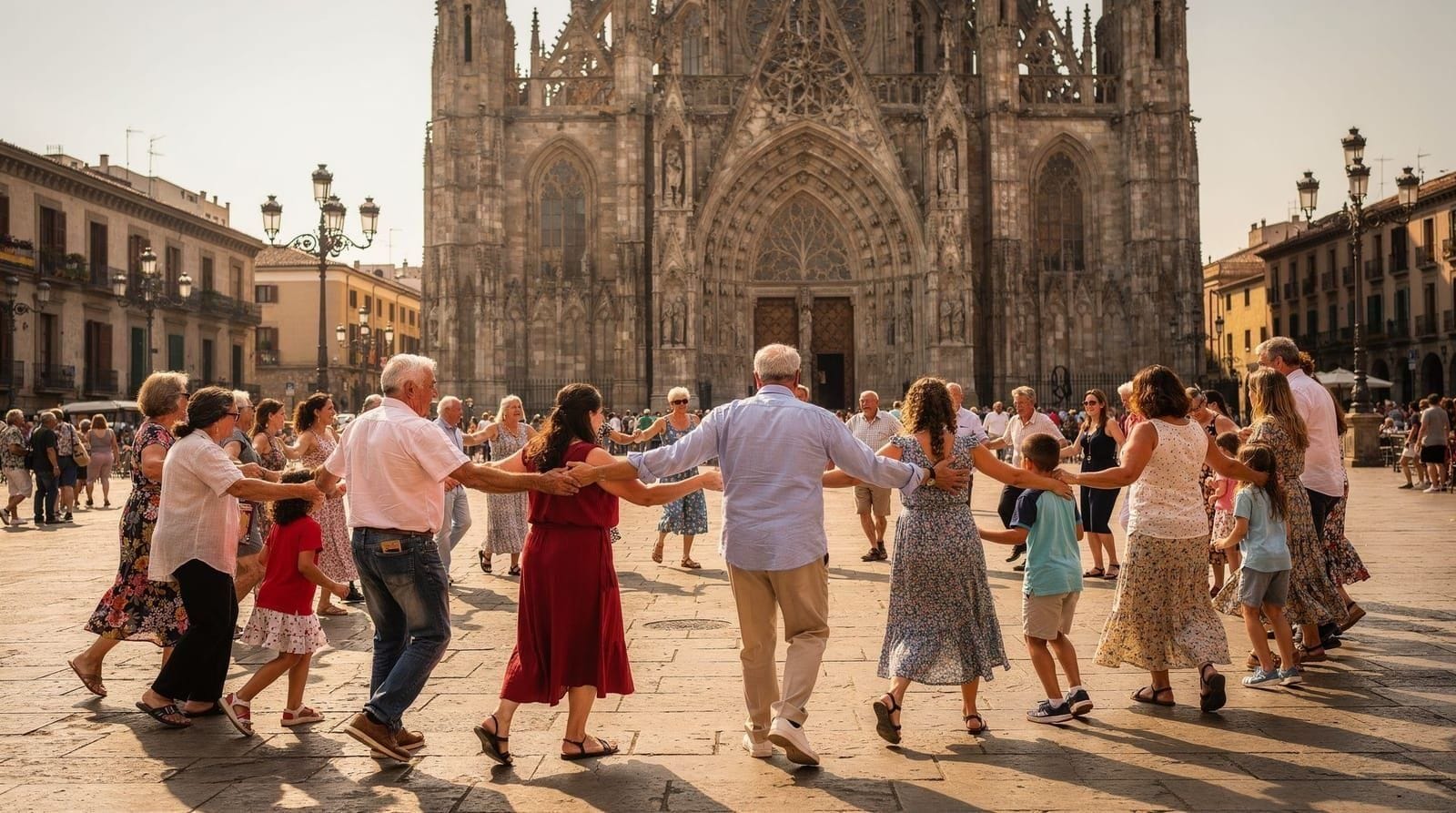
Language is not separate from the traditions, festivals and history that make Catalan culture what it is. The sardana — the circle dance performed in front of the cathedral on Sunday mornings — is sung in Catalan. The castellers who build human towers at festivals use Catalan terms of command. The Barcelona you visit today is a city that spent nearly four decades forbidden from expressing itself in its own language, and which has spent the years since proving that suppression failed.
Knowing even a handful of words in Catalan is not linguistic homework — it is a way of arriving somewhere with your eyes open. The city rewards that kind of attention.
A guided walk through the Gothic Quarter is a good way to hear this history explained in context by a local, with Catalan place names and terms naturally woven into the commentary rather than encountered cold on a street sign.
Whether you are planning your first trip or your fifth, Catalan’s position in Barcelona consistently surprises visitors who arrive expecting a Spanish-language city and find something more layered. The questions above cover the most common points of confusion. The practical bottom line: learn “bon dia”, “gràcies” and “si us plau”, point Google Translate at any menu you cannot parse, and do not worry about the rest. Barcelona is a deeply bilingual city, deeply accustomed to international visitors, and the warmth of a Catalan opener will carry you through most of what the city has to offer. If you are still planning your trip, our best time to visit Barcelona guide and Barcelona on a budget round out the practical picture.
Frequently asked questions about Catalan language basics for Barcelona visitors
Is Catalan a dialect of Spanish?
No. Catalan is a separate Romance language, descended from Vulgar Latin through its own distinct evolution. It is closer to Occitan (spoken in southern France) and shares significant vocabulary with Portuguese and Italian. Spanish and Catalan are related — both are Romance languages — but are no more similar than, say, French and Portuguese. Catalan has its own grammar, orthography, and a literary tradition dating to the 12th century. The idea that it is a 'dialect of Spanish' is linguistically incorrect and culturally sensitive in Catalonia, where the language was suppressed for decades under Franco's dictatorship.Which language should I use in Barcelona — Catalan or Spanish?
Either works everywhere in Barcelona. The practical approach: open with a Catalan greeting ('bon dia', 'gràcies') and then switch to whichever language you have. Most locals will respond in Spanish if they sense that is more useful for you, and will not take offence. Avoid defaulting to Spanish without any acknowledgement of Catalan — in some contexts (particularly in more local neighbourhoods away from the tourist centre) this can feel dismissive. A Catalan opener followed by Spanish is always well received.Does Google Translate work for Catalan?
Yes. Google Translate supports Catalan and performs reasonably well for everyday text and conversation. The camera translation feature works on menus, signs and shop notices. Duolingo also offers a Catalan course, which is worth starting a week or two before your trip if you enjoy gamified language learning. iTranslate and DeepL also support Catalan. For offline use, download the Google Translate Catalan language pack before you travel.Will I see both Catalan and Spanish signs in Barcelona?
Catalan is the official language of the Catalan government and the primary language of public signage in Barcelona. Street names, metro signs, official notices and public buildings are primarily or exclusively in Catalan. Spanish appears alongside Catalan on some national infrastructure (railway, airport). In shops and restaurants, menus are often in both languages, plus English and sometimes French. You will see Catalan everywhere; do not assume it is a misprint or error.Are there parts of Barcelona where Catalan is more commonly spoken?
Catalan is spoken as a first language more widely in the outer neighbourhoods, wealthier residential areas (Sarrià-Sant Gervasi, Gràcia, parts of Eixample), and among older families who maintained it through the Franco years. The tourist-heavy areas — La Rambla, Gothic Quarter, Born — tend toward Spanish and English in service interactions. Public servants, teachers and local politicians use Catalan as the default. On the metro, announcements are in Catalan first, Spanish second.What should I say if I cannot communicate with someone?
If Spanish, Catalan and English all fail, try gestures, pointing at a phone screen or writing numbers. French has some mutual intelligibility with Catalan and may help in a pinch. Most young people working in hospitality in Barcelona have serviceable English. If communication genuinely breaks down, 'Parla anglès?' (Do you speak English?) or 'Parla castellà?' (Do you speak Spanish?) usually opens a new route.Is it rude to only speak Spanish in Catalonia?
Not rude, but contextually aware visitors do better. The historical suppression of Catalan (banned for nearly 40 years under Franco) means the language carries emotional weight for many locals. Speaking only Spanish without any acknowledgement of Catalan is not offensive, but it can feel tone-deaf in the same way that visiting Wales and speaking only English without acknowledging Welsh might feel. A single Catalan word or phrase shifts the dynamic significantly.