Sardana dance: Catalonia's circle dance explained
Where can I see the sardana dance in Barcelona?
The most reliable opportunity is Sunday morning at the Barcelona Cathedral (Plaça de la Seu), where sardana is traditionally danced from approximately 11:30 to 13:30. La Mercè festival (23–27 September) and Sant Jordi (23 April) are the other dependable occasions. Since 2020, the frequency of impromptu Sunday sardana has declined; check Barcelona City Council's cultural calendar before visiting specifically for sardana.
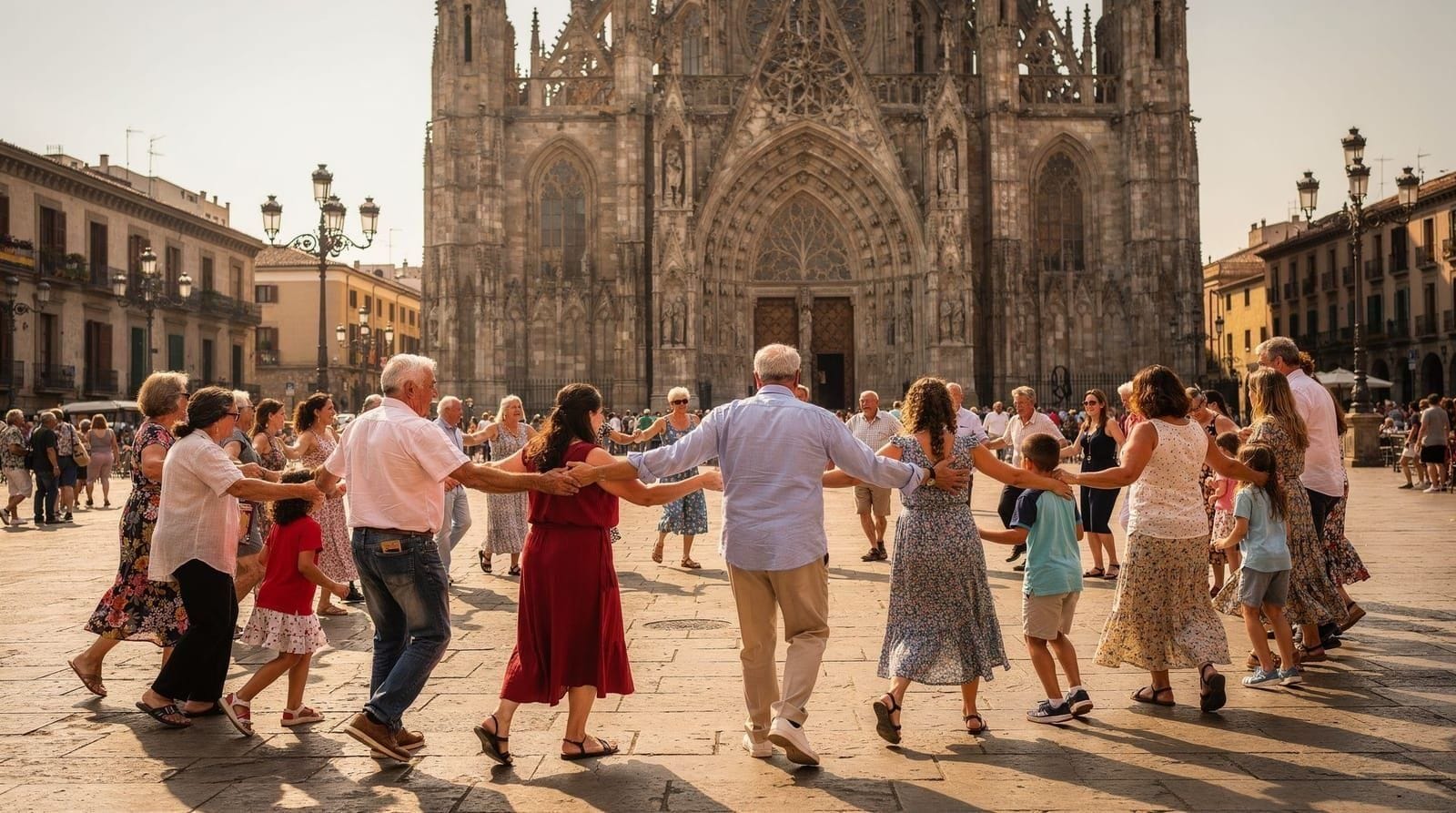
On a Sunday morning in Barcelona, in the wide square in front of the Cathedral, a circle forms. A few dozen people — working-age adults, older couples, the occasional visitor who has been told what is happening — stand in a ring, holding hands. A band of eleven musicians, the cobla, begins to play: a slightly nasal, reedy melody carried by the tenora, supported by brass and percussion. The circle begins to move: small steps left, small steps right, a rising and falling of joined hands, a pattern of feet that looks simple until you try to replicate it exactly.
This is the sardana — the traditional circle dance of Catalonia — and it is one of the strangest and most affecting things you will encounter in Barcelona, partly because it costs nothing, partly because anyone can join, and partly because it is so thoroughly unlike what most visitors expect from a European city’s cultural life.
Sardana at a glance
| Where | Plaça de la Seu, in front of Barcelona Cathedral (Gothic Quarter) |
| Cost | Free — no ticket, no admission |
| Time needed | 30 minutes to watch, up to 2 hours for a full Sunday session |
| Best time | Sunday mornings (~11:30–13:30); guaranteed at La Mercè (23–27 Sept) and Sant Jordi (23 April) |
| Getting there | Metro L4 (Jaume I) or L3/L4 (Liceu), both a short walk into the Gothic Quarter |
Origins and history
The history of the sardana is genuinely contested, and accounts of it reveal as much about Catalan cultural politics as about the dance itself. Most accounts trace the current form of the sardana to the coastal regions of the Alt Empordà and the Baix Empordà — the northeastern corner of Catalonia around Girona and the Costa Brava — in the early 19th century. The dance in its present form, with its specific step pattern and its accompaniment by the modern cobla, was consolidated around the 1850s by the musician Pep Ventura, who is credited with standardising both the choreography and the instrumental ensemble.
Earlier origins are debated. Some scholars propose medieval antecedents in Catalan and Sardinian circle dances; others trace the name itself to connections with Sardinia through the Crown of Aragon (which ruled both Catalonia and Sardinia from the 14th to the 18th century). The word “sardana” appears in documents from the 16th century but the precise relationship between these historical references and the 19th-century form of the dance is unclear. The honest answer is that no single origin story has been definitively established.
What is historically clear is that the sardana underwent a significant transformation in the second half of the 19th century, both musically and culturally. The Renaixença — the Catalan cultural renaissance of the late 19th century, which also produced Modernisme in architecture and a revival of Catalan literature — embraced the sardana as a symbol of Catalan identity. For the full history of how Catalonia forged its modern cultural identity, the Barcelona history guide gives essential context. At a moment when Catalan language and culture were asserting their distinctiveness from Castilian Spanish culture, the sardana became a deliberate cultural emblem: a dance that was specifically Catalan, danced in the street, open to everyone, requiring neither professional training nor a stage.
This symbolism deepened under the Franco dictatorship (1939–1975). Catalan cultural expression was suppressed; dancing the sardana in public, like speaking Catalan in public, was an act of cultural resistance. The dance continued — sometimes clandestinely, sometimes tolerated — and emerged from the dictatorship with an intensified political and cultural charge that it retains, less urgently, today.
How the sardana works
The sardana is a group circle dance with a specific and precise structure. Understanding it before you watch makes the experience considerably richer.
The circle
Participants form one or more concentric circles. Each circle is a group of people who have gathered for that particular piece; circles can range from eight or ten people to several dozen. When a new piece of music begins, new circles form and existing ones expand. The traditional gesture for joining is simply to approach the circle and take a hand; the circle opens to accept you.
In the centre of each circle, participants leave their bags, coats and personal belongings in an unguarded pile. This is the most immediately striking visual element of a sardana — a heap of handbags and jackets sitting unwatched in the middle of a public square while their owners dance around them. The pile is respected by everyone. Do not touch or step over it.
The steps
The sardana has a specific choreographic pattern built from a combination of curts (short steps) and llargs (long steps). The pattern shifts according to the structure of the music: the first section (curts) uses smaller, lower steps; the second section (llargs) uses larger steps with more height. Arms rise to shoulder height and lower in coordination with the footwork.
The full pattern is learned over months of practice. But the basic motion — alternating weight, small steps left and right, arms moving in rhythm — can be followed instinctively within the first minute. Local participants are invariably patient with newcomers. If you lose the rhythm, continue; the circle is forgiving and your neighbours will subtly guide you back.
Counting in sardana
Experienced sardana dancers count the beats silently while dancing — a practice that looks odd from the outside but is entirely normal within the circle. The music is in compound time and the transitions between curts and llargs sections require counting to anticipate correctly. Beginners do not need to count; following the person beside you is sufficient.
Dress and formality
There is no dress code. The sardana is a street event, not a performance. People dance in ordinary clothes, often street clothes or slightly smart-casual for a Sunday morning. The only thing worth noting: comfortable flat shoes are better than heels for the footwork.
The cobla: the music of the sardana
The cobla is the eleven-piece ensemble that plays for sardana. Its sound is unlike any other musical ensemble and entirely specific to Catalan musical tradition. Hearing a cobla for the first time is one of those sounds that locates you immediately — you know you are in Catalonia.
The instruments
Tenora: The lead instrument of the cobla, a large double-reed instrument in the oboe family. The tenora produces the characteristic slightly nasal, piercing quality that carries the sardana melody across a square. It is not an oboe — it is larger, louder and tuned differently. The tenora was developed by Pep Ventura in the 19th century specifically for sardana music.
Tible: A smaller double-reed instrument, also in the oboe family, tuned higher than the tenora. The tible typically plays countermelodies and harmonies to the tenora’s lead.
Flabiol: A small Catalan flute played with one hand, leaving the other hand free to play the tamborí simultaneously. The flabiol is a historical Catalan instrument predating the current cobla.
Tamborí: A small drum strapped to the wrist of the flabiol player. The simultaneous playing of flabiol and tamborí by a single performer is one of the more visually impressive aspects of cobla technique.
Fiscorn: A valved brass instrument specific to the cobla, similar in appearance to a small flugelhorn. The fiscorn fills the harmonic middle register.
Trombones (two): Providing the brass low-end harmonic support.
Trumpets (two): Adding brightness and attack to the brass section.
Double bass: Providing the rhythmic and harmonic foundation.
The resulting sound — reedy melody over brass harmony over bass pulse — is precise, slightly formal and entirely its own thing. It rewards repeated listening; what sounds mechanical at first reveals considerable nuance in rhythm and phrasing.
Where to hear cobla music outside sardana
The Palau de la Música Catalana programs cobla concerts periodically throughout the year. The Orquestra de Cobla de Barcelona performs at major festivals and at ticketed concerts. La Mercè festival always includes free cobla performances. For music lovers, hearing a cobla concert in a proper venue gives context to what you hear at the sardana in the square.
Sardana, community and cultural meaning
The sardana is sometimes described as Catalonia’s “national dance,” which is accurate enough but slightly misleading if it suggests pageantry or ceremony. The sardana is anti-performative by design. There is no stage, no audience section, no admission fee, no defined performer and no defined spectator. The circle can always expand.
This is what distinguishes it from nearly every other form of traditional dance. Flamenco is an art form — watching it is the primary mode of engagement, and the distance between performer and audience is built into its structure. The sardana has no such distance. The cobla plays; the circle forms; whoever is present joins or watches as they prefer. The dance belongs, in the most literal sense, to whoever is in the circle.
This structure made the sardana an unusually effective expression of Catalan communal identity during periods of political pressure. It could not easily be banned without banning all public assembly; it required no infrastructure other than a square and a band; and it expressed, through its very form, the value of mutual participation over individual performance. A sardana with twenty people is as valid as one with two hundred.
The contrast with flamenco is worth dwelling on because the confusion between flamenco and Catalan culture irritates local residents considerably. Flamenco is a brilliant art form from Andalusia — the southern region of Spain — with roots in Romani, Arabic and Moorish musical traditions specific to that region. It has no organic connection to Catalonia. Tourists seeking flamenco in Barcelona are not seeking Catalan culture; they are seeking Andalusian culture in the wrong place. The Catalan culture guide addresses this distinction more fully.
When and where to see sardana in Barcelona
Sunday mornings at the Cathedral
The traditional venue is the Plaça de la Seu, the square in front of the Barcelona Cathedral in the Gothic Quarter. On Sunday mornings, from approximately 11:30 to 13:30, sardana is traditionally danced here, with a cobla playing live. This is the most reliably publicised sardana event in Barcelona.
Important caveat: the frequency and regularity of this Sunday event has fluctuated since 2020. It does not happen every single Sunday throughout the year; it is more reliable in spring, summer and autumn than in winter. Before making a specific trip to the Cathedral for sardana, check the current programme on the websites of the Agrupació Cultural Folklòrica Barcelona or the Barcelona City Council cultural calendar.
The Cathedral setting is excellent: the Gothic facade as backdrop, the cobla set up in the square, circles forming on the stone paving. The morning crowd is local — families, residents, older couples — with visitors who have sought it out. It is a genuine neighbourhood event rather than a tourist production.
La Mercè — 23–27 September
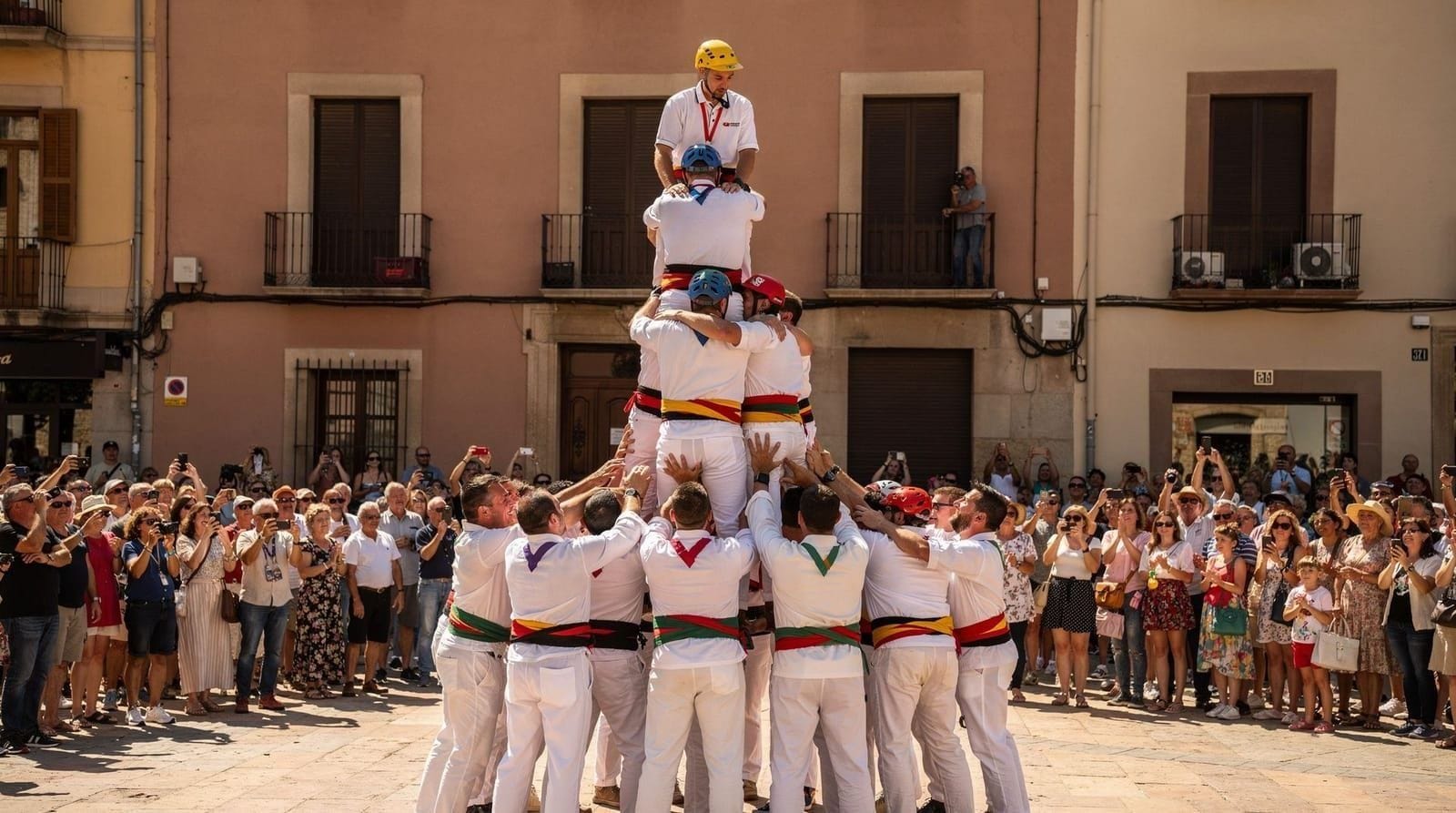
La Mercè, Barcelona’s main patron-saint festival, includes sardana performances as a formal part of the programme. Multiple cobla groups play across different squares over the four-day festival. This is the most reliable opportunity of the year and is well-publicised in advance. It coincides with the casteller performances at Plaça de Sant Jaume and the correfoc fire run — a full programme of Catalan traditional culture available for free across a single week. See the castellers guide for details on the human tower performances at the same festival.
Sant Jordi — 23 April
Sant Jordi, Catalonia’s patron-saint day and the day of roses and books, typically includes sardana dancing in central squares. The atmosphere on Sant Jordi is festive and the sardana adds a musical dimension to what is already a full street day in the Gothic Quarter.
Plaça de Sant Jaume
Sardana is also danced periodically at Plaça de Sant Jaume, the square between the town hall and the Generalitat building, on Sunday evenings and at specific festivals. Check the current programme; this is a secondary venue to the Cathedral but equally good in terms of setting.
Neighbourhood festivals
Every Barcelona neighbourhood holds a festa major during summer and autumn. These festivals regularly include sardana performances, often by local cobla groups rather than the more prominent city-centre ensembles. If you are staying in Gràcia, Sants, Poblenou or any other neighbourhood during its festa major, a sardana event is likely nearby.
Sardana etiquette: what to know before you join
Joining a sardana circle is genuinely welcomed, but there is an unspoken etiquette worth knowing so you don’t feel — or look — lost.
Watch one full piece before joining. The step pattern changes between the curts and llargs sections, and watching a complete piece first lets you absorb the rhythm before your feet have to follow it. Jumping in mid-piece is fine too, but you will find your footing faster if you have watched at least once.
Take a hand when a gap opens, don’t force one. Circles expand naturally to welcome newcomers, particularly at the ends where new arrivals typically enter. Hovering at the edge and catching someone’s eye is usually enough; a participant will open the circle for you.
Don’t touch the belongings pile. The bags and coats left unguarded in the centre of the circle are part of the tradition, not an oversight. Never step into the centre, move anything, or use the space to take a photo from inside the ring.
Dress is irrelevant, but shoes matter. No one will look twice at your clothing — this is a street event, not a performance with a dress code. Flat, comfortable shoes make the small, precise steps easier than sandals or heels.
Don’t expect to master it in one session. The full pattern takes months to learn properly. Locals do not expect visitors to dance perfectly, and stumbling through the first attempt is completely normal — most participants started exactly the same way.
Bring cash for nothing at all. There is no admission, no suggested donation box, and no merchandise stall attached to a typical Sunday session — unlike many free cultural events, sardana has resisted any form of commercialisation, which is itself part of what makes it worth experiencing.
Photographing sardana respectfully
Sardana is a public event and photography is welcome, but a few habits keep it considerate. Shoot from outside the circle rather than stepping into the ring or the belongings pile to get a better angle — participants need that space to dance safely. Avoid using flash, which is unnecessary in daylight and intrusive if a session runs into early afternoon shade. If you want a portrait of a specific dancer or musician, especially an older participant, a quick smile and gesture asking permission goes a long way; most are happy to be photographed but appreciate being asked rather than treated as a photo opportunity. The Cathedral facade behind the circle makes a strong background shot — position yourself to one side of the square rather than directly in the dancers’ sightline.
Sardana today: an honest assessment
The sardana occupies an interesting and slightly difficult position in contemporary Catalan culture. It is beloved by older generations and is genuinely important as a cultural symbol; it is less popular with younger Catalans than with their grandparents, and the challenge of attracting new participants to a tradition with a specific and learned step pattern is real.
The post-pandemic period accelerated some pre-existing trends. Fewer cobla groups are active than a decade ago; the number of regular sardana groups in Barcelona has declined; and the Sunday morning sessions at the Cathedral are less consistent than they were in the 2010s. The tradition is not dying — it remains active at festivals and in cultural associations throughout Catalonia, and it has a younger generation of advocates — but it is under real demographic pressure.
What this means practically for a visitor: if you want to see sardana in Barcelona, the festival calendar (La Mercè, Sant Jordi) is more reliable than the informal Sunday sessions. A weekend in late September, coinciding with La Mercè, is the single best combination of guaranteed sardana, guaranteed castellers and guaranteed free Catalan cultural events. See best time to visit Barcelona for a full seasonal breakdown.
Sardana beyond Barcelona
Since the sardana’s modern form developed in the Empordà region rather than in Barcelona itself, visitors with time for a day trip can see it closer to its roots. Towns around the Costa Brava and Girona hold sardana as a routine part of local festa major calendars throughout summer, often with smaller, more intimate cobla groups than the city-centre ensembles. These village sessions tend to be less crowded and, arguably, closer in spirit to the dance’s original 19th-century context — a genuine local gathering rather than a capital-city cultural showcase. If a Girona or Costa Brava day trip is already on your itinerary, it is worth checking the local town hall’s summer events calendar for a festa major that overlaps with your visit; the timing is often more flexible than Barcelona’s Sunday-morning tradition, with evening sessions common in warmer months.
Sardana and the broader Catalan cultural picture
The sardana sits alongside castellers and the cobla as one of the three pillars of Catalan traditional public culture — things that happen in squares, for free, as expressions of communal Catalan identity. Together they constitute something genuinely unusual in European cultural life: a tradition of public, participatory, non-commercial cultural expression that has survived industrialisation, dictatorship and globalisation.
Seeing all three in a single week — a cobla playing sardana on a Sunday morning, castellers rising in Plaça de Sant Jaume on a September afternoon, a correfoc fire run on a Friday evening — gives a picture of Catalan culture that no museum or guided tour can provide. The Catalan culture guide is the recommended starting point for understanding how these traditions connect, and the barcelona-history guide gives the political context in which they developed and survived.
The sardana is, in the end, a very simple thing: a circle of people holding hands and moving together while music plays. Its simplicity is not accidental. It was designed to be joinable by anyone, learnable in minutes and performable anywhere a cobla can set up. Its cultural significance comes not from complexity but from persistence — the fact that Catalans have been doing this, in public squares, for free, for each other and for anyone who wants to join, for more than a century and a half. That is worth experiencing directly.
For quick reference on joining a sardana circle, the instruments, the distinction from flamenco and the current reliability of Sunday sessions, see the FAQ section at the top of this page.
For practical logistics — getting to the Cathedral, combining a sardana visit with the Gothic Quarter, or planning around La Mercè — the getting around Barcelona guide covers transport options, and the Barcelona on a budget guide confirms that sardana, like all the best things about Catalan public culture, costs nothing at all. Use the daily budget calculator to plan your full trip alongside these free cultural events.
Frequently asked questions about Sardana dance
What is the sardana?
The sardana is the traditional circle dance of Catalonia. Participants stand in a circle, hold hands, and follow a precise sequence of steps while a cobla (a traditional Catalan wind-and-brass ensemble) plays. It is not a performance — it is a participatory community ritual, open to anyone who wishes to join the circle.Can visitors join a sardana circle?
Yes, and they are actively welcome. The sardana circle expands to include newcomers; joining is simply a matter of approaching the circle and taking a hand when a natural gap appears. The steps have a specific pattern that takes some practice to learn fully, but the basics can be picked up in the first few minutes by watching and following. Local participants will help newcomers without any fuss.Is sardana the same as flamenco?
No. Flamenco is an Andalusian art form from southern Spain, originating in the Romani and Moorish musical traditions of Andalusia. The sardana is a Catalan circle dance from northeastern Catalonia with completely different origins, music, structure and cultural meaning. Tourists often encounter flamenco shows marketed in Barcelona, but flamenco is not Catalan and is not part of Barcelona's own cultural tradition.What instruments does the cobla play?
A traditional cobla has eleven musicians playing: the tenora (a large double-reed instrument similar to an oboe, producing the characteristic slightly nasal sound of sardana music), the tible (a smaller double-reed instrument), the flabiol (a small Catalan flute, usually played by the tamborí player), the tamborí (a small drum strapped to the flabiol player's wrist), the fiscorn (a valved Catalan horn), two trombones, two trumpets and a double bass. The tenora carries the melody and is the sound most associated with sardana.How long does a sardana session last?
A cobla plays a series of pieces, each lasting approximately 5–10 minutes. A Sunday morning session at the Cathedral square typically runs from about 11:30 to 13:30 — roughly two hours. Individual circles form for each piece and may dissolve between pieces; participants rest, chat and reform. You can join for a single piece or stay for the full session.Is sardana declining?
Honestly, yes. The frequency of public sardana performances, particularly the informal Sunday sessions, has declined since the pandemic disruptions of 2020, and the tradition struggles to attract younger participants in the same numbers as older generations. Formal performances at festivals remain reliable; impromptu Sunday sessions are less consistent than they were a decade ago. La Mercè and Sant Jordi remain the most dependable occasions.Why don't people leave bags and coats on the ground in the centre of the circle?
It is traditional for sardana participants to leave their bags, coats and belongings in a pile in the centre of the circle during the dance — a visible expression of mutual trust. The pile is entirely unguarded; everyone's attention is on the dance. This is a genuine tradition and genuinely respected. Do not step over or touch the belongings pile.