Barcelona's history: from Roman colony to Olympic city
Barcelona: 2-hour Gothic Quarter walking tour
Duration: 2 hours
- Free cancellation
What are Barcelona's most important historical highlights?
Barcelona has over 2,000 years of layered history. The Roman colony of Barcino (founded c. 15 BCE) left walls still visible in the Gothic Quarter today. Medieval Barcelona became the capital of a Catalan-Aragonese maritime empire stretching to Sicily and Athens. September 11, 1714 — the fall of Barcelona to Philip V's Bourbon forces — remains the Catalan National Day. The 19th century brought Cerdà's grid plan and the Modernisme movement of Gaudí and his contemporaries. The 1992 Olympic Games transformed the waterfront and put the modern city on the global map.
Two thousand years of Barcelona’s history are still legible in the city’s streets — if you know where to look. The Gothic Quarter is not a reconstruction; its narrow lanes follow the Roman grid. The walls of the medieval merchant city still stand in the Barri Gòtic. The scars of 1714 shaped the neighbourhood of La Barceloneta. Cerdà’s grid runs for kilometre after kilometre across the Eixample. And the Olympic waterfront, created from nothing in 1992, is the reason Barcelona feels like a Mediterranean city rather than an industrial port.
This is the story of how those layers accumulated.
| Era | Where to see it today |
|---|---|
| Roman Barcino (c. 15 BCE) | MUHBA underground city, Temple d’August columns, walls at Plaça de Ramon Berenguer el Gran |
| Medieval Catalan-Aragonese empire | Santa Maria del Mar, Barcelona Cathedral, Palau de la Generalitat |
| 1714 and the Bourbon conquest | Born Cultural Centre ruins, La Barceloneta grid |
| 19th-century Eixample | Cerdà’s grid, Passeig de Gràcia Modernisme |
| 1992 Olympics | Port Olímpic, Vila Olímpica, Barceloneta beach |
Roman Barcino: the foundation under the Gothic Quarter
Before the Romans arrived, the hills above the present-day Gothic Quarter were home to the Laietani, an Iberian people whose settlement on Montjuïc predates the Roman conquest by centuries. The Romans established the colony of Barcino around 15 BCE under the orders of Emperor Augustus — a modest but strategically placed town on the flat top of Mons Taber, a small hill (barely noticeable today) between the rivers Besòs and Llobregat.
Barcino was never among the great cities of the Roman empire. It was considerably smaller than nearby Tarraco (Tarragona), the capital of the province of Hispania Citerior. But it had a regular forum, temples, a theatre, baths and a street grid — all of which survive, partially, beneath the current Gothic Quarter. The Roman forum occupied roughly the area of the current Plaça de Sant Jaume, where the Ajuntament (city hall) and the Palau de la Generalitat now face each other across what was once the civic heart of a Roman town.
The most remarkable Roman survival is the Temple d’August. Four Corinthian columns — still standing to nearly their full height — are preserved inside a medieval courtyard at Carrer del Paradís 10, entered through an unassuming door a few paces from the cathedral. The temple was dedicated to the Imperial cult of Augustus and stood at the highest point of Mons Taber. You can visit the columns free of charge; the contrast between the ancient stonework and the medieval walls built around it is quietly extraordinary.
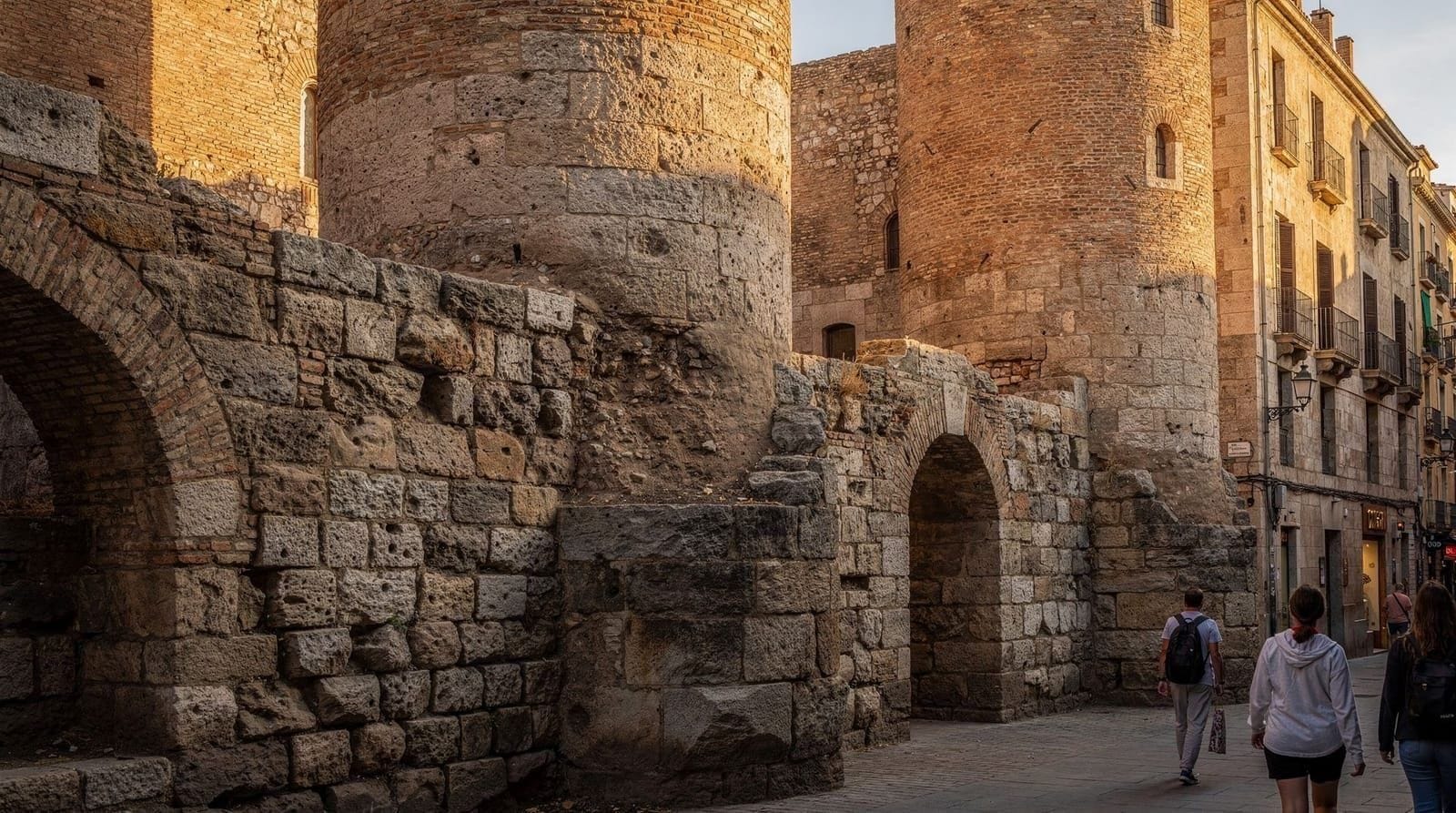
The Roman walls, constructed between the 2nd and 4th centuries CE, are visible in multiple places. The most impressive section runs along Avinguda de la Catedral and continues around Plaça de Ramon Berenguer el Gran, where a stretch with original towers still stands at street level, incorporated into later medieval buildings. The walls enclosed a modest area — roughly 10 hectares — but defined the shape of the city for the next thousand years.
The deepest exploration of Roman Barcino is underground. The MUHBA (Museu d’Història de Barcelona) in Plaça del Rei allows visitors to walk above the excavated streets, drainage channels and workshops of the original Roman colony, preserved beneath medieval and later construction. It is one of the most extensive in-situ archaeological displays in southern Europe. The ruins include a 4th-century episcopal complex, evidence that Barcelona became a Christian city even before the Western Empire fell.
Visigoths, Franks and the emergence of Catalonia
After the collapse of Roman administration in the 5th century, Barcelona passed through Visigoth hands before being taken briefly by the Moors (718 CE) and then recaptured by Frankish forces under Louis the Pious in 801 CE. The city became a frontier county of the Carolingian empire, buffering Christian territories against al-Andalus to the south.
The foundational figure in Catalan historical mythology is Count Guifré el Pelós — Wilfred the Hairy — who ruled the County of Barcelona from 878 until his death in 897. Wilfred is traditionally credited with uniting the Catalan counties and ruling independently of Frankish authority. He is also the subject of the legendary origin of the Catalan flag: the Senyera, four red bars on a gold field, supposedly traced by a Frankish king dipping his fingers in Wilfred’s blood after a battle. The legend is 13th-century invention, but the symbol itself is among the oldest flags in Europe still in use.
From the 10th century onwards, the County of Barcelona developed as a distinct political and cultural entity. The Catalan language emerged from Vulgar Latin during this period, shaped by the Carolingian cultural sphere rather than by the Castilian or Mozarabic influences that shaped Spanish to the west. For an introduction to the language that grew from this heritage, see our guide to Catalan language basics.
Medieval Barcelona: the capital of a Mediterranean empire
The political event that defined medieval Barcelona’s trajectory was the marriage in 1137 of Ramon Berenguer IV, Count of Barcelona, to Petronilla, heiress to the Kingdom of Aragon. This dynastic union — the Catalan-Aragonese Crown — made Barcelona the capital of a state that would, over the following two centuries, become one of the dominant powers of the Mediterranean.
Between the 13th and 14th centuries, Catalan-Aragonese forces expanded to the Balearic Islands, Valencia, Sicily, Sardinia and eventually to the Duchy of Athens. Barcelona’s merchant class grew wealthy on this trade. The Consolat de Mar, established in the 13th century, was one of the first maritime trade courts in Europe, and its regulations influenced commercial law across the Mediterranean for centuries.
The Generalitat de Catalunya — Catalonia’s parliamentary government — was founded in 1289, one of the earliest representative institutions in Europe. Its original building, the Palau de la Generalitat on Plaça de Sant Jaume, is still in use as the seat of the Catalan government today.
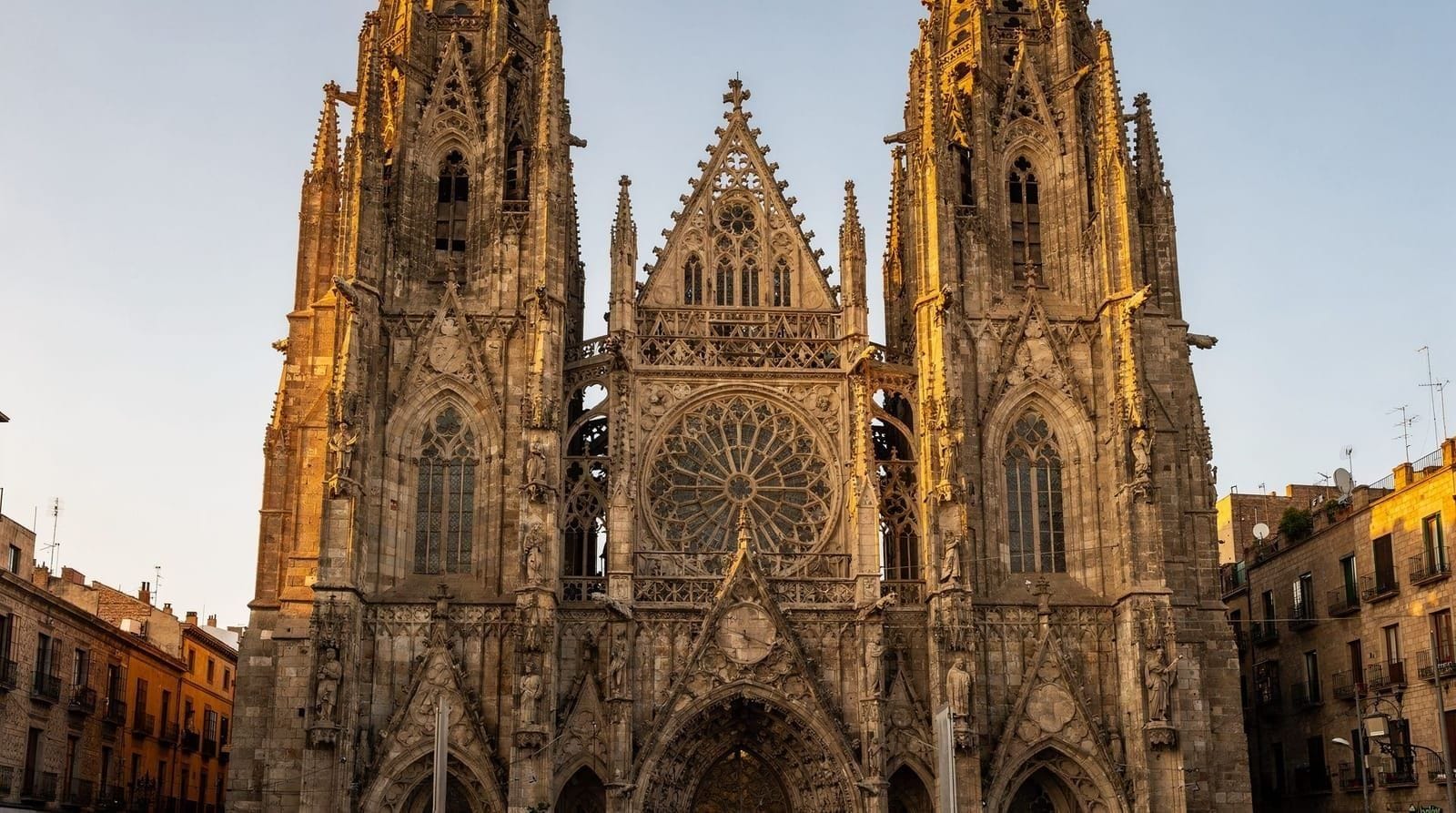
The wealth of medieval Barcelona is most legible in its Gothic architecture. The Barcelona Cathedral — the Catedral de Santa Eulàlia — was begun in 1298 and largely completed by 1450, though the neo-Gothic facade was only added in the 1880s. But the building that most purely captures the spirit of medieval Catalan Gothic is Santa Maria del Mar, in what is now the El Born district.
Santa Maria del Mar was built between 1329 and 1383 — just 54 years, an extraordinary speed for a major Gothic church — and funded not by the crown but by the community of La Ribera: merchants, fishermen, dockers and the young men of the neighbourhood who carried the stone from the Montjuïc quarry on their backs. The building’s unity of design, its wide nave, its soaring simplicity relative to Castilian or French Gothic, express the character of a civic, merchant-funded architecture. It remains one of the most beautiful interiors in Barcelona.
The Gothic Quarter itself — the Barri Gòtic — takes its name from this period, though the quarter’s boundaries were tidied up and partly reconstructed during the early 20th century (some “medieval” facades are Noucentisme additions from the 1920s). The genuine medieval streetscape is still there beneath the tourist overlay: narrow lanes following the Roman grid, walls incorporating Roman stones, courtyards with Gothic arcades.
1469 and after: the long decline
The marriage of Ferdinand II of Aragon and Isabella I of Castile in 1469 — the event usually given as the founding of modern Spain — was not straightforwardly good news for Barcelona. As trade shifted from the Mediterranean to the Atlantic following Columbus’s 1492 voyages, Catalonia found itself on the wrong coast. Seville and Cádiz controlled the lucrative Americas trade; Barcelona, excluded by Castilian monopolies, stagnated.
The tensions accumulated across the 16th and 17th centuries. In 1640, the Reapers’ War (Guerra dels Segadors) — a Catalan revolt against Castilian taxation and military demands during the Thirty Years’ War — became the defining moment of Catalan resistance mythology. The rebel song “Els Segadors” (The Reapers) is still the Catalan national anthem. The revolt failed, and Catalonia lost the Roussillon region (now in southern France) to France by treaty in 1659.
1714: the wound that doesn’t close
September 11, 1714 is the date most freighted with meaning in Catalan historical consciousness. On that day, Barcelona fell to the forces of Philip V after a 14-month siege during the War of the Spanish Succession — a continent-wide conflict over who would rule the Spanish empire. Catalonia had backed the Habsburg claimant (Charles of Austria); Philip V was Bourbon, French-backed and absolutist.
The consequences were severe. Philip’s Nova Planta decrees of 1715–16 abolished the Catalan institutions: the Generalitat was dissolved, the Corts suspended, Catalan law replaced by Castilian law, the Catalan language expelled from official use. To physically control the defeated city, Philip ordered the demolition of a large section of the La Ribera neighbourhood — homes, churches, streets — to build the Citadel fortress (Ciutadella) overlooking the city. The residents displaced from La Ribera were rehoused in a new, strictly planned neighbourhood by the sea: La Barceloneta, with its characteristic grid of narrow parallel streets still visible today.
Every September 11, Catalans observe the Diada Nacional — their national day — by commemorating not a victory but a defeat. Since 2012, the Diada has been the annual focal point for the independence movement, with demonstrations regularly drawing over a million people through central Barcelona. If your trip coincides with mid-September, it is worth checking the best time to visit Barcelona guide for what this means practically for travel.
To walk the Born district, where the 1714 siege defences were excavated beneath the old Born market building (now the Born Cultural Centre), is to stand above the neighbourhood that was physically destroyed as a punishment. The ruins are visible through glass floors in the market building.
The 19th century: walls down, Eixample up
Barcelona spent the 18th century slowly rebuilding under Bourbon rule. By the early 19th century, the industrial revolution was transforming the city — textile mills in Poble Nou and Sant Martí made Catalonia the most industrialised part of the Iberian Peninsula. By mid-century, the population had outgrown the medieval walls by an enormous margin, with workers crowded into one of the most densely packed urban areas in Europe.
In 1854, Madrid authorised the demolition of Barcelona’s medieval walls. The question of what to build outside them produced one of the most significant urban planning debates of the 19th century. The engineer Ildefons Cerdà won the commission with a proposal of radical geometric regularity: a grid of identical square blocks, each with chamfered (octagonal) corners to improve traffic flow and street light, stretching in every direction across the flat plain between the old city and the towns of Gràcia, Sarrià and Sant Andreu.
Cerdà’s Eixample plan, approved in 1859, was visionary in ways that went beyond geometry. Each block was designed with interior gardens — green space at the heart of a dense urban grid. Cerdà imagined a city of equal neighbourhoods, with hospitals, schools and markets evenly distributed. In practice, the bourgeoisie colonised the Eixample almost immediately, building the great Moderniste palaces along Passeig de Gràcia and the Diagonal, while the workers’ districts were pushed to the periphery. The interior gardens were mostly built over by later 19th-century development. But the grid itself — walkable, legible, full of light — remains one of the great achievements of 19th-century urban design.
Modernisme: not Art Nouveau but something more charged
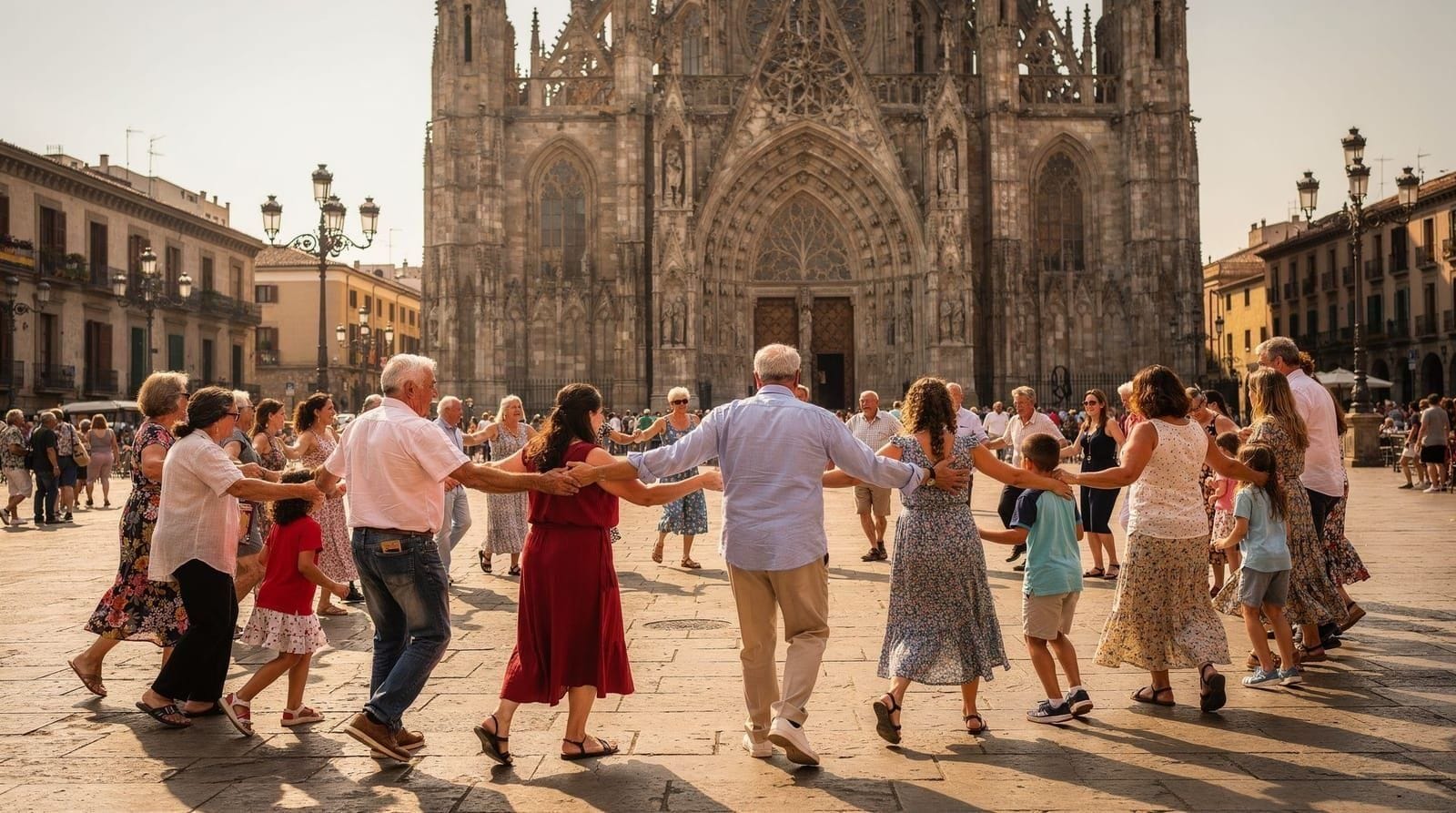
The Renaixença — Catalan cultural renaissance — of the 19th century was a literary and intellectual movement that reclaimed the Catalan language, history and traditions suppressed since 1714. It produced new editions of medieval Catalan literature, elevated Sant Jordi and the sardana as national symbols, and created the cultural soil from which Catalan Modernisme grew.
Catalan Modernisme (roughly 1880s to 1920s) is sometimes described as the local form of Art Nouveau, and it shares the movement’s organic forms, decorative richness and rejection of historicist revival styles. But it was also something more: a conscious assertion of Catalan identity through architecture. Gaudí, Domènech i Montaner and Puig i Cadafalch were not simply following a European aesthetic trend; they were building a Catalan architecture that would be unmistakably different from Castilian or French precedents.
Antoni Gaudí (1852–1926) is the most famous, but the movement was broader. Lluís Domènech i Montaner designed the Palau de la Música Catalana (1908) — a concert hall encrusted with stained glass, ceramic and mosaic on every surface — and the Hospital de Sant Pau, a complex of Art Nouveau pavilions that served as Barcelona’s main hospital until 2009 and is now a UNESCO World Heritage Site. Puig i Cadafalch designed Casa Amatller on the Manzana de la Discordia. All three were also committed Catalan nationalists.
Gaudí’s Sagrada Família, begun in 1882 and still under construction, absorbs most of the tourist attention — and deservedly so. But the Moderniste presence in the Eixample is pervasive once you start looking: the lamp posts on Passeig de Gràcia were designed by Pere Falqués; the tiled benches in Parc Güell by Gaudí; the Casa Lleó Morera by Domènech i Montaner. The entire neighbourhood is a monument to a cultural moment when architecture and national identity were consciously intertwined.
For more context on the cultural traditions that grew from this period, see our guides to the sardana dance and the castellers human towers. The Catalan language was the vehicle through which all of this identity was expressed — and preserved, even when banned.
The 20th century: war, dictatorship and reinvention
Barcelona entered the 20th century as a prosperous, turbulent, cosmopolitan city. The 1888 and 1929 Universal Exhibitions had given it international visibility (the 1929 exhibition left Montjuïc’s pavilions, the Pavelló Mies van der Rohe, and the Font Màgica). Anarchist and labour movements were powerful in the working-class districts; the Semana Trágica (Tragic Week) of 1909, when anticlerical riots burned churches across the city, reflected deep social tensions.
The Spanish Civil War (1936–39) began with an attempted military coup that Barcelona resisted with particular ferocity — and then divided against itself, as George Orwell famously documented in Homage to Catalonia. The city was a Republican stronghold under successive anarchist and communist factions, bombed by Italian and Nationalist aircraft (one of the first systematic aerial bombardments of a civilian city in Europe), and finally taken by Nationalist forces on January 26, 1939, without significant street fighting — the Republican forces had already retreated.
What followed was four decades of Francoist dictatorship and, for Catalans, something additionally specific: the suppression of their language, culture and institutions. Catalan was banned from schools, public administration, publishing and the media. Streets were renamed in Spanish. The phrase “If you are Spanish, speak Spanish” was enforced in offices and shops. Workers who migrated from Andalusia and Extremadura in the 1950s and 60s — many hundreds of thousands — arrived into a city where the local language was illegal in public.
Franco died in November 1975. Catalan autonomy was restored by the 1979 Statute of Autonomy, the Generalitat re-established, and Catalan co-official. The recovery of the language has been substantial — Catalan is now the primary language of the government, public schools and much public life in Catalonia — though the political questions opened by the 2017 independence referendum and its aftermath remain unresolved.
1992: the waterfront reborn
The 1992 Olympic Games were the transformative event of modern Barcelona. The waterfront — historically an industrial port that the city had its back to for over a century — was completely rebuilt. The Vila Olímpica neighbourhood replaced old rail yards and factories. Port Olímpic was created from reclaimed land. The Barceloneta beach, previously narrow, polluted and inadequately served, was cleaned, expanded and equipped with the infrastructure that makes it one of the most popular urban beaches in Europe today.
The ring roads (rondes) were built. Montjuïc was renovated with a new Olympic stadium (built on the shell of the 1929 stadium). The telecommunications tower on Tibidabo was erected. Entire districts were served with water and sewage infrastructure for the first time.
The human cost should also be noted: the clearance of land for Olympic construction displaced numerous informal settlements and working-class communities from the waterfront. The transformation was real but not costless.
What the Olympics gave Barcelona, beyond infrastructure, was a global profile. Before 1992, Barcelona was considerably less well known internationally than Madrid or Seville. Within a decade of the Games, it was among the most-visited cities in Europe. Whether the city has handled that influx well — overtourism, rising rents, neighbourhood displacement — is a debate that continues today.
The 2017 referendum and where things stand today
For visitors trying to understand contemporary Catalonia, the 2017 independence referendum is the most recent chapter in the long history of tension between Barcelona and Madrid traced above. On 1 October 2017, the Catalan government held a referendum on independence that the Spanish Constitutional Court had ruled illegal; Spanish national police used force against voters at some polling stations, images that were broadcast internationally and hardened opinion on both sides. The Catalan parliament’s subsequent declaration of independence was never recognised, direct rule from Madrid was imposed temporarily, and several Catalan political leaders faced trial or went into exile.
The years since have seen a gradual, uneven de-escalation: pardons for imprisoned leaders, ongoing negotiations over Catalonia’s fiscal and political autonomy, and a Catalan public opinion that has shifted over time without resolving the underlying question. For a visitor, the practical relevance is limited to occasional large demonstrations (particularly around the Diada on 11 September, discussed above) and a general awareness that questions of Catalan identity, language and self-government are not historical curiosities but live political topics that many Catalans hold strong views on. This context deepens rather than complicates a Barcelona visit — understanding why the Senyera flag or the Estelada (the independence variant with a star) appears on balconies throughout the city adds a layer of meaning to an ordinary walk.
Barcelona’s Jewish quarter and a history less visible today
One layer of Barcelona’s history that is genuinely harder to trace on the ground is the medieval Jewish community, the Call, which occupied a dense network of streets in what is now the western Gothic Quarter, roughly around Carrer de Sant Domènec del Call and Carrer de Marlet. Barcelona’s Jewish community was one of the most significant in medieval Catalonia, contributing scholars, physicians and financiers to the city’s medieval prosperity, until the pogrom of 1391 — part of a wave of anti-Jewish violence across the Iberian Peninsula — devastated the community. Formal expulsion followed a century later under the Catholic Monarchs in 1492, the same year as Columbus’s voyage.
A small but genuine synagogue site, the Sinagoga Major de Barcelona on Carrer de Marlet, has been identified and partially restored, and is open to visitors as one of the oldest synagogue buildings in Europe, predating the 1391 violence. It is a quiet, easy-to-miss counterpoint to the grander Gothic and Roman sites nearby, and worth the short detour for visitors interested in the fuller texture of the medieval city’s population, not only its Christian institutions.
Nearby street names still carry traces of this history for those who know to look: Carrer de Marlet has a Hebrew inscription built into a wall (a medieval memorial stone reused as building material), and the general density and narrowness of the Call’s streets — noticeably tighter even than the rest of the Gothic Quarter — reflects the confined space the medieval Jewish community was restricted to. A short, quiet walk through these few streets adds meaningfully to a Gothic Quarter visit that otherwise risks flattening the neighbourhood into a single generic “medieval” category.
The 1888 and 1929 Universal Exhibitions
Before the 1992 Olympics, two earlier international exhibitions shaped the city in ways still visible today. The 1888 Universal Exhibition, held in the Parc de la Ciutadella (the site of Philip V’s demolished fortress, itself finally torn down and given back to the city as a public park), gave Barcelona the Arc de Triomf, the Cascada monument and its first taste of large-scale international attention. The exhibition was a deliberate act of civic ambition — a way for a provincial Spanish city to announce itself on the European stage — and it directly encouraged the wave of Modernisme architecture that followed over the next four decades, as the city’s confidence and prosperity grew.
The 1929 International Exhibition, centred on Montjuïc, was even more transformative for that part of the city. The exhibition left behind the Palau Nacional (now home to MNAC), the Font Màgica, the Poble Espanyol (a purpose-built “village” showcasing Spanish regional architecture, still open as an open-air museum today) and Mies van der Rohe’s German Pavilion — a building so influential in the history of modern architecture that it was reconstructed on its original site in the 1980s after the original was dismantled following the exhibition. Together, the 1888 and 1929 exhibitions did for Barcelona’s built environment roughly what the 1992 Olympics later did for its waterfront: each was a deadline-driven burst of civic investment that left permanent, visitable infrastructure behind it, and each is a useful lens for understanding why the city’s landmark buildings cluster the way they do in three distinct chronological pockets — the Ciutadella, Montjuïc and the modern waterfront — rather than being spread evenly across the city in the way an organic, centuries-long growth pattern might otherwise suggest. Knowing this in advance changes how a first-time visitor reads the map: the Ciutadella, Montjuïc and the waterfront are not simply “more sights” but three separate, deliberate acts of civic reinvention, each legible as a coherent whole if you visit it together rather than piecing it apart across a scattered itinerary.
Where to trace the layers today
A Gothic Quarter walking tour is the best single introduction to the layered history of the old city. If you are planning logistics, check the getting around Barcelona guide and the daily budget calculator before booking. Start at the Temple d’August columns (Carrer del Paradís 10), continue to the Roman walls at Plaça de Ramon Berenguer el Gran, enter MUHBA in Plaça del Rei for the underground Roman city, cross to Santa Maria del Mar and the Born Cultural Centre for the 1714 ruins, then walk up through the Gothic Quarter to the cathedral square.
For the 19th and 20th centuries, the Eixample grid unfolds from Passeig de Gràcia outward. If you are watching your spending, our Barcelona on a budget guide identifies which museum entrances are free on which days. The Catalan culture guide connects the historical narrative to the living traditions — language, festivals, food — that have survived the disruptions of the centuries.
Barcelona’s history is not linear progress. It is a sequence of expansions, contractions, conquests and cultural assertions, each leaving its mark on the fabric of the city. The Gothic Quarter’s warren of streets, the grid of the Eixample, the reborn waterfront — each makes more sense once you know the story behind it.
The questions visitors most often ask about Barcelona’s past tend to cluster around a few themes: the Roman remains and where to find them, the meaning of September 11, and the relationship between Catalan identity and the city’s architecture. The answers above address these, but the best way to engage with the history is in person — in the underground rooms of MUHBA, standing beside the walls that the Romans built and that the medieval city later reused, or in the nave of Santa Maria del Mar, which the people of La Ribera raised from the ground in 54 years and which Philip V’s soldiers could not destroy, though they tried.
History here is not in glass cases. It is in the streets.
Frequently asked questions about Barcelona's history
Where can I see Roman remains in Barcelona?
The best Roman remains are underground at MUHBA (Museu d'Història de Barcelona) in Plaça del Rei — you walk above the excavated streets of Barcino. The Temple d'August (four Corinthian columns) is preserved in a medieval courtyard at Carrer del Paradís 10. Roman walls are visible at Plaça de Ramon Berenguer el Gran and along Avinguda de la Catedral.What is the Diada and why does it fall on September 11?
The Diada is Catalonia's National Day, commemorating September 11, 1714, when Barcelona fell to the forces of Philip V after a 14-month siege during the War of the Spanish Succession. The Bourbon king subsequently abolished Catalan institutions and banned the use of Catalan in public life. The date is marked each year with mass demonstrations; since 2012 it has been the focal point for Catalan independence rallies drawing over a million people.Who designed the Eixample grid and why does it have octagonal blocks?
Ildefons Cerdà designed the Eixample (meaning 'extension' in Catalan) in 1859 after the medieval walls were demolished. The chamfered corners on each block serve a practical purpose: they improve sight lines at intersections and allow more light into the streets. Cerdà's original design included interior gardens in each block; most have since been built over, though a few survive.Is Modernisme the same as Art Nouveau?
Catalan Modernisme is related to — but distinct from — the broader European Art Nouveau movement. Where French Art Nouveau drew on natural forms as aesthetic decoration, Catalan Modernisme was also a conscious political and cultural statement, rooted in the Renaixença (Catalan cultural renaissance) and the assertion of Catalan identity against Castilian dominance. Gaudí, Domènech i Montaner and Puig i Cadafalch were not importing a French style; they were building a specifically Catalan architecture.What happened to Barcelona during the Spanish Civil War?
Barcelona was one of the main Republican strongholds during the Civil War (1936–39). The city held out until January 26, 1939, when Nationalist forces under Franco entered without major street fighting. The preceding years had seen anarchist collectives control much of the city's industry, internal conflicts between Republican factions (documented by George Orwell in Homage to Catalonia), and aerial bombing by Nationalist and Italian aircraft. Franco's victory brought the suppression of Catalan language and culture for nearly four decades.How did the 1992 Olympics change Barcelona?
The 1992 Olympics were the most transformative urban project in Barcelona's modern history. The waterfront was reconstructed: Port Olímpic was built from scratch, the Barceloneta beach was cleaned and expanded, and the industrial seafront that had cut the city off from the sea for over a century was demolished. The ring roads (rondes) were built. Montjuïc was renovated. The Vila Olímpica neighbourhood replaced old industrial land. Barcelona went from a city largely unknown internationally to one of the most-visited in Europe within a decade.What is Santa Maria del Mar and why is it significant?
Santa Maria del Mar, completed in 1383, is considered the finest example of Catalan Gothic architecture. Unlike the Barcelona Cathedral, which was funded by the crown and the diocese, Santa Maria del Mar was built by the community of La Ribera — merchants, fishermen and dockers — who carried the stones from the Montjuïc quarry themselves. Its construction took just 55 years (extraordinarily fast for a medieval Gothic church), giving it an architectural unity rare in buildings of this scale.When was Catalan language banned and when was it restored?
The Catalan language was progressively suppressed under the Nova Planta decrees from 1716 onwards and was banned from public life under Franco's dictatorship (1939–1975). Public use, publishing, education and broadcasting in Catalan were prohibited. After Franco's death, Catalan autonomy was restored under the 1978 Spanish Constitution, and Catalan became co-official in Catalonia in 1979. Today it is the language of the Catalan government and public schools.
Top experiences
Bookable activities with verified prices and instant confirmation on GetYourGuide.