Food markets in Barcelona: beyond La Boqueria
Barcelona: markets walking tour – La Boquería, tastings and more
Duration: 2.5 hours
- Free cancellation
What is the best food market in Barcelona?
La Boqueria is the most famous but is heavily tourist-oriented. For authentic local shopping, Mercat de Santa Caterina (El Born) or Mercat de Sant Antoni (Eixample) are far better. Each market has a different character and best use.
The city’s markets — what they are and what each one is actually for
Barcelona has a market culture that most visitors only partially experience. They visit La Boqueria because it is on every tourist map and directly accessible from La Rambla, and they leave having bought an overpriced smoothie and taken photos of the produce displays. They miss the fact that La Boqueria is one of at least five significant food markets in the city, that two of them are architecturally extraordinary, and that the ones tourists rarely visit are often both better and cheaper.
This guide covers all the main markets: what they sell, who shops there, what the architecture is like, when to visit, and what to buy. The premise is simple — La Boqueria deserves to be visited, but it should not be the only market you visit, and understanding how the city’s markets differ is what transforms a tourist experience into something closer to how residents actually live.
| Where | La Rambla, El Born, Eixample, Gràcia, Barceloneta |
| Cost | Free to browse; produce priced by weight, generally lower outside La Boqueria |
| Time needed | 30–45 minutes per market, longer with a guided tour |
| Best time | Weekday mornings, before 13:00 for the freshest fish |
| Closed | Most markets close Sundays (Boqueria, Santa Caterina, Sant Antoni food hall) |
| Market | Best for | Character |
|---|---|---|
| La Boqueria | Famous produce, charcuterie, spices | Tourist-heavy at the front, genuine at the back |
| Santa Caterina | Fresh fish, prepared lunches, architecture | Neighbourhood market, spectacular roof |
| Sant Antoni | Full range, Sunday books market | Restored 1882 hall, comprehensive |
| Abaceria | Sunday atmosphere, vintage stalls | Bohemian, Gràcia character |
| Barceloneta | Fresh fish only | Small, unperformed, working local market |
La Boqueria: the famous one, approached honestly
The Mercat de Sant Josep de la Boqueria occupies a site on La Rambla that has served as a market space since the 13th century. The current iron-and-glass hall was built in 1840 and expanded through the 19th century. The stained-glass entrance gate, the soaring central roof, and the formal market layout are genuinely beautiful achievements of 19th-century market architecture.
The problem — and it is a real problem — is that the market’s proximity to La Rambla and its international fame have transformed the entrance section into one of the most tourist-facing retail environments in Barcelona. The smoothie stands charging €5–8 for blended fruit, the prepared-food counters with tourist-level pricing, the candy stalls with mounds of coloured sweets — these dominate what most visitors see.
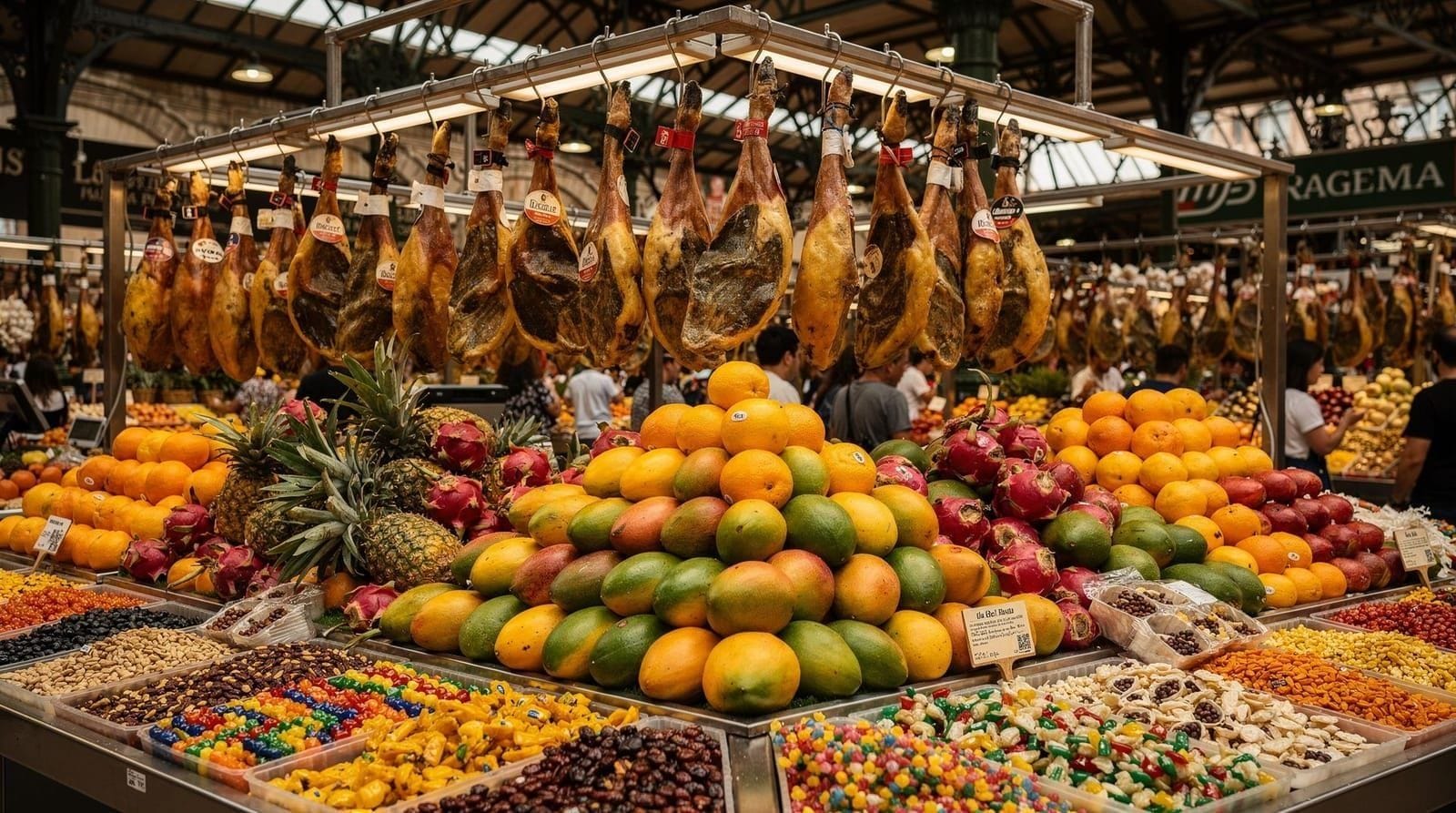
The back section of the market, behind the tourist corridor, is a different operation. Professional buyers from restaurants still shop here. The charcuterie, cheese, spice, and olive stalls in the rear aisles offer genuine quality at fair prices. The fish counters serving trade buyers have fish that competes with any market in the city.
What to buy at La Boqueria: Jamón ibérico from the back-section charcuterie stalls, fresh olives (taste before buying), Catalan and Spanish cheeses, pimentón and spices, dried fruits. The La Boqueria guide covers these purchases in detail, including how to navigate the tourist corridor without getting pulled into it.
Hours: Monday to Saturday, 08:00–20:30. Closed Sundays.
How to visit: Enter from La Rambla but walk straight through the first 30 metres without stopping. Find the rear aisles. The atmosphere changes immediately.
For a route that adds the streets around the market to the market itself:
Mercat de Santa Caterina: the architect’s market
Mercat de Santa Caterina in El Born is, by a significant margin, the most architecturally spectacular market in Barcelona that most visitors miss. It was redesigned by Enric Miralles — the Catalan architect who also designed the Scottish Parliament in Edinburgh — and completed in 2005 by his wife and partner Benedetta Tagliabue after Miralles died during construction.
The exterior roof is what makes it unmistakable: an undulating ceramic tile mosaic in hexagonal patterns of yellow, green, and blue, covering the market like a pixelated wave. It is one of the most distinctive pieces of architecture in a city full of distinctive architecture, and it sits in a neighbourhood of 14th-century Gothic churches and medieval streets, which makes the contrast extraordinary.
The market itself functions as a genuine neighbourhood market for the residents of El Born and the surrounding barris. The fish counters are excellent and well-priced. The meat section is serious — this is where neighbourhood restaurants buy their produce. The prepared food stalls sell cocido (stew), tortillas, and roasted vegetables at lunch-counter prices that feel startlingly cheap compared to the restaurants two streets away.
What to buy at Santa Caterina: Fresh fish (the selection is outstanding), Catalan vegetables, prepared foods at the lunch counters, charcuterie. The prices throughout the market are noticeably lower than La Boqueria for equivalent quality.
Who shops here: Residents of El Born and the old town, chefs from neighbourhood restaurants, and the growing number of visitors who have been told to skip La Boqueria. The market’s customer base is predominantly local.
Hours: Monday to Saturday. Specific hours vary by section — typically 07:30–14:00 for fish and meat, later for other stalls. Closed Sundays.
Getting there: 10 minutes’ walk from La Rambla, or the Jaume I metro stop on L4. It is adjacent to the Basílica de Santa Maria del Mar, which makes it a natural combination visit with the Picasso Museum — both are in the same neighbourhood.
Architecture note: The original medieval convent that occupied this site — Sant Caterina, demolished in 1837 — was one of the largest Gothic structures in Catalonia. Archaeological excavations during the market renovation uncovered significant medieval remains, which are now visible beneath glass panels in the market floor. Worth looking for.
Mercat de Sant Antoni: the renovation success story
Mercat de Sant Antoni in Eixample is the market that best demonstrates what Barcelona’s food market culture looks like when the architecture is exceptional and the renovation is done right.
The original market hall dates from 1882 — a vast iron-frame structure with Moorish-influenced tiled facades, occupying an entire city block on the edge of the old Eixample grid. By the 2000s, it had become cramped, dated, and in need of major structural work. In 2009, the market closed for what was planned as a two-year renovation. Nine years later, in 2019, it reopened.
The renovation was worth the wait. The original 19th-century ironwork has been meticulously restored. The Moorish facades have been cleaned and repaired. Inside, the market layout has been modernised while preserving the character of the original hall. New lighting, new refrigeration, new sanitation — but the bones and atmosphere of an 1882 market hall.
The food market operates daily through the week, with the full range of produce, meat, fish, and prepared food stalls. On Sundays, the covered arcades surrounding the market building host one of the city’s best weekend markets: a vintage books and comics market that has been running since the 1970s (it operated on the market’s exterior during the nine years of closure) and draws a genuinely local crowd of readers, collectors, and neighbourhood residents.
What to buy at Sant Antoni: The full range — this is a comprehensive neighbourhood market with excellent fresh produce, reliable fish and meat counters, and competitive prices throughout. The prepared-food stalls are particularly good for a quick lunch.
The Sunday books market: Runs approximately 09:00–14:00 in the covered arcades. Not a food market, but worth combining with a weekday visit or mentioning as context — it represents Sant Antoni’s role as a neighbourhood cultural institution rather than a tourist attraction.
Hours: Monday to Saturday for the food market. Sunday for the books and vintage market (exterior arcades).
Getting there: Sant Antoni metro (L2) or Universitat (L1, L2). Walking distance from the southern end of Eixample.
Mercat de l’Abaceria: Gràcia’s bohemian option
Mercat de l’Abaceria in Gràcia occupies a different position in Barcelona’s market ecosystem. It is a covered market in the Abaceria building — a 19th-century iron-frame structure on Travessera de Gràcia — that functions partly as a food market and partly as something more eclectic: stalls selling vintage clothing, second-hand books, antiques, and craft goods alongside the food vendors.
The Sunday market at Abaceria is one of the city’s most characteristically Gràcia experiences. The neighbourhood — historically associated with artists, intellectuals, and independence movements — has a bohemian character that the market reflects. Sunday morning here means a mix of food shopping, rummaging through vintage stalls, and sitting at the market café with a coffee while the neighbourhood does its weekly rounds.
The food section is competent rather than extraordinary — a solid neighbourhood market with fresh produce, meat, and some prepared food options. It is not the destination for serious food shopping that Santa Caterina or Sant Antoni are. But as a cultural experience, a Sunday morning in Abaceria followed by a coffee in one of Gràcia’s squares is one of the more genuinely local things you can do in Barcelona.
What to buy at Abaceria: Fresh produce, local herbs, some prepared foods. The main draw is the atmosphere and the Sunday market rather than the food quality per se.
Hours: Daily for food stalls. Sunday antiques and vintage market in addition.
Getting there: Fontana (L3) or Diagonal (L3, L5). Walking distance from Plaça de Gràcia.
Combination: The neighbourhood around Abaceria — the squares, the local bars, the residential streets — is worth exploring. The Gràcia neighbourhood guide covers the wider area.
Mercat de la Barceloneta: fresh fish for the neighbourhood
Mercat de la Barceloneta is the smallest and most specialised of Barcelona’s major food markets — a compact market in the Barceloneta neighbourhood that serves the immediate community with fresh fish, vegetables, and basic provisions.
There is almost no tourist infrastructure here. The market is small, the stalls are few, and the focus is narrow: if you want the freshest fish in the city at the prices that neighbourhood residents pay, this is where to come. The fish that arrives here is sourced from the Barceloneta fishing boats and the Mercabarna wholesale market and is typically sold out by early afternoon.
The market has no prepared-food counters worth mentioning and no architecture to write home about. Its value is entirely in the quality and price of the fresh fish. If you are staying in Barceloneta and want to cook, or if you want to understand what a working local market looks like rather than a tourist-adapted one, this is an honest, unperformed version of that.
What to buy at Barceloneta: Fresh fish and shellfish. Everything else is secondary.
Hours: Monday to Saturday mornings. Arrive before 13:00 for best selection; the fish is often sold out before the market officially closes.
Getting there: Barceloneta metro (L4) or a 20-minute walk along the waterfront from the old town.
How to approach Barcelona’s markets as a visitor
The most useful mental model for Barcelona’s food markets is to think of them as having complementary roles rather than competing with each other.
La Boqueria is the market you visit for the experience of a famous 19th-century market hall, for specific high-quality purchases (jamón, spices, olive oil, specialist charcuterie), and as a starting point for understanding how the city’s food system works. Go early, avoid the entrance tourist zone, buy from the back stalls.
Santa Caterina is the market you visit when you want to see how the system actually works for people who live here — where the fish is cheaper and fresher, where the prepared-food counter lunch is a genuine bargain, and where the architecture is arguably more interesting than La Boqueria. Go mid-morning on a weekday.
Sant Antoni is the market you visit if you are staying in or near Eixample, or if you want to see a brilliantly executed historical restoration combined with a proper working market. The Sunday books market is worth a special trip.
Abaceria is the market you visit if you want a Sunday morning that feels like Gràcia rather than tourism — bohemian, relaxed, with more vintage clothing than fish, and a neighbourhood atmosphere that is entirely its own.
Barceloneta is the market you visit if you are cooking and want fish, or if you want to see what a completely un-touristy local market looks like.
Market tours: what a guide adds
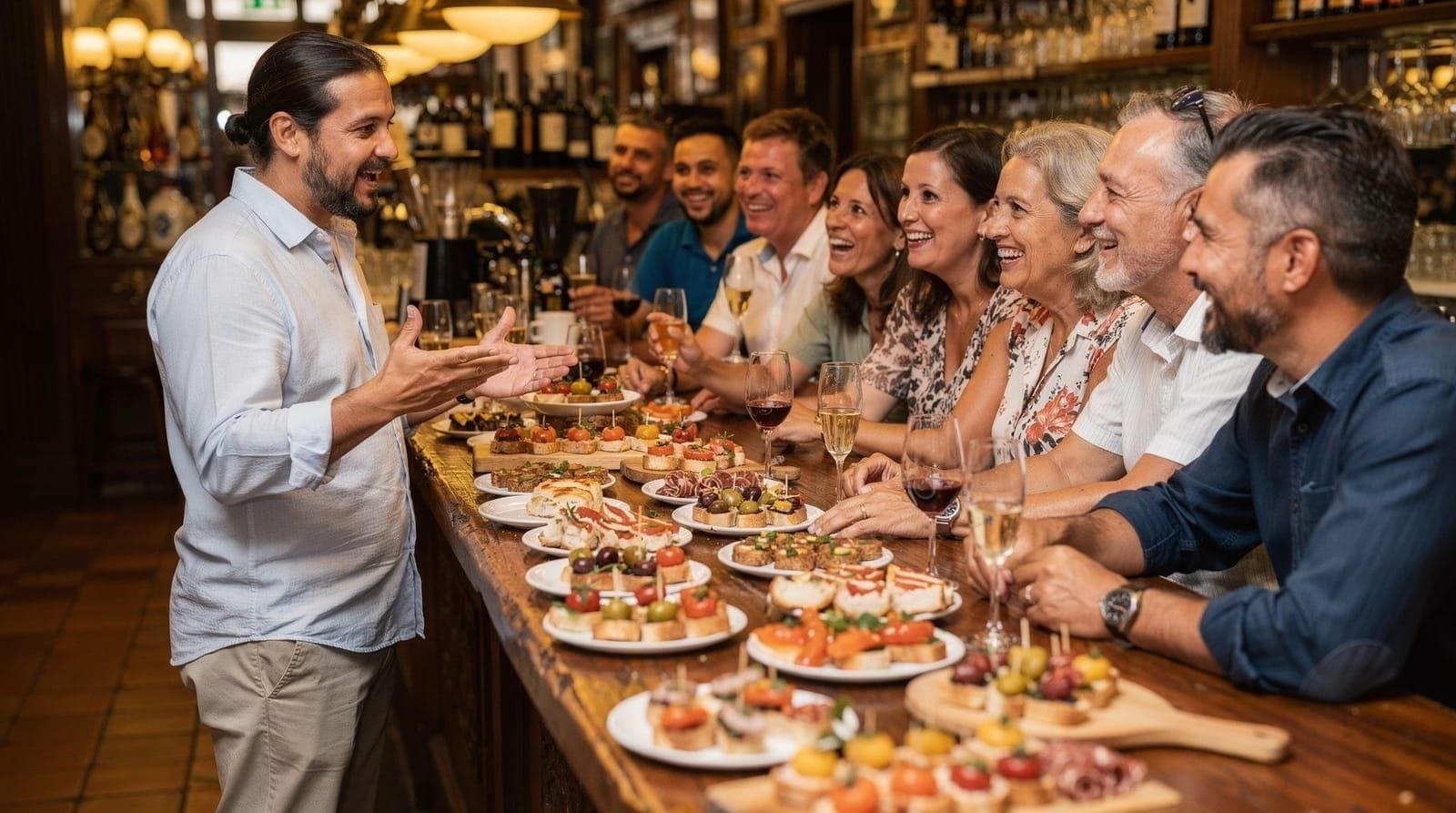
A guided market tour in Barcelona adds most value at La Boqueria specifically — not because the market is hard to navigate, but because the gap between what a first-time visitor buys (entrance-section tourist products) and what a knowledgeable guide points toward (back-stall professional market) is large enough that guidance genuinely changes the experience.
Beyond La Boqueria, a tour that combines a market visit with the surrounding neighbourhood — the Gothic Quarter, El Born, the street-food scene beyond the market walls — turns a market visit into a broader understanding of how the city eats.
The tapas tours guide covers the main guided food experiences in Barcelona, including which tours incorporate market visits and what each one adds to the independent experience.
The best tapas neighborhoods guide is useful for understanding how the markets fit into the broader food geography of the city — which neighbourhoods have which markets, and how the market and the bar and restaurant scene around it connect.
Cooking what you buy
If you are staying in an apartment or a rental with a kitchen rather than a hotel, Barcelona’s markets become considerably more useful than a browsing experience — they are where you actually shop for the week. Santa Caterina and Sant Antoni are the two best markets for this: comprehensive range, fair prices and a genuine neighbourhood atmosphere that makes daily shopping (rather than one big supermarket trip) a pleasant habit rather than a chore. Most stallholders are used to visitors asking basic questions about how to cook or prepare something, particularly at fish and produce stalls — do not hesitate to ask, since it is standard practice and often the fastest way to learn how a specific ingredient is meant to be used. If you want a more structured introduction to cooking with market ingredients rather than simply carrying groceries home, our cooking classes guide covers the schools that build a full session around a market visit, which is a good next step if the markets themselves spark an interest in cooking Catalan food properly.
Seasonal considerations
Barcelona’s food markets reflect the seasonal rhythms of Mediterranean agriculture. What changes through the year:
Spring: Calçots (spring onions, eaten with romesco sauce) arrive in February and March and are a Catalan seasonal obsession. Fresh peas, artichokes, and wild asparagus appear at good produce stalls. Santa Caterina and Sant Antoni are the best places to find these.
Summer: Tomatoes reach their peak in July and August — the Catalan tradition of pa amb tomàquet (bread rubbed with tomato) makes sense only if the tomato is genuinely ripe. Look for the flat, ribbed varieties at produce stalls. Peaches, nectarines, and figs from the interior. The markets are busier with tourists but also stocked with the best seasonal fruit.
Autumn: Mushrooms are the defining autumn ingredient in Catalan cooking — rovellons (saffron milk caps) and ceps (porcini) in October and November. Game from the interior. The first new-season olive oils from the Penedès and Siurana.
Winter: Citrus in abundance — Valencian oranges and clementines, local tangerines. Salt cod in multiple preparations for Christmas. The quietest and most genuinely local time to visit any market in the city.
Is it better to visit La Boqueria or Mercat de Santa Caterina? If you can only visit one market, La Boqueria has more international fame and is more centrally located. If you want authentic local market culture and better prices, Santa Caterina is superior. Ideally, visit both — they are 15 minutes apart on foot.
Can you eat breakfast at a Barcelona market? Yes — most markets have a café or breakfast bar attached. The best option is the café at Mercat de Sant Antoni, which serves a proper breakfast (coffee, toast, pa amb tomàquet) at neighbourhood prices. La Boqueria has cafés but at tourist pricing.
Are Barcelona markets suitable for children? Very much so — the colour, noise, and variety of a working market is genuinely engaging for children, and nobody minds. Mercat de Sant Antoni and Mercat de l’Abaceria are particularly good for families, as they have more space and a less crowded atmosphere than La Boqueria.
What is the best market for olive oil? La Boqueria has the widest selection of premium olive oils, including Catalan single-variety arbequina oils. Sant Antoni and Santa Caterina have good options at lower prices. Look for DO Siurana (Tarragona province) for the definitive Catalan arbequina.
Can I ship market purchases home? Most charcuterie, dried goods, spices, and sealed olive oil can travel in checked luggage or be shipped. Fresh fish and meat cannot. The vacuum-packed jamón ibérico available at La Boqueria’s back-section charcuterie stalls is specifically packaged for travel.
For more context on Barcelona’s food and drink scene, the best tapas neighborhoods guide covers how eating culture works across the city’s different barris, while the La Boqueria detailed guide provides the specific stall-by-stall advice you need for navigating the city’s most famous market.
Frequently asked questions about Food markets in Barcelona
Do locals shop at La Boqueria?
Some professionals and specialist buyers do, particularly at the back stalls. But most Barcelona residents shop at their neighbourhood markets — Santa Caterina, Sant Antoni, Abaceria, or Barceloneta — which are cheaper and less crowded.Is Mercat de Santa Caterina worth visiting?
Absolutely. Designed by architect Enric Miralles with a spectacular mosaic-tiled undulating roof, it is architecturally extraordinary and has excellent produce, fish, and prepared-food stalls at authentic local prices.When is Mercat de Sant Antoni open?
The food market runs Monday to Saturday. On Sundays, the surrounding covered arcades host a popular vintage book and comic market. The building reopened in 2019 after a nine-year renovation.Which market is best for fresh fish in Barcelona?
Mercat de la Barceloneta has the freshest and most competitively priced fish, serving the immediate neighbourhood. Santa Caterina also has excellent fish counters. La Boqueria has good fish but at tourist-area pricing.Are Barcelona food markets open on Sundays?
Most food markets are closed Sundays. La Boqueria closes on Sundays. Sant Antoni hosts a different market (books/vintage) on Sundays. Abaceria has a food and antiques market on Sundays.
Top experiences
Bookable activities with verified prices and instant confirmation on GetYourGuide.