Picasso Museum Barcelona: free days, prices and what to see
Barcelona: Picasso tour with skip-the-line museum entry
Duration: 2 hours
- Free cancellation
When is the Picasso Museum free to enter?
Entry is free on the first Sunday of each month and on Thursday evenings — 16:00–19:00 from October to April, and 19:00–21:00 from May to October. Queues on those days are long; booking a skip-the-line ticket is faster for most visitors.
Barcelona’s Picasso Museum is one of the most visited art museums in Spain, and for good reason: the collection covers the years Picasso spent in the city as a teenager and young man, before he left for Paris and changed the history of painting. Understanding those Barcelona years — the academic rigour, the bohemian energy of El Born, the influence of the Catalan Modernisme scene around him — makes the later Cubist leaps far easier to grasp. This is not a greatest-hits museum. It is a biography in paint, and that is precisely what makes it worth your time.
| Where | Carrer de Montcada, El Born |
| Cost | Around €15 permanent collection; around €19 with temporary exhibition |
| Time needed | 1.5–2 hours; add 30–45 minutes for a temporary exhibition |
| Getting there | Metro Jaume I (L4), 5 minutes’ walk |
| Best time | Weekday mornings; avoid the first-Sunday free slot unless you enjoy queuing |
What you are actually going to see
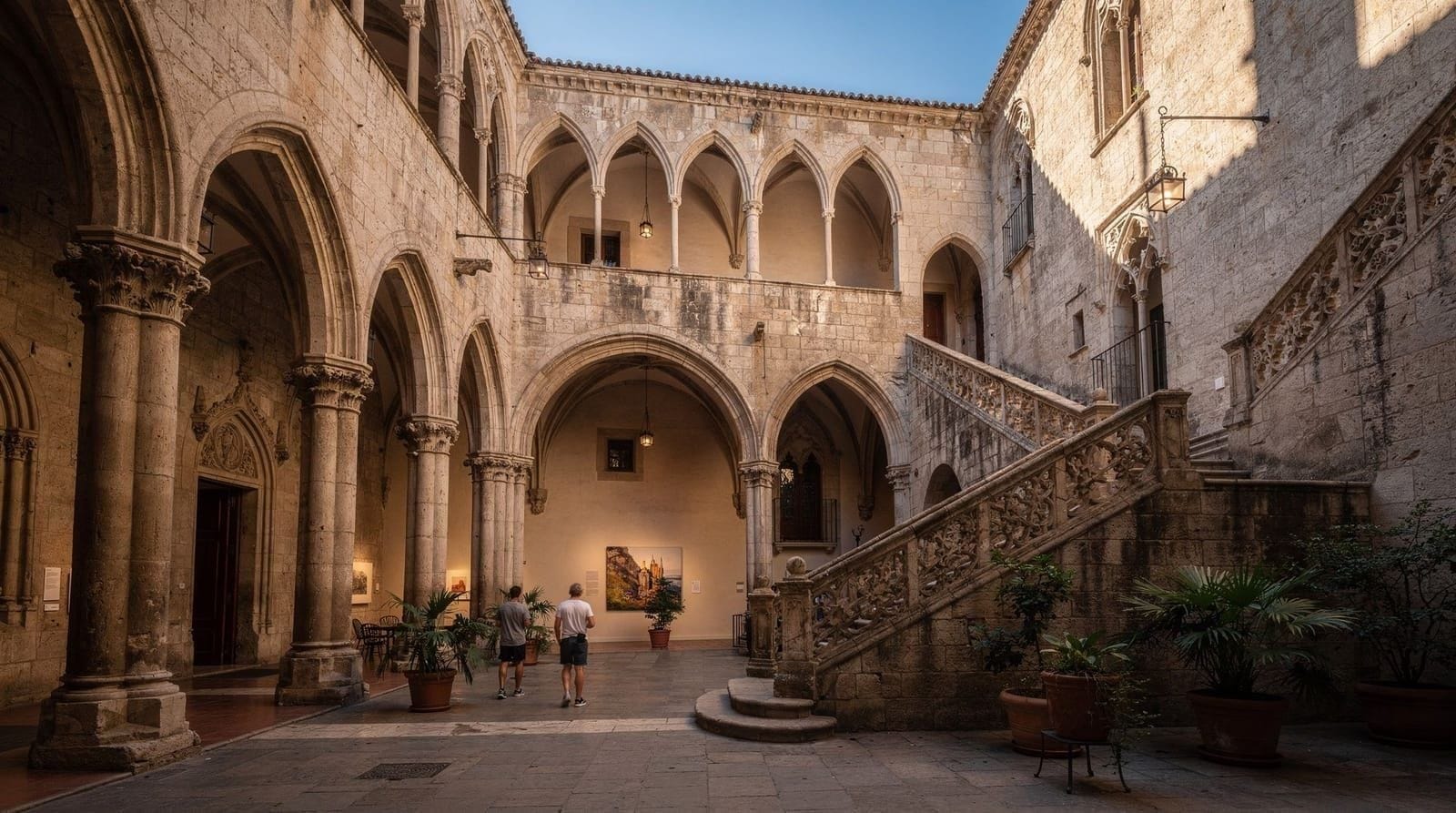
The museum is spread across five interconnected medieval palaces on Carrer de Montcada, a narrow, stone-paved street in El Born that is itself worth walking slowly before you go in. The palaces date from the 14th and 15th centuries — handsome Gothic courtyards, arched galleries, uneven flagstone floors — and the contrast between the medieval architecture and 20th-century canvases hung on whitewashed walls is part of the pleasure of the visit.
The collection runs roughly chronologically, beginning with the extraordinarily polished academic paintings Picasso made at thirteen and fourteen in La Coruña and later in Barcelona. These early works are consistently the biggest surprise for visitors who arrive expecting abstraction: the draftsmanship is meticulous, the compositions classically sound, and several canvases would not embarrass a seasoned professional of the period. Science and Charity (1897), painted when Picasso was fifteen and submitted to national exhibitions, is among the most technically accomplished teenage paintings by any artist in any century.
From the early academic work, the collection traces his Barcelona years through the bohemian café scene of the 1890s, the street sketches of the Gothic Quarter and El Raval, and into the Blue Period that would define his early international reputation. Portraits of his Barcelona friends — the poet Jaume Sabartés, the painter Carles Casagemas — give these early rooms a personal quality you do not find in the Paris museum collections, which tend to focus on the later canonical works.
The collection culminates in the remarkable Las Meninas series of 1957, in which Picasso systematically reworked Velázquez’s famous painting in 58 canvases, decomposing and reassembling the original over weeks in his studio. This is not included in most general retrospectives — the Museu Picasso holds it complete, room after room of variations in which the same composition is fractured, flattened, inverted and rebuilt with increasing intensity. Without the audio guide explaining the sequence, it can feel repetitive; with it, the obsessive logic becomes clear and rather extraordinary.
What the museum does not have is Guernica (that is in the Museo Reina Sofía in Madrid) or the fully developed Cubist works from the Paris years. If you come expecting the deconstructed faces and fractured planes of the classic Picasso images, you will be surprised by what you find here. The strength of this collection is the formative story: how a prodigy became an innovator, and what Barcelona had to do with it.
The temporary exhibition programme runs parallel to the permanent collection on different floors and varies considerably in quality and subject. It is worth checking the museum’s website to see what is showing during your stay. Some years the temporary show is directly related to Picasso and adds genuine depth; other times it is a partnership exhibition with less obvious connection. The combined ticket at €19 is only worth it if the temporary show interests you specifically.
Ticket prices and who gets a discount
Adult entry to the permanent collection costs €15. A combined ticket covering both the permanent collection and the current temporary exhibition costs €19. Reduced tickets at €7.50 apply to visitors aged 18–25 and to those 65 and older — documentation may be requested. Children under 18 always enter free, regardless of the day or time.
These are fair prices for what is on offer. Most visitors who spend 90 minutes in the permanent collection feel the €15 was well spent. If you are planning to visit several Barcelona art museums during your trip, the Articket BCN pass covers the Picasso Museum alongside five other major venues — Fundació Joan Miró, MNAC, MACBA, Fundació Antoni Tàpies and Museu Nacional — for €38 total, with skip-the-line access at each and validity for 12 months. It is substantially cheaper than buying individually if you visit three or more of the participating museums.
Do not pay premium prices through unofficial resellers without verifying what you are actually getting. Some third-party booking sites add €5–10 above the museum’s own price for exactly the same ticket. The museum’s own booking system and established tour operators are the safest and usually cheapest options for standard entry.
Free entry days: honest advice about the queues
The museum offers free entry on the first Sunday of each month, all day, and on Thursday evenings. The Thursday evening free period runs 16:00–19:00 from October through April, and shifts to 19:00–21:00 from May through October. These are genuinely free visits, not promotional discounts requiring registration or proof of anything.
The honest caveat is that the queues on free days are serious. On the first Sunday of the month, particularly in spring and summer, queues regularly stretch around the corner from Carrer de Montcada and wait times of 45 to 90 minutes are common. The museum still operates with timed-entry capacity control, and the free slots fill quickly. Many visitors who plan to use the free Sunday end up either waiting a long time or not getting in at all after a late arrival.
Thursday evenings are meaningfully better than Sundays. Fewer people plan their trip around a Thursday evening free slot, and the session is shorter (a three-hour window rather than all day), so the distribution of visitors is more manageable. Arriving a few minutes before the session opens — 15:50 rather than 16:00, or 18:45 rather than 19:00 in summer — gives you a significant advantage in the queue.
For most visitors, a paid skip-the-line ticket is the more reliable choice. The cost of the ticket is recovered many times over in time saved, and a confirmed timed slot means you can plan the rest of the day around a known variable rather than an uncertain one. If you are flexible and have a full week in Barcelona, a free Thursday evening is a worthwhile gamble. If you have two or three days and this is high on your list, book ahead.
Skip-the-line tickets and guided tour options
Skip-the-line entry gives you a timed slot that bypasses the standard queue. The premium above face-value entry is typically €5–10 depending on the provider, and in peak season — April through October, and around holidays — that premium is routinely worth it. You arrive, scan your QR code and walk in while others wait.
Guided tours add a further layer. A private guided tour of the museum with entry included is the most expensive option and the most informative — a knowledgeable guide can illuminate the chronology, explain the Las Meninas obsession in real time, and answer questions that the audio guide does not cover. The per-person cost is higher, but for groups of two or three it compares favourably with multiple individual tickets plus separate audio guide hire.
Walking tours that combine a guided walk through Picasso’s Barcelona neighbourhood with museum entry are a particularly good option for first-time visitors. These tours typically start in the area around Plaça Reial or the lower Gothic Quarter, trace the cafés and studios Picasso frequented as a young man, and end at the museum entrance with ticket included. The neighbourhood context genuinely enriches what you see inside — knowing which streets appear in the early sketches and where the Quatre Gats café stood makes the collection feel less like a static exhibition and more like a sequence of locations you have just walked through.
Getting there and what is nearby
The museum is at Carrer de Montcada 15–23 in El Born. The closest metro stop is Jaume I on the L4 (yellow) line, a five-minute walk away through the backstreets of the Gothic Quarter. From the Arc de Triomf area to the north, the walk through El Born is about 10 minutes. From the Barceloneta beachfront it is a 15-minute walk north through El Born’s market area. There is no practical parking nearby — Carrer de Montcada is a pedestrian-only street in one of the densest medieval street grids in Europe. The metro is the right option.
The neighbourhood around the museum rewards time before or after. Carrer de Montcada itself houses several other small galleries and the Museu Europeu d’Art Modern. The Basílica de Santa Maria del Mar, one of the finest Gothic churches in Catalonia and very different in atmosphere from the more famous cathedral, is three minutes away on foot to the south. The Mercat de Santa Caterina — a covered market designed by Enric Miralles with a dramatically tiled roof — is five minutes north. The best tapas bars in El Born cluster along Passeig del Born and the side streets running off it: Bar del Pla, El Xampanyet, and a dozen others make a post-museum lunch straightforward to arrange.
For a fuller picture of the neighbourhood, the El Born destination guide covers the area in detail, including where to eat, what to see and how it fits into a broader Barcelona itinerary.
Picasso’s Barcelona: the context behind the collection
Pablo Ruiz Picasso first arrived in Barcelona in 1895 at the age of thirteen, when his father, a drawing teacher, took a post at the Escola de Llotja — the city’s main art school. The family settled in the Raval neighbourhood and later in the Eixample, and Picasso enrolled at the school, which was then the most technically rigorous art academy in Catalonia. His early progress was startling even by the standards of a demanding institution: work that would have taken senior students weeks to produce, he completed in days.
What Barcelona gave Picasso was not only technical instruction but a particular cultural atmosphere. The city was in the middle of the Modernisme movement — Catalan Art Nouveau, driven by figures like Antoni Gaudí, the designer Lluís Domènech i Montaner, and a generation of painters who were drawing on French Post-Impressionism, Symbolism and the Arts and Crafts movement simultaneously. The café Els Quatre Gats (The Four Cats) on Carrer de Montsió became the centre of this world, and Picasso was among the youngest figures who gathered there. He held his first documented exhibition on its walls in 1900, when he was eighteen.
The city’s social geography also shaped what Picasso painted during these years. The Barri Xinès — the network of streets around the El Raval area and the lower Rambla — was where Picasso spent significant time: workers’ bars, working-class boarding houses, the figures at the margins of a rapidly industrialising city. This is the world that would feed into the Blue Period paintings made after he moved permanently to Paris in 1904. The melancholy emaciated figures of that period are not abstractions — they are drawn from direct observation of people Picasso knew in the streets around him.
Understanding this context transforms what you see in the museum. The portraits of street children and café workers in the early Barcelona rooms are not preparatory exercises. They are the raw material of a social education that runs through Picasso’s entire subsequent career, however far his formal language would eventually travel from these roots.
The museum does not make this context explicit enough on its interpretive panels for visitors who arrive without background knowledge, which is one reason guided options — whether a tour guide inside the museum or a walking tour that begins in the neighbourhood before entering — add genuine value over self-guided visits.
A brief history of the museum itself
The Museu Picasso opened in 1963, making it one of the first dedicated Picasso museums in the world and the earliest to open during the artist’s lifetime. It was established with the help of Jaume Sabartés, Picasso’s longtime secretary and one of his oldest Barcelona friends, who donated his personal collection to the city as the founding nucleus.
Picasso himself had a complicated relationship with Franco’s Spain and largely stayed away from the country during the dictatorship years. But he maintained deep emotional ties to Barcelona — he chose to donate the Las Meninas series specifically to this museum, and the collection has continued to grow through donations and acquisitions since his death in 1973. The building expanded over the decades by incorporating more of the Carrer de Montcada palaces, so the museum you visit today is considerably larger than what Sabartés originally donated.
Combining the museum with other art institutions
The Picasso Museum pairs well with a range of other Barcelona art experiences, depending on what you are most interested in. For modern and contemporary art in a very different register, the Fundació Joan Miró on Montjuïc covers abstraction and Surrealism from roughly where Picasso’s later career begins. The MACBA in El Raval takes the story forward into the postwar contemporary period. Our MNAC guide covers Romanesque and medieval Catalan art at the Palau Nacional on Montjuïc — a very different experience but one that illuminates what Barcelona and Catalonia were making for the thousand years before Picasso arrived.
The most efficient multi-museum approach combines a morning at the Picasso Museum with an afternoon walking up to the Moco Museum, which is nearby in the Gothic Quarter and holds notable contemporary and street art alongside pieces by Miró and Dalí. The combined Picasso and Moco Museum ticket with an El Born walking tour is one of the more popular options for visitors who want a full art day centred on this part of the city.
For budget planning, the Barcelona on a budget guide explains how to combine free-entry days across different museums across a week-long stay, and the Articket guide runs through the numbers in detail.
| Museum | Focus | Cost | Time needed |
|---|---|---|---|
| Picasso Museum | Picasso’s formative Barcelona years | Around €15 | 1.5–2 hours |
| Fundació Joan Miró | Miró’s abstraction and Surrealism | Around €14 | 1.5–2 hours |
| MNAC | Romanesque and medieval Catalan art | Around €12 | 2 hours |
| MACBA | Postwar and contemporary art | Around €13 | 1–1.5 hours |
If time only allows one, the Picasso Museum has the broadest general appeal thanks to the biographical narrative; MNAC rewards visitors with a specific interest in medieval art, and the Miró Foundation suits those drawn to abstraction over figurative work.
Practical notes that actually matter
The audio guide included with most booked tickets is better than average and is particularly helpful in the Las Meninas room, where the logic of the 58-canvas sequence becomes clear only with explanation. Earphones are provided. The audio guide app is also downloadable to your own phone, which some visitors prefer.
Bags larger than a small daypack must be stored in the free lockers near the main entrance on Carrer de Montcada. Photography is allowed in the permanent collection without flash. The building is wheelchair accessible with lifts connecting the different palace levels, though the medieval stone floors are not entirely level in places and some corridors are narrow.
The museum café, accessed from the courtyard, is adequate for coffee and a pastry but not especially good value compared with the surrounding neighbourhood. The gift shop near the exit has a solid range of prints and art books, including several specific to the collection that are not easily found elsewhere in the city.
The quietest hours are the first hour after opening on a weekday, before tour groups arrive, and the final hour before closing, when day-trippers have moved on to dinner plans. Saturday afternoons are consistently the busiest paid-entry period, roughly on par with the free Thursday evening sessions in terms of density. If your schedule is flexible, a Tuesday or Wednesday morning slot is the closest the museum gets to an uncrowded visit outside of winter off-season.
The museum is closed on Mondays. This catches a notable number of visitors out — El Born and the Gothic Quarter are full of things to do on a Monday, but the Picasso Museum is not one of them. The tapas tours of El Born run seven days a week and make an excellent Monday alternative if the museum is your reason for being in the neighbourhood. Our best time to visit Barcelona guide covers seasonal crowd patterns and how to time a visit to balance weather, queues and value.
First visit vs return visit
Most guides treat the Picasso Museum as a one-and-done stop, but the collection genuinely rewards a second look if you are in Barcelona for more than a few days. A first visit tends to be dominated by orientation — working out the chronology, absorbing the surprise of the academic early work, getting through the Las Meninas room with the audio guide. A second visit, ticket already paid for on a combined pass or simply repeated, lets you slow down in the rooms that resonated most, usually the Blue Period portraits or the Las Meninas sequence, without the pressure of covering everything. If your schedule allows it, splitting the collection across two shorter visits rather than one long one is a genuinely different, often better experience.
Book a timed slot, arrive with the audio guide earphones ready and give yourself the full morning — the Las Meninas room alone will hold you longer than you expect.
Frequently asked questions about Picasso Museum Barcelona
How much does the Picasso Museum cost?
The permanent collection costs €15 for adults. A combined ticket including the temporary exhibition runs €19. Reduced entry (€7.50) is available for visitors aged 18–25 and those 65 and over. Under-18s enter free at all times.Do I need to book tickets in advance?
Timed entry is strongly advised. The museum uses capacity control, and free-entry periods fill up very quickly. Booking a slot online a few days ahead is the safest approach, especially in spring and summer.When is the Picasso Museum open?
Tuesday to Sunday 09:00–19:00, with Thursday sessions until 21:30. The museum is closed on Mondays, and closes early on some public holidays. Check the official site for exact dates before you go.Is the Picasso Museum worth it?
Yes, especially for anyone interested in how a major artist develops. The chronological display of Picasso's early Barcelona years is genuinely surprising — the academic precision of his teenage canvases makes the later leaps feel even more dramatic.How long do you need at the Picasso Museum?
Budget 1.5 to 2 hours for the permanent collection at a comfortable pace. Add another 30–45 minutes if there is a temporary exhibition running alongside.Does the Picasso Museum include Guernica or Cubist paintings?
No. Guernica is held at the Museo Reina Sofía in Madrid, and the museum does not hold the fully developed Cubist works from Picasso's Paris years. The Barcelona collection focuses on his formative years in the city, from academic teenage paintings through the early Blue Period, plus the complete Las Meninas series from 1957.
Top experiences
Bookable activities with verified prices and instant confirmation on GetYourGuide.
Barcelona: Picasso Museum guided tour with ticket
- Free cancellation
- Private tour
Barcelona: Picasso and Moco Museum with walking tour in El Born
- Free cancellation
Barcelona: Picasso walking tour with Picasso Museum tickets
- Free cancellation
Barcelona: Picasso's Barcelona and Picasso Museum walking tour
- Free cancellation