Penedès Codorníu cava tour: honest winery review
Penedès: Codorníu discovery tour with cava tasting
Duration: 4 hours
- Free cancellation
Catalans do not drink sangria. Catalan drink culture runs to vermut before lunch, cava at celebrations, and the still wines of Penedès and Priorat with dinner. A day trip to the Penedès wine country — Catalonia’s most important wine-producing region, an hour south-west of Barcelona — is not just a wine-tasting excursion; it is an introduction to the culture that underpins much of what you eat and drink in the city.
| Where | Sant Sadurní d’Anoia, Penedès (1hr south-west of Barcelona) |
| Cost | around €55/adult guided; ~€6/each way DIY by train |
| Time needed | half-day (returning ~2pm) to full day (8–9 hours) |
| Getting there | Guided coach pickup, or FGC train to Sant Sadurní d’Anoia |
| Best time | Late September–early October (harvest) or April–May |
What Codorníu is and why it matters
Codorníu is the oldest and largest cava producer in the world, founded in 1551 and the first Spanish producer to make sparkling wine by the traditional method (in 1872, predating the widespread commercial production of cava in the region). The estate in Sant Sadurní d’Anoia covers 30km of underground caves — the largest network of its kind in the world — and the above-ground cellars are housed in a Modernista complex designed by Josep Puig i Cadafalch, a contemporary of Gaudí and one of the three great Barcelona Moderniste architects.
This is not a boutique winery. Annual production runs to tens of millions of bottles. The scale is impressive on its own terms — the underground caves were an engineering feat in the 1890s — but if you want the intimacy of a small family producer, Codorníu is not that experience.
What the tour includes
Guided winery visit: Walking tour of the Puig i Cadafalch cellar building (the entrance hall, the production facilities, the underground caves). The guide explains cava production — the secondary fermentation in bottle, the riddling (gyropalette or hand-riddling for premium cavas), the dosage process that determines sweetness.
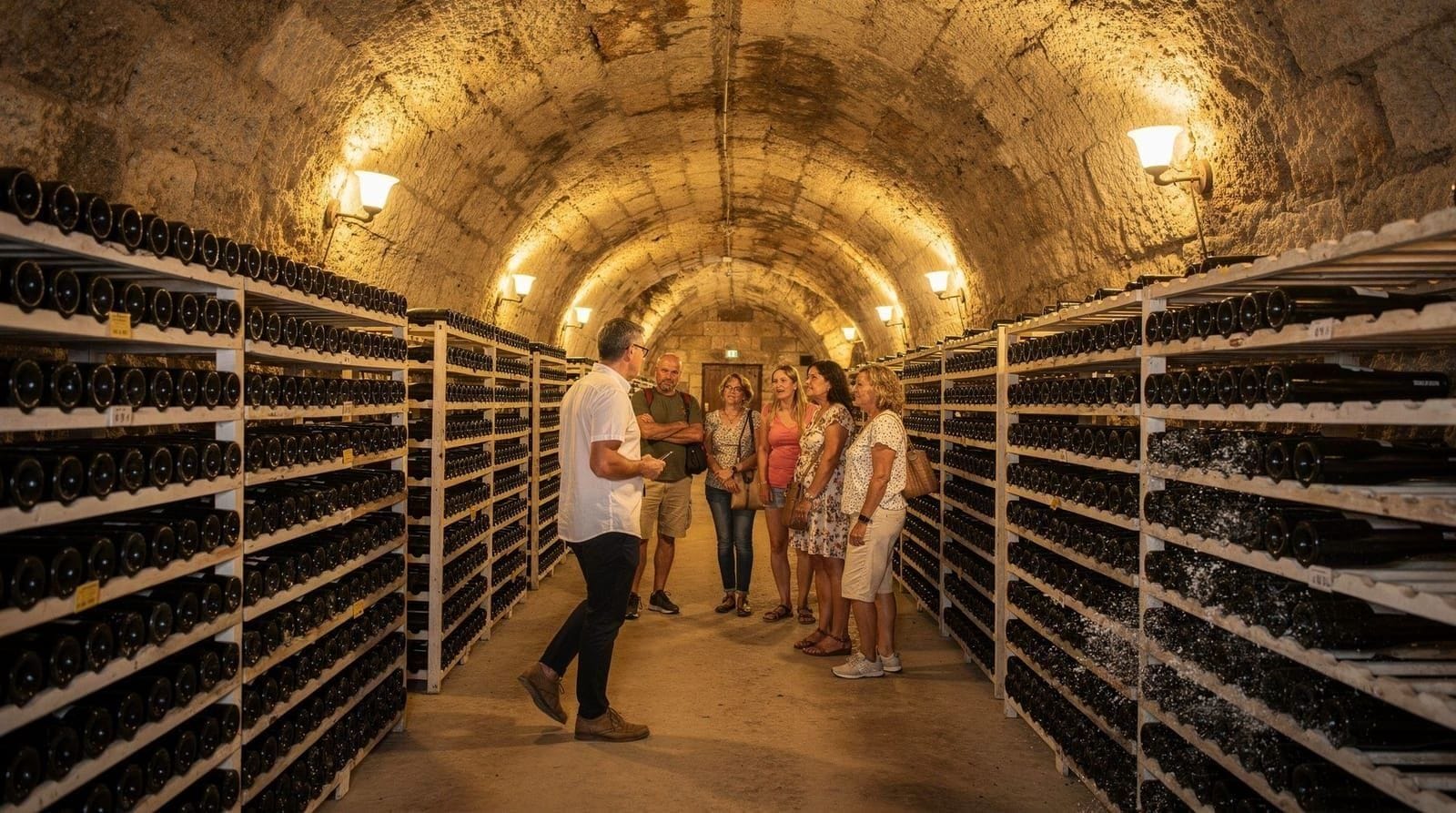
Underground caves: The 30km network is not all accessible, but guided groups see a substantial section. The caves maintain a constant 15°C year-round — cold enough that visitors in summer appreciate the contrast with the heat above.
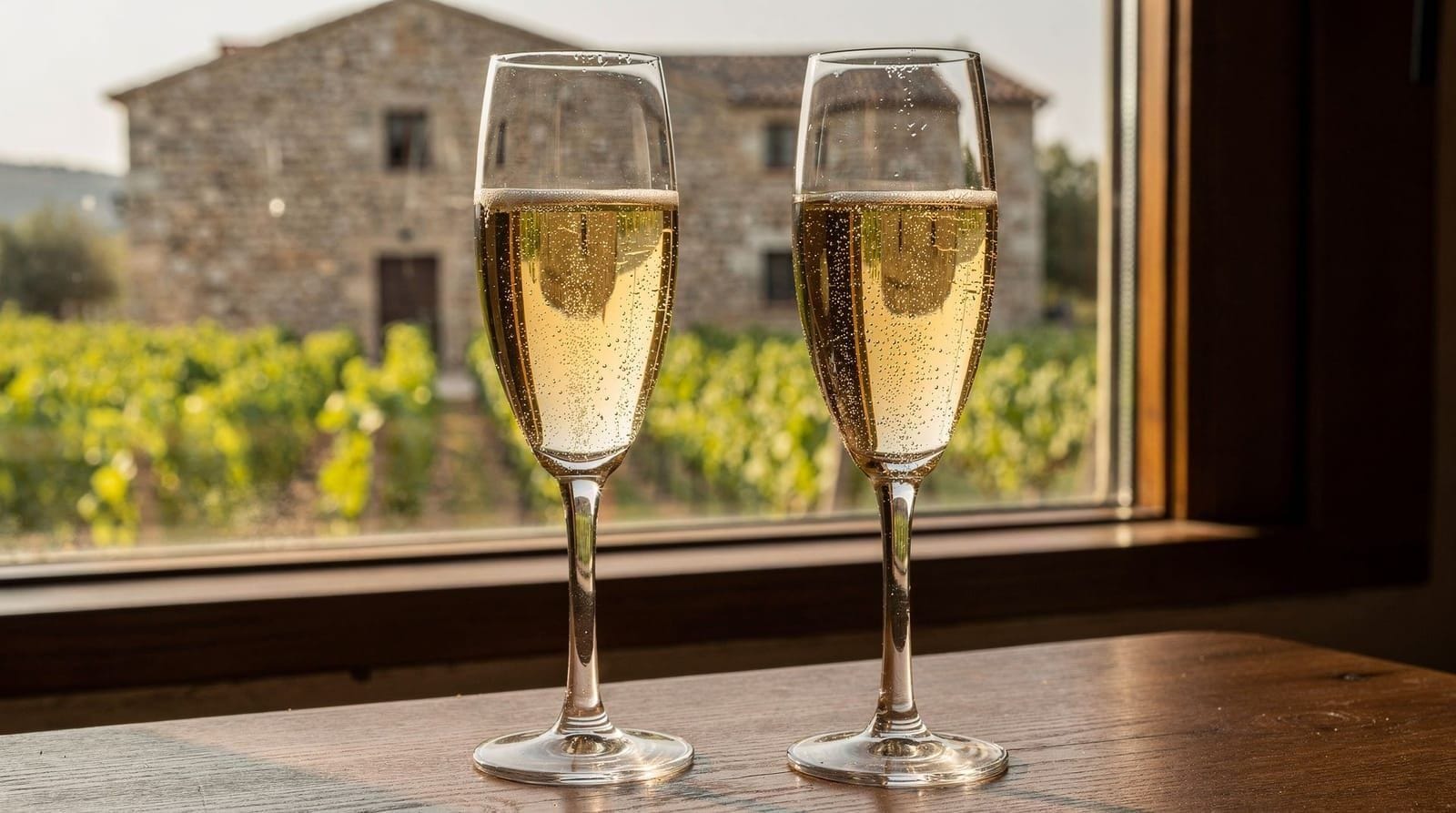
Cava tasting: Typically 2–3 expressions of Codorníu cava, guided by a professional. The progression usually moves from brut nature (zero dosage, bone dry) through brut and reserva to a vintage expression. Food pairing notes are part of the tasting.
Return transport from Barcelona: Most packaged tours include air-conditioned bus transport from Barcelona, with a pickup point in the city centre.
Not included: Lunch. The winery has a restaurant (Codorníu Restaurante) that does a good set lunch for €25–35, or the town of Sant Sadurní d’Anoia has several bars and restaurants within walking distance.
Understanding cava: the honest guide
Cava DO: The Denominació d’Origen cava covers production across several Spanish regions, though 95% of cava comes from the Penedès. The rules require traditional-method fermentation, a minimum of 9 months on the lees for non-vintage and 15 months for reserva.
The grape varieties: Macabeo (the main variety, relatively neutral), Xarel·lo (the backbone grape, gives body and local character) and Parellada (aromatics and freshness). Chardonnay and Pinot Noir are permitted in the DO but the traditional blend is the Catalan trio.
Brut versus brut nature: Most commercially sold cava is brut (dosage of 6–12g/l residual sugar). Brut nature (zero dosage) is drier, more austere, and shows the wine more clearly. For serious tasters, the best Penedès producers’ brut nature releases are comparable in quality to good Champagne at half the price.
Cava versus Champagne: See our cava vs champagne guide for the full comparison. The short version: different grapes, different region, same method, significant quality range in both. Great cava is excellent; the mass-market category produces exactly what you would expect from wine produced at industrial scale.
The Penedès wine region beyond cava
Cava gets most of the international attention, but still wines of the Penedès are equally serious. The DO Penedès covers white wines (Torres’ Gran Viña Sol is one of the most recognisable), reds (Garnatxa, Monastrell, Tempranillo) and increasingly the indigenous Catalan varieties like Sumoll and Malvasia de Sitges.
The best-known producer in the region is Miguel Torres (headquartered in Vilafranca del Penedès, the regional capital), which runs its own visitor centre and tours independently of package day trips. If you want to cover more of the region, Vilafranca del Penedès has its own wine museum and more restaurant options than Sant Sadurní d’Anoia.
Alternatives worth considering
E-bike tour through Penedès wineries (€70, half day): A guided electric-bike circuit through the vineyards with stops at 2–3 smaller producers. More physical, more intimate with the landscape, and the producers visited are typically smaller family estates rather than industrial operations. Good option for anyone who wants fewer crowds and more conversation with winemakers.
4WD Penedès wine tour (€85, 6 hours): A 4-wheel-drive circuit through more remote vineyard areas with a stop at a family-run winery. More scenery, more exclusivity, more varied terrain. Best in late summer (harvest season) when the vines are at their most photogenic.
Montserrat and cava wineries combo (€90, full day): Combines the monastery visit with a winery stop on the return journey. Covers two highlights efficiently but rushes both. Only worth it if you want to tick two boxes in one day. See our Montserrat day trip tour review if the mountain is your real priority.
Going independently
FGC train from Plaça Espanya to Sant Sadurní d’Anoia: 45 minutes, €5.80 each way. The Codorníu estate is approximately 1.5km from the station (taxi or 20-minute walk). You can book Codorníu tours directly at the estate, though advance booking is recommended in summer.
The train option costs significantly less and gives you flexibility on timing. The guided tour from Barcelona adds transport convenience and a pre-arranged tasting, which is worth something on a first visit when you may not know which producers to prioritise.
What the Penedès looks like
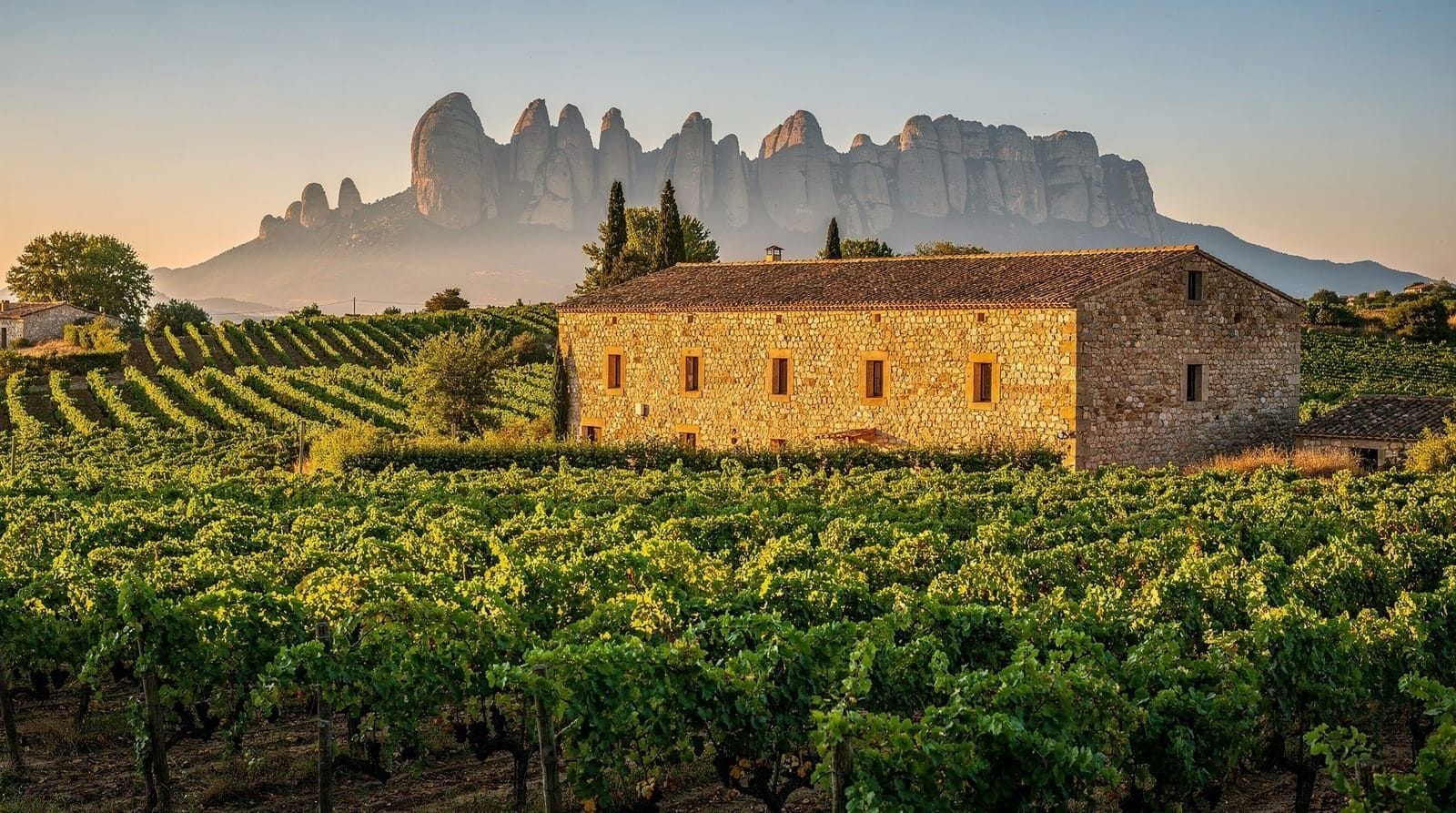
The landscape between Barcelona and the Penedès is a transition from the coastal urban density through the industrial suburbs of El Prat and Viladecans, then suddenly into a different Catalonia — rolling hills covered with vines, small towns with Sunday market squares, and the flat-topped mountain of Montserrat visible to the north-west on clear days.
The best time to visit is late September to early October during the vendimia (harvest), when the grapes are being picked and the whole region smells of fermenting juice. Spring (April–May) is the second-best option — the vines are green, temperatures are comfortable, and the tourist volumes are much lower than summer.
The honest verdict
The Codorníu tour delivers exactly what it promises: an impressive industrial-scale winery, an extraordinary Modernista building, and a professional cava tasting. It is not the most intimate wine experience available in the Penedès, and if you have serious wine knowledge, the educational content may feel broad.
For casual visitors to Barcelona who want to understand where Catalan bubbles come from and drink some on a pleasant day out: it is an excellent choice. For wine enthusiasts who want to meet winemakers and taste small-production expressions: look at the e-bike tour or book directly with Gramona or Recaredo.
The Penedès wine region is covered in detail in our Penedès wine day trip guide and Penedès cava tours guide.
Sant Sadurní d’Anoia: the town itself
Codorníu’s estate sits just outside the town centre, and it is worth budgeting 20–30 minutes to walk into Sant Sadurní d’Anoia proper rather than treating the visit purely as a winery-to-bus transfer. The town of roughly 13,000 people is built almost entirely around the cava industry — more than 80 producers operate within the municipal boundaries, and the streets are lined with small bodegas, cooperage workshops and family-run bars that pour cava by the glass for a couple of euros. The Cal Bolet market square hosts a modest Saturday market, and several producers not covered by the standard package tours — Sabaté i Coca, Mont-Ferrant, Freixenet’s own visitor centre a short walk from the station — welcome walk-in visitors without advance booking.
If you have time before your return train or coach, the Espai Cava interpretation centre near the town hall gives a free, quick overview of the DO’s history and production process — useful context if your guided tour moved quickly through the technical detail. Restaurants in the town centre, rather than the winery’s own restaurant, tend to be cheaper and more locally oriented; a set lunch menu (menú del día) at a town-centre restaurant runs €15–20, noticeably less than the winery restaurant’s €25–35.
Visiting other producers directly
For travellers who want to go beyond Codorníu without joining a different packaged tour, several Penedès producers welcome independent visitors with advance email or phone booking. Gramona, a fifth-generation family estate now producing under the Corpinnat designation, offers small-group tastings focused on their long-aged reserves. Recaredo, biodynamic and similarly Corpinnat, is a short taxi ride from the Sant Sadurní d’Anoia station and offers tastings by appointment. Both require booking further ahead than Codorníu’s higher-volume operation, typically a week or more, but reward the extra planning with a more personal, less scripted visit — the kind of experience the Penedès wine day trip guide recommends for repeat visitors to the region who have already done the standard Codorníu tour once.
Pairing the Penedès with the rest of your trip
If wine is one interest among several, the Penedès pairs naturally with a relaxed second half of the day rather than a rushed return to more sightseeing. Many visitors combine the winery visit with an evening back in the Gothic Quarter for dinner, since the train back from Sant Sadurní d’Anoia arrives well before dinner hours. For a fuller Catalan drinks education, pair the visit with our vermut guide — the pre-lunch vermouth tradition and the celebratory cava tradition are the two pillars of Catalan drinking culture, and understanding both gives you a complete picture that most visitors never get.
The history of cava production in Catalunya
On 16 December 1872, Josep Raventós Fatjó — then head of the Codorníu estate in Sant Sadurní d’Anoia — produced Spain’s first bottles of sparkling wine made by the méthode champenoise, the technique of secondary fermentation inside the bottle. He had been to Champagne, studied the process, and brought it back to his family estate along with the vine cuttings he needed to adapt the method to local varieties. The first commercial release followed in 1882. What Raventós started, the Penedès adopted entirely: by the turn of the twentieth century, dozens of producers in Sant Sadurní d’Anoia were making the wine, and the town’s identity became synonymous with it.
The Catalan producers did not call it cava initially — it was referred to as champagne català or xampany (the Catalan phonetic rendering) for decades, until the European Community’s rules on protected geographic indications forced a name change in the 1980s. The word cava, from the Catalan for cellar or cave, became the official DO designation in 1986. Today, 95% of all Spanish cava is produced in Sant Sadurní d’Anoia, which has more than 80 active producers within the municipal boundaries.
The more recent historical drama concerns quality and geography. In 2019, eleven of the Penedès’ most artisan producers — including Gramona, Recaredo, and the Raventós i Blanc estate (run by descendants of Josep Raventós) — formally resigned from the Cava DO and launched a separate designation called Corpinnat, effective from 2020. Their argument was that the Cava DO had become too large, too geographically dispersed (it covers producers as far away as Extremadura and Rioja), and too permissive on minimum ageing requirements to maintain a meaningful quality signal.
Corpinnat requires 100% estate fruit, organic viticulture, a minimum of 18 months on the lees, and production exclusively within a defined Penedès zone. The split was acrimonious and is not fully resolved; the Corpinnat producers consider themselves the successors to the original Catalan sparkling tradition, while the Cava DO argues that Corpinnat is an elite club using the Cava DO’s infrastructure and reputation while refusing to contribute to it.
How cava is made: the process you see on the tour
The Codorníu tour walks you through the production process roughly in order, which means the experience tracks the chronology of cava production.
Harvest (September–October): The Macabeo, Xarel·lo and Parellada grapes are picked in late September, typically earlier than for still white wines because you want higher acidity and lower sugar for a base wine. The harvest at Codorníu’s scale involves mechanical picking on most vineyard parcels, though the premium reservas use hand-picked fruit.
Pressing and primary fermentation: The grapes are pressed gently to avoid extracting harsh phenolics from the skins, and the juice ferments in stainless steel tanks at controlled temperatures to produce the base wine — a still, dry, relatively high-acid white. This is the cuvée. At Codorníu’s scale, hundreds of separate tank fermentations are blended into a consistent house style.
Blending (assemblage): The winemaker blends tank lots to achieve the target profile — balancing Macabeo’s neutrality against Xarel·lo’s earthy body and Parellada’s floral lift. This is the most decision-intensive step and the most invisible to visitors, since it happens in a laboratory of small samples rather than in the caves.
Tirage: The blended base wine is bottled with a measured addition of sugar and yeast — the liqueur de tirage. This triggers the secondary fermentation that produces the bubbles. The bottles are sealed with a crown cap (like a beer cap) and moved to the caves.
Secondary fermentation in bottle: In the constant 15°C of the underground caves, the yeast slowly consumes the added sugar, producing alcohol and CO2, which dissolves into the wine under pressure. This process takes several weeks. The bottles then rest on the lees — the dead yeast cells — for a minimum of nine months (non-vintage), fifteen months (reserva), or thirty months (gran reserva). Longer ageing on the lees produces the brioche, toast and autolytic complexity that distinguishes aged cava from simple party wine.
Riddling (remuage): The yeast sediment must be moved from the body of the bottle to the neck before removal. Traditional hand riddling — turning each bottle a small amount daily on a wooden rack called a pupitre — takes six to eight weeks and requires skilled human labour. Codorníu uses gyropalettes: large metal cages that hold hundreds of bottles simultaneously and perform the same action mechanically in 5–7 days. Premium small producers still do hand riddling for their top cavas; the process is slower and more expensive but does not affect quality in any demonstrable way — it is mainly a marketing signal.
Disgorgement (dégorgement): The inverted bottle necks are frozen in a brine bath, the crown cap removed, and the plug of frozen sediment expelled by the pressure inside the bottle. The operation takes a fraction of a second. The bottle is then quickly topped up and re-sealed with the permanent cork and wire cage.
Dosage: Before the final cork goes in, the bottle is topped up with a mixture of wine and dissolved sugar — the liqueur d’expédition. The amount determines the sweetness level: zero for brut nature, up to 12g/l for brut, up to 17g/l for extra sec. The tasting you do at the end of the tour will almost certainly progress through these categories in order.
What to buy to take home
If you want to bring back a serious bottle, the Codorníu estate shop stocks their full range including vintage and prestige expressions not always found in supermarkets. But if you have time before leaving Barcelona, a wine shop like Vila Viniteca in El Born stocks the full range of quality Penedès producers.
The names worth looking for: Gramona (now Corpinnat) makes some of the longest-aged sparkling wines in Spain — their Imperial Gran Reserva (minimum 36 months) is a benchmark. Recaredo (Corpinnat) makes biodynamic sparkling wines of exceptional precision; their Terrers Brut Nature is widely considered among the top cavas available. Raventós i Blanc (Corpinnat) — the direct descendants of Josep Raventós — make a range of still and sparkling wines from single-vineyard parcels; the L’Hereu is their accessible entry point and genuinely excellent.
Reading a cava label: the key information is the sweetness designation (brut nature, brut, extra brut, extra sec, sec, semi-sec, dolç), the ageing category (reserva = minimum 15 months, gran reserva = minimum 30 months), and whether it states a vintage year (if so, all grapes are from that harvest). “NV” or no year means a blended-vintage wine. Look also for “producte de l’agricultor” if you want estate-grown fruit.
On transporting wine home: EU flights within the EU have no quantity restrictions on wine in checked luggage. Flights to the UK or non-EU destinations are subject to duty-free limits at the destination country (typically 1–2 bottles duty-free). Bubble wrap sleeves designed for wine bottles are sold at most airports. Bottles in carry-on luggage are not permitted (liquids over 100ml). Pack in checked luggage, surrounded by soft clothing, and you will be fine.
Is it worth it? The honest verdict
The Penedès cava tour is a genuinely worthwhile day out from Barcelona — drink the brut nature, tour the caves, and come back to the city with a better understanding of what to order at a Catalan restaurant.
Compare alternative tours
Frequently asked questions about Penedès Codorníu cava tour
How much does the Penedès cava tour cost?
The Codorníu discovery tour with cava tasting runs around €55 per adult including transport and the tasting. Not included: lunch, which you arrange separately at the winery restaurant or in Sant Sadurní d'Anoia.What is cava, and how is it different from Champagne?
Cava is a Spanish sparkling wine made using the traditional method (same secondary fermentation in bottle as Champagne) but with local Catalan grape varieties: Macabeo, Xarel·lo and Parellada. Unlike Champagne, cava can only be called cava if it meets DO (Denominació d'Origen) standards. Most cava production is concentrated in Sant Sadurní d'Anoia in the Penedès.What does the Codorníu tour include?
A guided visit to the Codorníu estate (a Modernista cellar designed by Josep Puig i Cadafalch), a tour of the underground caves and production areas, and a tasting of 2–3 cavas. Return transport from Barcelona is included in most packages.Is Codorníu the best winery to visit?
Codorníu is one of the largest producers in the world and the tour reflects that — impressive scale, great history, professional setup. For a more intimate family-winery experience, smaller Penedès producers (Gramona, Recaredo, Alta Alella) offer private tours with more personal contact.How long is the tour?
Most full-day versions run 8–9 hours door to door including transit. The winery visit itself takes 2–3 hours. Half-day options returning by 2pm are also available.Can I visit the Penedès independently?
Yes. FGC trains run from Plaça Espanya to Sant Sadurní d'Anoia (45 minutes, €5.80 each way). Many wineries are within walking distance or a short taxi from the station. A guided tour adds value primarily in transport coordination and booking.Is the Penedès cava tour suitable for non-drinkers or children?
The winery visit and underground caves are interesting regardless of whether you drink, and children are generally welcome on the tour itself, though the tasting portion is adults-only. Some operators offer a reduced-price ticket for non-tasting participants — check the listing before booking.What is the best month to visit for the harvest atmosphere?
Late September into early October, during the vendimia, when the grapes are being picked and the region has a distinct, active atmosphere. Spring (April–May) is the next-best option, with green vines, comfortable temperatures and far fewer visitors than summer.