Barcelona old town tapas tour: is it worth booking?
Barcelona: old town tapas & paella food tour with 8 tastings
Duration: 3 hours
- Free cancellation
A tapas tour solves a specific Barcelona problem: the city has hundreds of excellent tapas bars, they are often unmarked, the best ones do not have menus in English, and finding them on your first night without a guide involves more guesswork than most visitors want after a long travel day. That is the genuine value proposition — not access to food you could not otherwise find, but a curated first introduction to the bar culture of the old city.
| Where | Gothic Quarter, El Born, sometimes Barceloneta |
| Cost | around €75/adult, food and drinks included |
| Time needed | around 3 hours |
| Getting there | Meeting point in the old town, on foot for the tour |
| Best time | Evening starts, 7pm or 8pm; book 3–5 days ahead in summer |
What the 8-tasting tour includes
The old town tapas and paella tour visits four to six bars across the Gothic Quarter, El Born and sometimes the Barceloneta waterfront over three hours. The route changes slightly night to night based on which bars are open and what the guide has reserved in advance.
Typical eight tastings might include:
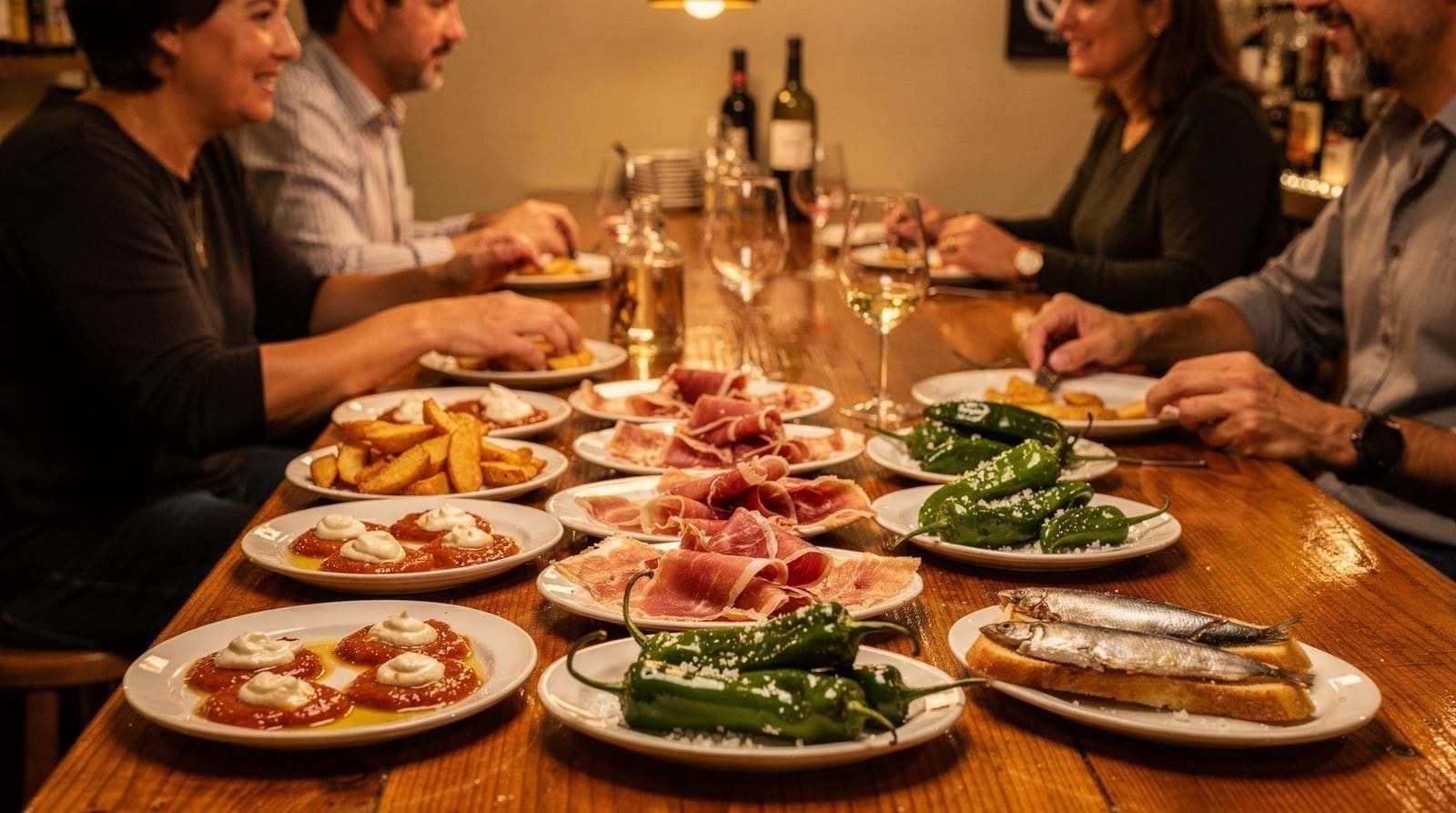
- Pan amb tomàquet — the Catalan staple: toasted bread rubbed with ripe tomato and drizzled with olive oil. Simple, essential, a benchmark for how good bread can be.
- Patatas bravas — fried potatoes with spicy tomato sauce and aioli. Every bar in Barcelona makes them; good ones are creamy inside and properly crisp outside.
- Croquetas de jamón — bechamel and cured ham in a deep-fried shell. The best ones collapse into silk; the worst are gummy inside. A guide who knows the difference is worth something here.
- Anchoas del Cantábrico — Cantabrian anchovies on bread, a completely different animal from the salty Italian version. Briny, meaty and rich.
- Jamón ibérico — acorn-fed Iberian pork, served thinly sliced. The guide should explain the grade system (bellota vs cebo vs cebo de campo).
- Tortilla española — Spanish omelette with potato. The great Barcelona debate: should it be runny in the middle (jugosa) or fully set? Good tours take you somewhere that has an opinion.
- Paella or fideuà tasting — a portion of paella Valenciana or fideuà (noodle paella from the Costa Brava/Valencia border). Note the honest-planner caveat below on paella.
- Postres — a sweet finish, usually crema catalana (the original crème brûlée), mel i mató (fresh cheese with honey) or a glass of cava.
Drinks throughout include house wine (typically a Catalan red or white from Penedès or Priorat), cava, and water. Vermouth may feature at a bar stop if the route includes a pre-dinner vermouth bar — a very Catalan tradition.
The honest note on paella
Paella is not a Catalan dish. It originates from Valencia. The beachfront “paella” restaurants of La Barceloneta are one of Barcelona’s most notorious tourist traps: frozen rice, minimum spend of €25 per person, often pre-cooked and reheated. Our honest paella and sangria guide covers this in full.
Good food tours address this directly. The paella tasting on a reputable tour typically involves a small portion at a bar that actually makes it properly, not a Barceloneta tourist trap. Ask your guide where the rice was cooked.
Similarly, sangria is not Catalan — it is more associated with Castile and Andalusia. You may be offered it at tourist bars, but locals drink vermouth (vermut), cava or beer. The tour’s drinks should reflect this if the operator knows what they are doing.
Comparing the main tapas tour formats
| Tour | Focus | Price | Best for |
|---|---|---|---|
| Old town 8-tasting tour | Broad sampler, paella included | ~€75 | First-timers wanting one substantial food evening |
| El Born food tour | El Born specifically, more design-led venues | varies | Repeat visitors who know Gothic Quarter already |
| Tapas, wine & vermouth tour | Drinks-led, fewer but more focused stops | varies | Wine and vermouth enthusiasts over volume-eaters |
Which neighbourhoods you walk through
Gothic Quarter (Barri Gòtic): The oldest part of the city, built over Roman Barcino. The streets are narrow enough that two people walking abreast fill the lane. The best bars here are hidden in passages and covered markets that do not appear on Google Maps. A guide with long-standing relationships at these bars is genuinely useful.
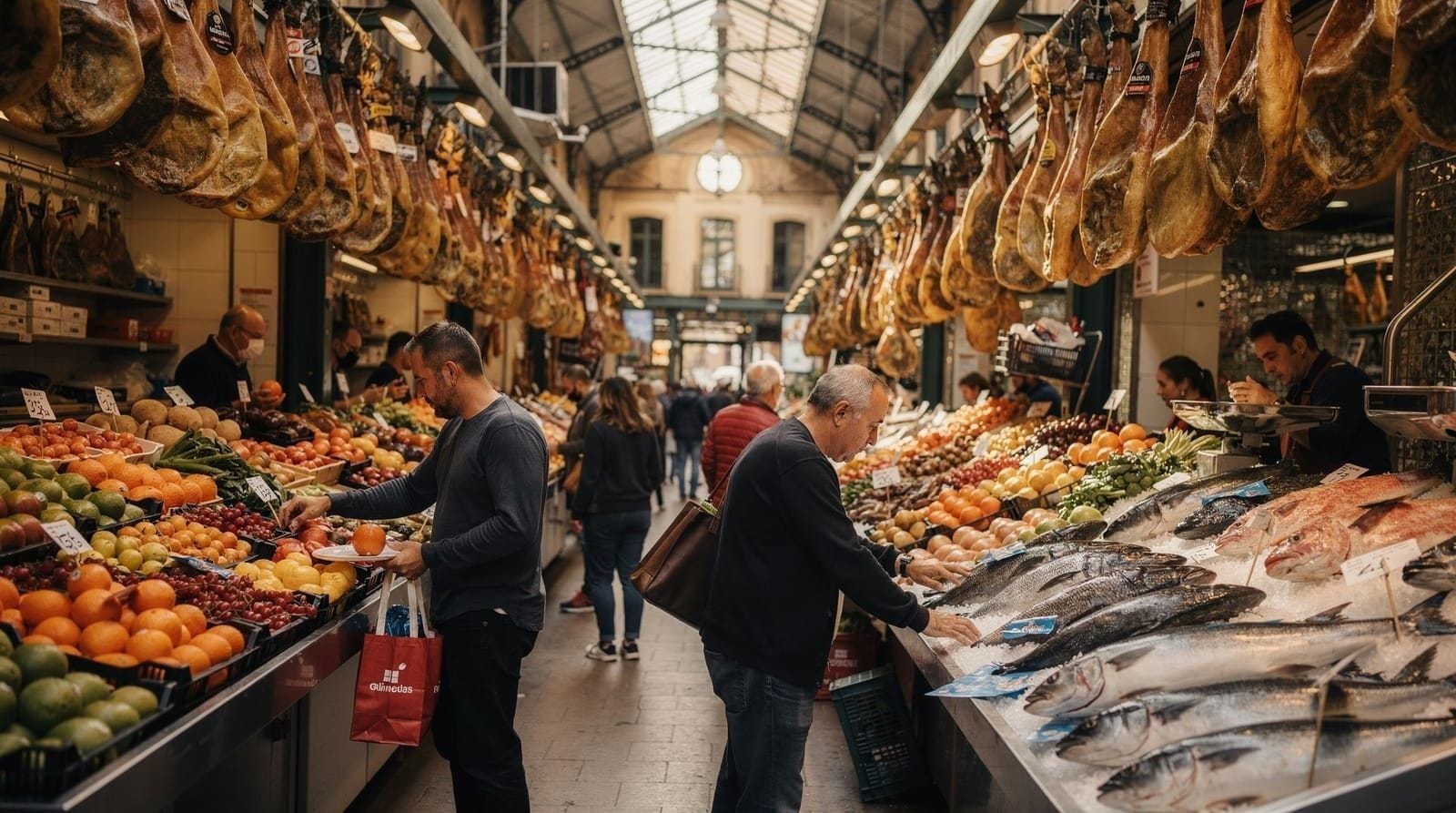
El Born: The neighbourhood immediately east of the Gothic Quarter, more design-conscious and slightly younger in character. The Mercat de Santa Caterina provides produce to several bars in the neighbourhood. El Born food culture trends toward better-quality pintxos and creative tapas rather than the classics-heavy Gothic Quarter.
Barceloneta waterfront (some tours): The historic fishermen’s neighbourhood at the end of La Barceloneta beach has good seafood bars well away from the tourist strip — grilled razor clams, fresh anchovies, fideuà. If your tour route goes here, it is a highlight; if the route goes to the beach restaurants rather than the residential grid, skip that part.
What a good guide adds beyond the food
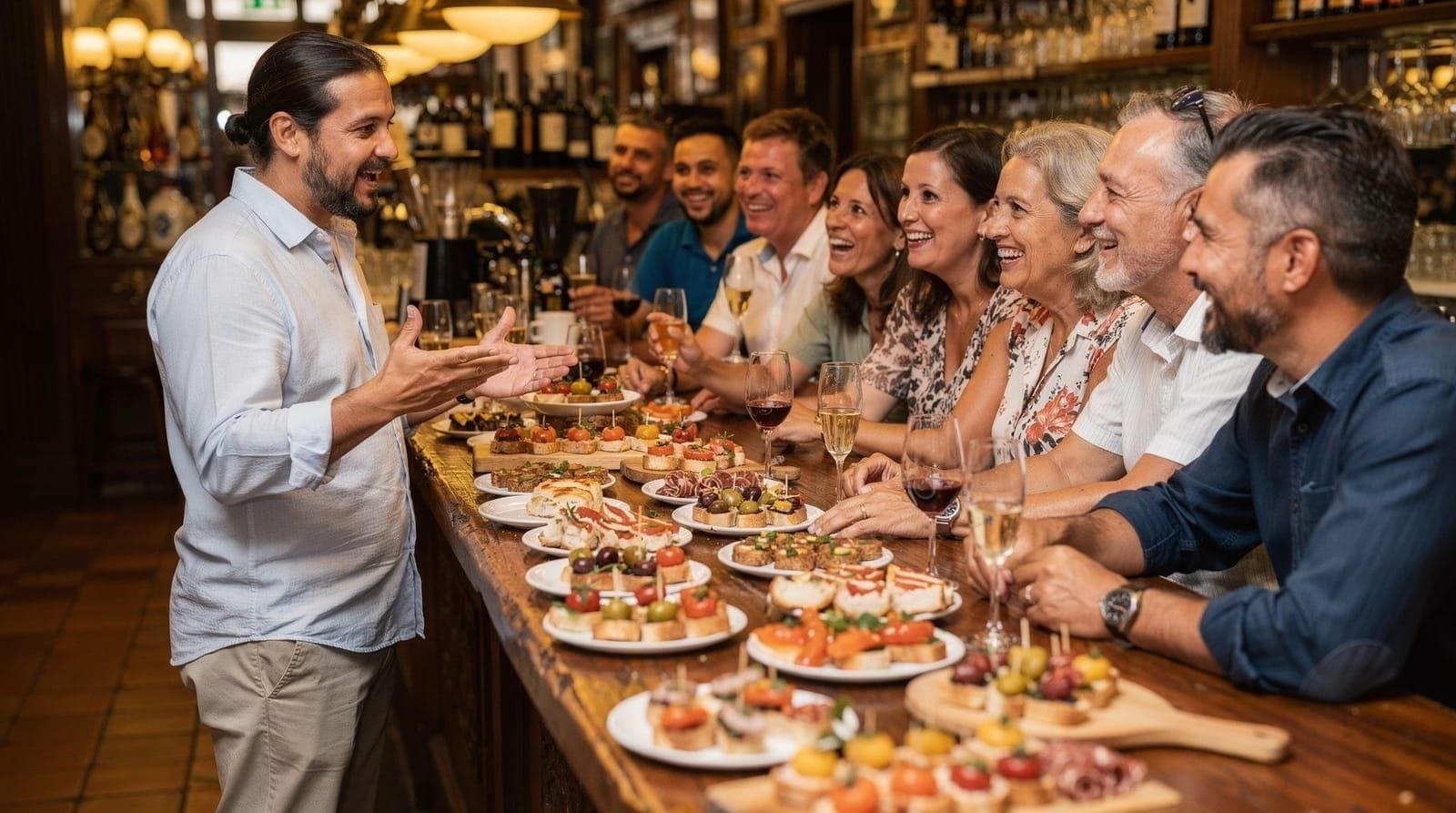
The value of a knowledgeable guide on a tapas tour goes beyond simply choosing decent bars. A guide who has built relationships with bar owners over years often secures a table or standing space during peak hours when a walk-in group would be turned away or made to wait 20–30 minutes. They also translate the board (the pissarra), explain regional specialities that are not obvious from the name alone, and flag which dishes are made in-house that day versus which are standard menu items served regardless of freshness.
This kind of local knowledge is difficult to replicate on a first visit without months of living in the neighbourhood, which is the real argument for paying the tour premium on your first night rather than treating it as an unnecessary expense. Ask your guide, if you get the chance, which bar on the route they would take a visiting friend to on their night off — the answer is often more revealing than anything printed in the tour description.
The real price comparison
The 8-tasting tour costs approximately €75 per adult. This covers food, wine, cava and the guide for 3 hours.
Going independently for an equivalent evening: at four well-chosen bars, expect to pay €12–18 per bar (one tapa each + a glass of wine). A solo tapas crawl through the old town costs €50–70 for one person if you know where to go, or €30–40 if you stick to the standing-room bars with marked prices.
The tour’s premium is partly the guide knowledge, partly the social structure (most tours have 8–14 people, which makes for a livelier evening than eating alone at the bar), and partly the pre-arranged portions (you are not standing at a bar trying to read a chalkboard menu in Catalan at 8pm on your first night).
What you will see on foot
The walking component covers 1–2km over three hours, mostly on the flat old city streets. No hills, no stairs beyond the occasional step. Comfortable shoes are recommended — the Gothic Quarter’s Roman-era paving can be uneven.
The walk serves as a neighbourhood orientation as much as a food experience. By the end of the night, most participants have a mental map of the old city and know roughly where the Mercat de Santa Caterina is, how El Born connects to the Gothic Quarter, and why La Rambla is better crossed than eaten on.
Is a food tour better than just going?
For the first evening of a first visit to Barcelona: yes, at this price level. The curation is genuine, the guide context adds to the experience, and you end the night with a list of bars to return to independently. Most participants leave knowing more about Catalan food culture than they arrived with.
For experienced travellers, repeat visitors to Barcelona, or anyone who already knows the difference between a good and a bad croqueta: the DIY version costs €20–30 less and gives you full control over pace, quantity and venue. Our tapas tours guide maps the best self-guided bar circuits by neighbourhood.
Booking tips
Start times are typically 7pm or 8pm — earlier than most Spaniards eat dinner, but calibrated for tourist schedules. The later start is better: bars are livelier, the streets cool down in summer, and the evening atmosphere is at its best from 9pm onwards.
Group sizes are usually 8–14 people. Book 3–5 days ahead in summer; shoulder season often has same-day availability.
Choose a tour that specifies the stops in advance or has recent verified reviews mentioning specific bars by name — that is a sign the operator has genuine local relationships rather than rotating through tourist-facing venues.
What to do after the tour
After three hours of tapas, you have two options: a nightcap bar (the Gothic Quarter has excellent cocktail bars in its covered passages) or straight to bed. Most people in the second category made better decisions than those in the first, but Barcelona’s bar culture runs to 2am on weekends.
If you want to continue, our Barcelona nightlife guide covers the best options by neighbourhood and time.
The history of tapas culture in Barcelona
The etymology of “tapa” — and what it has to do with Barcelona specifically — is genuinely disputed. The most common story, repeated endlessly in guidebooks, claims that a Spanish king ordered a thin slice of bread or cured meat placed on top of a wine glass to keep flies out, and that the name derives from tapar, to cover. The story is plausible; it is also almost certainly a later invention. Food historians tend to locate the origin of small-plate bar culture in the sherry bars of Andalusia — Jerez, Seville, Cádiz — where it became conventional to serve a small bite alongside the drink, partly as a hospitality gesture and partly because food slows the absorption of alcohol in a culture where afternoon wine was a daily reality.
Barcelona’s food culture absorbed and transformed this southern tradition through the twentieth century. The city’s proximity to the sea, its distinct Catalan agricultural hinterland, and its working-class immigrant communities from Murcia, Extremadura and Andalusia produced a tapas culture that is neither purely Catalan nor purely Andalusian — it is Barcelonan, which means it leans toward seafood, it takes bread and tomato (pa amb tomàquet) as an axiom rather than an option, and it maintains a level of ambient formality (standing at a zinc bar, ordering from a handwritten slate, paying by memory rather than by bill) that has remained largely unchanged since the 1960s.
The vermouth hour — vermut, or la hora del vermut — is the institution that most clearly defines the social architecture of the Barcelona tapas bar. From the late 19th century, Catalan manufacturers (Zaragozano, Carpano’s local imitators) produced their own vermuts and sold them through the city’s cafés and tabernes. By the mid-20th century, the vermut hour was a Sunday ritual in every neighbourhood: you took an aperitivo before the midday meal, you stood at the bar or sat at a marble table, you ate a few olives and some chips and maybe a plate of mussels, and then you went home. The ritual declined under Franco and revived dramatically from about 2010 as part of a broader Catalan cultural reassertion.
Reading a tapas bar: what to look for
A good tapas bar in Barcelona announces itself in ways that, once you know them, become easy to read. The board — the pissarra — is written in Catalan, not Spanish. The prices are displayed clearly, either on the board or on a physical menu available at the bar. The staff are busy and do not approach you with a special greeting designed to welcome you inside. The regular clientele are speaking Spanish or Catalan to each other, not to the bar in a foreign language. The food comes out as it is ready, not in a coordinated sequence.
Red flags are equally readable. A menu translated into ten languages with photographs of every dish indicates a venue that has optimised for the tourist trade rather than for the food. The phrase “typical paella” on a board in the Gothic Quarter should be treated with the same suspicion you would apply to a restaurant in Paris offering “typical baguette.” Menus displayed on illuminated boards outside a Barceloneta beach restaurant, with lobsters and paellas and sangria jugs rendered in glowing amber, are directing their marketing specifically at people who do not know where else to go.
The distinction between venues is also partly categorical. A bar de tapas serves tapas in the traditional sense — small portions ordered individually at the bar, usually consumed standing or at high stools. A pintxos bar is Basque in origin and common in the Eixample and El Born: small portions on bread, often displayed on the bar itself and chosen by pointing. A restaurant is a sit-down operation with a full menu, a table, and a bill at the end; tapas exist on the menu but the context is formal. Understanding which you have walked into prevents the main source of confusion for visitors, which is sitting down in a tapas bar and waiting for a waiter to arrive with a menu.
The vermut tradition
Vermouth — vermut in Catalan, vermú in Spanish — is a fortified wine aromatised with a blend of botanicals and wormwood (from Artemisia absinthium, from which the word vermouth derives via the German Wermut). The wine base is typically white, the colour achieved by caramelised sugar in the red (rojo) styles. The aromatisation process involves macerating or infusing dozens of herbs, roots, and spices — cinchona bark, coriander, cloves, citrus peel, gentian, star anise — the exact combination being proprietary to each producer.
What makes the Catalan vermut tradition distinct from Italian or French vermouth culture is its social function rather than its production. Catalans do not typically drink vermut at dinner or as a digestif. Vermut happens before lunch, specifically on Sundays, specifically at a bar where you are known or where the bar itself is old enough to have been there longer than you have. The classic serving is a glass over ice with a splash of soda, a green olive, and a piece of preserved orange peel or a slice of fresh orange. Some bars serve it with a stick of gin; some serve it with nothing but the glass.
In the Gothic Quarter, the best vermut bars operate in the older residential streets away from the tourist perimeter: narrow, tiled interiors with wooden casks visible behind the bar, owners who have been doing this for thirty years, prices that have not doubled in the last decade. La Cova Fumada in the Barceloneta neighbourhood is famous enough to appear in guidebooks but remains genuinely good; Bar Calders in Sant Antoni is the neighbourhood anchor for the younger vermut revival crowd.
Vermut hour in Barcelona is technically noon to 2pm on Sundays, but in practice any bar worth the name opens for vermut from 11am and the serious vermut drinkers are there from 11:30. The ritual does not require Sunday — a Thursday lunchtime vermut with anchovies and a glass of fizzy water is a perfectly legitimate meal for a Barcelonan with nowhere else to be. Our vermut guide covers the best bars for it by neighbourhood if you want to build a dedicated vermut hour into your trip rather than relying on the tour’s single stop.
Timing the tour with the rest of your evening
Since the 8-tasting tour typically starts at 7pm or 8pm and runs around three hours, it lands you back on the street between 10pm and 11pm — early enough for a nightcap but late enough that dinner plans elsewhere are unnecessary. This makes it a strong choice for your first evening after arriving, when jet lag or travel fatigue makes independent bar-hopping feel like effort you would rather outsource. Save a more independent, slower-paced tapas crawl through the best tapas neighbourhoods for a later night in your trip, once you have your bearings and know which style of bar you actually prefer.
Is it worth it? The honest verdict
A well-run tapas tour is one of the best first-night experiences in Barcelona — it orients you geographically, introduces you to the food culture honestly, and sends you home full and ready to explore independently the next day.
Compare alternative tours
Frequently asked questions about Barcelona old town tapas tour
How much does the Barcelona tapas tour cost?
The old town tapas and paella food tour with 8 tastings costs around €75 per adult, including food, drinks and the guide. No meals to pay for separately — this is typically a substantial evening of food.What do you eat on the tour?
Eight tastings across several stops: typically patatas bravas, pan amb tomàquet, jamón ibérico, anchoas, tortilla española, various tapas at different bars, a paella or fideuà tasting, and a sweet finish. Wine, cava and local soft drinks are usually included.How long does the tour last?
Around 3 hours, starting at 7pm or 8pm. The pace is walking-and-eating — comfortable for most groups, though you cover 1–2km on foot.Is this a dinner replacement?
Yes. Eight tastings across 3 hours is a substantial amount of food. Most people are full by the end. You do not need dinner before or after.Which neighbourhood does the tour cover?
The Gothic Quarter, El Born and Barceloneta waterfront are the most common routes. The exact stops depend on the operator and night — bars rotate.Is a food tour better than finding tapas bars independently?
For the first night in Barcelona or for visitors who do not speak Spanish, a food tour removes the uncertainty of finding the right bars and ordering correctly. Experienced travellers comfortable with local bars can eat as well for €30–40 less.Can vegetarians or vegans join the tapas tour?
Vegetarians are usually well catered for — pan amb tomàquet, patatas bravas and several other classics are meat-free. Vegan options are more limited given how central jamón and cheese are to Catalan tapas culture; contact the operator in advance so the guide can adjust stops where possible.What should I wear on the tapas tour?
Comfortable walking shoes are the main requirement, since the tour covers 1–2km on the Gothic Quarter's uneven Roman-era paving. Barcelona evenings cool down noticeably after sunset even in summer, so a light layer is worth carrying.