MACBA: guide to Barcelona's contemporary art museum
Barcelona: skip-the-line entry to 6 top art museums
Duration: Full day
- Free cancellation
Is MACBA worth visiting?
Yes, especially if you care about contemporary art from the 1960s onward. Free entry on Saturdays from 16:00 and Sundays from 15:00 makes it easy to include without budget strain.
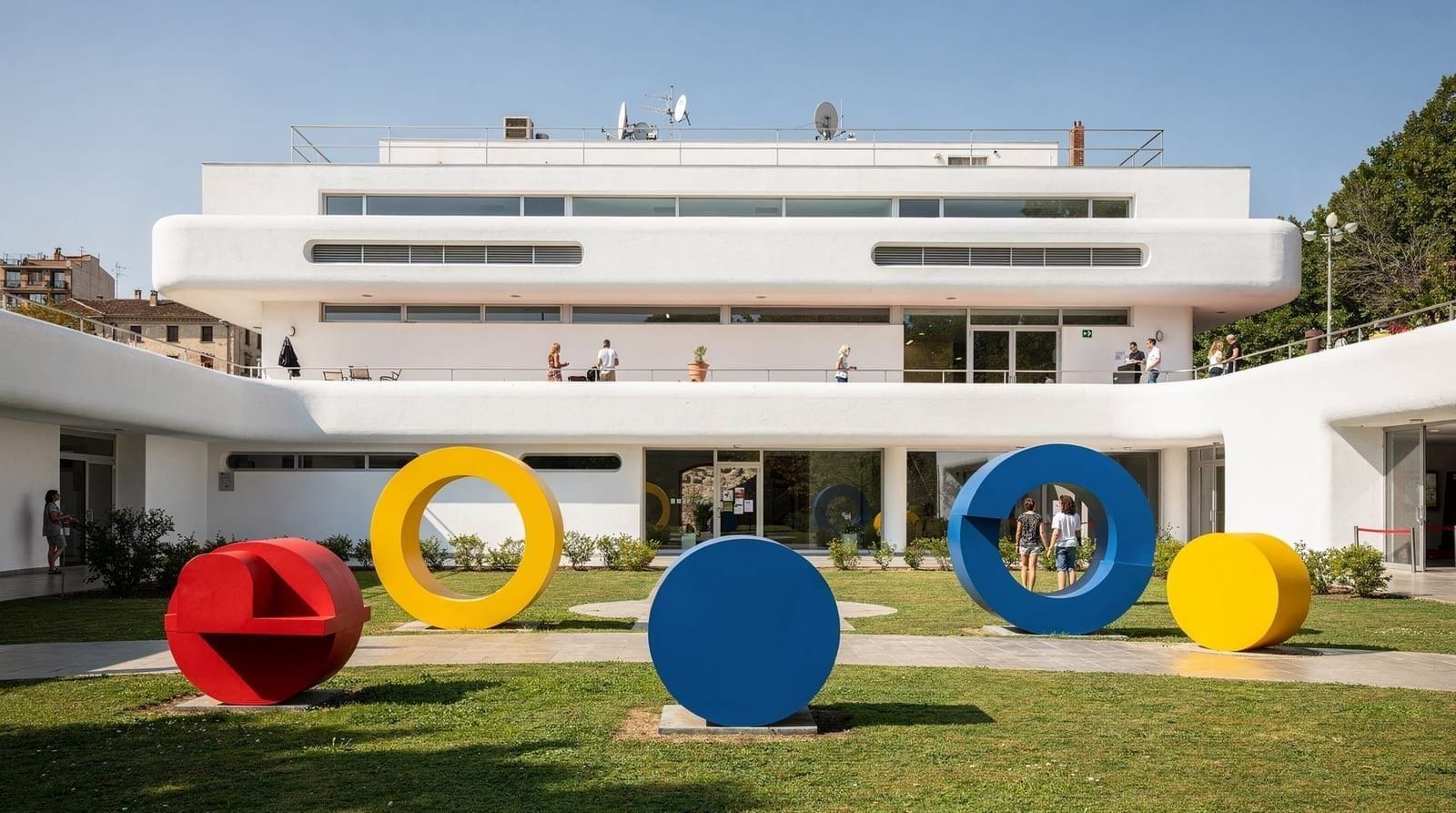
Richard Meier’s white rationalist building arrives as a shock in the narrow, ochre-washed streets of El Raval. That contrast — cool geometric precision set against a dense medieval neighbourhood — is part of what MACBA offers before you even buy a ticket. The Museu d’Art Contemporani de Barcelona opened in 1995 and has spent three decades building one of southern Europe’s most serious collections of post-1960s art. It is not the most visited museum in Barcelona, and that is quietly a point in its favour. Where the Picasso Museum draws hour-long queues on a Tuesday morning, MACBA rewards visitors who show up knowing roughly what they want from contemporary art — and punishes those who wander in expecting something else.
| Where | Plaça dels Àngels, El Raval |
| Cost | Around €12, free Sun 15:00–19:30 |
| Time needed | 90 minutes to 2 hours |
| Getting there | Metro Universitat (L1/L2) or Catalunya (L1/L3) |
| Best time | Sunday afternoon free window, or weekday morning for quiet |
This guide tells you what is actually inside, when to go for free, how the museum fits into a broader art itinerary, and what the surrounding neighbourhood adds to the visit.
What the building is doing to you
Before you go inside, spend five minutes outside. Meier designed MACBA on the same principles as his other white institutions — the Getty Center in Los Angeles, the Museum of Applied Arts in Frankfurt, the High Museum in Atlanta: a single-material exterior that floods interiors with controlled natural light, long internal ramps that double as viewing corridors, and a relationship between building and public space that turns the approach itself into a deliberate procession. The white enamel panels and the full-height glazing on the main façade catch Barcelona’s intense southern light and bounce it in ways that shift across the day.
That relationship with light is not decorative. Contemporary art from the period MACBA covers — roughly 1955 to the early 2000s — often depends on scale, colour and spatial context in ways that reproduction cannot convey. Works that look minor in a catalogue open up inside these rooms. This is why the building matters, and why MACBA has been a significant venue for ambitious touring exhibitions rather than just a container for a permanent collection.
The main ramp running through the interior across three levels is one of the functional pleasures of the building: you walk it at an angle to the artworks, which means you see pieces from a distance before approaching them, and the light through the glazing changes as you ascend. Spend a few minutes on the upper level looking back down through the glass toward the plaza and El Raval’s roofline. That view — neighbourhood rooftops, hills in the middle distance — explains why the site was chosen.
What you will actually find inside
The permanent collection occupies the upper floors and runs roughly chronologically from the 1950s through the early 2000s, with particular focus on Catalan and Spanish art in dialogue with broader European and American movements. Three areas of the collection stand out for their depth and quality.
Informel painting is one of MACBA’s genuine strengths. Informel (also called Art Informel or Tachisme) was the gestural, emotionally raw movement that emerged across Western Europe in the late 1940s and 1950s as a reaction against geometric abstraction and rational design. In Spain it had a particular charge: working under the Franco dictatorship, painters like Antoni Tàpies, Joan Ponç, Joan-Josep Tharrats and Antoni Clavé used abstracted, often deliberately ugly surfaces — thick impasto, torn paper, raw materials pressed into paint — as a form of coded protest that evaded direct censorship. MACBA holds some of the most important examples of this work and presents them with enough context that even viewers who have never encountered Informel before can understand what these painters were doing and why it mattered.
Conceptual art of the 1960s and 70s makes up the next major section. This is where MACBA either captivates or loses visitors depending on their disposition. Conceptual work — pieces where the idea is the primary content, often presented as text, instruction, documentation or deliberately anti-aesthetic objects — rewards attention and punishes impatience. The collection includes work by artists associated with Fluxus, Arte Povera and Spanish conceptual movements. If you approach it curious about what these artists were questioning, it is genuinely interesting. If you walk in expecting conventional painting, you will find it puzzling.
Video and installation art from the 1980s and 90s rounds out the permanent collection. MACBA has been particularly rigorous about building a strong video archive, and the rotating selection shown in the permanent galleries tends to favour work that has held up critically rather than merely being historically significant.
Temporary exhibitions occupy the ground floor and lower levels and rotate roughly every three to four months. MACBA has a strong international exhibition record — past collaborations have included the Tate Modern, the Centre Pompidou and the Stedelijk — and the temporary show is often the main reason serious contemporary art visitors prioritise a visit. Check macba.cat before your trip: if the current show is strong, building your visit around it makes sense. If it is in transition (installation periods typically close the space for several weeks), the permanent collection alone is still worthwhile but the visit is shorter.
The plaza: a city space that works
Plaça dels Àngels in front of MACBA is one of the more successful pieces of urban design to come out of Barcelona’s 1990s modernisation programme. The open paving, the shallow steps and the long marble ledges of the museum’s base were designed as public space, and they function as public space in a way that a lot of planned plazas do not. By the mid-1990s, skateboarders from across Europe had identified the space as one of the best natural skate spots on the continent, and the culture has persisted for thirty years despite periodic municipal attempts to introduce deterrents.
The energy on the plaza on a warm evening — skaters running lines across the open paving, people sitting on the museum steps, the CCCB lit up across the square — is part of the texture of El Raval in a way that feels genuinely unlaundered by tourism. If you arrive for the free Sunday entry window, you will find the plaza already well-populated well before 15:00.
Directly across the plaza, the CCCB (Centre de Cultura Contemporània de Barcelona) occupies a converted nineteenth-century hospice building with a spectacular mirrored glass courtyard designed by Helio Piñón and Albert Viaplana. The CCCB’s exhibitions focus on urban culture, digital art, architecture and moving image — adjacent to but distinct from MACBA’s fine-art focus. Entry is separate and not covered by the Articket, but the two institutions form a natural pairing for an afternoon in the square. The courtyard alone is worth a look even if you are not attending a CCCB exhibition.
Free entry: what is actually free and when
MACBA has three free entry windows and the specifics matter:
Saturdays, 16:00–20:00 — officially restricted to Barcelona residents, who are asked to show identification. In practice the residency check is inconsistently applied, and many visitors who are staying in the city (not just residents) use this window without issue. If you are uncomfortable with the ambiguity, use the Sunday window instead.
Sundays, 15:00–19:30 — open to everyone, no residency required, no question asked. This is the most accessible free slot for tourists. The queue builds from about 14:40 onward; arriving at 14:55 means you are near the front when the doors open. The museum does not fill uncomfortably on ordinary Sundays, though it gets busier on the first Sunday of the month.
First Sunday of the month — free all day from opening, no restrictions. This coincides with free entry at several other Barcelona museums, including MNAC. Combine them and you can build a full museum day at no cost. Be aware that first Sundays in summer (June through August) see the highest attendance; the permanent collection at peak time can feel crowded.
If those free windows do not fit your schedule, the €12 adult price is straightforward. Unlike the Sagrada Família or the Picasso Museum at peak times, MACBA does not operate a timed entry system — you buy at the door or online and walk in. There is no advance booking requirement.
How MACBA fits the Articket calculation
The Articket BCN (€38) covers MACBA alongside the Picasso Museum, Fundació Joan Miró, MNAC, Fundació Antoni Tàpies and the Museu Nacional. If you plan to visit three or more of those six institutions, the pass breaks even and starts generating savings.
MACBA at €12 is the cheapest of the six individually, which means it contributes the least to the Articket’s value mathematics. The pass is primarily justified by Picasso (€14), Miró (€15) and MNAC (€15) — those three alone total €44 against the pass price of €38. MACBA then becomes a bonus rather than a driver.
The free Sunday window complicates this further. If your Barcelona visit falls on a Sunday afternoon and you are already planning to visit three paid museums via the Articket, you can add MACBA at no additional cost regardless of whether you have the pass. If Sunday is your only museum day and MACBA is the main thing you want to see, the free entry is the simplest option. The full value analysis is in our Articket guide.
El Raval and what surrounds the museum
MACBA sits at the upper end of El Raval, historically one of Barcelona’s most layered neighbourhoods. Before the nineteenth century it was the site of convents and charitable institutions outside the old city walls; through the late nineteenth and early twentieth centuries it absorbed working-class immigration and became one of the densest, poorest districts in the city; the Barri Xino (the red-light district covering part of El Raval) was dismantled progressively through the 1980s and 90s as part of the pre-Olympics cleanup. MACBA itself was a deliberate regeneration anchor, placed here by the city government to begin a cultural transformation of the upper Raval. The strategy worked more than it failed — the area has gentrified substantially, though it retains ethnic and economic diversity that the tourist-facing Gothic Quarter has largely lost.
A few minutes south of the museum on Las Ramblas, La Boqueria is one of Barcelona’s most famous food markets. Our La Boqueria guide is honest about where the tourist markup has taken over versus what remains worth buying — the short answer is that the stalls in the back sections are better value than those facing the main entrance. Walking north from MACBA toward El Born takes about fifteen minutes through the streets behind the cathedral, depositing you close to the Picasso Museum. The two museums form the most natural single-day art pairing in the city.
The vermut culture of El Raval repays attention. The neighbourhood has a concentration of old-style bars where the aperitivo hour (roughly noon to 14:00) is conducted with vermouth, anchovies, olives and small plates at prices that have not yet been adjusted for tourism. This is one of the less manufactured versions of a very Barcelona ritual, and MACBA makes a natural anchor for a late-morning visit that flows into an unhurried vermut lunch before heading across the city for the afternoon.
Practical visiting notes
Hours: Monday and Wednesday through Friday, 11:00–19:30. Saturday, 10:00–21:00 (free from 16:00 for residents). Sunday, 10:00–15:00 paid, then 15:00–19:30 free for all. Closed Tuesdays.
Tickets: €12 adults. Reductions available for students, seniors and visitors under 25. Under-14s free. Buy at the door or online at macba.cat. No advance booking or timed entry required.
Audio guide: Available for a small additional charge and generally worth taking. The contemporary art context can be genuinely unfamiliar to visitors whose museum experience is primarily in older collections, and the audio guide covers the movements and ideas without being condescending.
Accessibility: The museum is fully accessible. The ramps that give the building its distinctive interior circulation also serve as the primary routes between all floors, making MACBA one of the more practically comfortable art institutions in the city for visitors with mobility limitations. Lifts are also available. Contact the museum in advance if you need specific assistance.
Getting there: Metro to Universitat (L1 or L2) is the easiest option — a five-minute walk northeast brings you to the plaza. Catalunya station (L1, L3) is slightly further but useful if you are arriving from the Eixample or the waterfront. Driving is not recommended: the area has almost no parking and the streets narrow sharply as you approach from any direction.
What to manage expectations about: The museum shop is small and the selection is modest — fine for a postcard but not a shopping destination. The café is functional rather than good. Save appetite for El Raval itself: the neighbourhood has genuinely excellent places to eat in the blocks between the museum and Las Ramblas once you step off the main tourist axis.
Building a day around MACBA
The museum works best as part of a day that moves between El Raval and one or two adjacent areas. One sequence that works well:
Arrive at MACBA for opening (11:00 Monday or Wednesday through Friday, 10:00 Saturday or Sunday). Spend 90 minutes to two hours in the collection and current exhibition. Cross Plaça dels Àngels to look at the CCCB courtyard. Walk south through El Raval to La Boqueria for a late morning snack, using our guide to avoid the tourist-facing stalls. Lunch at one of the neighbourhood bars doing vermut (Bar Marsella and Bar Calders are two options in different price brackets). Cross to El Born in the afternoon for the Picasso Museum or simply to walk Carrer Montcada and the medieval streets around the Basílica de Santa Maria del Mar.
If your priority is Montjuïc rather than El Born, the sequencing reverses well: start at the Fundació Joan Miró and MNAC in the morning (both on Montjuïc), descend to Poble Sec for lunch, and arrive at MACBA in mid-afternoon in time for the free Sunday window. The two Montjuïc museums anchor what is arguably the strongest single art day Barcelona offers, and adding MACBA free at the end is an easy bonus.
For the comprehensive view of how to sequence all six Articket museums efficiently — including the cost analysis of individual tickets versus the pass — see our Articket BCN guide.
MACBA compared to Barcelona’s other major art museums
| Museum | Focus | Adult price | Best for |
|---|---|---|---|
| MACBA | Contemporary, post-1955 | Around €12 | Conceptual and Informel art, video |
| Picasso Museum | Picasso’s early career | Around €14 | Chronological depth on one artist |
| Fundació Joan Miró | Miró’s full career | Around €15 | Colour, sculpture, Montjuïc setting |
| MNAC | Romanesque to 20th century | Around €15 | Broad Catalan art history in one building |
If your time in Barcelona only allows one contemporary-leaning museum, MACBA is the strongest single choice — it is also the only one of the four genuinely built around post-war and contemporary work rather than a single historical figure. A skip-the-line combined ticket covering several of these museums is worth considering if you plan to see more than two in the same trip.
If the Picasso Museum is also on your list, pairing it with MACBA on the same day works well given their proximity through El Raval and El Born.
Photography and the video galleries
Photography without flash is generally permitted in the permanent collection, though individual temporary exhibitions sometimes restrict it — check the signage at the entrance to each show rather than assuming the museum-wide rule applies everywhere. The video and installation galleries are the one area where photography etiquette matters most: many pieces run on loops with specific timing, and stepping in front of a projector or lingering in a doorway to get a shot disrupts the piece for everyone else in the room. If a video work interests you, sit through a full loop before moving on — some pieces only make sense once you have seen the beginning and end in sequence, which a quick photo-and-leave visit misses entirely. Bring headphones if you have them; the museum sometimes provides them at video installations but supply is limited on busy days, and having your own means you are not waiting for a free set to properly experience a piece with sound.
What first-time contemporary art visitors get wrong at MACBA
Visitors used to older, chronological museums sometimes walk through MACBA expecting a narrative that resolves neatly, and leave frustrated when it does not. Contemporary and conceptual art is often deliberately unresolved — the point is the question it raises, not a tidy conclusion. Slowing down at the wall text rather than skipping it changes the experience considerably; MACBA’s labelling is generally better than average at explaining what a given period or movement was reacting against, which is the context that makes Informel or 1970s conceptual work legible rather than baffling. Visitors who treat the museum shop and café as an afterthought and instead spend the saved time in the temporary exhibition tend to report the most satisfying visits.
MACBA is at its best when you arrive with some curiosity about what happened in European and Spanish art between 1955 and 2000. Go in without context and you may find the permanent collection opaque; go in knowing roughly what Informel was pushing against, or what conceptual art was questioning, and the collection snaps into focus quickly. The free Sunday window makes trying it genuinely low-risk — if the temporary exhibition does not grab you, you have spent nothing and can be back in El Raval in under an hour.
Frequently asked questions about MACBA
How much does MACBA cost?
Adult entry is €12. There is a free window on Saturdays from 16:00 to 20:00 (Barcelona residents only) and on Sundays from 15:00 to 19:30 (open to all). The first Sunday of the month is free all day.How long do you need at MACBA?
Budget 90 minutes to two hours for a focused visit covering both the permanent collection and one temporary exhibition. If you are a serious contemporary art fan, three hours is more comfortable.Is MACBA included in the Articket?
Yes. The Articket BCN (€38) covers MACBA along with five other major art museums. If you plan to visit three or more of the six, the pass pays for itself easily.Is MACBA good for children?
It depends on the child. The building itself is striking and the open skate plaza outside is a genuine draw for teenagers. The art inside skews conceptual; children under ten often find it less engaging than the Picasso Museum or MNAC.Where exactly is MACBA?
On Plaça dels Àngels in El Raval, about an eight-minute walk from Las Ramblas. The closest metro is Universitat (L1, L2) or Catalunya (L1, L3).Is MACBA better than the Joan Miró Foundation for contemporary art?
They cover different ground. MACBA focuses on international and Spanish contemporary art from the 1950s onward across painting, conceptual work and video; the Fundació Joan Miró is devoted almost entirely to one artist's output across his full career. If you want breadth and a genuinely challenging contemporary programme, choose MACBA. If you want depth on a single major figure in a beautiful Montjuïc setting, choose the Miró. Both are on the Articket, so a serious art visitor typically does both rather than choosing.Can I skip the queue at MACBA?
MACBA rarely has meaningful queues outside the Sunday free window, so a skip-the-line ticket is not usually necessary for the museum on its own. Queue-skipping matters more if you are combining MACBA with busier museums like the Picasso Museum on a multi-museum pass, where a bundled skip-the-line ticket saves real time across the day.
Top experiences
Bookable activities with verified prices and instant confirmation on GetYourGuide.