Fundació Joan Miró: what to see, how to get there and what to combine
Barcelona: Fundació Joan Miró skip-the-line entry ticket
Duration: 2 hours
- Free cancellation
How do I get to the Fundació Joan Miró?
Take the metro to Paral·lel (L2 or L3), then the Funicular de Montjuïc up the hill. From there it is a short walk or you can continue by cable car. Allow 20–30 minutes from the city centre. Buses also run directly to Montjuïc.
The Fundació Joan Miró sits on the southern slope of Montjuïc in one of the most carefully designed museum buildings in Europe.
| Where | Montjuïc, via Paral·lel metro + Funicular de Montjuïc |
| Cost | Around €15 adults, or included in Articket BCN (€38) |
| Time needed | 1.5–2.5 hours |
| Getting there | Metro L2/L3 to Paral·lel, then funicular (3 min) |
| Best time | Weekday 10:00 opening, or Thursday evening in summer |
What Joan Miró actually made, and why it is worth your time
Joan Miró was born in Barcelona in 1893, the son of a goldsmith from the Gothic Quarter, and spent the greater part of his long career moving between Catalonia, Paris and Mallorca. His work is immediately recognisable — primary colours, simplified biomorphic forms, a visual language that sits somewhere between Surrealism and pure abstraction — but it is richer and stranger than the poster reproductions suggest. The foundation holds around 10,000 works across paintings, sculptures, tapestries, graphic works and drawings spanning his entire career, from early figurative canvases of the 1910s through the monumental late works of the 1970s.
The chronological progression through the galleries shows how a painter who started in strict Realism and Fauvism — his early work strongly influenced by Cézanne and Van Gogh, whom he studied in depth — invented an entirely personal visual language over several decades. The visual grammar Miró developed is instantly identifiable: a black line, a red sphere, a scatter of stars and biomorphic shapes against a luminous ground. But the development of that grammar, traceable across the permanent collection, is far more complex than the iconic finished style suggests.
The collection includes several anchor works that are worth knowing in advance. The Mercury Fountain, created by the American sculptor Alexander Calder for the 1937 Paris International Exhibition (where it stood alongside Picasso’s Guernica in the Spanish Republican pavilion), is in the permanent collection — a cascading kinetic sculpture that uses real mercury, visible through a protective screen. The Constellations series of small gouaches, which Miró made in wartime Normandy between 1940 and 1941, are among the finest works in the collection: exquisitely finished, densely layered with symbols, painted while Europe was collapsing around him with what looks like serene detachment but was in fact a fierce act of withdrawal into pure visual thought.
The large-scale Triptych cycle in the main gallery is harder to grasp in a single visit but repays return. And the tapestry works — particularly the Tapis de la Fundació made for the building’s inauguration in 1975 — demonstrate a dimension of Miró’s practice that is rarely reproduced and rarely discussed but is genuinely impressive in person.
The rooftop sculpture terrace is often overlooked by visitors who are full from the interior galleries. It is worth the short climb. Miró’s large bronze figures stand against the Montjuïc sky and partial sea view, and the terrace itself offers a different spatial experience from the interior rooms — you understand the building’s relationship to the hillside and the city below in a way that the interior alone does not give you.
Getting up to Montjuïc without wasting time
The most direct and pleasant combination of transport options starts with the metro. Take the L2 (purple) or L3 (green) line to Paral·lel station, which is straightforward from anywhere in the city centre, the Eixample or Gràcia. At Paral·lel, follow the signs for the Funicular de Montjuïc — it departs from inside the metro station area and is included in the price of a standard T-Casual metro ticket, so you do not pay extra. The funicular rises steeply and takes about three minutes.
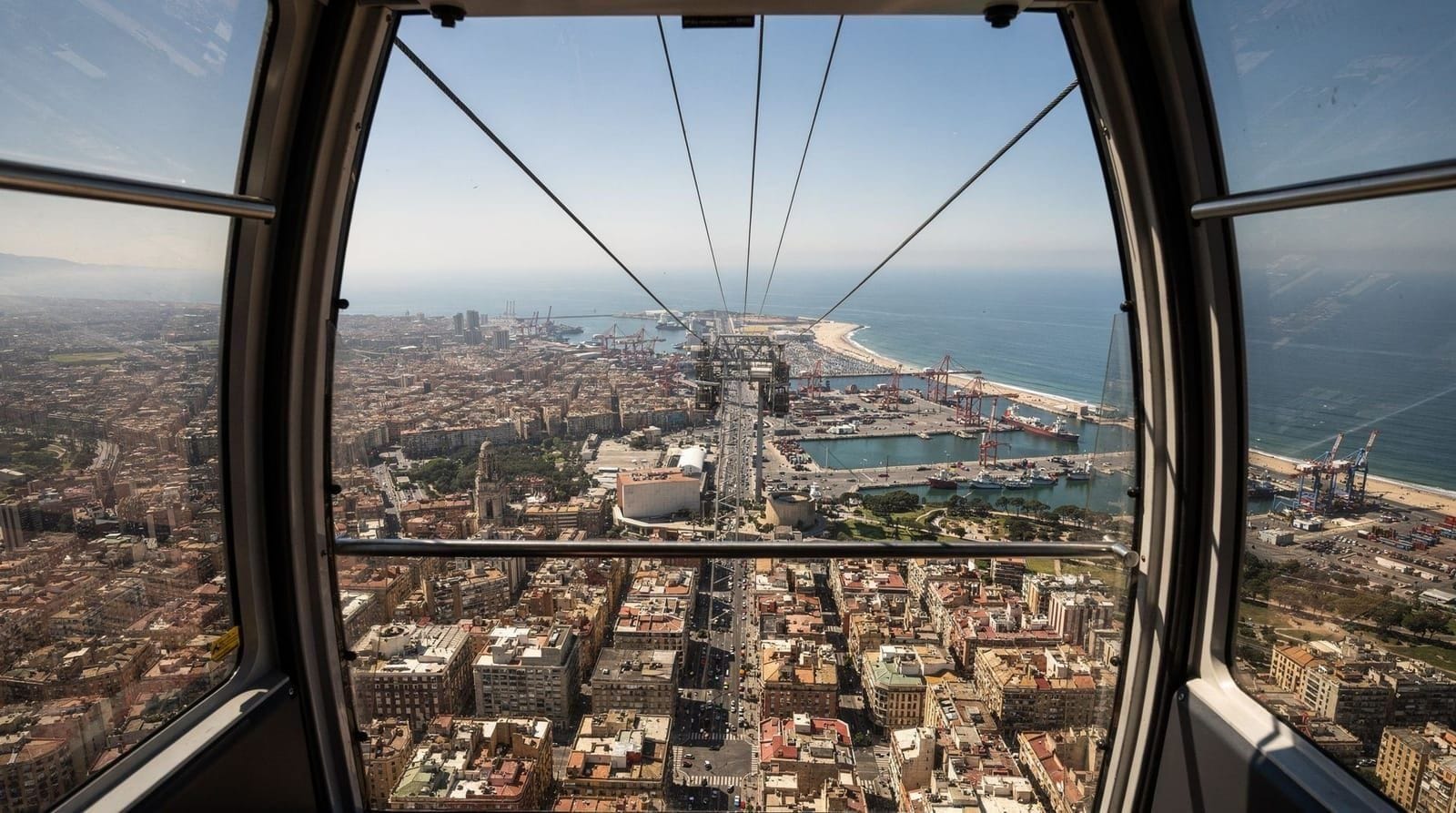
At the top of the funicular, you have two options. You can walk along the well-signposted park path to the Fundació in about 10 to 12 minutes through pleasant gardens. Alternatively, the Montjuïc cable car departs from near the funicular station and can take you higher up the hill toward the castle, passing above the Fundació area. If you are planning to visit the castle as well as the Fundació, the cable car makes sense as a sequence; if you are only going to the Fundació, the walk is faster.
Bus 55 runs directly from Plaça de Catalunya and stops near the Fundació entrance. This is particularly convenient if you are coming from the upper part of the city or from areas without a direct metro link to Paral·lel. Journey time from Plaça de Catalunya is roughly 25 minutes depending on traffic.
Driving is technically possible but practically pointless. Montjuïc road access is limited, parking is scarce, and the hill road slows down considerably in summer when tourist traffic increases. The public transport options are reliable and the approach by funicular is itself a small pleasure.
What else is on Montjuïc and how to plan a full day
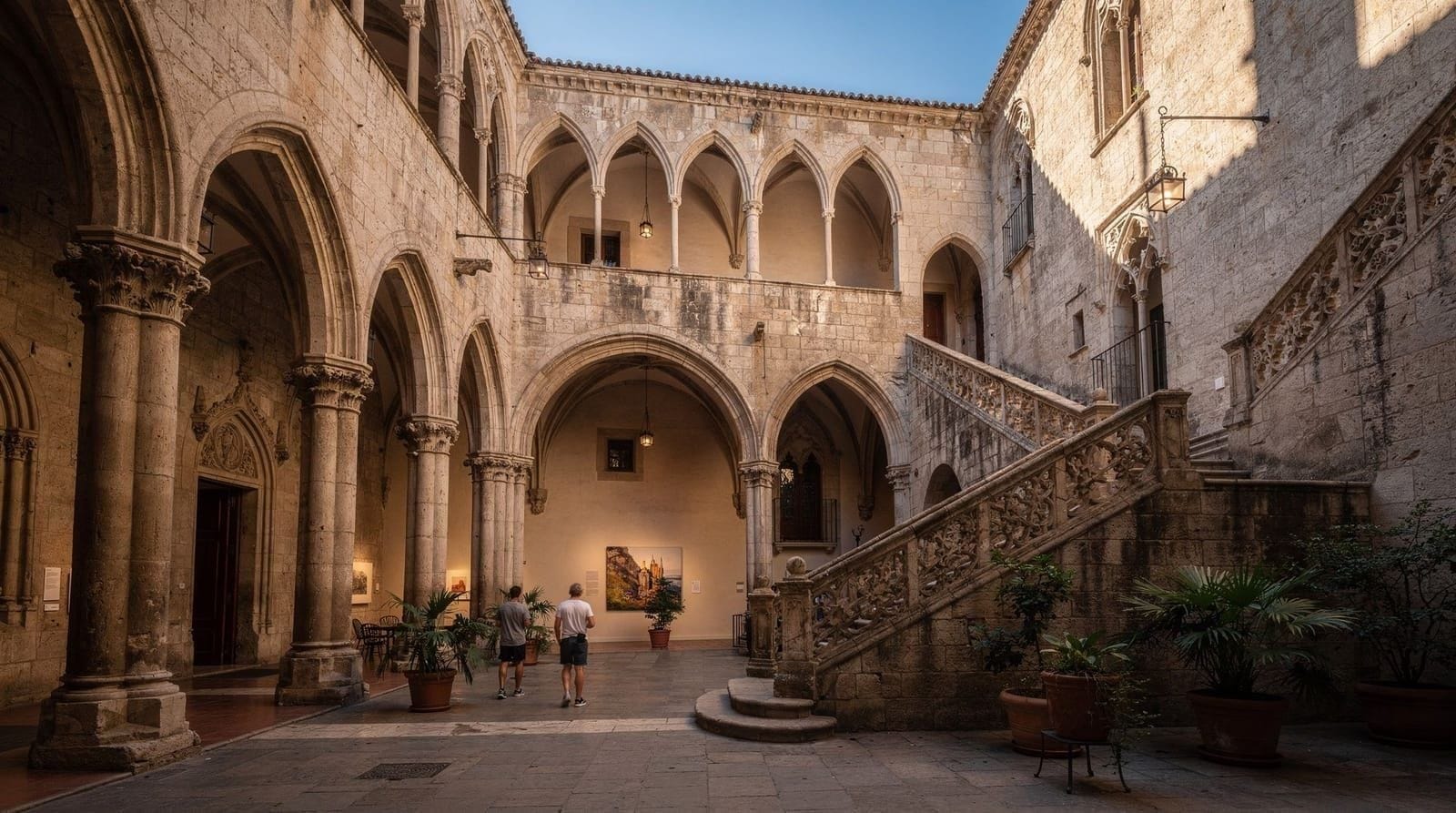
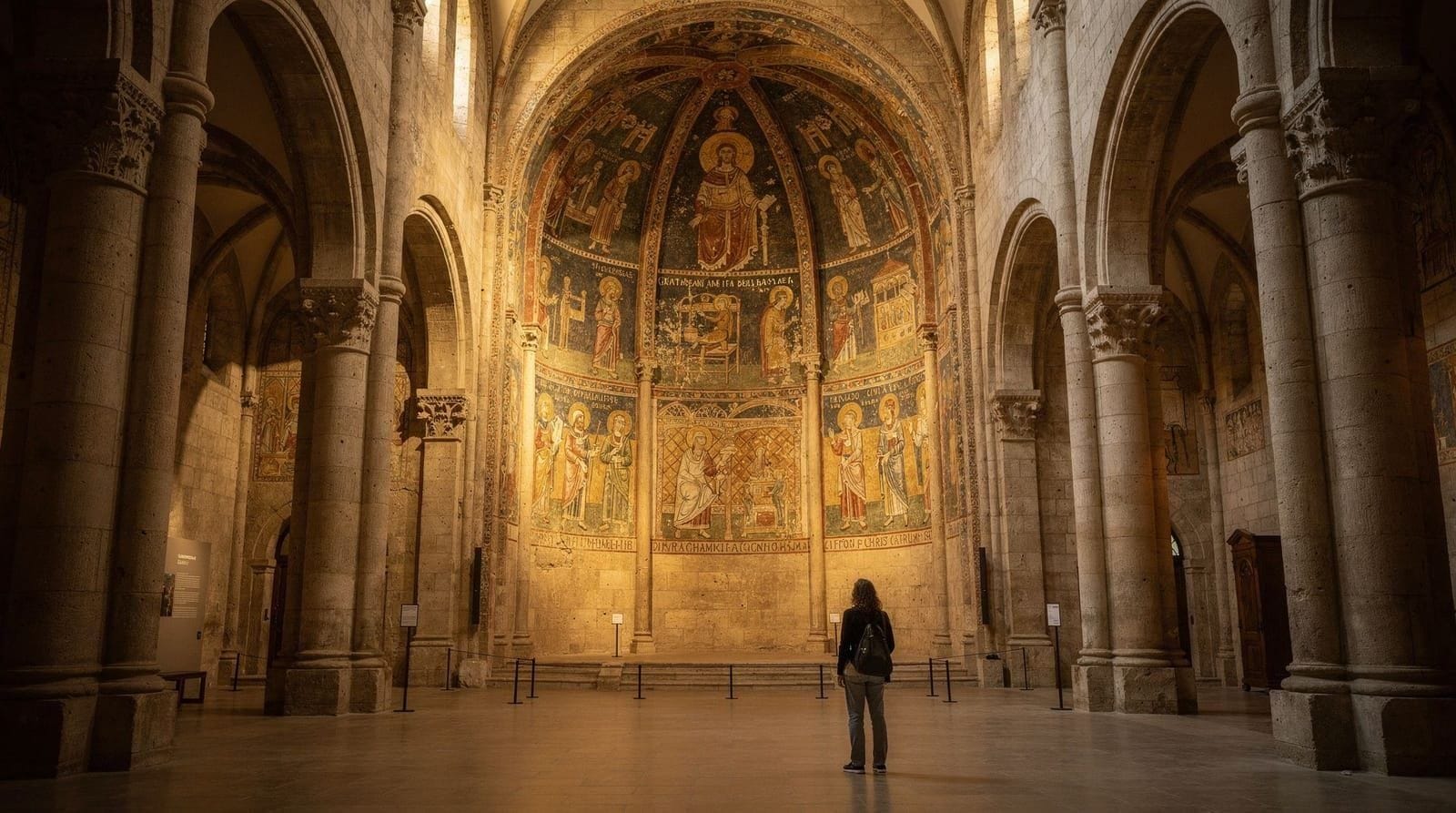
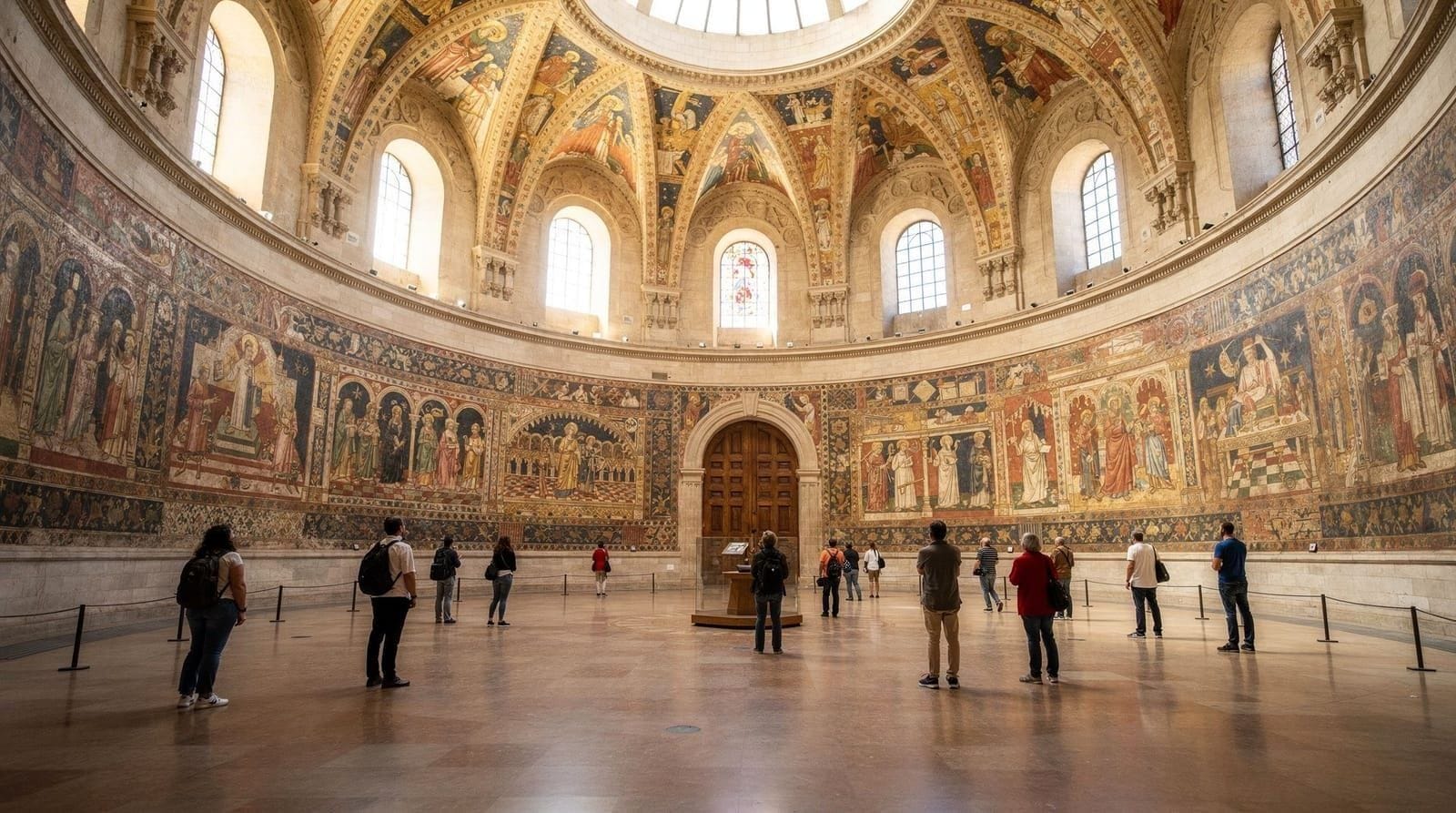
Montjuïc rewards a full day rather than a single museum visit. The MNAC (Museu Nacional d’Art de Catalunya) is 15 minutes from the Fundació along the park paths and contains one of the finest Romanesque art collections in the world — medieval frescoes rescued from Pyrenean churches and displayed in reconstructed apsidal chambers. It is an entirely different experience from Miró: solemn and ancient rather than luminous and modern, but the pairing works precisely because the contrast is so complete. Both museums are compact enough that you can cover both in a single day without feeling you have rushed either.
Above the MNAC, the hill continues up to the Castell de Montjuïc, a fortress with a complicated and often dark history as both a military installation and a site of political executions during and after the Spanish Civil War. The castle is now open as a museum and viewpoint, and the views from its walls — stretching across the entire Barcelona coastline, north toward Tibidabo and down into the port — are among the best unobstructed panoramas available anywhere near the city. The Montjuïc cable car connects the upper funicular station area with the castle and is a worthwhile experience in itself, particularly on a clear day.
Between the museums and the castle, Montjuïc has several garden areas that are useful when you need a break from indoor galleries. The Jardins de Laribal, on the terraced slopes below the castle road, are quiet and well-maintained, with water runnels and pergolas that feel very distant from the tourism intensity of the city below. The Jardins de Joan Brossa, closer to the castle, have open spaces and city views. Neither is a formal destination, but both are pleasant interludes in a long Montjuïc day.
The Poble Sec neighbourhood sits directly below Montjuïc to the east and is where you will naturally end up coming down from the hill in the evening. It has become one of the better areas for eating and drinking in Barcelona — Carrer de Blai (the pintxos street) runs parallel to the base of the hill and is an easy dinner option after a museum-heavy afternoon.
Ticket options: buying individually versus the Articket pass
A standalone adult ticket to the Fundació Joan Miró costs €15. There is no free-entry Sunday equivalent to the Picasso Museum’s programme — the Fundació does not offer a regular free day open to all visitors, though it occasionally runs free events as part of cultural festivals. A reduced ticket is available for qualifying groups; check the website for current eligibility.
For visitors planning more than two or three museum visits during their stay, the Articket BCN pass is the straightforward choice. At €38 for six museums — Miró, MNAC, Picasso Museum, MACBA, Fundació Antoni Tàpies and Museu Picasso — it saves approximately €46 versus buying individual tickets for all six. The pass includes skip-the-line entry at participating venues and is valid for 12 months from the date of first use, so you do not need to visit all six in a single trip.
If you are combining the Fundació with the Montjuïc cable car, roundtrip cable car tickets are sold separately and are worth booking ahead in summer when wait times at the lower station can extend to 20–30 minutes on popular weekends.
Hours, practical details and what to bring
The Fundació is open Tuesday to Saturday 10:00–20:00, with hours extending to 21:00 on Thursdays in summer — worth noting for a cooler afternoon visit in July or August. Sundays and public holidays the museum closes at 15:00, so an early arrival is essential on those days. The museum is closed Mondays.
Photography is permitted throughout the permanent collection. Audio guides are available in several languages and are particularly useful for the Constellations series and the context around the Mercury Fountain. The building is fully accessible with lifts connecting all levels. Lockers near the entrance are free and compulsory for large bags.
The café terrace has a pleasant outdoor seating area and is a reasonable option for lunch between the Fundació and a walk to MNAC — nothing exceptional, but decent enough and convenient, with good views toward the lower city on clear days. The museum shop is worth a few minutes: Miró’s graphic output was extensive across his career, and the range of quality prints, posters and catalogues available here is considerably better than what you will find in city-centre souvenir shops or at the airport. The permanent collection catalogue in particular is a worthwhile purchase if you found the Constellations series absorbing.
Crowds tend to peak between 11:00 and 14:00 on Saturdays, when tour groups are most concentrated. A 10:00 opening arrival is consistently the least crowded option. Thursday evenings in summer are also relatively quiet, and the extended hours make them practical for visitors with packed daytime schedules.
Miró and Barcelona: a lifelong attachment
Joan Miró never fully left Barcelona. Even when he moved his studio to Mallorca in the 1950s — and he worked there for the last three decades of his life — the city and Catalonia remained the emotional centre of his identity. The foundation was not simply a museum established at the end of a long career: it was a deliberate act of cultural rootedness, a decision to anchor a major body of work in the city where Miró had grown up and where he had formed the sensibility that shaped everything he made.
Miró was born in 1893 in the Gothic Quarter, the son of a goldsmith. He studied at the Escola de Llotja — the same art school where Picasso had enrolled a few years earlier under similar conditions — and later at the Barcelona Academy of Art under Francesc Galí, a teacher who would introduce him to the most progressive ideas circulating in European art at the time. These early years gave Miró a rigorous technical foundation that he then spent decades systematically dismantling in pursuit of a more essential visual language.
His early work shows the influence of Fauvism and Cubism very directly. By the early 1920s, living between Barcelona and Paris, he had begun developing the personal iconography that would become his signature: celestial bodies, biomorphic figures, primary colours against atmospheric grounds. The first fully mature Miró canvases — what critics later called his Detailist style, extraordinarily dense paintings in which every blade of grass is rendered with hallucinatory intensity — were made in Catalonia at his family farm in Montroig del Camp, looking at the Tarragona countryside.
The farm at Montroig was where Miró did his most sustained thinking about what painting could be. He returned to it every summer, working slowly and obsessively, producing the canvases that would travel to Paris and eventually to the wider world. Understanding this rhythm — the farm in summer, Paris or Barcelona in the working season, always in motion between the local and the international — helps explain the double quality in his work: simultaneously cosmopolitan and deeply rooted, formally experimental and iconographically Catalan.
The foundation preserves this biography in a way that few artist museums manage. The library, the study archive and the prints collection give researchers access to the full texture of a working life. For general visitors, the chronological rooms trace the development clearly enough that even those arriving with no prior knowledge of Miró’s work tend to leave with a firm sense of the arc.
How the Fundació fits into a broader Barcelona art itinerary
The natural Barcelona art circuit for a visitor who wants to trace the city’s creative history runs from the medieval and Romanesque collections at MNAC, through the early 20th century at the Picasso Museum in El Born, into Miró’s midcentury abstraction at the Fundació, and forward to the contemporary at MACBA in El Raval. Covering all four in a single trip gives you a remarkably comprehensive arc of Western art history, most of it at high quality.
The Picasso and Miró pairing is the most commonly attempted single-day combination. Both are achievable — Picasso in the morning in El Born, Miró in the afternoon on Montjuïc — but the travel time between them (metro to Paral·lel, funicular, walk) takes 30 to 40 minutes each way, so you need a reasonably early start and some stamina. Many visitors prefer two shorter days: one art day in the city (Picasso, Moco, a stroll through El Born) and one Montjuïc day (Miró, MNAC, castle and cable car). The two-day structure gives each museum the time it deserves and leaves energy for the neighbourhood exploration that makes both stops more memorable. Trying to cram three major art institutions into a single day is possible in a logistical sense, but the quality of attention you can give each one diminishes considerably by the third visit.
For practical budget planning across a museum-heavy stay, the Barcelona on a budget guide covers how to use free Sundays, Articket timing and seasonal variation to keep costs reasonable. The best time to visit Barcelona guide covers how Montjuïc specifically changes across the seasons — the hill is genuinely pleasant in winter, when the light is clear, crowds are thin and the gardens have a different, quieter quality.
Visit on a weekday morning, give the Constellations room the time it deserves, step out to the rooftop terrace before leaving, and continue up the hill to the castle for the view — it is one of the better half-days Barcelona offers.
Frequently asked questions about Fundació Joan Miró
How much does the Fundació Joan Miró cost?
Adult entry costs €15. The foundation is included in the Articket BCN pass (€38), which covers five other major Barcelona museums. There is no free-entry day equivalent to the Picasso Museum's first Sunday.How long do you need at the Fundació Joan Miró?
The collection rewards 1.5 to 2 hours at a relaxed pace. If you combine it with the rooftop sculptures and any temporary exhibition, allow closer to 2.5 hours.Can I combine the Fundació Joan Miró with MNAC on the same day?
Yes, and it makes good logistical sense. Both are on Montjuïc and a 15-minute walk apart. Visit Miró in the morning when it is quieter, then MNAC over lunch and into the afternoon.Is the Articket BCN worth it for the Fundació Joan Miró?
Yes if you plan to visit at least two other Articket museums during your stay. The pass costs €38 and covers six venues including Miró, MNAC, Picasso Museum and MACBA — a saving of around €46 versus buying individually.What is the Fundació Joan Miró known for?
The permanent collection holds around 10,000 works by Miró, including paintings, sculptures, tapestries and graphic works. The building by Josep Lluís Sert is itself an attraction — rationalist, luminous and perfectly scaled to the art inside.Is the Fundació Joan Miró suitable for a quick visit before catching a flight?
It's possible but not ideal — the collection rewards 1.5–2 hours, and reaching Montjuïc by metro and funicular from the city centre takes 20–30 minutes each way. If time is very tight, prioritise the chronological galleries and the Constellations room over the rooftop terrace.
Top experiences
Bookable activities with verified prices and instant confirmation on GetYourGuide.