MNAC Barcelona: Romanesque art, free days and how to visit
Barcelona: skip-the-line entry to 6 top art museums
Duration: Full day
- Free cancellation
Is the MNAC free to visit?
Entry is free on the first Sunday of every month. Standard adult tickets cost €12. The museum is included in the Articket BCN pass (€38), which covers six Barcelona art museums with skip-the-line access.
| Where | Palau Nacional, Montjuïc |
| Cost | Around €12, free first Sunday of the month |
| Time needed | 1.5–2 hours for Romanesque alone, half a day for everything |
| Getting there | Metro Espanya (L1/L3), walk up the avenue |
| Best time | Opening (10:00) on weekdays for quiet Romanesque galleries |
The Museu Nacional d’Art de Catalunya occupies the Palau Nacional at the crest of the Avinguda de la Reina Maria Cristina on Montjuïc — the vast, domed neoclassical building that has anchored the hill since the 1929 International Exposition. The view from its terrace looking back across Barcelona, with the grid of the Eixample stretching to the sea and Tibidabo visible in the haze behind the city, is one of the genuinely free pleasures of a visit, available even if you do not go inside. But the building’s imposing exterior is almost a distraction from what it contains: the MNAC holds the finest collection of Romanesque art in the world, and most visitors who enter expecting a solid regional museum leave considerably more impressed than they anticipated.
The Romanesque collection: why it is genuinely irreplaceable
In the opening decades of the 20th century, a small group of Catalan art historians, archaeologists and museum officials undertook one of the most ambitious cultural rescue operations in European history. Remote Pyrenean churches — many accessible only by mountain track, serving villages that had been depopulating since the Industrial Revolution — were being systematically stripped of their medieval frescoes by foreign collectors and dealers. The method was simple and destructive: detach the painted plaster from the walls, roll or section it, and ship it to buyers in New York, Munich and Paris. By the 1900s the process was well advanced, and significant panels from Catalan Romanesque churches had already entered collections in the United States and Germany.
The Catalan government and the Institut d’Estudis Catalans responded by commissioning their own team to detach and preserve the remaining frescoes before they disappeared entirely. The technique was painstaking: the plaster was stabilised with a layer of canvas, carefully removed in sections, and transported to Barcelona. Over several decades, starting around 1919, they brought back thousands of fragments from dozens of churches across the Pallars, the Vall de Boí and the broader Pyrenean valleys.
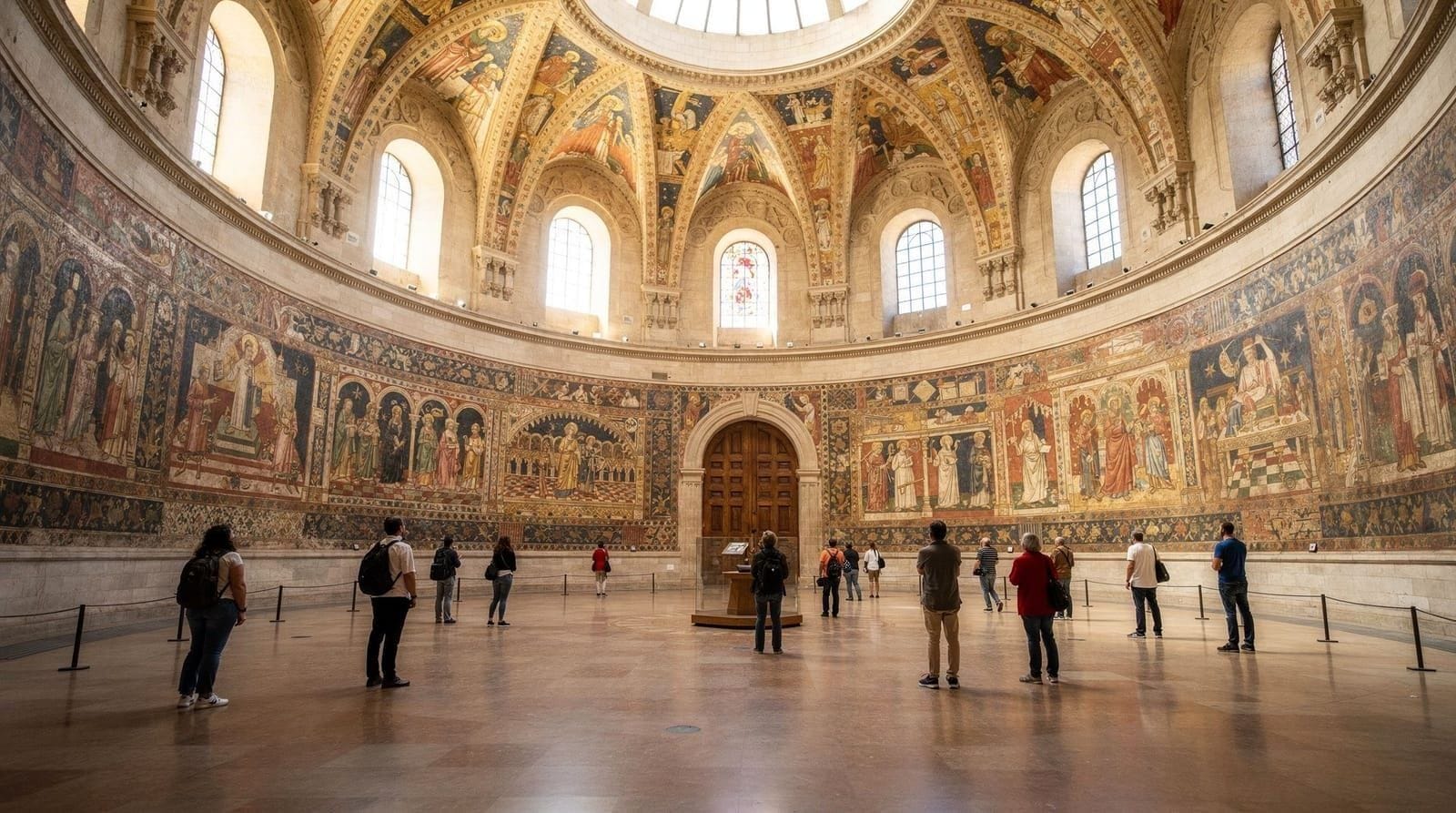
What they brought back fills the entire ground floor of the MNAC. Room after room contains reassembled apses — the curved eastern ends of Romanesque churches — with frescoes still intact on the original plaster, now displayed in purpose-built semicircular chambers that approximate the original architectural context as closely as modern construction allows. The effect is not like looking at paintings in a conventional gallery. You stand inside reconstructed church interiors and feel the space close around you, as it would have done for a 12th-century parishioner entering the church on a Sunday morning.
The Christ in Majesty from Sant Climent de Taüll, painted around 1123, is the centrepiece of the collection and one of the most reproduced images of Romanesque art in any context. The frontal, almond-eyed Christ set in a luminous mandorla, surrounded by apostles and the symbols of the four evangelists, painted with formal authority and hieratic gravity, is among the most powerful single images in any museum in Spain. Seeing it reproduced in a textbook does not prepare you for being enclosed by it in three dimensions, the apse curving overhead, the painted figures descending on both sides.
Adjacent rooms hold apses from Sant Joan de Boí, Santa Maria de Taüll and a dozen other churches, each with distinct stylistic character and quality of preservation. The altarpieces, wooden crucifixes, reliquary chests and liturgical objects displayed between and around the apse rooms add further depth — these are objects of daily religious use from communities that no longer exist in the forms that produced them, preserved through what amounts to an institutional act of will over several generations.
The quality and density of this collection is extraordinary by any international standard. The Musées de Cluny in Paris, the Metropolitan Museum in New York, the Victoria and Albert in London — all hold significant Romanesque works. None holds anything approaching this concentration of in-situ fresco in its original architectural context.
What else is in the museum
The MNAC’s holdings do not stop with the Romanesque. The medieval collection extends through a substantial Gothic section covering panel paintings and altarpieces from the 14th to 16th centuries, tracing the gradual shift from the flat, gold-background hieratic style of the Romanesque toward the Italian-influenced naturalism of the early Renaissance. Catalan Gothic had its own distinctive character — a certain hardness of line and intensity of colour that distinguishes it from the softer Sienese models it partly followed — and the museum’s holdings are the best place to understand it.
The Renaissance and Baroque section includes works by El Greco, Zurbarán and Velázquez alongside Catalan painters who are considerably less well known internationally but form an important thread in the regional story. This section is often moved through quickly by visitors who came for the Romanesque, but it repays attention.
The Modernisme galleries, covering roughly 1880 to 1910, are one of the unexpected strengths of the collection. This is where the MNAC displays furnishings, decorative arts, ceramics, glass and paintings from the same era as Gaudí’s Sagrada Família and the Passeig de Gràcia buildings, giving substance and texture to what you see in the streets of the Eixample. The collection includes major works by Ramon Casas and Santiago Rusiñol, the painters most associated with the Els Quatre Gats café where the young Picasso spent his early Barcelona evenings. Casas’s enormous canvas of a man being dragged by a galloping horse, originally a billboard-scale painting for the Anís del Mono brand, is one of the collection’s most striking individual works.
The 20th-century section picks up from around 1910 and runs forward through Noucentisme (the classical, Mediterranean-influenced reaction to Modernisme’s ornamental excess), modernist painting and sculpture, and into the postwar period. The museum also holds the Thyssen-Bornemisza collection on long-term loan — primarily Italian and German panel paintings from the 13th to 18th centuries — which broadens the chronological and geographic range considerably.
Free entry and ticket prices
Standard adult entry costs €12, which covers both the permanent collection and most temporary exhibitions running alongside it. The museum offers free entry on the first Sunday of every month, all day from opening to closing. Unlike the more tourist-focused free days at some other Barcelona museums, the MNAC’s free Sundays tend to attract a mixed audience of locals and visitors, and the museum’s large size means crowds are manageable even on popular dates.
That said, the busiest free Sundays — particularly in April, May, September and October, when the Barcelona tourist season is at its peak and weather is good — do see significant queues. Arriving at the 10:00 opening is strongly advisable if you plan to use the free day. Mid-afternoon on a free Sunday is usually the worst time to arrive.
For visitors planning several museum visits, the Articket BCN pass covers the MNAC alongside five other major institutions — Fundació Joan Miró, Picasso Museum, MACBA, Fundació Antoni Tàpies and Museu Picasso — for €38, with skip-the-line access at all six venues and 12-month validity. At €12 for the MNAC alone, it is one of the higher-priced individual tickets in the Articket group, which makes it a useful anchor for the pass calculation: if you visit MNAC plus two others, the pass has paid for itself.
There are reduced rates for various qualifying groups, and under-16s typically enter free. Check the museum’s official website for current eligibility, as the categories have shifted in recent years.
Getting there: approach options and practical advice
The most dramatic way to arrive — and the one that most clearly frames the experience — is by metro to Espanya station on the L1 (red) or L3 (green) line. Coming up from the station, you follow the Avinguda de la Reina Maria Cristina through the remnants of the 1929 World Exposition: the old trade fair pavilions that still house various Barcelona institutions on either side, the Pavelló Mies van der Rohe (the reconstructed German pavilion, a pilgrimage site for architecture enthusiasts) just to the right, and the Magic Fountain of Montjuïc at the head of the avenue. The Palau Nacional fills the view from the moment you exit the station, so the 15-minute walk up the avenue is more a procession than a slog.
Alternatively, take the Funicular de Montjuïc from Paral·lel station — included in the metro fare — and walk downhill through the park paths toward the museum. This approach is faster if you are coming from further east, and gives you more time for the terrace views once you arrive. If you are combining the MNAC with the Fundació Joan Miró, the walk between the two through the park is a pleasant 15 minutes and can be done in either direction.
Bus 55 runs from Plaça de Catalunya directly to the Montjuïc stops and is useful if you are starting from the northern end of the Rambla or the Gothic Quarter area. The journey takes around 25 minutes depending on traffic.
Cars are not recommended. The Montjuïc road is slow in summer, parking is genuinely scarce, and the metro-plus-funicular option is faster in practice for most starting points in the city.
Planning a full Montjuïc day around the MNAC
The MNAC and the Fundació Miró are the natural pair for a Montjuïc day, and together they fill a satisfying full day without feeling rushed. Visit the Fundació Miró in the morning — it opens at 10:00 and the galleries are at their least crowded between 10:00 and 11:30 — then walk through the park to the MNAC for a later morning or early afternoon session. Both can be done at a reasonable pace in a single day if you allocate around two hours to each.
The contrast between the two museums is remarkable: Miró’s luminous midcentury abstraction, housed in a building of brilliant Mediterranean rationalism, versus the solemn intensity of 12th-century Pyrenean fresco inside a building of neoclassical grandeur. If you visit them on the same day, you will leave Montjuïc with a disorienting but interesting sense of how much Spanish and Catalan art has transformed across a millennium.
Above the MNAC, the Montjuïc path continues toward the Castell de Montjuïc — roughly 30 minutes on foot, or reachable by cable car from the upper funicular junction. The castle views over the coastline are a natural endpoint for a hill day. Coming down in the early evening, Poble Sec at the foot of Montjuïc has some of the city’s better eating options, particularly along Carrer de Blai and the streets off Carrer del Parlament.
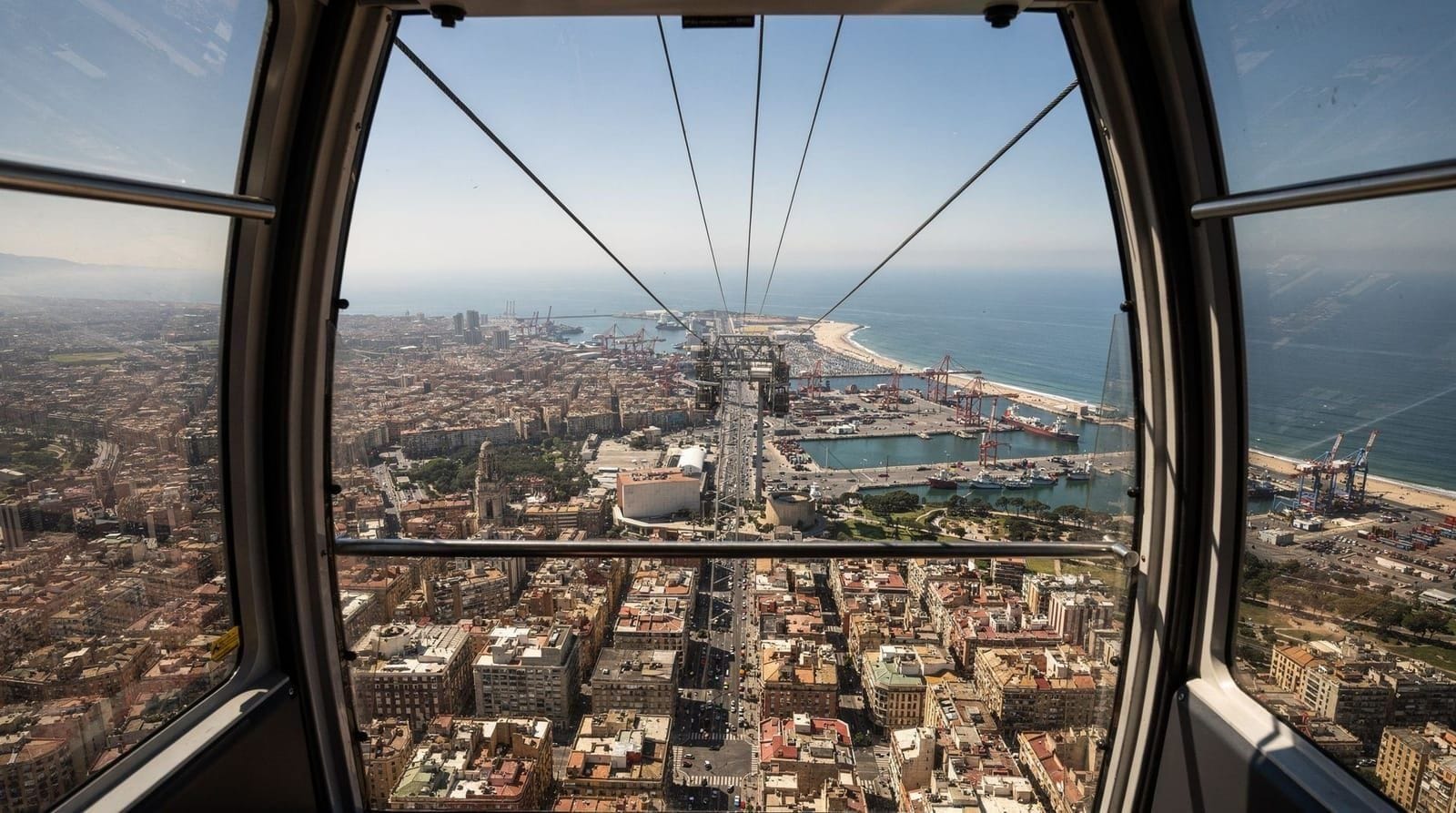
For visitors who want to see the Montjuïc highlights from above before committing to the museums on foot, the Montjuïc cable car roundtrip provides a good aerial orientation — the views over the port and the lower city to the south are different from the terrace views of the MNAC and together they give you a comprehensive sense of the hill’s geography.
The story of the 1929 Palau Nacional and what it means for the museum
The building itself has a history worth understanding, because it shapes the experience of visiting in subtle ways. The Palau Nacional was built for the 1929 International Exposition of Barcelona as the centrepiece of the fairground laid out on Montjuïc’s lower slopes — a deliberate statement of Spanish imperial grandeur at a moment when the country was under the dictatorship of Primo de Rivera and anxious to project stability and civilisation to the world. The building’s Baroque revival design, with its twin towers, massive dome and cascading stairways, was intended to impress rather than to function as a museum. It succeeded in the first aim.
After the exposition closed, the building hosted various exhibitions and eventually became the home of the art collection now known as the MNAC, though the definitive consolidation of the collection into a single institution did not occur until 1990. The renovation by Gae Aulenti — the same architect who converted the Orsay railway station into a museum in Paris — opened the modern MNAC in phases through the 1990s and 2000s, and the current building represents decades of considered museum conversion work underneath the original shell.
The result is a museum that sits somewhat awkwardly in its own architecture: the grand halls and ceremonial spaces of a 1920s exposition building, fitted out with the neutral gallery infrastructure of a late-20th-century museum. In most rooms this tension resolves itself quietly. In the Romanesque wing, where the apsidal chambers were purpose-built within the existing structure, the insertion works particularly well — the circular church reconstructions sit within rectangular rooms in a way that feels contained and focused rather than forced.
The terrace experience benefits most directly from the original building’s ambitions. Standing on the esplanade looking back down the Avinguda de la Reina Maria Cristina toward the Plaça d’Espanya, with the Venetian towers framing the view and the city spreading in every direction below, you understand exactly the statement the 1929 planners intended to make. Whatever you think of the political context of that statement, the view is genuine and it is free.
The museum’s relationship to Catalan identity
No honest account of the MNAC can entirely separate the collection from the political dimension it carries for many Catalan visitors. The Romanesque rescue project of the early 20th century was not purely an act of cultural preservation — it was also, explicitly and self-consciously, a project of national definition. The Catalan intellectuals who organised the frescoes campaign believed they were recovering evidence of a specifically Catalan medieval culture, distinct from Castilian Spain and with roots running back to the Carolingian period. The collection they assembled was meant to demonstrate that Catalonia had been a significant cultural producer for a thousand years.
This context does not diminish the quality of the art or the importance of its preservation, but it does add a layer to the visit that is worth being aware of. Many of the interpretive texts in the museum still carry traces of this framing — the Catalan Romanesque is presented as a coherent school with a distinct identity, which is broadly accurate as art history and simultaneously a position in an ongoing cultural argument. International visitors who are used to thinking of Romanesque art as a broadly European phenomenon will find some of the curatorial framing more emphatic about Catalan specificity than they might expect.
This is not a criticism of the museum. It is simply worth knowing in advance that the MNAC is doing more than one thing at once — functioning simultaneously as an art museum of international quality and as a cultural institution that addresses a specific Catalan public and its sense of its own history.
What to prioritise if your time is short
If you have only 60 to 90 minutes rather than a half-day, go directly to the Romanesque galleries on the ground floor and spend the entire time there. The room containing the Sant Climent de Taüll apse is the irreplaceable core of the collection. Find it on the floor plan available at the entrance (the Romanesque wing is clearly marked) and be in that room before you look at anything else. Everything else in the MNAC is excellent but broadly comparable to other European museums of similar standing. The Romanesque galleries are not replicated at the same quality anywhere else on earth.
If you have more time and energy after the Romanesque wing, the Modernisme section is the second priority — it provides essential context for the architecture you are seeing in the Eixample streets and the Gràcia neighbourhood, and it is one of the more underappreciated sections of the museum. The Gothic collection is third on most visitors’ lists but has genuine depth for anyone with an interest in medieval panel painting.
Practical information
The MNAC is open Tuesday to Saturday 10:00–18:00, Sunday and public holidays 10:00–15:00, closed Monday. The museum closes at 15:00 on Sundays, which is easy to underestimate — plan to arrive by 12:30 at the latest if you want a full Sunday visit.
The rooftop terrace (reached via lift from the main hall) is accessible without a museum ticket and is one of the better free viewpoints on Montjuïc. The panoramic view from up there includes the Magic Fountain below and the city spreading all the way to the sea. It is a legitimate destination on its own and worth 15 minutes regardless of whether you are visiting the collection.
The café on the main level has a pleasant outlook and reasonable prices for a tourist-facing museum café. The museum shop, on the ground floor near the exit, has an unusually strong selection of art history books, including Romanesque-specific titles — English, Catalan, Spanish and French — that are difficult to find in the city’s general bookshops.
Photography is permitted throughout the permanent collection without flash. Audio guides are available and are particularly well-suited to the Romanesque wing, where the guides provide both the archaeological context (where each church stood, what happened to the community that built it) and the art-historical reading. The building is fully accessible with lifts throughout. Lockers are available near the main entrance for large bags.
For visitors planning further art in the city, our Barcelona on a budget guide explains how to combine MNAC’s free Sundays with other free-day windows across a week’s stay. The best time to visit Barcelona covers how Montjuïc’s crowds shift seasonally — January and February are genuinely quiet months on the hill, with clear winter light that makes the MNAC terrace particularly good. For evenings after a Montjuïc day, the vermut bars of Poble Sec below the hill are a 10-minute walk from the Espanya metro exit and are among the better pre-dinner options in that part of the city.
MNAC compared to Montjuïc’s other major museum
| MNAC | Fundació Joan Miró | |
|---|---|---|
| Focus | Romanesque to 20th-century Catalan art | One artist’s full career |
| Signature work | Christ in Majesty, Sant Climent de Taüll | Miró’s sculptures and late paintings |
| Setting | 1929 Palau Nacional, grand terrace | 1975 Sert building, garden sculptures |
| Time needed | 1.5–2 hours minimum | 1.5–2 hours |
| Adult price | Around €12 | Around €15 |
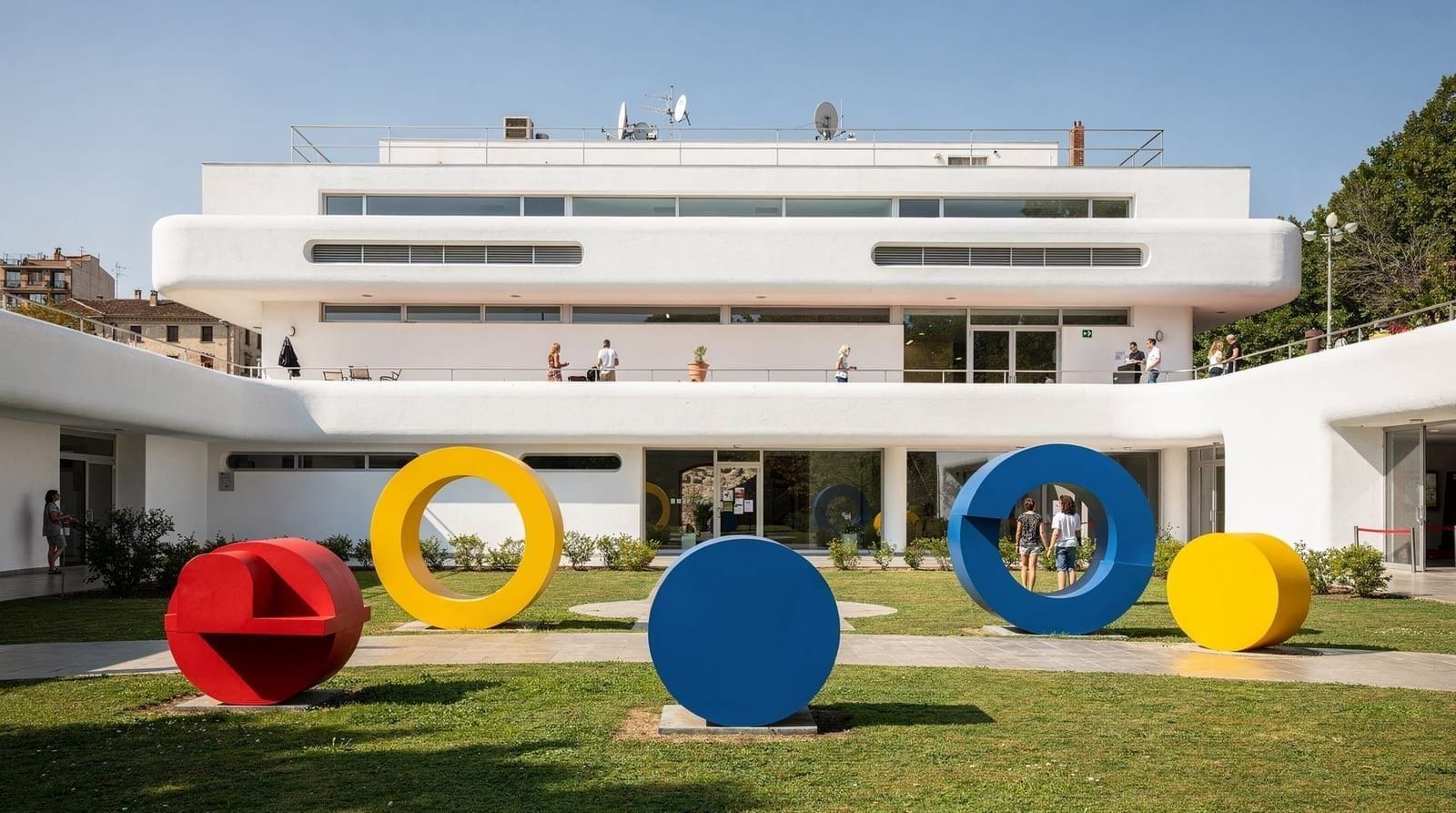
Both sit on Montjuïc a 15-minute walk apart and pair naturally into a single art-focused day — see the planning section above for a suggested order. If you are visiting several of Barcelona’s major museums in the same trip, a combined skip-the-line ticket covering the MNAC alongside the Miró Foundation and other major collections is worth pricing against buying each ticket separately. Families travelling with children who find a full Romanesque wing slow going often do better splitting the two museums across separate mornings rather than combining them into one long day — the Miró Foundation’s sculpture garden gives children something physical to engage with in a way the MNAC’s more contemplative galleries do not, so leading with Miró and treating the MNAC as an optional add-on tends to work better for family groups than the reverse order.
For the aerial orientation of Montjuïc before or after your museum time, a cable car roundtrip covering the hill’s main viewpoints complements the MNAC terrace view well, giving you the wider geography that the terrace alone only partly shows.
Booking, timed entry and what to expect at the door
Unlike the Sagrada Família or the Picasso Museum, the MNAC does not operate a timed-entry system for standard visits — you can buy a ticket at the counter or online and walk straight in on most days, which removes one layer of pre-trip planning most visitors have to do for Barcelona’s other major sights. The exception is the free first Sunday of the month, when a queue forms from before opening and a genuine wait is likely if you arrive after about 10:30. Buying an online ticket in advance for a paid visit is still worth doing if your schedule is tight, mainly to skip the ticket counter itself rather than because the museum sells out — the galleries rarely reach uncomfortable capacity outside the free Sunday window.
Why the apse rooms feel different from a normal gallery
It is worth pausing on why the Romanesque wing has such an unusually strong effect on first-time visitors, because it is easy to underestimate from photographs. Conventional museum display removes an object from its original context and presents it in isolation — a fresco fragment on a wall, lit and labelled like any other painting. The MNAC does the opposite: an entire semicircular apse, floor to ceiling, has been reassembled at something close to its original scale and curvature, so that walking into the room means walking into an approximation of the church itself. The ceiling curves overhead the way it would have for a medieval parishioner; the figures are positioned at the height and angle they were painted to be seen from below. This is closer to an installation than a conventional hang, and it is the reason repeat visitors often say a second or third visit to the same rooms still produces a physical reaction that a photograph never does. If you have any interest in medieval art at all, resist the temptation to walk the Romanesque wing quickly on the way to the rest of the museum — it is worth the full 90 minutes the guide above suggests, ideally with the audio guide adding the archaeological story behind each individual apse.
Arrive at opening, spend the first 90 minutes in the Romanesque galleries without rushing, and you will understand why this collection is considered irreplaceable — the experience of standing inside a 12th-century Pyrenean church apse in the middle of a 21st-century city is one of the stranger and more rewarding things available anywhere in Barcelona.
Frequently asked questions about MNAC Barcelona
How much does the MNAC cost?
Standard adult entry is €12. The ticket includes both the permanent collection and most temporary exhibitions. Entry is free on the first Sunday of each month. The MNAC is also included in the Articket BCN pass alongside five other major museums.What is the MNAC most famous for?
The Romanesque art collection is widely considered the best in the world. The museum rescued thousands of medieval frescoes, altarpieces and wooden sculptures from remote Pyrenean churches in the early 20th century and reassembled them in purpose-built apsidal rooms.How long do you need at the MNAC?
The Romanesque galleries alone take 1.5 to 2 hours to do justice. The Gothic, Renaissance, Baroque, Modernisme and 20th-century sections add another 1.5–2 hours if you visit them fully. A half-day is ideal; rushing it in an hour is a waste.How do I get to the MNAC?
Metro to Espanya station (L1 or L3), then walk up through the Avinguda de la Reina Maria Cristina — the approach past the old World Exposition pavilions is part of the experience. Alternatively, take the Funicular de Montjuïc from Paral·lel and walk down from higher on the hill.Can I combine MNAC with the Fundació Joan Miró on the same day?
Yes, comfortably. Both are on Montjuïc and a 15-minute walk apart through the park. Visit the Fundació Miró in the morning and the MNAC in the afternoon, or reverse the order depending on which opens first on your chosen day.Is the MNAC or the Picasso Museum a better priority if I can only visit one?
It depends on what you want. The MNAC's Romanesque collection is genuinely unrepeatable anywhere else in the world and rewards visitors interested in medieval art and Catalan history; the Picasso Museum traces one artist's formative years in unusual depth and is more accessible to visitors without a background in art history. If you only have time for one and you have never seen anything like the Romanesque apses before, the MNAC is the stronger single recommendation.Does the MNAC have an audio guide in English?
Yes. Audio guides are available at the entrance in several languages including English, and are particularly worthwhile for the Romanesque wing, where they explain both the archaeological rescue story and the art-historical context of each apse. Renting one adds meaningfully to a first-time visit, especially if you are prioritising the Romanesque galleries over the rest of the museum.
Top experiences
Bookable activities with verified prices and instant confirmation on GetYourGuide.