Best paella in Barcelona: where to find it (and what to avoid)
Barcelona: paella cooking experience & Boqueria market tour
Duration: 3 hours
- Free cancellation
Where can I find good paella in Barcelona?
Away from the beach. Can Solé in Barceloneta (founded 1903) and La Mar Salada near the waterfront are the most reliable bets for genuine paella. Inland restaurants in the Eixample also do good rice dishes without tourist pricing. Avoid anything fronting the sand — the quality-to-price ratio at beachfront paella restaurants is reliably poor.
Paella is the dish every visitor to Barcelona wants to eat, and finding a good version of it is harder than it should be. The problem is structural: the most visible paella — bright, steaming, displayed in huge pans outside restaurants facing the beach — is also the worst paella. This guide explains why, and where to go instead.
| Avoid | Any Passeig Marítim beachfront restaurant with photo menus |
| Try instead | Can Solé, La Mar Salada, or an inland Eixample restaurant |
| Cost | Around €20–25/person at a serious restaurant |
| Booking | 24–48 hours ahead for genuine cooked-to-order paella |
| Alternative | Fideuà — the more genuinely Catalan rice-pan dish |
The beachfront paella problem: a direct account
The restaurants lining the seafront near Barceloneta operate on a specific economic logic. Millions of tourists pass through each year. Most of them are visiting Barcelona once and will never return to any specific restaurant. The incentive to cook well is therefore minimal; the incentive to maximise turnover is total.
The result is a consistent product across most beachfront paella restaurants: rice that was cooked earlier in the day (or yesterday) and reheated to order, seafood that is frozen rather than fresh, saffron replaced with yellow food colouring, and a bill that reaches €25–35 per person before drinks. The pan that arrives at the table is often not the pan the rice was cooked in — it is a serving vessel. The defining quality of real paella, the socarrat (the caramelised crust that forms against the bottom of the pan), is absent because there was no pan-cooking involved.
Touts at the door add to the picture. Aggressive menus in six languages, photographs on laminated boards, spoken minimum spends — all reliable indicators of what you are about to receive.
This is not a travel writer’s exaggeration or snobbery about tourist restaurants. It is the consistent observation of food writers, local residents and the restaurants themselves that operate in the same area at higher standards. Several of the better Barcelona-adjacent restaurants have publicly noted the damage done by beachfront rice dishes to expectations around what paella should be.
Walk two blocks inland. The prices drop, the quality improves, and the rice is cooked in the pan it arrives in.
What real paella is
Before eating or cooking paella in Barcelona, it helps to understand what you are looking for.
Origin: paella comes from Valencia, not Catalonia. The original is a field workers’ dish made with short-grain rice, rabbit, chicken, green beans, tomato, saffron and water — cooked over an orange wood fire in a wide, flat iron pan (the paella, which is also the dish’s name). The seafood version is a coastal adaptation. It became associated with the wider Spanish food identity, but its roots are distinctly Valencian.
The rice: the variety matters. Bomba or senia rice — short-grain, grown in Valencia or the Ebro Delta — absorbs stock without becoming mushy and holds its structure through the cooking process. It cannot be substituted with arborio, basmati, or any other type without changing the result fundamentally.
The sofregit: the flavour base. Onion, tomato and garlic cooked down for twenty to thirty minutes until reduced and almost jammy. This is the foundation of Catalan and Valencian cooking alike, and a rushed or skipped sofregit is one of the main indicators of a poor paella.
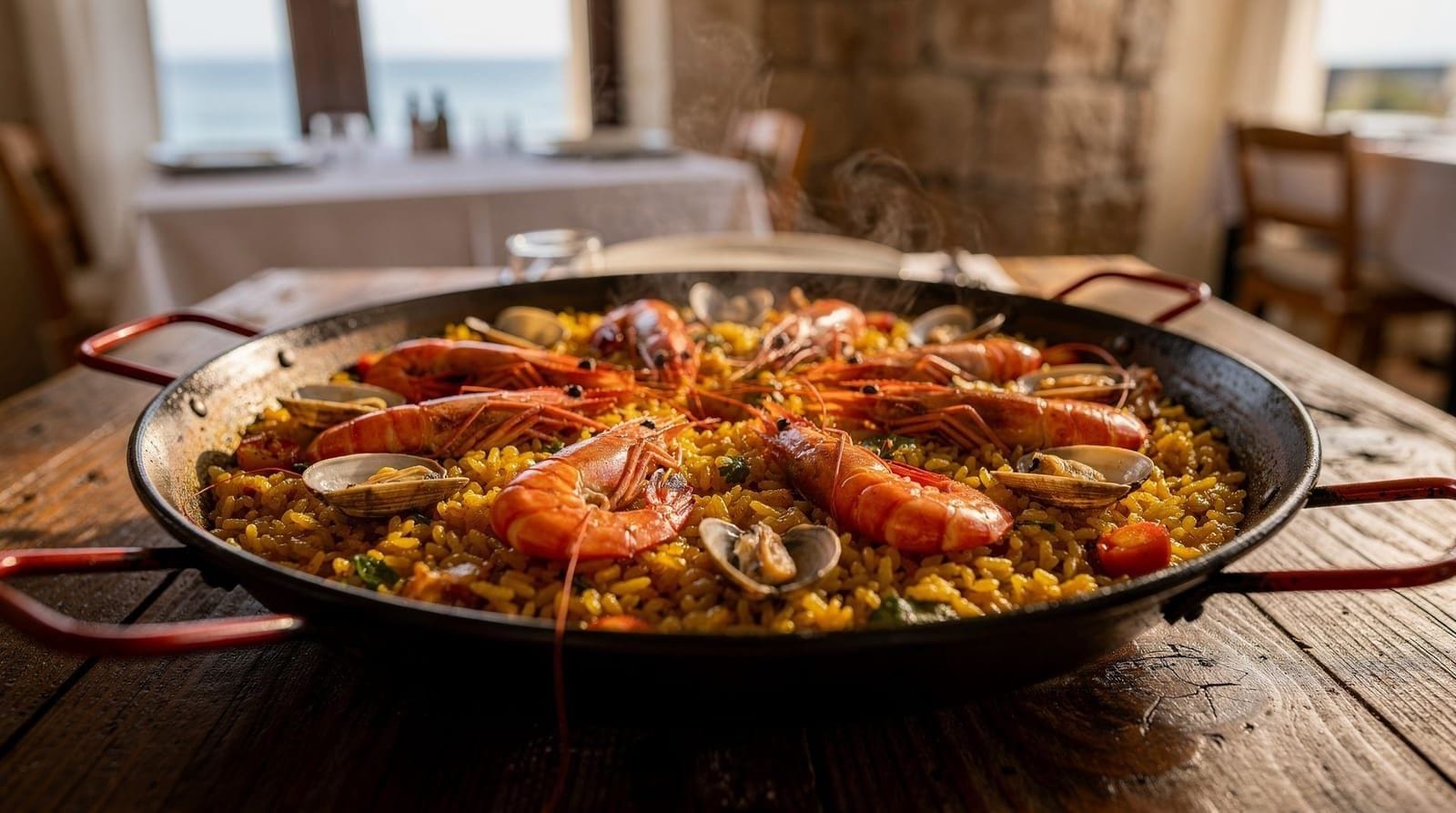
The socarrat: the caramelised layer of rice that forms on the bottom of the pan in the final minutes of cooking, when the liquid has been fully absorbed and the heat is raised briefly. A slight crackling sound tells you it is forming. This is the most prized part of the paella — the part regulars at serious restaurants ask for specifically. Its absence tells you a great deal about how the dish was cooked.
The stock: in a seafood paella, the stock should be made from the prawn shells and heads, fish bones and aromatics, simmered and strained. Ready-made fish stock exists and is used by some restaurants; homemade stock is better and distinguishable.
Where to find good paella in Barcelona
Can Solé — Barceloneta
Can Solé on Carrer de Sant Carles is the clearest answer to the question of where to find real paella in Barceloneta. The restaurant has been run by the same family since 1903 — more than 120 years in the same location, serving the same fishing neighbourhood. The rice is cooked to order, the seafood is fresh, and the socarrat is present. The room is old-school comfortable rather than fashionable.
The approach is old Barcelona: you call ahead, you specify how many, they confirm the paella is available. It is worth booking a day in advance, particularly on Sundays. The price is fair for the quality — roughly what you would expect to pay at a serious restaurant, and considerably less than a beachfront tourist trap of equivalent ambition.
La Mar Salada — near Barceloneta
La Mar Salada sits a short walk from the beach on Passeig de Joan de Borbó, but operates entirely differently from the beachfront places. The kitchen is serious, the seafood is sourced daily, and the paella is available in seafood and mixed versions. Like Can Solé, it requires a reservation and offers advance notice for the rice.
The room is brighter and slightly more contemporary than Can Solé. It works for a longer lunch rather than a quick meal.
Inland restaurants in the Eixample and beyond
Several restaurants in the Eixample serve paella and rice dishes that are better than most of what is available near the waterfront, simply because they are not operating in a tourist-saturation economy. The trade-off is that they are inland restaurants that serve many dishes — paella may be one of several rice options rather than the sole focus. Call ahead, confirm the paella is available that day, and specify that you want it cooked to order.
The Gràcia neighbourhood also has a handful of places with serious rice dishes. These are harder to find without local knowledge, which is where a guided tour with a Catalan food focus earns its value.
Fideuà: the dish Barcelona can actually call its own
If you are interested in genuinely Catalan seafood cooking rather than a Valencian dish that has been adopted and adapted, fideuà is the more honest recommendation.
Fideuà uses thin, short noodles (fideus) in place of rice. The noodles are first toasted dry in the pan until they take on a light brown colour, then cooked in exactly the same way as paella rice — with sofregit, seafood, stock and saffron. They absorb the stock and develop a toasted, slightly crispy exterior where they meet the hot pan. The result tastes different from paella but shares the same structural logic: concentrated seafood stock absorbed into a grain (or noodle), with a caramelised layer at the bottom.
Alioli — the Catalan emulsion of garlic and olive oil, not the mayonnaise-based version — is served on the side and stirred in at the table. This is optional but considered the correct way to eat fideuà by most Catalans.
Fideuà originated in Gandia, a coastal town south of Valencia, and migrated into Catalan coastal cooking over the twentieth century. You will find it in many of the same restaurants that serve paella, often on the same menu. If you have a choice, try both on separate occasions and compare.
Learning to cook it yourself
The experience of eating a well-made paella is substantially better if you understand what went into it. This is not an abstract point — knowing that the socarrat required careful attention during the final minutes, or that the stock was made from the prawn shells discarded on your plate, changes the sensory experience of eating it.
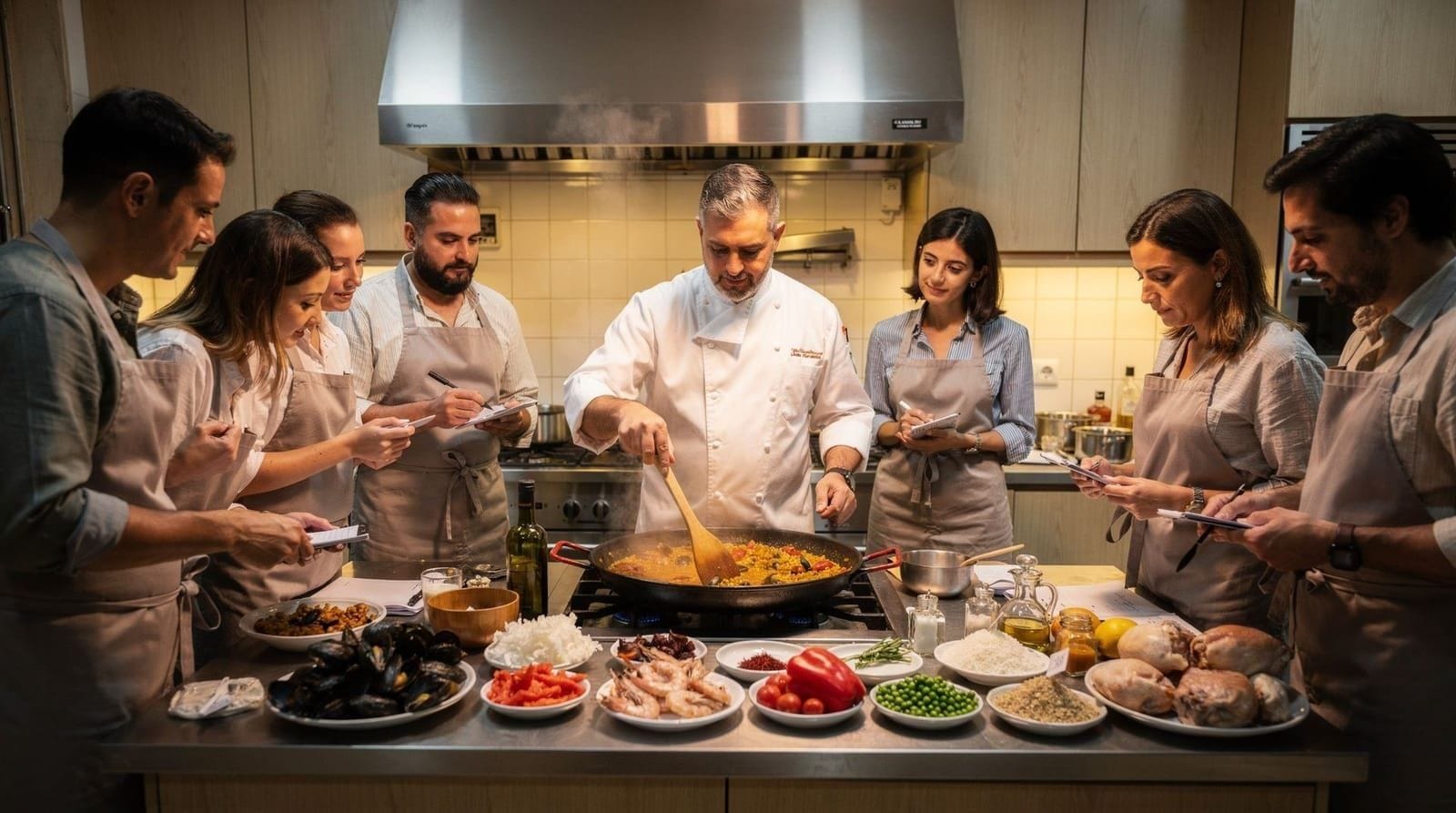
A cooking class that begins with a La Boqueria market visit and ends with you eating a paella you made yourself addresses this directly. Our cooking classes guide covers the full format in detail, but the short version is that a half-day class (three to four hours including market visit, cooking and eating) at €65–85 per person is one of the more substantive food experiences Barcelona offers.
Several classes offer the option of fideuà alongside or instead of paella. If you are particularly interested in the Catalan angle, ask when booking.
How to order paella correctly
Understanding the ordering process at a serious paella restaurant removes a point of friction that puts many visitors off.
Call ahead: most restaurants that cook paella properly require at least 24 hours notice, often more. Paella is cooked for the number of people at the table — the pan size, the quantity of stock and the timing all depend on knowing how many will eat. Walk-in paella is almost always pre-cooked rice reheated.
State the number clearly: the restaurant will prepare a pan sized for your group. Paella for two is possible; paella for four is more generous and usually produces a better socarrat because the pan can develop more crust relative to the total volume. If you are a group of more than six, ask whether the restaurant can accommodate a large pan or whether they recommend a different configuration.
Specify seafood or mixed: most serious restaurants offer both a seafood version (with prawns, clams and mussels) and a mixed version (adding chicken or rabbit alongside the seafood). The purist Valencian tradition is mixed with meat and vegetables; the Catalan coastal tradition leans seafood. Both are valid — choose based on preference, not on which one sounds more authentic.
Confirm the time slot: paella at a good restaurant is a lunch dish, traditionally eaten between 2 and 4 pm on Sundays (and sometimes Saturdays). Evening bookings for paella are less common and some restaurants do not offer it. If you want paella for dinner, confirm when booking that they will have it available that evening.
Ask about fideuà: at many restaurants, fideuà is available alongside or instead of paella with the same advance notice requirement. If you are curious about both, some kitchens will produce one pan of each for a group of four or more — worth asking.
Reading a menu before you commit
A few concrete signals help you judge a restaurant’s paella before ordering, beyond simply avoiding the beach. If the menu lists a price “per person” for paella rather than “per pan” or with a minimum of two people, that is usually a sign the rice is pre-portioned and reheated rather than cooked to order in a shared pan — genuine paella kitchens price by the pan because the cooking process is genuinely collective. If the menu photograph shows an implausibly uniform, bright orange rice with no visible crust or variation, that is closer to what food colouring produces than what saffron and a real socarrat look like. Conversely, a restaurant that requires you to order 24 hours ahead, or that only serves paella at lunch on specific days, is signalling that the kitchen treats it as a proper cooked-to-order dish rather than a menu filler available on demand.
Staff behaviour is another tell. At a serious address, asking about the rice variety, the stock, or whether today’s paella is seafood or mixed usually gets a specific, confident answer. At a tourist-oriented restaurant, the same questions tend to get a vague or rehearsed response, because the staff are not actually involved in cooking the dish to order.
Online reviews are a mixed signal for this specific dish — a restaurant can have thousands of generally positive reviews built on tapas and location while still serving mediocre paella, since most one-time visitors have no baseline for comparison. Reviews that specifically mention the socarrat, the booking requirement, or a wait time for the rice to cook are far more reliable than star ratings or review counts alone.
Paella variations worth knowing
Within the broad category of rice dishes served in Barcelona, a few variations are worth distinguishing:
Arròs negre — black rice, cooked with squid ink alongside squid, cuttlefish and seafood stock. The ink colours the rice dramatically and adds a deep, briny, slightly mineral flavour. It is served with alioli and is one of the more distinctive Catalan rice preparations. Many paella-focused restaurants offer it alongside their standard seafood paella.
Arròs a banda — rice cooked separately from the seafood it was used to make stock from. The rice absorbs the stock intensely; the seafood is served alongside as a separate course. This two-course structure is traditional in the fishing communities of the Costa Daurada south of Barcelona and is occasionally available at restaurants with a serious approach to rice cooking.
Arròs caldós — a wetter, brothier rice preparation, closer to a thick soup than a paella. More common in home cooking than in restaurants, it demonstrates the range of what Catalan cooks do with short-grain rice beyond the dry, socarrat-focused paella format.
Fideuà deserves its own category again: the noodle version is not a paella alternative but a distinct dish with its own character. The slight bitterness of the toasted noodles against the sweetness of the seafood stock is a different sensory experience, not simply a substitute for rice.
The Sunday paella tradition
If you are in Barcelona over a Sunday, the midday meal at a serious restaurant is one of the better cultural experiences the city offers — and paella or fideuà is the centrepiece.
Sunday lunch in Catalonia is a long, multi-course affair. It begins around 2 pm and may not finish until 5 or 5:30 pm. The table is likely to include multiple generations — grandparents, parents, children — and the meal serves as much as a social ritual as a nutritional event. Several shared starters, a main of paella or fideuà, dessert and coffee, and perhaps a glass of cava to start and a local brandy (or moscatel) to finish.
Visiting this tradition requires some planning — a table reservation, ideally at Can Solé or a similarly serious address — but it is a form of access to a genuinely local custom that is not available via a tapas crawl or a market visit. The restaurants understand that international visitors are part of their Sunday clientele; you will not be out of place.
The sangria and beachside drink problem
One more thing worth addressing because it comes up alongside paella: what to drink with it.
Locals drink cava, local white wine, or beer with paella — not sangria. Cava, made in the Penedès wine country an hour from Barcelona by the traditional method, is the region’s own sparkling wine and costs around €3–5 a glass at a good restaurant. A dry Brut Nature cava alongside a seafood paella is the standard local pairing and a genuinely good match.
White wines from Penedès — made from Xarel·lo, Macabeu or Parellada grapes — are the other obvious choice. The clean, slightly mineral character of these wines works well with seafood rice dishes.
For more on the Catalan drinks culture, our vermut guide and Penedès and cava tours guide cover the regional drinking traditions in depth.
Tapas alongside rice: building a full meal
Paella in Barcelona is not typically a standalone dish in the way a burger or a bowl of pasta might be. It is usually the main event of a longer meal that begins with tapas and ends with dessert and coffee.
At a serious restaurant, you might begin with pan con tomate (tomato rubbed on toast with olive oil and salt — simple and essential), followed by a plate of croquetes or fresh anchovies, then the paella arrives as the shared centrepiece. This structure is worth understanding before you arrive, because ordering just paella and nothing else can feel abrupt in restaurants geared towards the full meal format.
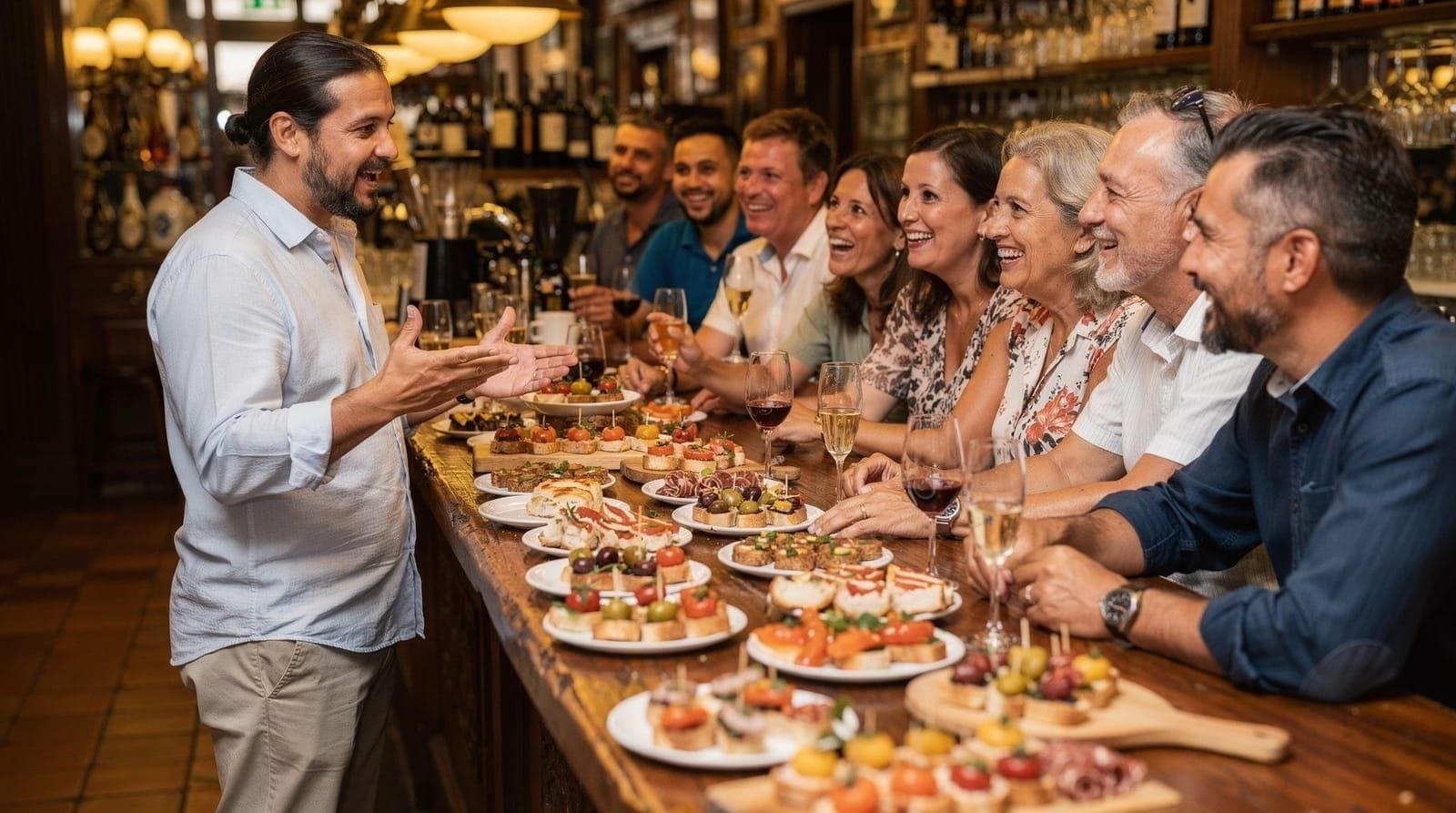
For the wider tapas culture — where to eat, which neighbourhoods to prioritise, what to drink — our tapas tours guide covers everything you need. The Gothic Quarter and El Born areas are well-placed for pre-paella tapas if you are planning a combined itinerary.
Paella in the wider Barcelona food picture
Paella is one significant thread in a much larger food culture. Barcelona is not primarily a rice-dish city the way Valencia is — it is a city with strong traditions across charcuterie, seafood, market cooking, and an increasingly ambitious restaurant scene shaped by Catalan modernist cooking.
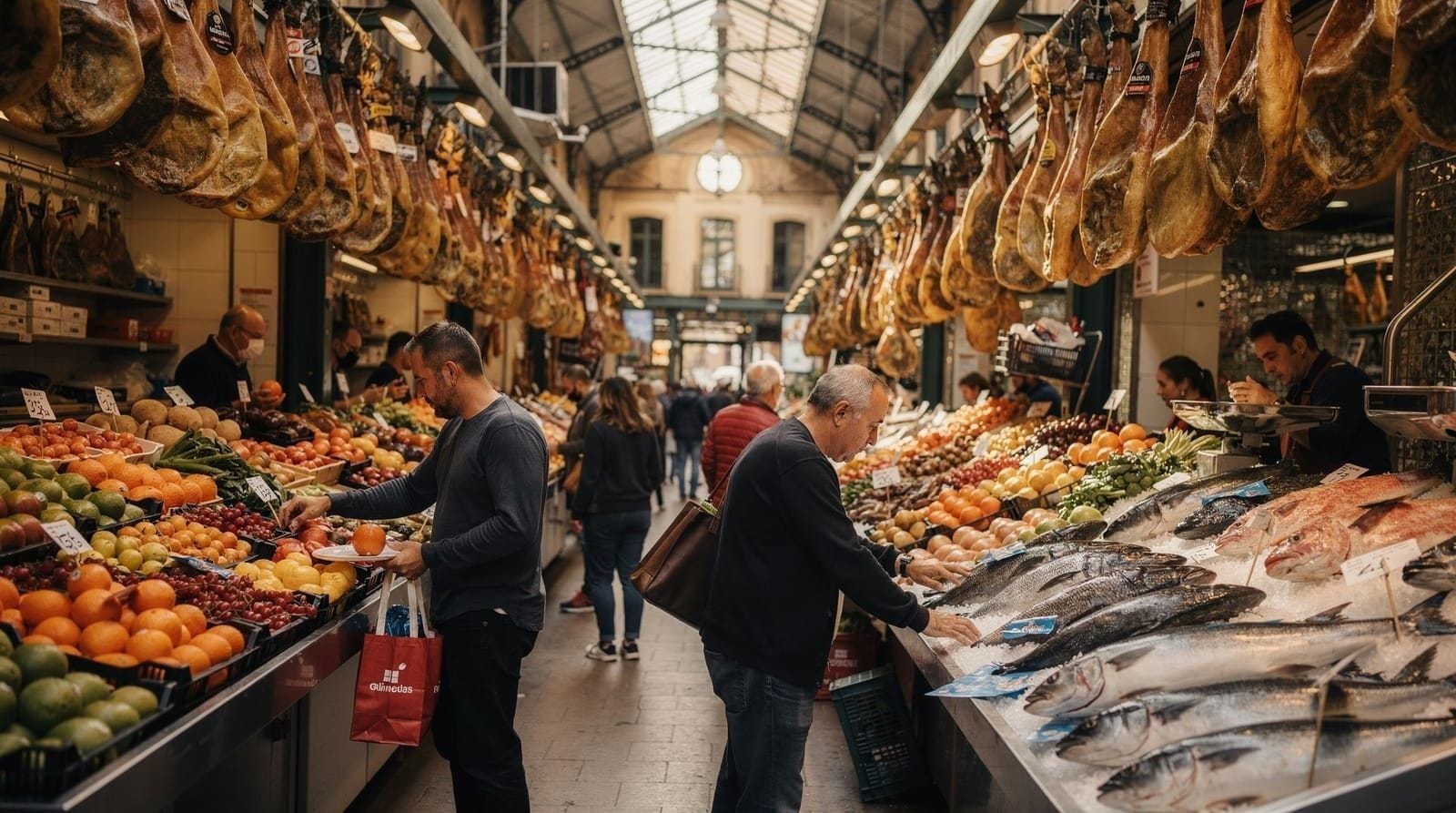
The food markets tell part of this story: Mercat de Santa Caterina in El Born and the traditional market in Gràcia are where Catalan home cooks actually shop, and spending an hour in either market before lunch gives you a more accurate picture of the local food culture than any beachfront restaurant menu. See our food markets guide for detail.
The Barceloneta neighbourhood itself is worth understanding beyond the beach restaurants. Historically a fishing neighbourhood — the grid of narrow streets built in the eighteenth century to house fishermen and sailors — it has genuine food culture alongside the tourist-facing seafood strip. Can Solé sits in this older layer of the neighbourhood, and walking the interior streets gives a sense of what Barceloneta was before the beach tourism economy arrived.
Paella in Barcelona is easy to eat badly and easy to eat well — the variable is almost entirely about where you sit. Turn away from the beach restaurants, make a reservation at Can Solé or a similarly serious address, order the fideuà alongside the paella if you can, and drink cava instead of sangria. The result will be one of the better meals of your trip to Barcelona.
How paella compares to the other rice-pan dishes
| Dish | Base | Character | Where to find it |
|---|---|---|---|
| Paella (seafood) | Bomba rice | Dry, socarrat crust | Can Solé, La Mar Salada |
| Fideuà | Toasted noodles | Nutty, slightly crisp | Same restaurants as paella |
| Arròs negre | Rice + squid ink | Briny, dramatic colour | Serious rice restaurants |
| Arròs a banda | Rice + separate seafood | Two-course structure | Costa Daurada-style kitchens |
| Arròs caldós | Rice, brothy | Soup-like, home-style | More common in home cooking |
If you cannot decide, fideuà is the safer first choice for anyone who wants the most distinctly Catalan version of this style of cooking, while paella remains the more internationally familiar reference point.
Combining paella with the rest of your day
A serious paella lunch is most naturally built around a Sunday in Barcelona, but it works on any day if you plan the booking. Pairing it with a morning at La Boqueria or the Mercat de Santa Caterina gives you a sense of where the ingredients actually come from before you sit down to eat them. If you are staying in Barceloneta itself, Can Solé is a short walk from most accommodation in the neighbourhood, which makes the inland-versus-beachfront choice an easy one geographically as well as gastronomically.
For visitors building a broader food-focused day, our best tapas neighborhoods guide and best neighborhoods guide both help you plan a route that ends at a serious paella restaurant rather than wherever happens to be nearest the beach at 2pm.
Frequently asked questions about Best paella in Barcelona
Is paella a Catalan dish?
No. Paella is Valencian in origin — it comes from the rice-growing wetlands of Valencia, where it was made with rabbit, chicken and green beans. What Barcelona restaurants call paella is usually a seafood adaptation. The Catalan equivalent is fideuà, made with thin noodles instead of rice, which has a stronger claim to being the region's own dish.Why is beachfront paella in Barcelona bad?
The restaurants facing Barceloneta beach are almost universally operating on tourist economics: frozen or pre-cooked rice reheated to order, minimum spend requirements of €25–30 per person, aggressive touts, and no incentive to improve because new visitors arrive every day. The paella is rarely made in the pan it arrives in.What is fideuà and how does it differ from paella?
Fideuà replaces rice with short thin noodles (fideus) that absorb the seafood stock and develop a toasted exterior. It is cooked in the same wide, flat paella pan and served with alioli on the side. Many Barcelona food people consider fideuà the more genuinely Catalan dish — it originated in the fishing port of Gandia and became embedded in Catalan coastal cooking.How much should paella cost in Barcelona?
A genuine paella for two at a serious restaurant costs €25–45 for the pan, plus drinks and sides — so roughly €20–25 per person. Beachfront restaurants charging €30 per person minimum for mediocre rice are not good value. A cooking class at €65–80 per person gives you paella plus the skill to make it at home.Do I need to reserve paella in advance?
Yes, at most good restaurants. Paella is traditionally a Sunday dish made in large pans — many kitchens require 24–48 hours advance notice for paella. Call or email ahead, specify the number of people, and confirm whether they are cooking it to order that day.What time do people eat paella in Barcelona?
Paella is a midday dish by tradition — the main Sunday meal, eaten between 2 and 4 pm. Evening paella is less common in serious restaurants. If you are planning to eat paella for lunch on a Sunday, you are following the genuine local tradition.Should I order paella or fideuà?
Try both if you can. Fideuà has the stronger claim to being genuinely Catalan and is often considered the more interesting dish by food-focused locals, while paella is the more internationally familiar choice. Most serious restaurants that do one do the other well too, often on the same menu.Can I take a paella cooking class instead of eating at a restaurant?
Yes, and it is one of the more substantive food experiences in Barcelona. A half-day class (3-4 hours including a market visit, cooking and eating) runs roughly €65-85 per person and teaches the sofregit, stock and socarrat technique that separates real paella from the reheated beachfront version.
Top experiences
Bookable activities with verified prices and instant confirmation on GetYourGuide.