Gaudí 3-day itinerary: every major work in Barcelona
Barcelona: Sagrada Família fast-track guided tour with tower access
Duration: 2 hours
- Free cancellation
- Tower access
Seeing all of Gaudí’s Barcelona in 3 days
Antoni Gaudí completed seven major buildings in Barcelona and one outside the city (Colonia Güell). Six of those buildings are UNESCO World Heritage sites. This three-day itinerary covers all of them — plus the three-kilometre Modernisme walking route along Passeig de Gràcia that contextualises Gaudí within the broader movement he both defined and transcended.
The sequencing matters. Gaudí’s career runs in a clear architectural arc: from the Moorish-influenced early work at Casa Vicens (1885) through the Gothic-inflected Palau Güell (1890), the ripening organic style of Park Güell and the two Passeig de Gràcia houses (1900–1912), to the transcendent sacred geometry of the Sagrada Família (1882–2026). Visiting them in roughly chronological order — as this itinerary does — means you are watching a mind develop, not just ticking landmarks.
Booking sequence (do this immediately):
- Sagrada Família tower access: Day 1, 09:00 (€55–65; books out 8–12 weeks ahead in summer — book first)
- Park Güell Monumental Zone: Day 2, 08:30 (€13–22 with Gaudí House Museum; 2–4 weeks ahead in summer)
- Casa Batlló Be the First slot: Day 1, 08:30 or standard afternoon (€35–45; 1–2 weeks ahead)
- La Pedrera: Day 1 or 2, afternoon (€25–38; 1–2 weeks ahead)
- Casa Vicens: Day 3 morning (€28; 3–5 days ahead)
- Colonia Güell: Day 3 afternoon (€12–22; small group tour, book 48 hours ahead)
| Where | Eixample, Gothic Quarter, Park Güell hill and Colonia Güell (outside the city) |
| Cost | Around €180–260 per person for all six paid entries across 3 days |
| Time needed | 3 full days, six paid-entry buildings plus two free stops |
| Getting there | Metro L2/L3/L5 for the city sites; FGC L8 from Plaça Espanya for Colonia Güell |
| Best time | Book Sagrada Família and Park Güell as early as possible; spring or autumn for shorter queues |
Day 1: The Passeig de Gràcia masterpieces
Early morning: Casa Batlló “Be the First” (08:30)
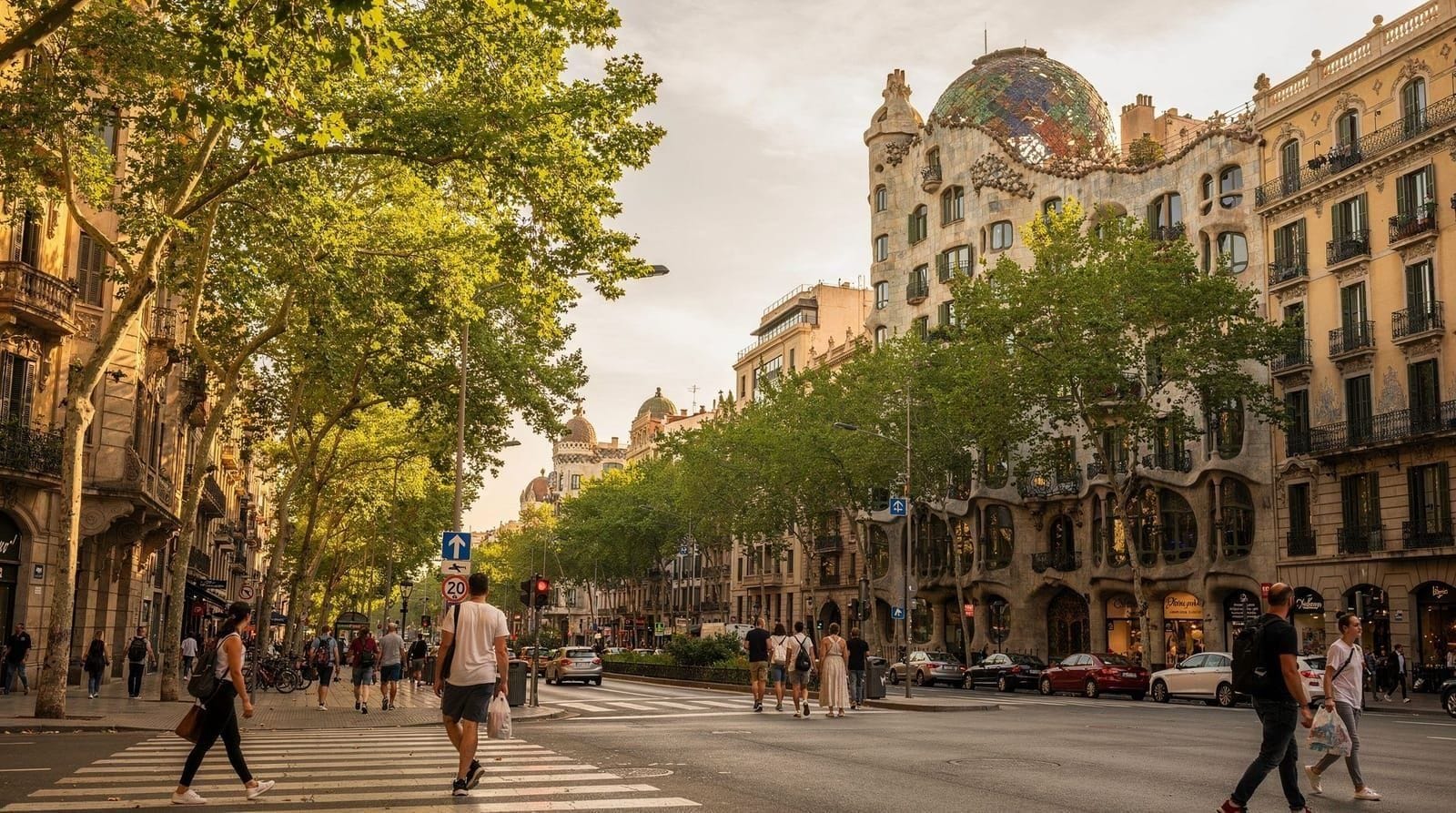
The “Be the First” early-access slot at Casa Batlló (Passeig de Gràcia 43, €45) opens at 08:30 before standard visitors arrive at 09:00. For 30–45 minutes, you have the building largely to yourself. This is the best moment to photograph the Blue Room (the light shaft) and the rooftop without other visitors in the frame, and to absorb the silence that Gaudí’s interiors reward.
The interpretation: Casa Batlló (1904–06) is Gaudí’s most legible building narratively. The bone-white columns and skull-like balconies on the façade represent the victims of St George’s dragon (Gaudí designed it for Sant Jordi, the Catalan patron saint). The undulating blue-ceramic roof is the dragon’s back. The interior Blue Room (the central light shaft, lined with deepening blue ceramic from light blue at the top to dark blue at the base) is designed to equalise light from top to bottom. All of this repays careful looking. Budget 90 minutes total.
Morning: Sagrada Família (09:00 slot, tower access)
Walk or take metro L3 to Passeig de Gràcia, then L2 or L5 to Sagrada Família (15 minutes total). The 09:00 slot with tower access is the most important experience in Barcelona for architectural visitors.
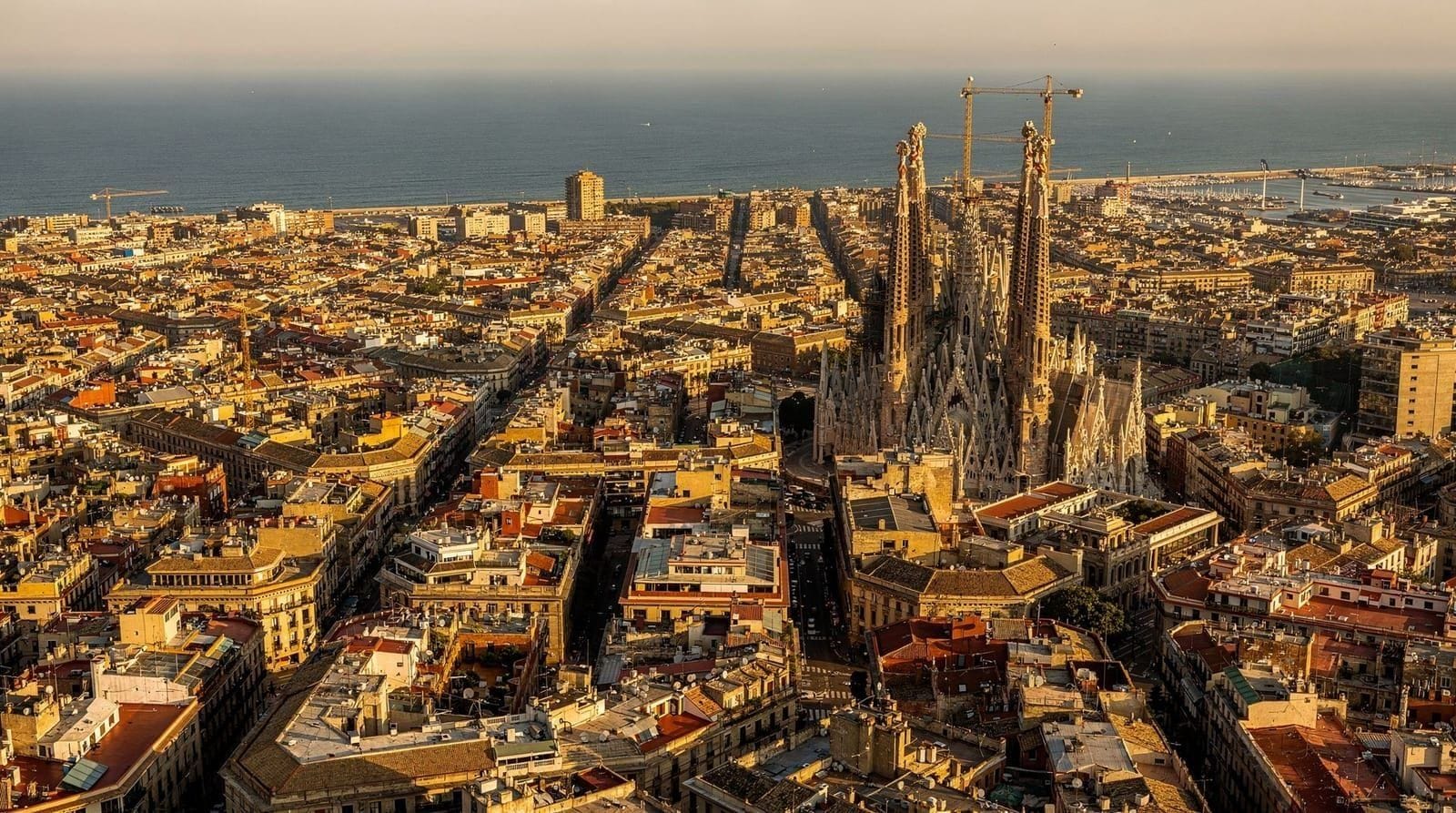
For a Gaudí itinerary specifically, the Sagrada Família requires a guided tour rather than an audio guide. A guided tour (€55–65) includes a guide trained in Gaudí’s mathematical and symbolic system: the hyperboloid and paraboloid geometry of the vaults, the way natural-light calculations determined the window placement, the meaning of every carved figure on the Nativity façade. This is the culminating work of Gaudí’s life — he spent the last 43 years of it on the project and is buried in the crypt below the apse. Budget 2.5–3 hours with tower access.
After the visit, the Museu de l’Escola de l’Arquitectura de Barcelona (Diagonal 649, free) and the nearby Eixample streetscape between Sagrada Família and Passeig de Gràcia show the grid that Gaudí both inhabited and worked against — worth 20 minutes to observe how his organic forms contrast with the rational Cerdà grid.
Midday: Sant Pau Recinte Modernista
Walk 10 minutes north-west along Avinguda de Gaudí to the Recinte Modernista de Sant Pau (Carrer de Sant Antoni Maria Claret 167, tickets €16, opens 10:00). This is Lluís Domènech i Montaner’s counterpart to Gaudí: while Gaudí worked organically, Domènech i Montaner built a hospital campus in Modernisme Gothic with Flemish-style brick, Art Nouveau tile mosaics and hermetic symbolic systems. For the complete Modernisme picture, understanding the contemporary means seeing what Gaudí was reacting against.
Lunch at Bar Calders (Carrer del Parlament 25, 20-minute metro from Passeig de Gràcia via L3) or more conveniently at Federal Café (Carrer del Parlament 39) — both are reliable mid-range options in Poble-sec.
Afternoon: La Pedrera
Return to Passeig de Gràcia for La Pedrera (Passeig de Gràcia 92, €25–38 pre-booked, afternoon slot). For an architecture-focused visit, La Pedrera (Casa Milà, 1906–12) is arguably more interesting than Casa Batlló because it is less finished as a narrative and more pure as form: the undulating stone facade has no symbolic programme — it is Gaudí working entirely from structural logic. The rooftop warriors (twisted chimneys resembling helmeted soldiers) are the last great sculptural installation of his mature secular style. The Espai Gaudí in the attic (models, drawings, construction photographs) is the best museum context for his working method. Budget 90 minutes.
At 18:00–19:00, walk the length of Passeig de Gràcia from La Pedrera to Plaça Catalunya: this is the Modernisme walking route in miniature, passing the three Block of Discord buildings (Batlló, Lleó Morera, Amatller) within two blocks of each other. The full Modernisme route extends beyond Passeig de Gràcia into the Eixample side streets.
Evening: Palau Güell
Walk from Plaça Catalunya south along La Rambla 10 minutes to Palau Güell (Carrer Nou de la Rambla 3–5, €12, opens until 20:00 in summer, closed Monday). This is Gaudí’s first major work for his patron Eusebi Güell (1886–90), and the one that established his reputation. The building predates his organic period: the Gothic arches and Moorish influence are structural references, not ornament. The most extraordinary element is the central salon ceiling — a parabolic dome with holes cut in it to create a starfield effect — and the rooftop with 20 chimneys in a style recognisably proto-Sagrada. Book online (€12) to avoid the queue; the late afternoon is calmer than midday.
Day 2: Park Güell and the natural-style period
Morning: Park Güell (08:30 slot)
Metro L3 to Vallcarca, 10 minutes uphill. The Park Güell Monumental Zone (€13) covers the Dragon Staircase, Hypostyle Room and main terrace. The Park Güell and Gaudí House Museum combo ticket (€22) adds the house where Gaudí lived from 1906 to 1925 — now a museum with original furniture, personal effects and drawings. For a Gaudí-specific itinerary, the house museum is worth the extra €9.
See our Park Güell free vs paid guide for the complete picture. The free sections — forested terraces, viaducts built from rough stone, the Calvary hill with city views — are essential context for the paid zone: Güell conceived the project as a garden suburb (based on English garden cities), and the forested terraces were the roads and gardens of the planned 60 plots, only two of which were ever sold.
Architectural context: Park Güell (1900–14) is the most important transition work in Gaudí’s career. The Hypostyle Room (the 86 columns, designed as a marketplace for the suburb) is the beginning of his exploration of the hyperboloid — the same geometry that governs the Sagrada Família vaults. The broken-ceramic trencadís mosaic technique (used on the main terrace bench and the dragon’s skin) was developed here by Gaudí’s collaborator Josep Maria Jujol.
Midday: Gràcia context and Bellesguard
Walk downhill from Park Güell into Gràcia. Before lunch, a 15-minute walk east brings you to Torre Bellesguard (Carrer de Bellesguard 20, tours €9–18, opens Tuesday–Sunday at 10:00) — Gaudí’s least-visited major work, built on the ruins of the medieval summer palace of the kings of Aragon. The tower integrates the medieval remains with neo-Gothic brickwork; it is completely unlike anything else Gaudí built and surprisingly little-known. Tours run at 11:00 and 15:00; the garden is open to walk through independently.
Lunch in Gràcia: Bar Bodega Manolo (Travessera de Gràcia 49) for a simple Catalan lunch, or La Pepita (Carrer del Torrent de l’Olla 74) for croquetes and montaditos.
Afternoon: Casa Vicens
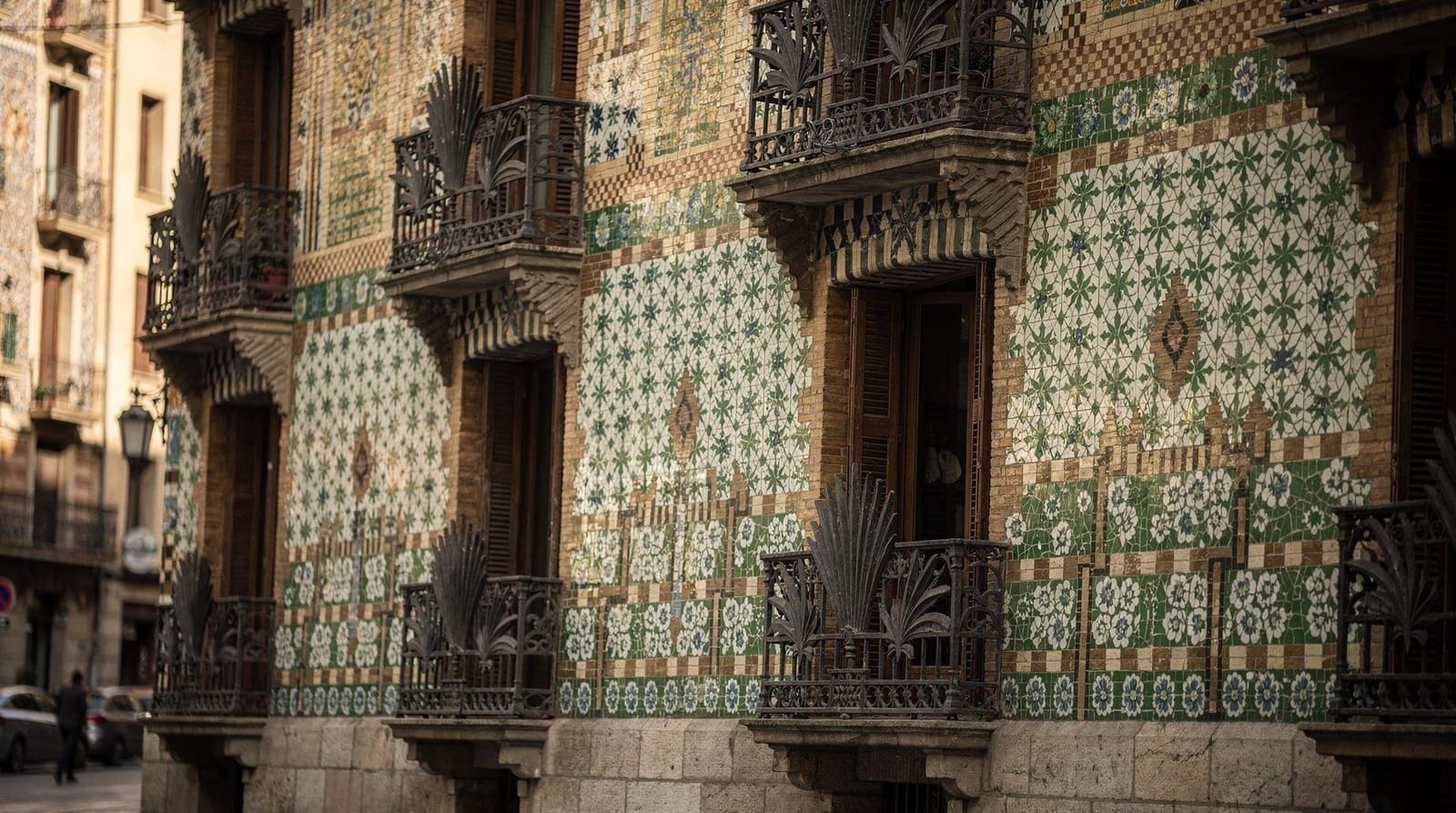
Metro or 20-minute walk to Casa Vicens (Carrer de les Carolines 18, opens 10:00, tickets €28, see our guide). This is Gaudí’s first major commission (1883–85) and the work that established his vocabulary: Moorish arches, Andalusian-style tilework, geometric ornament. The building was recently restored and opened to visitors for the first time in 2017; for the arc of Gaudí’s development, it is essential — you can see clearly which elements persisted (the organic balcony ironwork, the tension between structure and ornament) and which were abandoned (the Moorish reference, the flat-surfaced geometry).
The Gaudí trail guide maps the city’s works in geographical sequence if you want to extend the afternoon with lesser-known stops: the lamp posts at Plaça Reial (Gaudí’s first commission, 1878, iron lamp posts in the Old Port) and the Cascade Fountain in Parc de la Ciutadella (1877, a collaboration as a student before he graduated).
Evening: Eixample dinner
Dinner at Bodega Celler Cesc (Carrer de la Diputació 201) for wine-focused Catalan cooking, or Cervecería Catalana (Carrer de Mallorca 236) for dependable mid-range tapas. An evening walk along Passeig de Gràcia after dark is worthwhile: the Modernisme lamp posts (designed by Pere Falqués, 1906) and the building facades under artificial light are differently legible from their daytime appearance.
Day 3: Colonia Güell and deeper Modernisme
Morning: Colonia Güell and Gaudí’s crypt
Take FGC L8 from Plaça Espanya to Colonia Güell station (30 minutes, every 30 minutes, €5 each way). The Colonia Güell is a model workers’ village built by Eusebi Güell from 1890: factory, houses, school, church — a complete industrial utopia. Only the church crypt was built by Gaudí (1908–14); the nave above it was never completed. The crypt is the least-visited of Gaudí’s major works and arguably the most structurally radical: the catenary arch system, irregular basalt columns set at angles and the rough-stone construction are a direct precedent for the Sagrada Família nave. Entry includes the Gaudí crypt and the whole village (€12; or take the guided tour for contextual depth).
See our Colonia Güell guide for the full logistics. The village is atmospheric in a melancholy way: many of the original workers’ houses still stand, the factory is partially preserved, and almost no tourists come here — a complete contrast to the Sagrada Família’s 3 million annual visitors. The guided tour (€22) adds significantly to the experience.
Return to Barcelona by 13:00.
Afternoon: Palau de la Música Catalana
While not by Gaudí, the Palau de la Música Catalana (Carrer del Palau de la Música 4–6, guided tour €30) is Domènech i Montaner’s masterpiece (1905–08) and essential context for the Modernisme movement. The concert hall is a cascade of stained glass, ceramic flowers and Art Nouveau ironwork that makes Gaudí’s contemporary work look restrained by comparison. Tours run every 30 minutes from 10:00–15:30; this afternoon slot fits cleanly. See our Palau de la Música guide.
After the tour, walk five minutes to the Recinte Modernista de Sant Pau entrance on Carrer de Sant Antoni Maria Claret if you didn’t visit on Day 1 — the exterior alone is worth 20 minutes.
Evening: Gaudí’s last years and the Gothic Quarter
The final evening is best spent in the Gothic Quarter, where Gaudí spent his last period — he lived increasingly ascetically in the Sagrada Família workshop and died in 1926 after being struck by a tram on Gran Via near the corner of Carrer de Bailèn. The corner is marked; the tram route (now replaced by bus) passed the area you will have walked through repeatedly.
Dinner at El Xampanyet (Carrer de Montcada 22, El Born, opens 19:00) for cava and anchovies, then a final walk to Palau Güell (the closest of the Gaudí buildings to a Gothic Quarter base) if you want to see the rooftop chimneys by night — the building is lit from 20:00 to 23:00 and the exterior is visible for free from the street.
Full list of Gaudí buildings in this itinerary
| Work | Year | Address | Status in itinerary |
|---|---|---|---|
| Lamp posts at Plaça Reial | 1878 | Plaça Reial | Walk-past, free |
| Cascade Fountain (Parc de la Ciutadella) | 1877 | Parc de la Ciutadella | Walk-past, free |
| Palau Güell | 1886–90 | Carrer Nou de la Rambla 3–5 | Day 1 evening, €12 |
| Casa Vicens | 1883–85 | Carrer de les Carolines 18 | Day 2 afternoon, €28 |
| Bellesguard | 1900–09 | Carrer de Bellesguard 20 | Day 2 midday, €9–18 |
| Casa Batlló | 1904–06 | Passeig de Gràcia 43 | Day 1 morning, €35–45 |
| La Pedrera (Casa Milà) | 1906–12 | Passeig de Gràcia 92 | Day 1 afternoon, €25–38 |
| Park Güell | 1900–14 | Carrer d’Olot | Day 2 morning, €13–22 |
| Colonia Güell crypt | 1908–14 | Colonia Güell (FGC) | Day 3 morning, €12–22 |
| Sagrada Família | 1882–2026 | Carrer de Mallorca 401 | Day 1 midday, €33–65 |
Booking difficulty, ranked
| Site | How far ahead | Sells out in summer |
|---|---|---|
| Sagrada Família (tower access) | 8–12 weeks | Yes, routinely |
| Park Güell (Monumental Zone) | 2–4 weeks | Yes, weekends especially |
| Casa Batlló (“Be the First”) | 1–2 weeks | Sometimes |
| La Pedrera | 1–2 weeks | Rarely |
| Casa Vicens | 3–5 days | Rarely |
| Colonia Güell (guided tour) | 48 hours | Rarely |
| Palau Güell | Walk-up usually fine, online preferred | No |
Use this table to decide where to put your booking effort: Sagrada Família and Park Güell are the two that genuinely require advance planning; the rest can be arranged within a week of travel with minimal risk.
Where to stay for this itinerary
Basing yourself in Eixample, ideally within walking distance of Passeig de Gràcia, cuts transit time significantly: Casa Batlló, La Pedrera and the Sagrada Família metro connection are all within 15–20 minutes on foot or one metro stop of each other. The Gothic Quarter is the second-best base — closer to Palau Güell and the evening walk on Day 3 — but further from Sagrada Família and Park Güell. See our where to stay in Barcelona guide for a neighbourhood-by-neighbourhood breakdown.
Extending to a fourth day
If you have a fourth day, the strongest addition is a slower architectural context day rather than a seventh Gaudí building: the full Modernisme walking route through the Eixample side streets beyond Passeig de Gràcia, a visit to the MNAC for the Modernisme collection and city views from Montjuïc, or simply a return visit to whichever building rewarded the closest looking the first time — most visitors say that’s either the Sagrada Família nave or the Park Güell terrace. Avoid adding a seventh paid Gaudí entry on a fourth day purely for completeness; by Day 3 most visitors are experiencing diminishing returns from another ticketed interior.
Frequently asked questions about this Gaudí itinerary
Which Gaudí building is the most important to see?
The Sagrada Família is non-negotiable — it is Gaudí’s life work and the most significant religious building under construction in the 20th century. Park Güell and Casa Batlló are the strongest visual experiences for first-time visitors. For understanding Gaudí’s development as an architect, Casa Vicens and Colonia Güell are more revelatory than the famous houses, because they are less interpreted and require you to look carefully. See our Gaudí trail guide for a depth ranking.
Is three days enough for all of Gaudí’s Barcelona?
Yes, if you pre-book everything and start early each morning. The risk is museum fatigue: six paid-entry buildings in three days is a high intensity even for architecture enthusiasts. Build at least one unscheduled outdoor afternoon (Parc de la Ciutadella, Barceloneta, a walk through Gràcia) to decompress. The itinerary above has those moments built in at lunch and in the evening.
What is the 2026 Gaudí centenary about?
October 7, 2026 marks the hundredth anniversary of Gaudí’s death (he was struck by a tram on June 7, 1926 and died three days later). The centenary has prompted special exhibitions at the Sagrada Família, a Gaudí retrospective at the Museu Nacional d’Art de Catalunya (MNAC), and construction milestone events as the basilica nears completion. Guided tours in 2026 have additional centenary context that audio guides do not yet fully cover.
Do I need a guided tour for all the buildings?
Not for all of them. La Pedrera and Casa Vicens have good audio guides included with the ticket. Park Güell is navigable without a guide if you read the free-zone map and the online explanations. The Sagrada Família strongly rewards a guided tour for first-time visitors — the symbolic programme of the stone carving is inaccessible without context. The Colonia Güell crypt is much more intelligible with the guided tour because the structural innovation is not visually obvious without explanation.
Can I combine this Gaudí itinerary with a beach day?
Yes — Day 3 has the most flexibility. Replace the afternoon Palau de la Música tour with a Barceloneta swim and move the Palau de la Música to Day 1 evening (after Palau Güell). The itinerary works best when evenings and early mornings are Gaudí-focused and afternoons are more flexible.
What’s the best base neighbourhood for this itinerary?
Eixample, ideally close to Passeig de Gràcia — it puts Casa Batlló, La Pedrera and the Sagrada Família metro connection all within a 15–20 minute walk or one stop. See the “Where to stay for this itinerary” section above for the full comparison with the Gothic Quarter.
Can I do this itinerary in 2 days instead of 3?
It’s tight but possible if you drop Casa Vicens and Colonia Güell — both are the least essential for a first-time visitor, being less visually dramatic than Sagrada Família, Park Güell and Casa Batlló even though they’re architecturally significant. A 2-day version follows Day 1 and Day 2 above exactly and treats Bellesguard, Casa Vicens and Colonia Güell as an optional extension rather than a requirement.
Top experiences
Bookable activities with verified prices and instant confirmation on GetYourGuide.
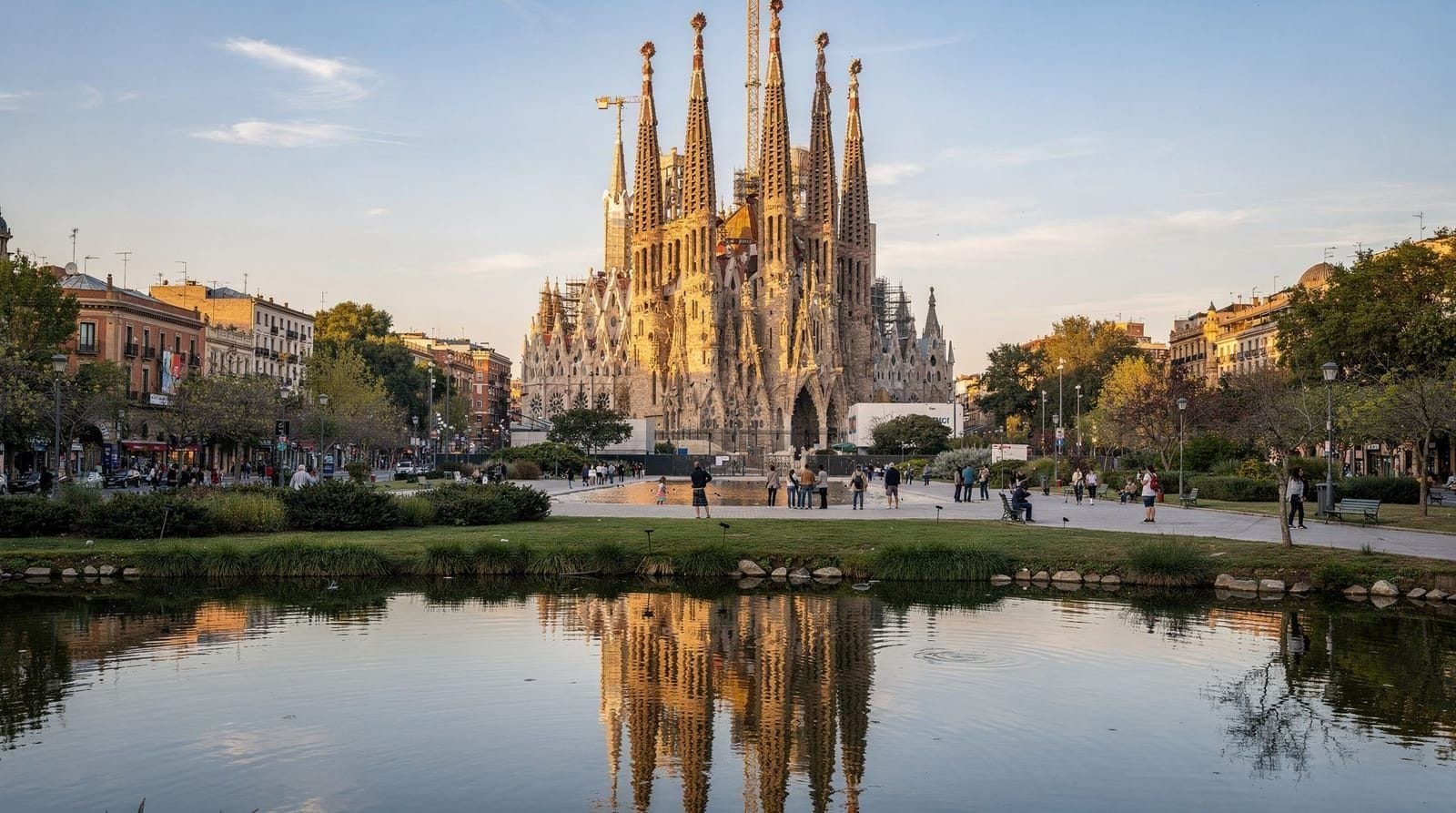
Barcelona: Sagrada Família fast-track guided tour with tower access
- Free cancellation
- Tower access
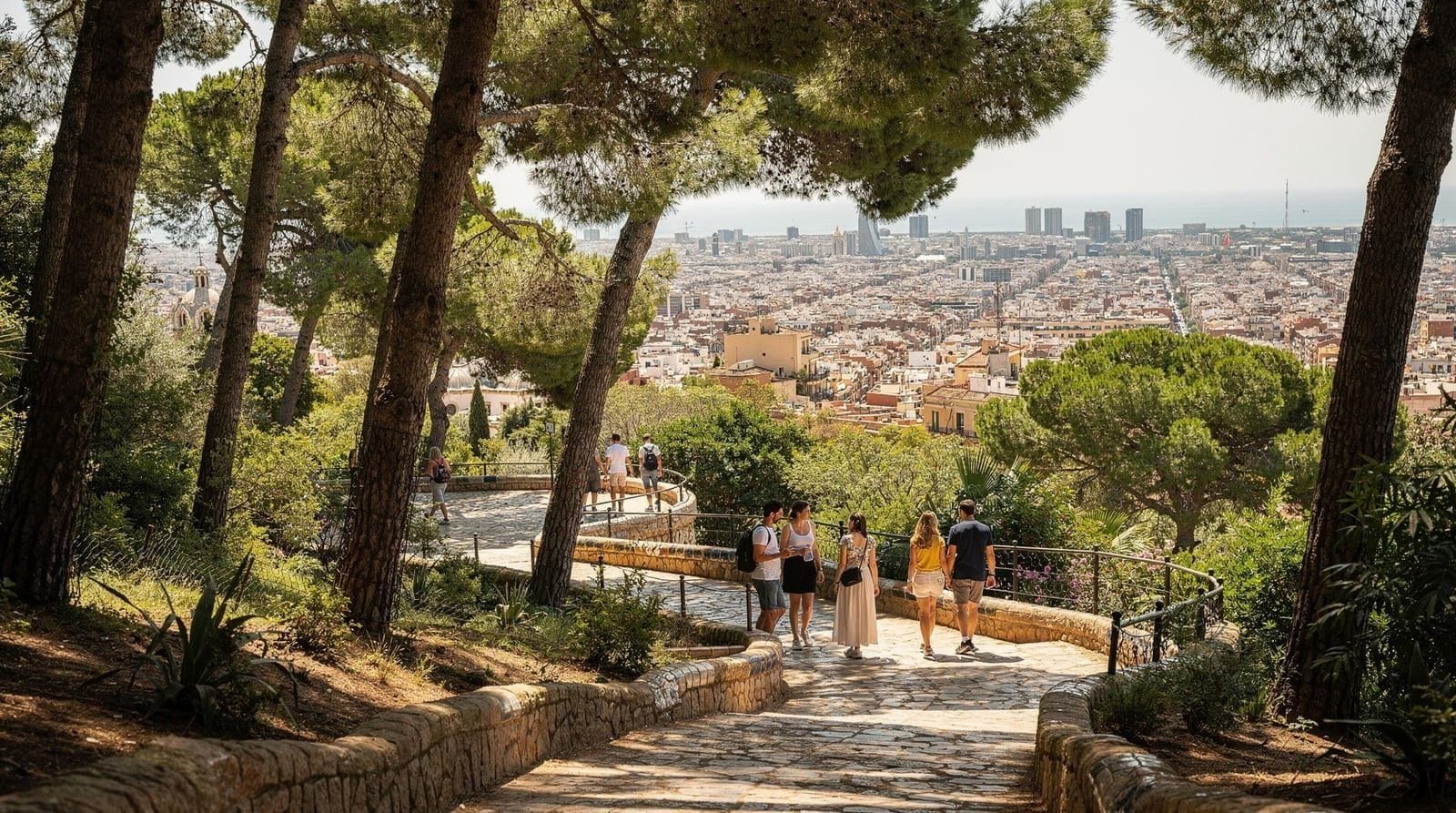
Barcelona: Park Güell and Gaudí House Museum entry ticket
- Free cancellation
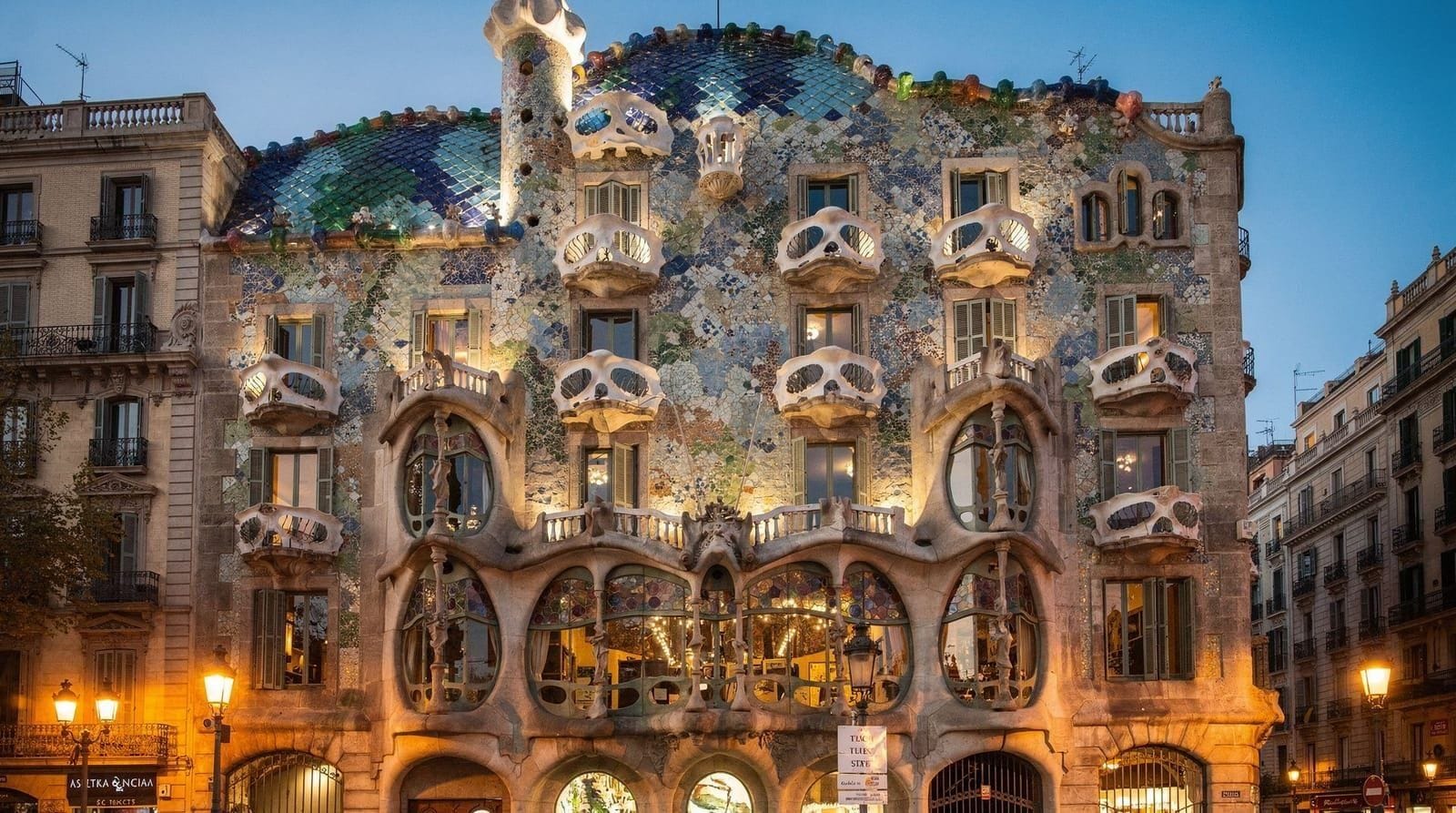
Barcelona: Casa Batlló "Be the First" early entry ticket
- Free cancellation
- Skip the line
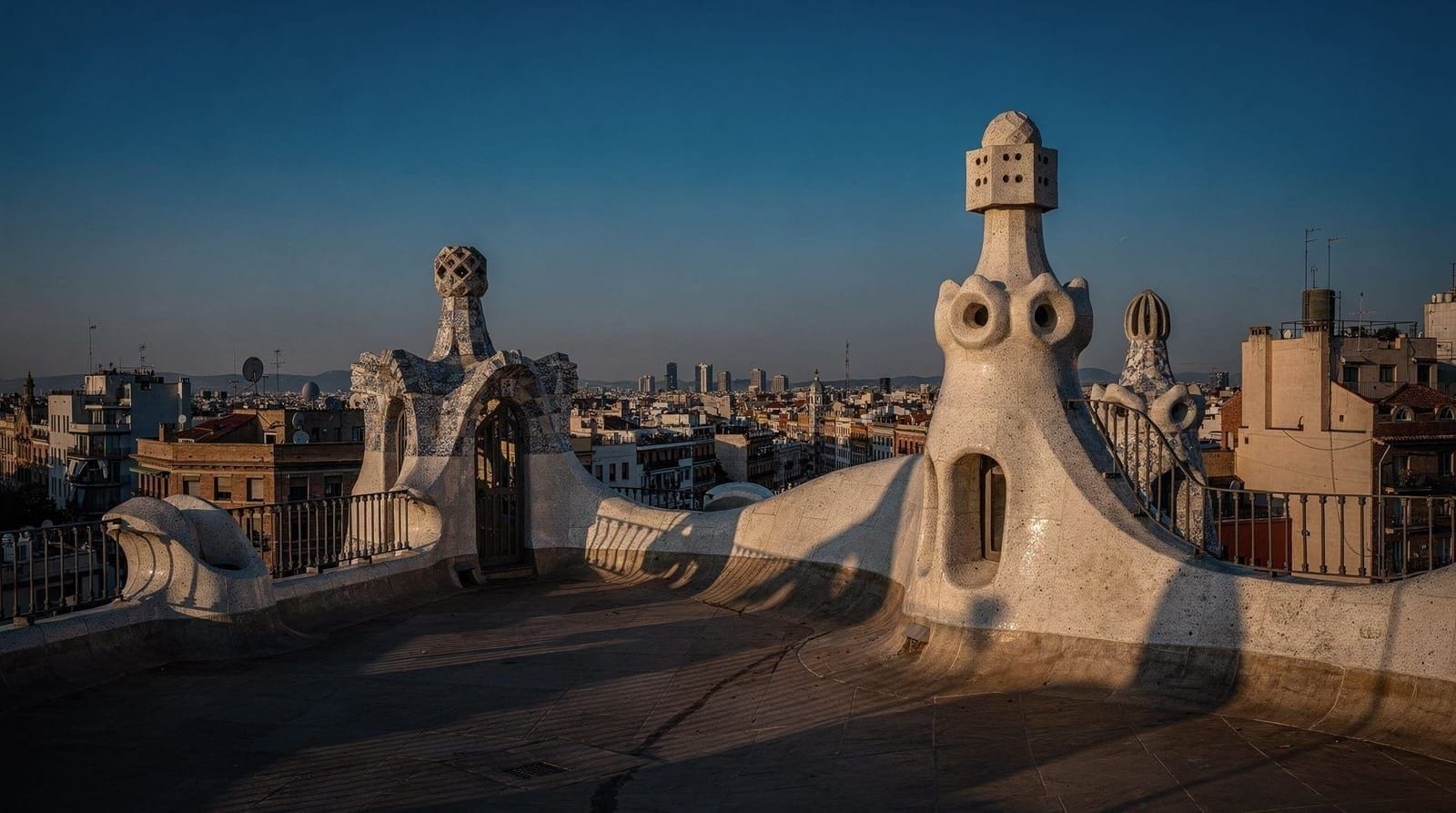
Barcelona: La Pedrera–Casa Milà skip-the-line ticket with audio guide
- Free cancellation
Barcelona: Casa Vicens Gaudí skip-the-line entrance ticket
- Free cancellation
Barcelona: the 3 Gaudí houses tour (Vicens, Milà and Batlló)
- Free cancellation
- Small group
Barcelona: 4-hour e-bike photography tour
- Free cancellation