Sagrada Família guided tour: is it worth it?
Barcelona: Sagrada Família guided tour and entry tickets
Duration: 1.5 hours
- Free cancellation
- Small group
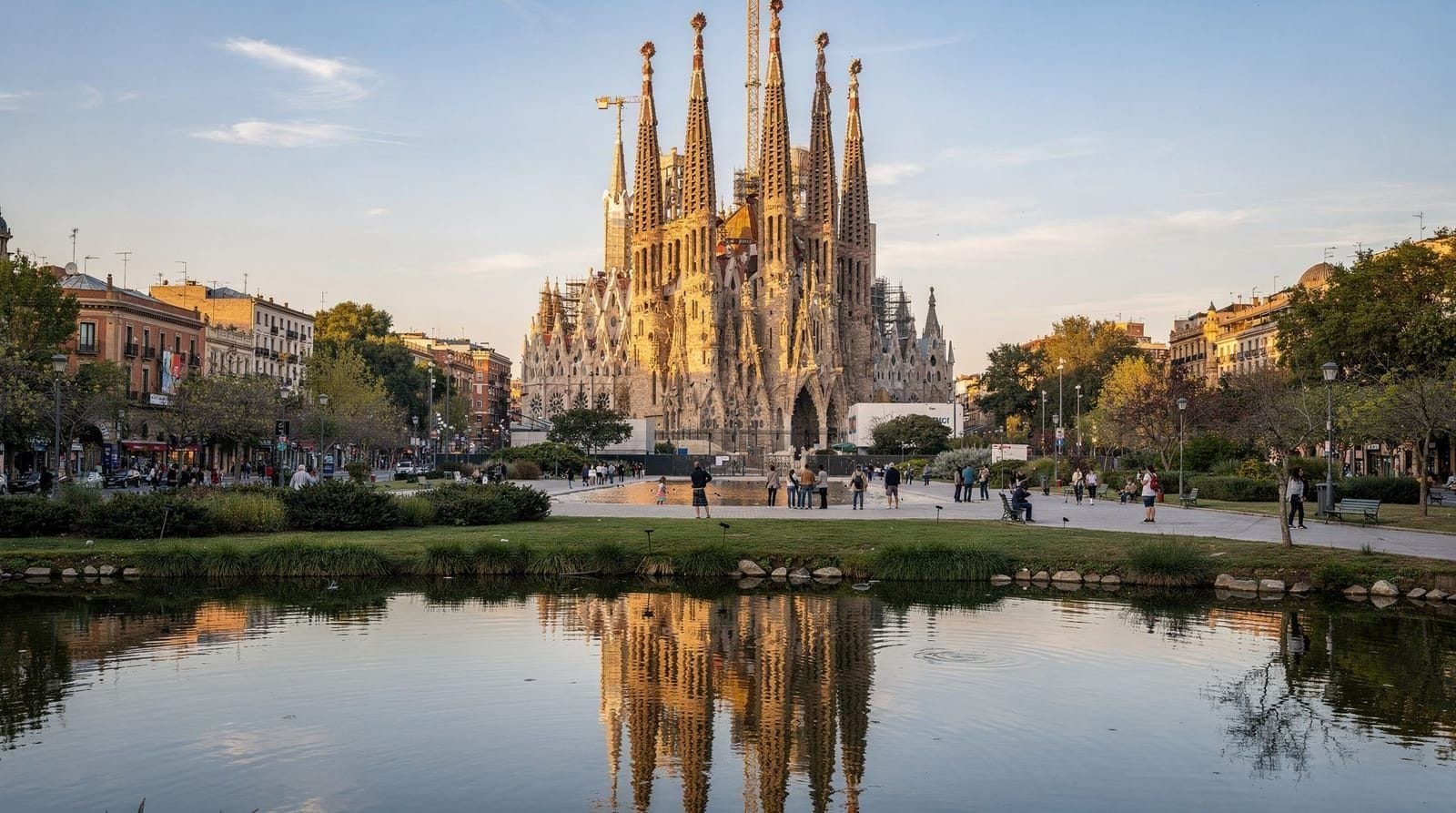
The Sagrada Família draws more than four million visitors a year, and the choice between a bare-bones entry ticket and a guided tour is one of the most common planning dilemmas in Barcelona. The short answer: guided is worth it for first-time visitors who want to understand what they are looking at. For everyone else, the audio guide is excellent and costs less.
| Where | Carrer de Mallorca 401, Eixample (metro L2/L5 Sagrada Família) |
| Cost | ~€45/adult guided; €26–33 solo audio-guide entry |
| Time needed | 1.5 hours (guided); add 30–45 min for tower access |
| Getting there | L2 (purple) or L5 (blue) metro, direct to the basilica |
| Best time | Weekday mornings in April–May or September–October |
What the tour actually covers inside
The guided tour lasts around 1.5 hours and focuses on the interior of the basilica — the soaring nave, the forest of branching columns, the kaleidoscopic stained glass and the underground crypt where Gaudí is buried. A good guide will walk you through the symbolism embedded in every surface: the twelve disciples towers, the difference between the Nativity and Passion facades, and Gaudí’s structural logic (he called it “God’s architecture” because it mimics natural forms).
You enter through the Nativity facade on the eastern side — the only part Gaudí himself lived to see built. From there the route moves through the central nave, which opened in 2010, past the high altar and into the lateral aisles. Most guided tours finish at the Gaudí Museum in the crypt, which contains his original scale models and the 1:10 mock-up he used to calculate load distribution with hanging chains.
Tower access is not included in the standard guided tour. If you want to go up — and it is worth doing at least once — you need to book it as a separate timed add-on, or choose a tour that explicitly includes it (budget €60–65 for that combination).
What you pay and what you get
The base guided tour with entry runs around €45 per adult for a small group of up to 15 people. That is roughly €12–19 more than a solo skip-the-line entry with audio guide (€26–33). Whether the premium is justified depends on whether you want context.
If you are visiting after reading about Modernisme in depth — after our Gaudí trail guide or the Modernisme route — the audio guide covers the facts adequately. If you are arriving cold, a guide who can answer questions live saves a lot of confusion in one of the most symbolically dense buildings in Europe.
For context: solo audio-guide entry costs €26 with the official basic ticket (audio guide app included). Guided tours with towers start around €60. Budget accordingly.
Group size and meeting logistics
Small-group tours (typically 8–15 people) on GetYourGuide meet at a specific gate, usually the Nativity facade on Carrer de la Marina. The guide carries a numbered sign or coloured umbrella. Bring your email confirmation and government-issued ID — the basilica’s security occasionally cross-checks names against the booking.
Arrive 15 minutes early. The timed-entry system is strict, and even guided tours forfeit their slot if the group is late. If you are coming from the centre by metro, line L2 (purple) drops you at Sagrada Família in under 10 minutes from Passeig de Gràcia.
Is it worth it? The honest verdict
For first-time visitors: yes. The guided format solves three problems at once — you skip the booking headache, you get someone to decode the symbolism, and you avoid losing 20 minutes figuring out the audio guide interface at the door.
For returning visitors or architecture buffs: probably not. The audio guide is genuinely thorough, covers every major element, and costs €7–10 less. If you are combining the basilica with Park Güell or Casa Batlló in the same day, saving the money makes sense.
Skip the third-party resellers. The Sagrada Família has strict anti-reseller policies, and numerous sites charge €10–15 more than face value for the same ticket with no added service. Legitimate tour operators like those listed on GYG have real GYG-verified tour IDs.
Tower add-on: should you book it?
The basilica has two climbable towers: the Nativity tower (north-east) with views over the old city, and the Passion tower (south-west) facing Eixample and the sea. Each costs around €10 extra on top of base entry or an included guided tour.
The Nativity tower is the more popular choice because the view over the Gothic Quarter and the Eixample grid is exceptional. Descending involves a tight spiral staircase — skip it if you are claustrophobic or have mobility issues. The Passion tower is quieter and gives a better sense of the modern Barcelona skyline.
Tower tickets have a separate timed entry. If you want both the guided tour and tower access in one booking, look for a tour that bundles them — it simplifies logistics on the day.
Combined tickets with Park Güell
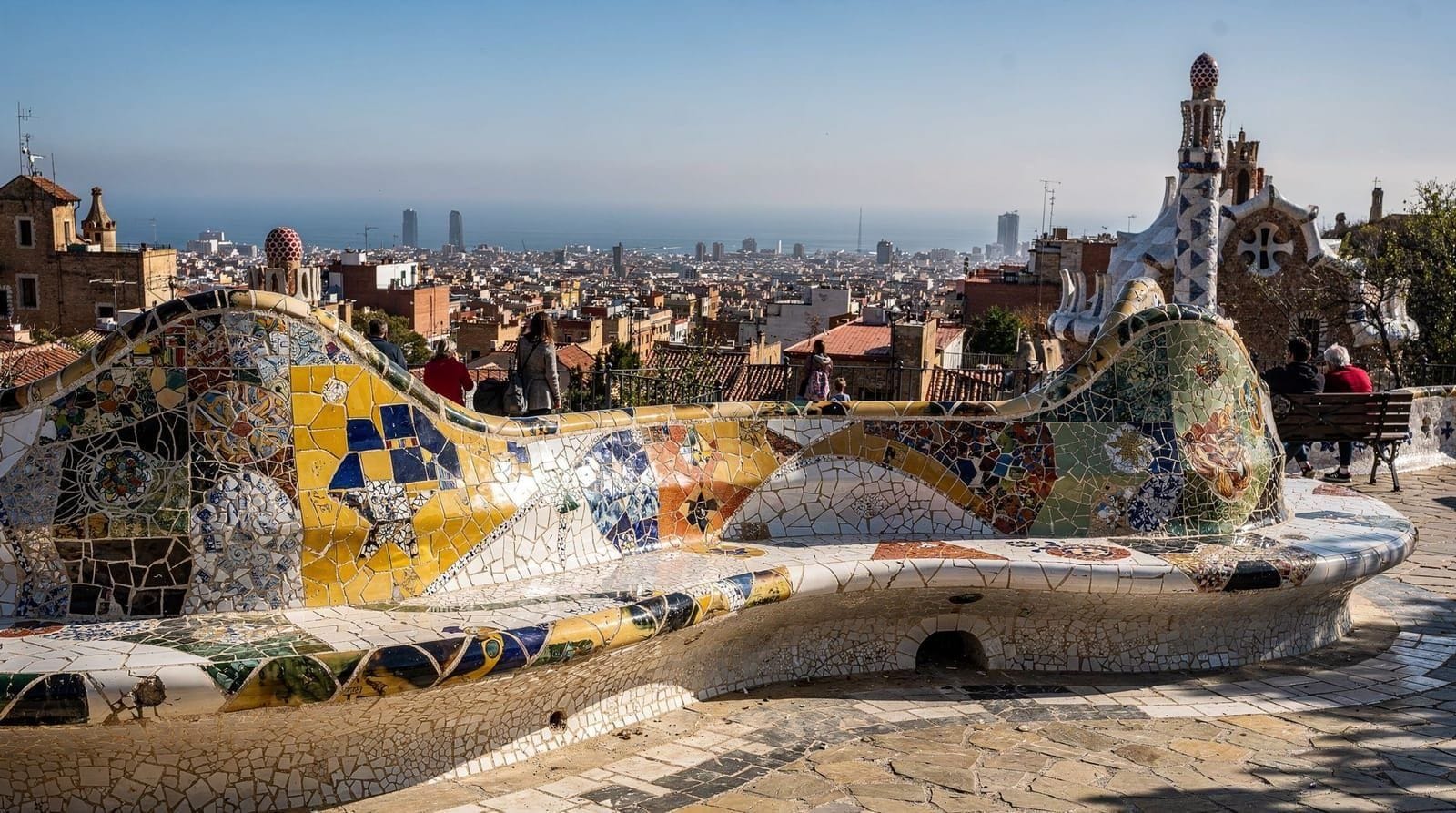
For visitors set on covering Gaudí’s two biggest sights in a single day, some operators sell a combined Sagrada Família and Park Güell ticket that bundles entry to both with a single timed-entry booking window for each. This is worth considering primarily for the convenience of one purchase rather than a genuine cost saving — check whether the combined price actually undercuts booking the two separately before assuming it is cheaper. Logistically it works well because Park Güell is a straightforward taxi or bus ride north from the basilica, and splitting the two across a morning and afternoon avoids the fatigue of trying to absorb both in back-to-back hours.
Combining with other Gaudí sights
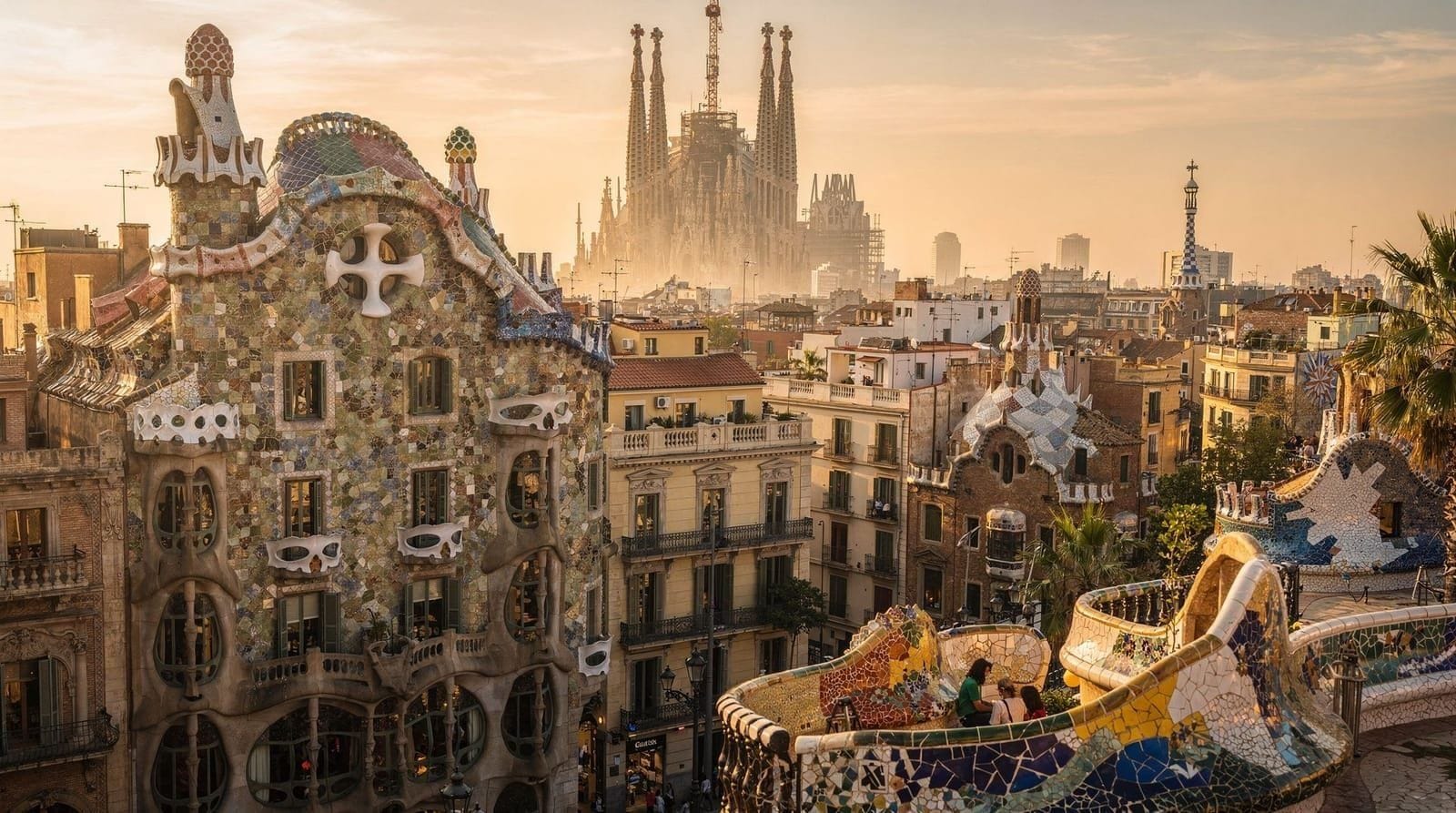
The Sagrada Família is the logical anchor of any Gaudí day in Barcelona. From the basilica you can walk or take the metro one stop south to Casa Batlló and La Pedrera (Casa Milà) on Passeig de Gràcia. Park Güell is a 15-minute taxi or bus ride north in the Gràcia neighbourhood.
If you are tight on time, the Sagrada Família + Park Güell combination is the single most popular pairing in Barcelona — there are combination tickets that cover both on the same or adjacent days, which we cover in the Park Güell guide.
For a full modernisme deep-dive, Casa Vicens — Gaudí’s first major commission — is near Park Güell and often skipped by visitors in a rush.
What to do if the tour sells out
Guided tours fill up faster than basic entry because group sizes are capped. If your preferred tour date is gone:
- Try booking a standard skip-the-line ticket with audio guide — solo entry remains easier to find a few days out.
- Check the official Sagrada Família website (sagradafamilia.org) for any released spots; the site updates its availability daily.
- Consider a morning slot on a weekday in shoulder season (April–May or September–October) — these are consistently the easiest windows to find.
- If you are visiting in July–August, treat any available slot as urgent and book immediately — summer availability is essentially zero the week of travel.
Our Sagrada Família booking guide covers the full strategy for last-minute and advance planning.
Booking tips for 2026
The 2026 centenary of Gaudí’s death is driving record demand. Guided tours with the “official partner” badge on GetYourGuide are allocated tickets directly from the Sagrada Família — they tend to have slightly better availability than third-party operators.
Book as soon as your Barcelona dates are confirmed. Guided tour slots for summer 2026 are already moving fast as of early June 2026.
Check the best time to visit Barcelona if you have flexibility — visiting in April, May or October cuts your booking headache dramatically and lowers accommodation costs by 20–40%.
Photography inside the basilica
Photography is permitted throughout the interior without flash, and tripods are not allowed in standard visiting hours. The stained-glass light is the main draw for photographers, and it changes dramatically through the day — see the section above on morning versus afternoon light. A wide-angle lens captures the scale of the nave better than a standard lens, but even a phone camera in portrait mode does a reasonable job of the vertical column lines if you shoot from directly beneath them looking straight up.
Crowds are the main obstacle to a clean shot rather than lighting — the nave fills quickly after 11am, and getting a composition without dozens of visitors in frame becomes difficult. Guided tour groups that enter at opening time have the best chance of relatively uncrowded photography before the general-admission crowds build up.
Accessibility
The basilica has lift access to the main nave for wheelchair users, though full accessibility is not available in all areas (the towers, for example, require stair use). Guided tours can accommodate most mobility needs — check the specific tour listing for confirmed accessibility details before booking.
Audio guides are available in around 15 languages. Most English-language guided tours on GYG are conducted by native or near-native speakers.
Gaudí’s design philosophy: what the guide explains
The Sagrada Família is not simply a large church with organic decoration. It is a fully worked structural system — what Gaudí called “naturalistic structuralism” — built on the observation that nature does not use straight lines or flat surfaces because straight lines and flat surfaces are structurally inefficient.
The most visible expression of this is the forest of branching columns in the nave. Each column branches upward at a precise angle, following the logic of a tree distributing load from canopy to root. Gaudí modelled the branching geometry on the actual load-path calculations he performed using hanging chain models: by inverting a chain hung under gravity, he could read the exact curve that would carry compressive load without bending stress. This meant his columns could be slimmer and taller than conventional Gothic pillars, which require buttresses to counteract the lateral thrust of the vault. The Sagrada Família has no flying buttresses — the structural system makes them unnecessary.
The roof of the central nave uses hyperboloid forms — double-ruled surfaces, the shape of a cooling tower in cross-section — which are inherently strong under load while allowing the roof to curve and open. The skylight cones in the ceiling are paraboloids: mathematically derived shapes that direct light inward and downward from the roof lanterns to the floor of the nave. A guide will point at these and explain why they are not just decorative; they are the structural vocabulary of the building.
The Nativity facade (east) versus the Passion facade (west) could not be more different in emotional register, and a guide makes this contrast legible. The Nativity facade — the only part Gaudí himself oversaw, completed in its main elements before his death in 1926 — is exuberantly naturalistic: stone covered in leaves, lizards, turtles, the shepherds and the Magi in detailed relief. It represents birth and joy. The Passion facade, designed by Gaudí in his later period and executed after his death by Josep Maria Subirachs, is angular and expressionist: stripped-down figures, sharp edges, skeletal forms. It represents suffering and death. Standing between the two facades inside the nave gives you the full dramatic arc.
The Portico of Glory, the main entrance on the south-west side, was Gaudí’s intended grand entrance — not yet complete during his lifetime. It depicts the Catholic theological order of salvation: Faith, Hope and Charity as the three portal arches, with columns resting on tortoises (land) and sea turtles (sea) to symbolise that the church rests on all of creation. Most visitors miss this because they enter from the Nativity side.
Why has construction taken 144 years? The honest answer is money and a war. Gaudí designed a building so complex that it has required continuous fundraising since the foundation stone was laid in 1882. Construction was primarily funded by public donations during Gaudí’s lifetime. Then in 1936, at the outbreak of the Spanish Civil War, anarchist militias burned the workshop and destroyed much of Gaudí’s original model collection. Work stopped entirely until 1952, when construction resumed using reconstructed models and Gaudí’s published plans. Since then, all funding has come exclusively from entry ticket revenue — the Sagrada Família receives no public subsidy and no Church funding. The current target completion date for the main towers is 2026, the centenary of Gaudí’s death, though some elements will continue beyond that date.
What visitors miss on their first visit
Even attentive first-time visitors tend to walk past several details that reward a slower look, and a good guide flags most of them.
The turtles at the base of the columns. Two of the columns near the Nativity facade entrance rest on the backs of a turtle and a tortoise — Gaudí’s way of symbolising the permanence of the church resting on land and sea. They are easy to miss because visitors tend to look up rather than down when entering.
The magic square on the Passion facade. A 4x4 grid of numbers on the exterior of the Passion facade sums to 33 — Christ’s age at crucifixion — along every row, column and diagonal, and through several other combinations besides. Subirachs designed it deliberately, adjusting standard magic-square numbers so the sequence would work with 33 rather than the mathematically conventional 34.
The snail-shell staircases. The spiral staircases inside the towers, visible from below through small windows, are structurally modelled on a nautilus shell cross-section — another example of Gaudí’s insistence that natural forms are more structurally efficient than straight lines and flat planes.
The sound of the building. Acoustically, the nave was engineered with the branching-column geometry in mind, and the cathedral’s acoustics are noticeably different from a traditional Gothic nave — less reverberant, more focused. If there is a quiet moment during your visit, it is worth simply listening.
The best time of day to visit
The experience of the interior changes dramatically depending on the time of day, and this is not marketing language — the building was engineered for it.
Morning (9am–11am) on the Nativity side: The eastern stained-glass windows on the Nativity facade glow in warm amber, gold and green as the morning sun comes through. The effect on the floor and columns of the nave is transformative — the stone turns from grey to gold and the interior fills with colour in a way that photographs cannot fully convey. A guided tour starting at 10am catches this light at close to its peak. This is the single best reason to book an early-morning slot rather than an afternoon visit.
Afternoon (2pm–5pm) on the Passion side: The western windows — designed in cooler blues and purples — come alive in the afternoon as the sun moves to the west. The contrast between the warm-lit Nativity side and the cool-lit Passion side is maximally visible in mid-afternoon. If you have already visited in the morning and want a different experience on a return trip, late afternoon shows you a different building.
The practical argument for a 10–11am guided tour slot is twofold: the morning light is at its best, and the crowds, while present, are not at their worst. The midday surge — roughly 11:30am to 2pm — is when the queues at the audio-guide pickup and the timed-entry barriers are longest. An organised guided tour that enters as a group avoids most of this friction because the guide handles the logistics.
For the towers specifically, morning is preferred for the Nativity tower (east-facing views, morning light) and late afternoon for the Passion tower (west-facing views, warm sunset light). If you are booking a tower add-on, consider which direction you want to look.
What a guided tour does better than the audio guide
The audio guide at the Sagrada Família is genuinely excellent — it is available in 15 languages, keyed to numbered stops, and covers the major elements comprehensively. For solo travellers who have done some reading, it is the right choice. But it has three structural limitations that a live guide solves.
Spontaneous explanation of visitor questions. The audio guide can only answer the questions the producers anticipated. In practice, visitors standing in front of the vaulted ceiling have questions that are not on the standard track: why does that column lean at that angle? What does the sculpture in that corner represent? When will that tower be finished? A guide answers these as they arise. In a building this symbolically layered, the ability to ask follow-up questions can double the amount you understand.
Navigation of timed-entry logistics. The Sagrada Família uses a zone-by-zone timed system that can be confusing to navigate alone on your first visit. The guided tour group enters together, the guide leads you through the sequence of zones in the correct order, and you do not waste 10 minutes trying to decode which door your ticket opens. This matters especially when you have the tower add-on, which uses a separate timed window that your audio guide cannot manage for you.
Physical direction to the specific thing you are looking at. Reading that the nave columns use “hyperboloid geometry” is one thing; having someone point exactly at the knuckle-joint where the column branches and explain the load path as you look at it is different. The audio guide is necessarily abstract. The guide can direct your gaze to the precise structural or decorative element under discussion, which makes the information stick differently. This is especially true in the high vaulting, where there is a great deal happening at once and it is easy to miss the most instructive elements.
Is it worth it? The honest verdict
Whether you choose the guided tour or the audio guide, book ahead — the Sagrada Família is the one sight in Barcelona where walk-up entry genuinely is not an option in peak season.
Compare alternative tours
Frequently asked questions about Sagrada Família guided tour
What does the guided tour include?
Entry tickets, an expert guide for 1.5 hours, and access to the interior of the basilica including the crypt and museum. Tower access is not included — that is a separate add-on.How much does the Sagrada Família guided tour cost?
Expect around €45 per adult for a small-group guided tour with entry. Tower-access upgrades push the total to €60–65.Is a guided tour better than the audio guide?
For first-timers, yes. A live guide explains Gaudí's symbolism in real time, answers questions and navigates the timed-entry system for you. The audio guide is fine for repeat visitors or solo travellers on a budget.How far ahead should I book?
At least 2–4 weeks in summer and 1–2 weeks in shoulder season. Guided tours have smaller group caps than standard tickets so they sell out first.Is the tour suitable for children?
Yes for ages 8 and up. Younger children often struggle with the 1.5-hour guided format. A self-paced audio-guide ticket gives families more flexibility.Are there free cancellation options?
Most GYG-listed tours offer free cancellation up to 24 hours before the start time. Check the specific tour listing when booking.Can I skip the guided tour and just book tower access?
Yes. Some tours sell tower access as a standalone add-on to a basic entry ticket without a guide attached. This works well for repeat visitors who already understand the building's symbolism and mainly want the view from the towers.How does the guided tour handle large groups or families?
Standard small-group tours cap at around 15 people, which keeps the pace manageable for families. If your group has very young children who may struggle with 1.5 hours of standing and listening, consider the audio-guide option instead, which lets you set your own pace and skip sections.