Hidden gems in Barcelona most tourists miss
The standard Barcelona itinerary is genuinely good — the Sagrada Família earns every superlative it receives, Park Güell is extraordinary, the Gothic Quarter has real atmosphere. But the city has another layer underneath the highlights, one that locals navigate daily while tourist crowds cluster around the obvious landmarks. These are ten of the places worth finding.
| Free entry | Bunkers del Carmel, Carrer del Bisbe, Jardins de Laribal, Palau del Lloctinent courtyard, Rambla del Poblenou |
| Paid entry | Hospital de Sant Pau (€15–17), El Born CCM |
| Best for sunset | Bunkers del Carmel |
| Best for a quiet morning | Carrer del Bisbe, Mercat de Santa Caterina |
| Time needed | 2–3 of these fit comfortably into a half-day |
Bunkers del Carmel — the best view in the city, and it’s free
The official viewpoint competition in Barcelona tends to be between the Tibidabo funicular summit and the Park Güell terrace. Both are good. Neither is the actual best view.
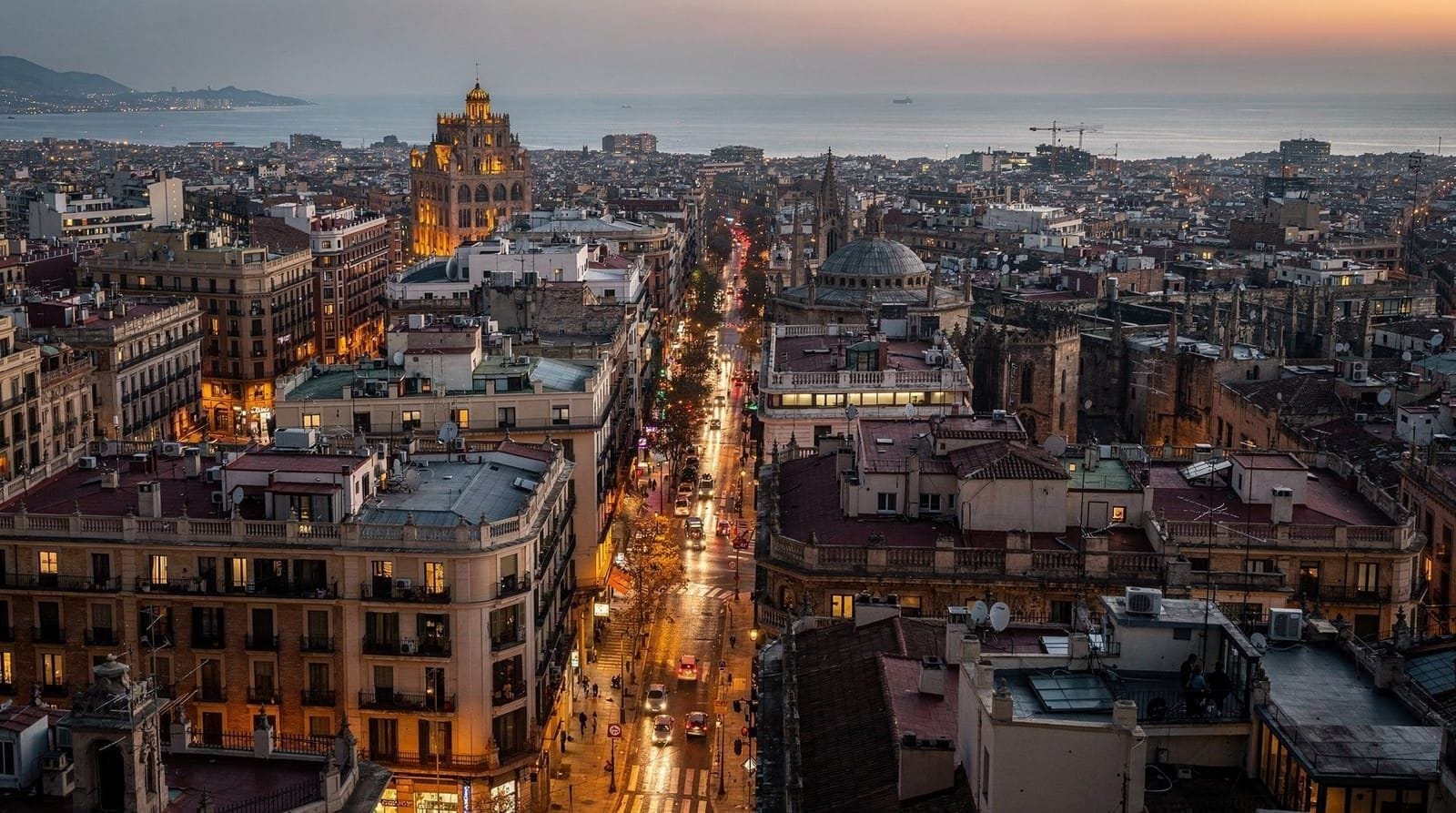
The Bunkers del Carmel, on the eastern rim of the Carmel hill above Gràcia, are the ruins of anti-aircraft bunkers from the Spanish Civil War. They’ve been converted into a civic viewpoint with a 360-degree panorama across the entire city — sea, mountains, Sagrada Família needle, port, everything. It’s free. There’s no ticket, no queue, no booking system. You walk up (about 20 minutes from the nearest metro) and you stand there and look at Barcelona laid out below you.
Sunset on a clear evening is extraordinary. It’s also popular with locals on summer evenings, which gives it a social atmosphere you won’t find at official tourist viewpoints. Go any time except perhaps peak Sunday afternoon in summer, when it gets genuinely busy.
Mercat de Santa Caterina — the market with the mosaic roof
Everyone knows La Boqueria. Few people know about Mercat de Santa Caterina in El Born, ten minutes’ walk away. The building was redesigned by Enric Miralles (completed posthumously in 2005) and has a spectacular undulating ceramic roof with a mosaic of 325,000 hand-cut tiles in a pattern that represents the produce sold inside. From above — from the rooftop of certain apartments nearby, or from photographs — it looks genuinely extraordinary.
Inside, it functions as a real neighbourhood market. The fish, meat, and vegetable stalls serve the residents of El Born rather than tourists. It’s less hectic than La Boqueria, prices are more sensible, and if you want to grab a coffee at the bar in the corner and watch a working market go about its business, this is the place to do it. Our food markets Barcelona guide compares Santa Caterina with La Boqueria and the other city markets in more detail.
Carrer del Bisbe — the Gothic corridor photographers know
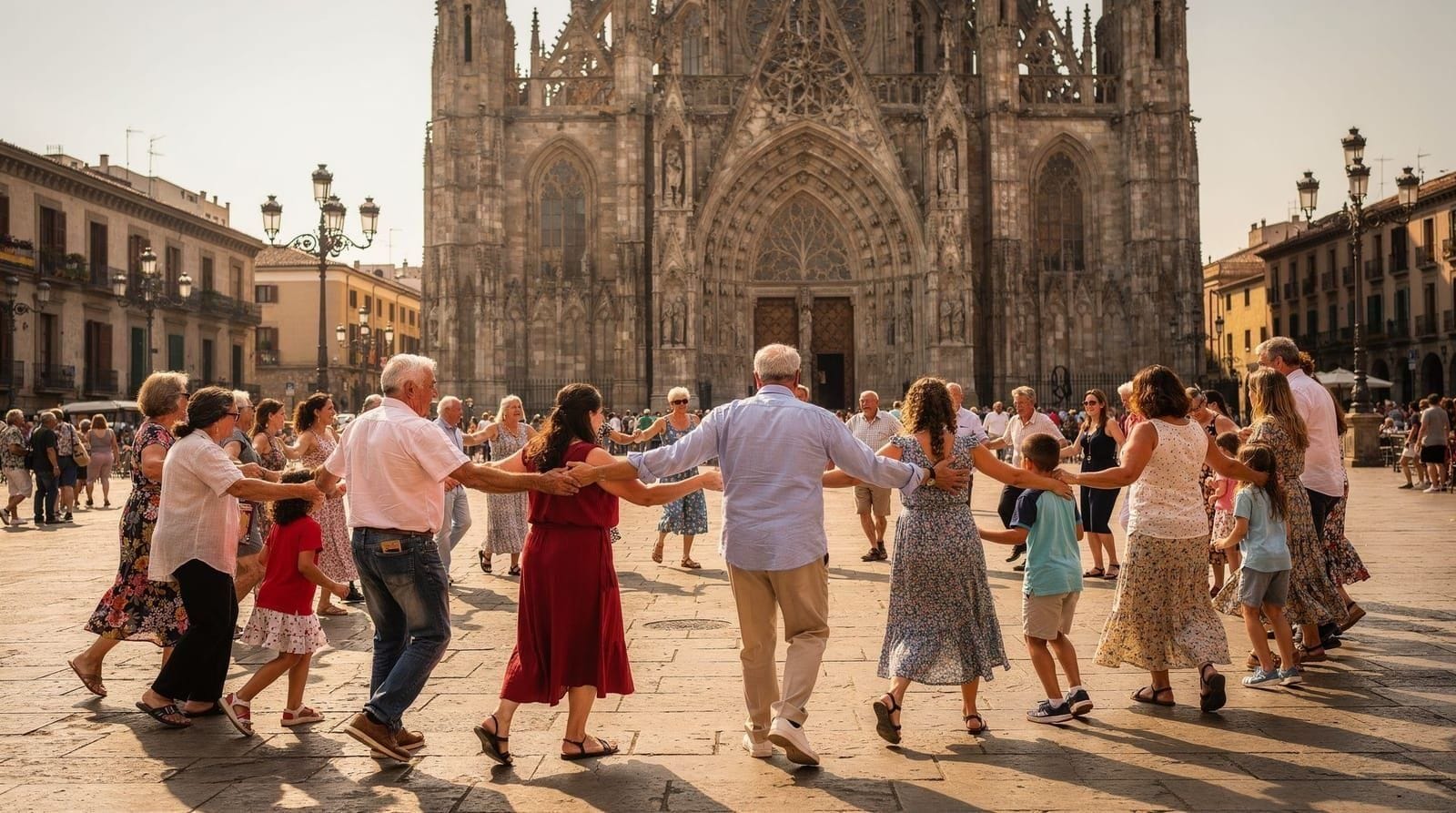
Running between the Plaça de Sant Jaume and the Cathedral in the Gothic Quarter, Carrer del Bisbe is a narrow medieval lane crossed by a neo-Gothic bridge that connects two buildings overhead. The bridge — built in 1928, so more recent than it looks — is decorated with gargoyles and coats of arms. Early morning, before the crowds arrive, the lane is dim and atmospheric in a way that makes it feel genuinely medieval. Photographically, it’s one of the best compositions in the old city.
The surrounding streets are worth exploring: Plaça de Sant Felip Neri nearby has cannonball marks in its walls from the Civil War, and the context for those marks — the 1938 bombing that killed 42 people sheltering in the square — makes it a sobering place to stand quietly for a moment.
Jardins de Laribal — the quiet garden on Montjuïc
Montjuïc gets visitors for the castle, the MNAC, and the Magic Fountain. Almost nobody goes to the Jardins de Laribal, a formal terraced garden on the hillside below the castle. It was designed in 1919 and has pergolas, water channels, fountains, and shaded seating areas across several levels. In summer, when the city below is baking, the garden is several degrees cooler. Entry is free.
There are better-known gardens on Montjuïc — the Jardins de Laribal tends to be quieter than the Joan Brossa gardens or the nearby Jardins de Costa i Llobera. If you’re spending time on the hill for the MNAC or Joan Miró Foundation (both worth it — our MNAC guide and Joan Miró Foundation guide will orient you), build in thirty minutes to walk through.
Palau del Lloctinent — the inner courtyard
On the east side of Plaça del Rei in the Gothic Quarter, the Palau del Lloctinent is a 16th-century building that now houses the Arxiu de la Corona d’Aragó (Archive of the Crown of Aragon). The archive itself is not open to casual visitors, but the interior courtyard is — and it’s one of the finest Renaissance courtyards in the city. Stone arches, an exterior staircase decorated with carved wood, and a carved wooden ceiling over the stairwell that’s genuinely beautiful.
Entry to the courtyard is free and it’s usually empty. A three-minute detour from the main tourist path around Plaça del Rei.
El Born CCM — the archaeological site inside a market
The El Born Cultural and Memory Centre occupies a 19th-century cast-iron market building that was abandoned before it opened and then lay unused for over a century. When it was being converted into a cultural centre in 2002, excavations revealed the remains of an entire neighbourhood destroyed during the siege of Barcelona in 1714 — houses, streets, wells, ovens, all intact under a metre of rubble.
The decision was made to display the archaeological site in situ, so the market’s iron structure now stands over the excavated ruins, which you can see from walkways above. It’s one of the most affecting historical experiences in the city: the 1714 siege marked the end of Catalan political autonomy for over two centuries, and these are the actual buildings that were demolished to make way for a military citadel. Entry is free. Our Barcelona history guide provides the context.
Hospital de Sant Pau — the Modernisme building that rivals Gaudí
Most people in Barcelona visit the Sagrada Família and think they’ve seen the city’s Modernisme architecture. The Hospital de Sant Pau, a short walk from the Sagrada Família down Avinguda de Gaudí, was designed by Lluís Domènech i Montaner (a contemporary and rival of Gaudí) between 1901 and 1930 and is, by any measure, extraordinary.
The complex consists of 12 pavilions connected by underground galleries, each decorated with mosaics, stained glass, sculpture, and ceramic ornament. It functioned as a hospital until 2009 and is now a UNESCO World Heritage Site open to visitors (entry €15–17 depending on the guided option). On a typical day it sees a fraction of the Sagrada Família’s visitors. Our modernisme route guide places it in the broader context of Barcelona’s Modernisme architecture.
Plaça de la Vila de Gràcia — café life without the tourists
Gràcia is one of the city’s most pleasant neighbourhoods and Plaça de la Vila de Gràcia is its local living room. The square has a clock tower, several café terraces, a market building on one side, and a steady flow of local life — parents with children, elderly men playing cards, teenagers on bikes. On a warm evening the terraces fill with residents, not tourists.
The square is five minutes’ walk from the Casa Vicens (Gaudí’s first major commission, open to visitors at €16) and a ten-minute walk from Park Güell, which makes it a natural lunch or coffee stop on any Gràcia itinerary. Order the menú del día at any of the restaurants — €12–14 for three courses and a drink, prepared for a neighbourhood audience.
Rambla del Poblenou — the local Rambla, zero tourists
The famous La Rambla gets roughly 150,000 people a day in summer. The Rambla del Poblenou, a pedestrian boulevard about 25 minutes’ walk northeast in Poblenou, gets almost exclusively locals. It has the same basic form — a central promenade with café terraces and trees — with none of the hustlers, street performers, or overpriced restaurants.
Poblenou is a former industrial neighbourhood that’s been gradually gentrifying since the 1992 Olympics, and the Rambla reflects this: independent coffee shops, a cheese shop, a wine bar, a place that sells excellent croquetas. It’s what La Rambla might have been if the entire tourist apparatus hadn’t accumulated on top of it.
Vermuteria del Tano — authentic vermouth in Poblenou
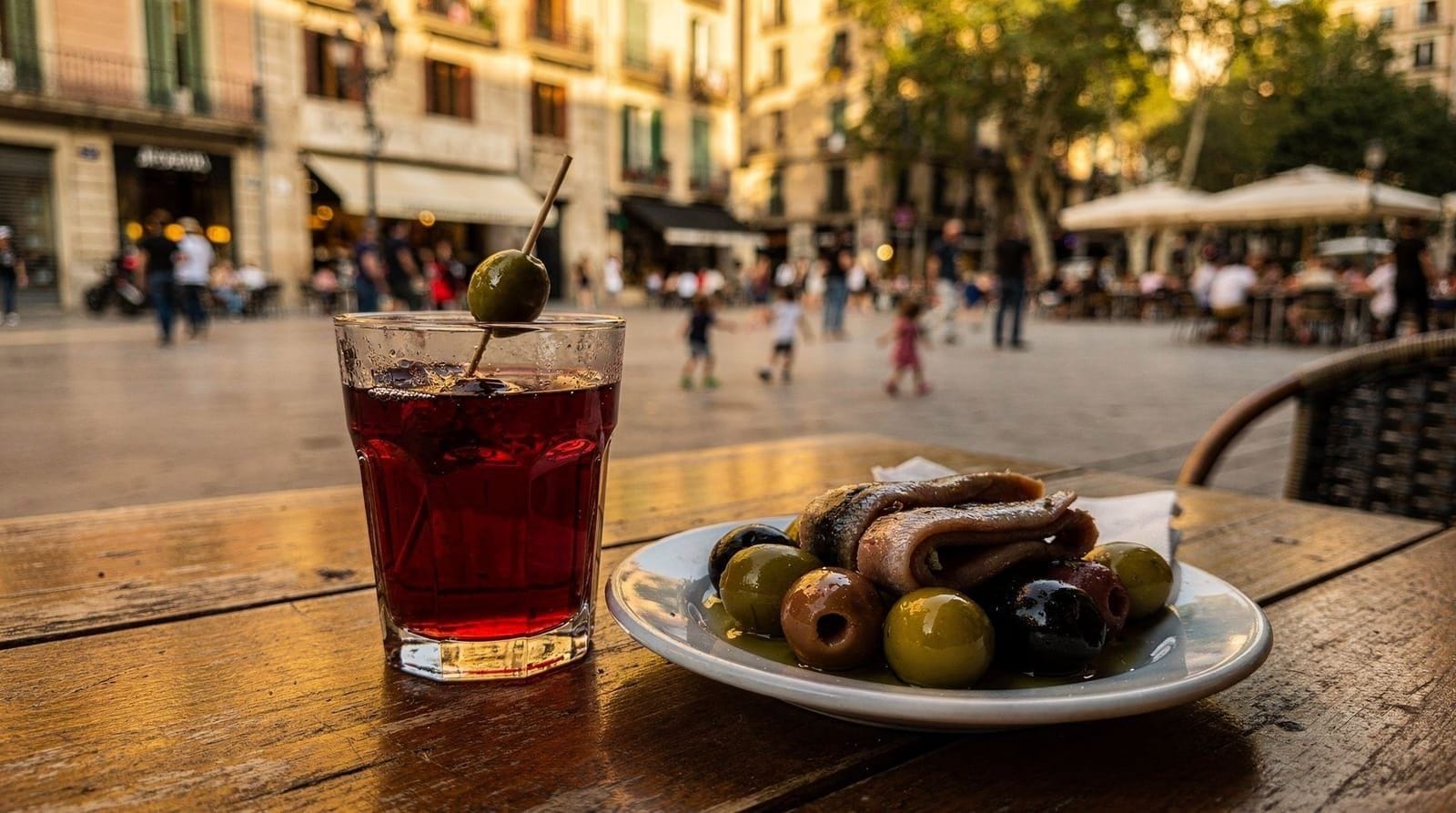
The vermut tradition in Barcelona — sweet vermouth served cold with an olive and a bit of sparkling water, consumed standing at a bar between noon and 2pm — is one of the city’s genuine pleasures and one of the things most tourists miss entirely. The Vermuteria del Tano in Poblenou is about as authentic as it gets: small, slightly chaotic, full of locals doing the Sunday vermut ritual, with a selection of sherries and cavas alongside the vermut.
Getting there requires combining it with the Rambla del Poblenou or a general Poblenou afternoon. It’s not a tourist attraction. It’s a bar. That’s precisely the point. Our vermut guide explains the custom and suggests similar spots across other neighbourhoods if Poblenou feels too far.
Why these places stay quiet
It’s worth understanding why these ten spots remain uncrowded when they’re often only a short walk from places drowning in visitors. Mostly it comes down to what tour groups and guidebooks default to: Bunkers del Carmel requires a 20-minute uphill walk with no direct metro stop, which filters out anyone unwilling to commit the time. Mercat de Santa Caterina sits in the shadow of La Boqueria’s name recognition despite being architecturally more interesting. Hospital de Sant Pau suffers from being positioned as an add-on to the Sagrada Família rather than a destination in its own right, even though it’s arguably the more technically accomplished building. None of this is secret information — it’s simply that Barcelona’s tourist attention is unevenly distributed, concentrated on a handful of names that appear in every top-ten list. Walking even one extra block, or being willing to climb a hill, is usually enough to leave the crowds behind.
Two more worth the detour
Casa Vicens, Gaudí’s first major commission in Gràcia, gets a fraction of the crowds of the Sagrada Família or Park Güell despite being a genuinely important building — the Moorish-influenced tilework and ironwork show where his later, more famous style came from. Combine it with a Plaça de la Vila de Gràcia coffee stop. Bellesguard, further up the hill, is a private Gaudí house built on the site of a medieval royal palace; it is rarely crowded and offers a very different, more austere side of his work than the Passeig de Gràcia landmarks.
A note on timing
Several of these places are best early morning or midday on weekdays. The Bunkers del Carmel and Carrer del Bisbe both reward going before 9am if you want them quiet. The Mercat de Santa Caterina is liveliest in the early morning when the market is fully active; it winds down by early afternoon. The best neighbourhoods guide has more on neighbourhood rhythms and when different parts of the city are at their best.